Metal Detection in Footwear Manufacturing – Full Shoe Assembly Series
Consumer safety is one of the highest priorities in modern footwear manufacturing. While extensive quality controls are applied throughout cutting, stitching, assembly, finishing, and packaging operations, manufacturers must also ensure that no foreign metallic objects remain inside the finished product before shipment. Even a small metal fragment can pose a safety risk to the end user and lead to costly product recalls, customer complaints, or damage to brand reputation.
Metal contamination can originate from various manufacturing activities. Broken sewing needles, staple fragments, wire pieces, blade chips, machine components, and other metallic debris may occasionally enter the production environment despite strict process controls. Because many of these contaminants can be hidden inside the shoe, unit box, or shipping carton, they may not always be detected through visual inspection alone.
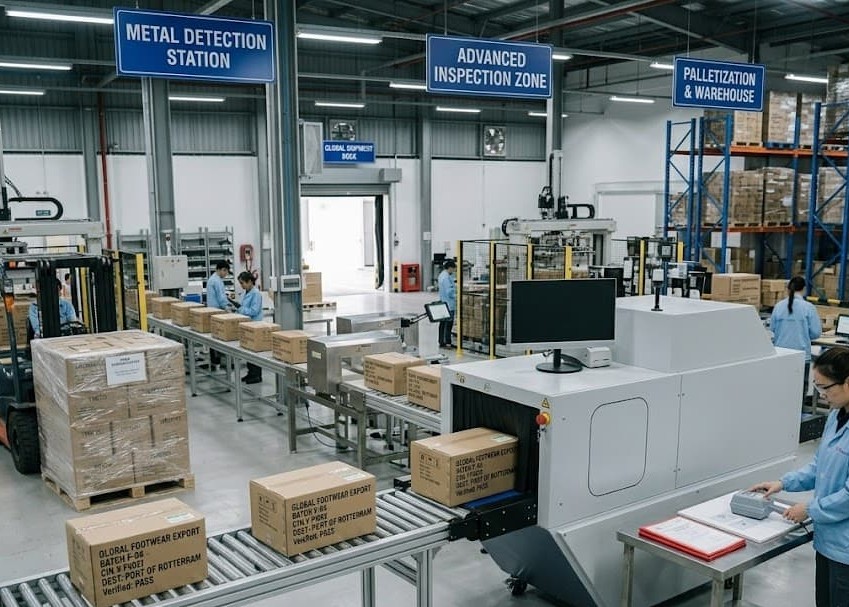
To eliminate this risk, footwear manufacturers implement industrial metal detection systems as a final consumer safety checkpoint before products are released for shipment. Finished cartons are passed through calibrated metal detectors capable of identifying metallic contamination that may have been introduced during production, inspection, or packing operations. Any carton that triggers the detector is immediately isolated for investigation and corrective action.
For global footwear brands, metal detection is not simply a quality requirement—it is a critical product safety process. By verifying that finished products are free from unintended metallic contaminants, manufacturers strengthen consumer protection, maintain compliance with brand standards, and reduce the risk of safety-related incidents in the marketplace.


Understanding the Purpose of Metal Detection
Metal detection is the final contamination control process performed after footwear products have been packed and sealed. Unlike visual inspections, metal detectors identify hidden metallic contaminants that cannot be seen from outside the carton. These contaminants may originate from several production activities including stitching, lasting, assembly, finishing, maintenance work, or packing operations.
The primary objective is to prevent contaminated products from reaching consumers. Major footwear brands require factories to implement metal detection programs because even a tiny metal fragment can cause injury, product recalls, customer complaints, legal claims, and brand reputation damage. Modern detector systems can identify:
- Broken sewing needle fragments
- Staple pieces
- Wire fragments
- Blade chips
- Metal shavings
- Machine wear particles
- Fastener fragments
- Ferrous metals
- Non-ferrous metals
- Stainless-steel contaminants
By implementing a robust metal detection program, factories strengthen consumer safety while demonstrating compliance with brand requirements and international quality standards.

Key Control Points
- All finished cartons must pass through metal detection.
- No carton may bypass inspection.
- Detector settings must remain locked.
- Sensitivity checks must follow approved standards.
Expert Tip: Maintain dedicated detector operators trained in contamination control procedures.


Sources of Metal Contamination in Footwear Manufacturing
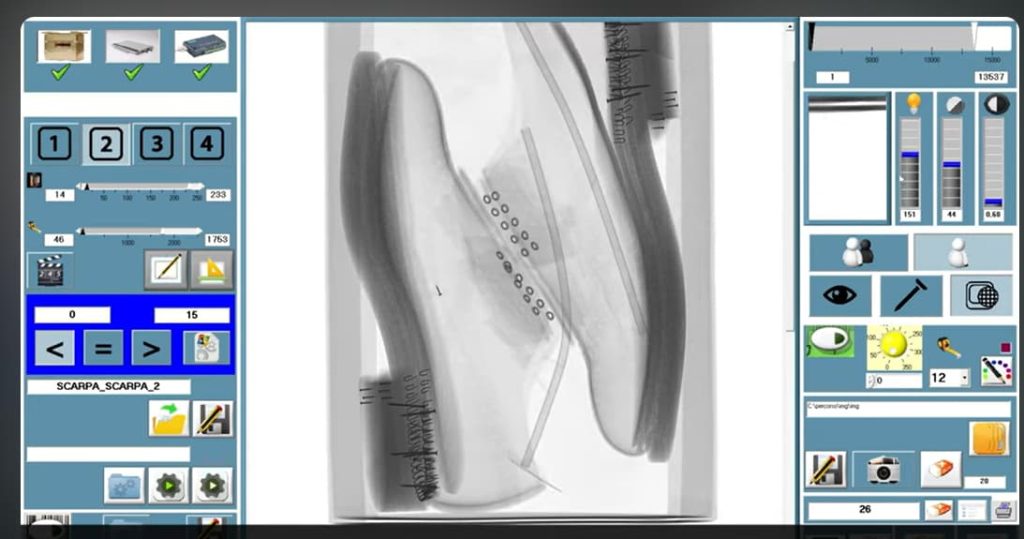
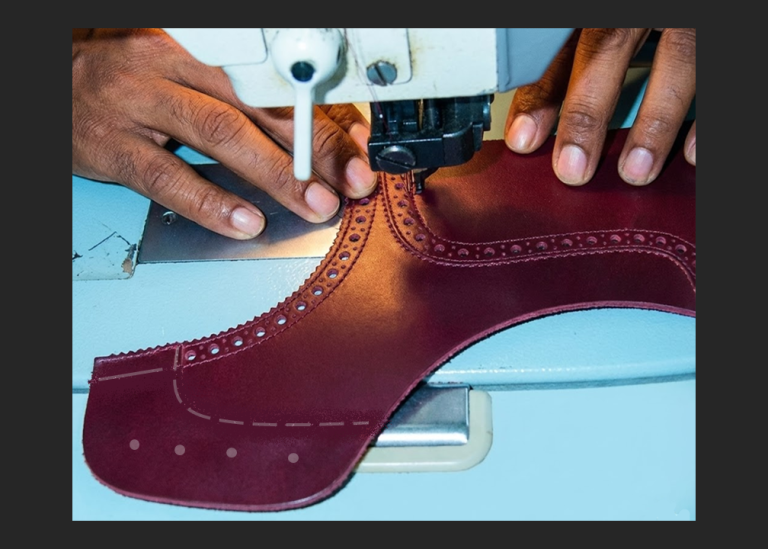
Metal contamination can originate from multiple processes throughout the factory. The most common source is broken sewing needles. During stitching operations, needle breakage occasionally occurs due to machine settings, operator handling, material hardness, or equipment wear. Although factories follow broken needle control procedures, a fragment may sometimes remain undetected.
Similarly, assembly operations may introduce metallic contamination through damaged tools, loose machine parts, or worn components. Maintenance activities also present contamination risks. Technicians often work near production equipment using tools, screws, washers, and replacement components. Without proper control, small metallic items may accidentally enter production areas.
Packing departments can introduce contamination through: Staples, Cutting Blade fragments, Wire ties, Carton sealing equipment, Damaged fixtures. Furthermore, transportation systems can generate metal particles through mechanical wear. Because contamination can occur at any stage, brands increasingly require a final verification process before shipment release.
Key Control Points
- Broken needle management system.
- Tool accountability procedures.
- Maintenance component tracking.
- Foreign object prevention programs.
Pro Tip: Store certified test pieces in locked, controlled locations.


Industrial Metal Detector Technology Used in Footwear Factories
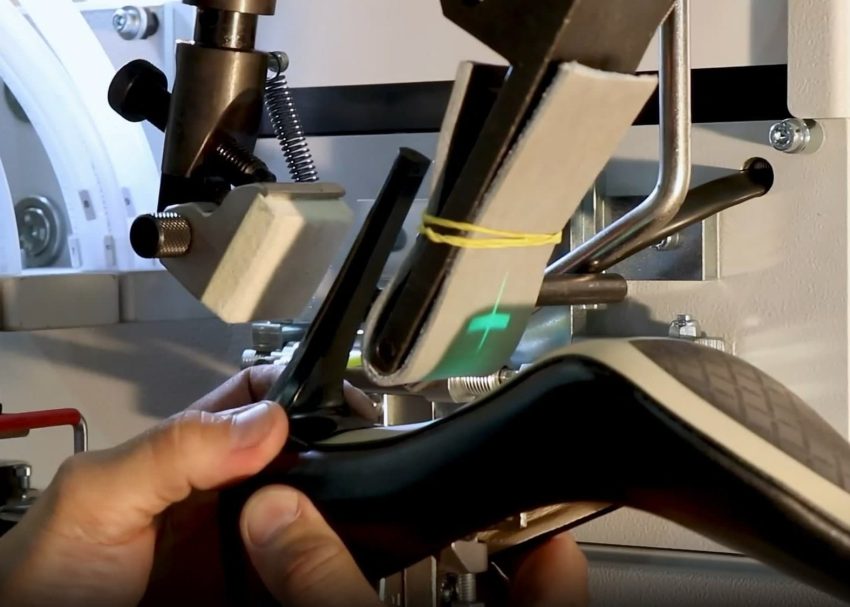
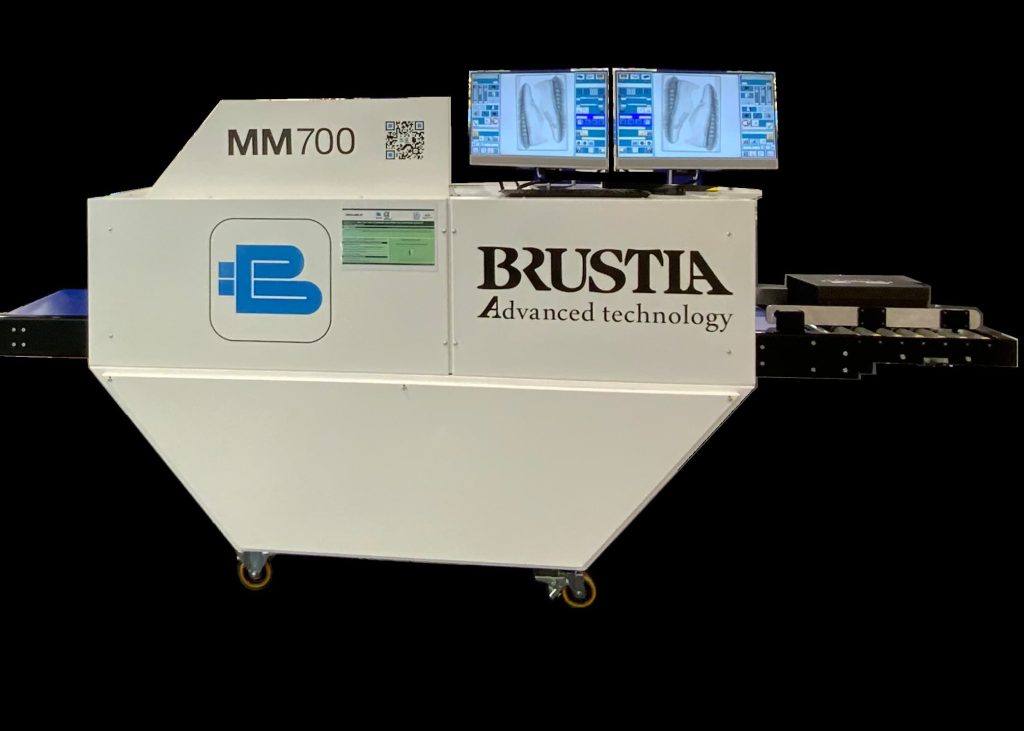
Industrial footwear metal detectors operate using electromagnetic field technology. When a carton passes through the detector tunnel, the equipment generates a controlled electromagnetic field. If a metallic object enters this field, the detector senses a disturbance and triggers an alarm.
Modern systems use advanced multi-frequency technology that improves detection capability across various metal types. Unlike older single-frequency systems, multi-frequency detectors provide greater accuracy and reduce false alarms. Typical detection capability includes:
Ferrous Metals
These include iron-based materials such as:
- Needle fragments
- Machine particles
- Carbon steel components
Ferrous metals are generally the easiest contaminants to detect.
Non-Ferrous Metals
These include:
- Copper
- Aluminum
- Brass
These materials require greater sensitivity but remain detectable with modern equipment.
Stainless Steel
Stainless steel presents the greatest detection challenge because it possesses weaker magnetic characteristics. Many sewing needles contain stainless steel components, making detector calibration especially important.
Advanced detector systems can reliably identify extremely small stainless-steel fragments when properly calibrated.
Key Control Points
- Detector tunnel must remain unobstructed.
- Approved detector settings only.
- Sensitivity level verification required.
- Multi-frequency mode recommended.
Pro Tip: Perform sensitivity checks from multiple tunnel positions.

Metal Detector Installation Location Within the Production Flow
Detector placement significantly influences inspection effectiveness. Most footwear factories position metal detectors immediately after carton sealing and before palletization. This location provides several advantages.
- First, products are already packed and ready for shipment.
- Second, contamination introduced during packing operations can still be detected.
- Third, any rejected carton can be isolated before entering finished goods inventory.
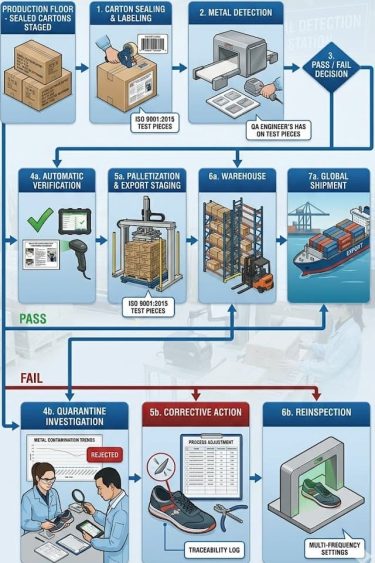
A typical workflow includes:
- Final Shoe Inspection
- Pair Packing
- Unit Box Packing
- Carton Packing
- Carton Sealing
- Metal Detection
- Palletization
- Warehouse Storage
- Shipment
Positioning the detector near shipment release ensures every carton receives final contamination verification.
Key Control Points
- Detector located before palletization.
- One-way product flow.
- No bypass routes permitted.
- Rejected cartons automatically isolated.

Pro Tip: Review rejection trends monthly to identify recurring contamination sources.

Detector Sensitivity Standards and Brand Requirements
Sensitivity standards define the smallest metal fragment the detector must identify. Every brand establishes minimum detection requirements based on product category, consumer safety expectations, and risk assessment results. Detector sensitivity is typically validated using certified metal test pieces.
Common test samples include:
- Ferrous sphere
- Non-ferrous sphere
- Stainless steel sphere
Each sphere size corresponds to a defined detection capability.
For example, a brand may require successful detection of:
- 1.2 mm ferrous metal
- 1.5 mm non-ferrous metal
- 2.0 mm stainless steel
Actual requirements vary by brand and product type. Factories must ensure detector performance consistently meets or exceeds approved standards.
Insufficient sensitivity creates contamination risks, while excessive sensitivity may generate unnecessary false rejects. Achieving the correct balance is essential for stable production performance.
Key Control Points
- Follow brand-approved sensitivity limits.
- Use certified test pieces only.
- Record all validation results.
- Investigate failed sensitivity checks immediately.

Pro Tip: Integrate metal detector records into factory traceability systems.

Calibration and Detector Validation Procedures
Metal detector calibration ensures reliable and repeatable detection performance. Calibration activities verify that detector settings continue to meet established standards.
Most factories perform validation: At shift start, Every hour, After maintenance, After power interruptions, At shift end. During validation, certified test pieces pass through the detector tunnel under controlled conditions. The detector must consistently identify all required metal types.
Validation results are recorded in official calibration logs. If the detector fails validation, production must stop until corrective action is completed. This requirement prevents potentially contaminated products from entering shipment channels. Proper calibration programs also support brand audits and compliance reviews.
This requirement prevents potentially contaminated products from entering shipment channels. Proper calibration programs also support brand audits and compliance reviews.
Key Control Points
- Hourly validation checks.
- Certified test standards.
- Immediate corrective action.
- Complete calibration documentation.
Pro Tip: Verify detector performance after every maintenance activity.


Rejection Handling Procedures Following Metal Detection Failure
Whenever a metal detector identifies contamination, the event must be treated as a serious quality and safety incident. The objective is not simply to remove the affected carton. Instead, the factory must determine whether the contamination represents an isolated occurrence or a symptom of a larger production issue.
Modern metal detection systems automatically stop the conveyor, activate visual and audible alarms, and reject the affected carton for investigation. Some advanced systems also record the event electronically with date, time, operator, production line, and carton information.
The rejected carton should immediately be transferred to a designated quarantine area. Unauthorized personnel must not access the carton until the investigation begins. The quality team then initiates a structured inspection process to identify the contamination source. Depending on brand requirements, inspectors may need to open the carton, inspect each pair, review production records, and verify traceability information. Depending on brand requirements, inspectors may need to open the carton, inspect each pair, review production records, and verify traceability information.
If contamination is confirmed, the factory must determine whether additional cartons produced during the same period are potentially affected. A thorough investigation prevents recurrence and protects consumers from receiving unsafe products.
Typical Rejection Investigation Process
- Detector identifies contamination.
- Carton automatically rejected.
- Quality team notified.
- Carton moved to quarantine area.
- Investigation initiated.
- Source identification performed.
- Adjacent production lots reviewed.
- Corrective actions implemented.
- Management approval obtained.
- Product disposition finalized.

Key Control Points
- Reject cartons immediately.
- Maintain quarantine control.
- Follow approved investigation procedure.
- Document every rejection event.
Pro Tip: Conduct annual third-party detector validation.


Traceability and Contamination Investigation Process
Metal detection programs are only effective when supported by strong traceability systems. Traceability allows factories to determine exactly when, where, and how contamination may have occurred. Every finished carton should be traceable back to: Production line, Assembly line, Stitching line, Operator group, Shift, Production date, Work order, Material batch.
When contamination occurs, investigators review production records to identify potential sources. For example, if a needle breakage occurred during stitching and the affected shoe subsequently reached packing operations, traceability records help narrow the investigation scope.
Factories typically review:
- Needle control logs
- Machine maintenance records
- Production reports
- Quality inspection records
- Tool accountability logs
- Detector rejection reports
The goal is to determine whether contamination originated from:
- A specific machine
- A specific operator
- A maintenance activity
- A tooling issue
- A process failure
Strong traceability significantly reduces investigation time and improves corrective action effectiveness.
Key Control Points
- Maintain carton-level traceability.
- Review historical records immediately.
- Link rejection events to production data.
- Retain investigation reports.
Pro Tip: Use digital logging systems whenever possible.

Compliance Requirements from Global Footwear Brands
Major footwear brands have established strict foreign object control requirements. These requirements often exceed local regulatory expectations because global brands must protect consumers across multiple markets.
Brand audits routinely evaluate:
- Detector sensitivity
- Calibration procedures
- Rejection management
- Traceability systems
- Needle control programs
- Documentation accuracy
- Employee training
- Corrective action effectiveness
Many brands require factories to demonstrate:
- 100% carton inspection
- Validated detector performance
- Hourly sensitivity verification
- Calibration records
- Investigation procedures
- Foreign object control programs
Auditors frequently conduct surprise detector verification tests during factory visits. They may introduce certified test pieces into production flow to confirm detector functionality. Failure to meet metal detection requirements can result in:
- Audit findings
- Corrective action requests
- Production restrictions
- Shipment delays
- Compliance penalties
- Loss of business opportunities
Consequently, metal detection has become a critical element of modern footwear quality management systems.
Key Control Points
- Follow customer-specific requirements.
- Maintain audit-ready records.
- Train personnel regularly.
- Verify detector performance continuously.


Documentation and Record Management
Accurate documentation provides evidence that metal detection controls operate effectively. Without proper records, factories cannot demonstrate compliance during audits, investigations, or customer reviews. A comprehensive documentation system should include:
Calibration Records
These records verify detector performance throughout production.
Sensitivity Test Records
These documents confirm compliance with approved detection standards.
Rejection Logs
Every rejection event should be recorded and investigated.
Maintenance Records
Maintenance activities affecting detector performance require documentation.
Training Records
Employee competency must be verified and maintained.
Corrective Action Reports
Investigation findings and improvement actions should be formally documented.
Many leading factories have transitioned to digital record management systems that improve accuracy, traceability, and audit readiness. Electronic systems also simplify trend analysis and performance monitoring.
Key Control Points
- Complete records immediately.
- Avoid undocumented adjustments.
- Store records securely.
- Maintain retention periods per customer requirements.


Common Metal Detection Program Failures
Even well-designed programs can fail if execution becomes inconsistent. One of the most common failures involves inadequate sensitivity verification. When operators skip validation checks or perform them incorrectly, detector performance may degrade without detection.
Another frequent issue involves poor investigation practices. Some facilities focus only on the rejected carton while ignoring the root cause of contamination. This approach increases the risk of repeat incidents.
Equipment maintenance failures also contribute to contamination events. Worn conveyor components, damaged detector tunnels, and unstable power supplies can negatively affect system performance. Training deficiencies represent another significant risk. Employees who do not fully understand contamination control procedures may unintentionally bypass critical requirements. Common failure causes include:
- Missed hourly checks
- Incomplete calibration
- Poor documentation
- Weak traceability
- Untrained operators
- Detector bypassing
- Delayed investigations
- Ineffective corrective actions
Continuous management oversight is necessary to prevent these failures
Key Control Points
- Monitor validation compliance.
- Audit detector operation regularly.
- Investigate recurring trends.
- Strengthen operator training.



Best Practices for World-Class Metal Detection Programs
The most successful footwear factories share several common practices. Rather than treating metal detection as a final inspection activity, they integrate contamination control throughout the entire manufacturing process. Recommended best practices include:
Management Practices
- Establish clear contamination control policies.
- Conduct periodic management reviews.
- Allocate resources for detector maintenance.
- Track contamination-related KPIs.
Operational Practices
- Perform hourly sensitivity verification.
- Use certified test pieces only.
- Implement strict rejection procedures.
- Prevent unauthorized setting changes.
Technical Practices
- Maintain multi-frequency detector systems.
- Schedule preventive maintenance.
- Verify detector stability after repairs.
- Conduct annual third-party validation.
Quality Practices
- Audit detector operations regularly.
- Analyze contamination trends.
- Verify traceability effectiveness.
- Strengthen corrective action systems.
Adopting these practices significantly improves product safety and compliance performance.




Conclusion
Metal detection represents the final consumer safety barrier within footwear manufacturing. Although contamination events are relatively rare, their potential consequences can be severe. A single needle fragment or metallic foreign object reaching a consumer can result in injuries, recalls, customer complaints, and significant reputational damage.
Therefore, every finished carton must undergo a properly controlled metal detection process before shipment approval. Successful programs depend on far more than detector equipment alone. Effective contamination prevention requires calibrated systems, trained operators, robust traceability, disciplined investigation procedures, comprehensive documentation, and continuous improvement activities. Next Blog in the Full Shoe Assembly Series. Final AQL Audit in Footwear Manufacturing – Full Shoe Assembly Series
In the next blog, we will explore how footwear factories conduct final AQL audits before shipment release, including sampling plans, defect classification, acceptance criteria, audit procedures, and customer compliance requirements that determine whether finished orders are approved for shipment.



Frequently Asked Questions (FAQs)
Why is metal detection required in footwear manufacturing?
Metal detection prevents metallic contaminants such as broken needles, staple fragments, and machine particles from reaching consumers and helps factories comply with brand safety requirements.
What metals can footwear metal detectors identify?
Modern systems detect ferrous metals, non-ferrous metals, and stainless steel contaminants.
How often should detector sensitivity be verified?
Most footwear factories perform sensitivity verification at shift start, every hour during production, after maintenance, after power interruptions, and at shift end.
What happens when a carton fails metal detection?
The carton is quarantined, investigated, traced back through production records, and dispositioned according to approved quality procedures.
Why are stainless steel contaminants harder to detect?
Stainless steel possesses weaker magnetic properties than ferrous metals, requiring greater detector sensitivity and calibration control.
Are all cartons inspected?
Yes. Most major footwear brands require 100% inspection of finished cartons before palletization and shipment.
What records should be maintained for metal detection compliance?
Factories should maintain calibration logs, sensitivity verification records, rejection reports, maintenance records, training records, and corrective action documentation.