Feeding to Assembly Line in Footwear Manufacturing – Full Shoe Assembly Series
In the previous blog, Forming (Specific to Moccasin Construction) was discussed, where uppers are shaped and stabilized for downstream operations. Once forming and all pre-lasting operations are completed, the next critical stage begins — feeding to the assembly line.
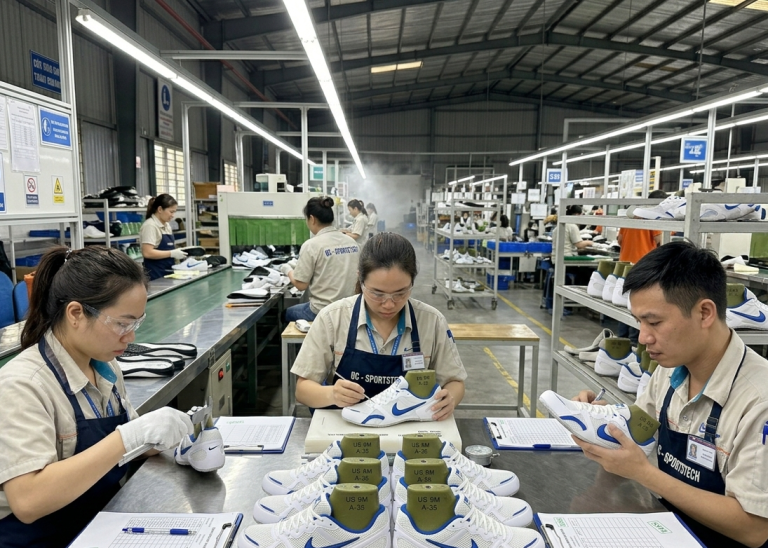
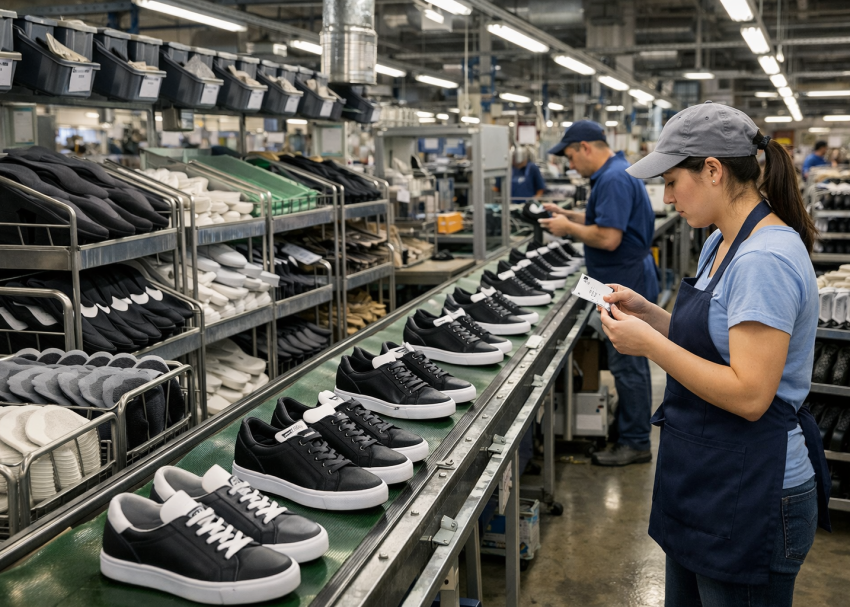
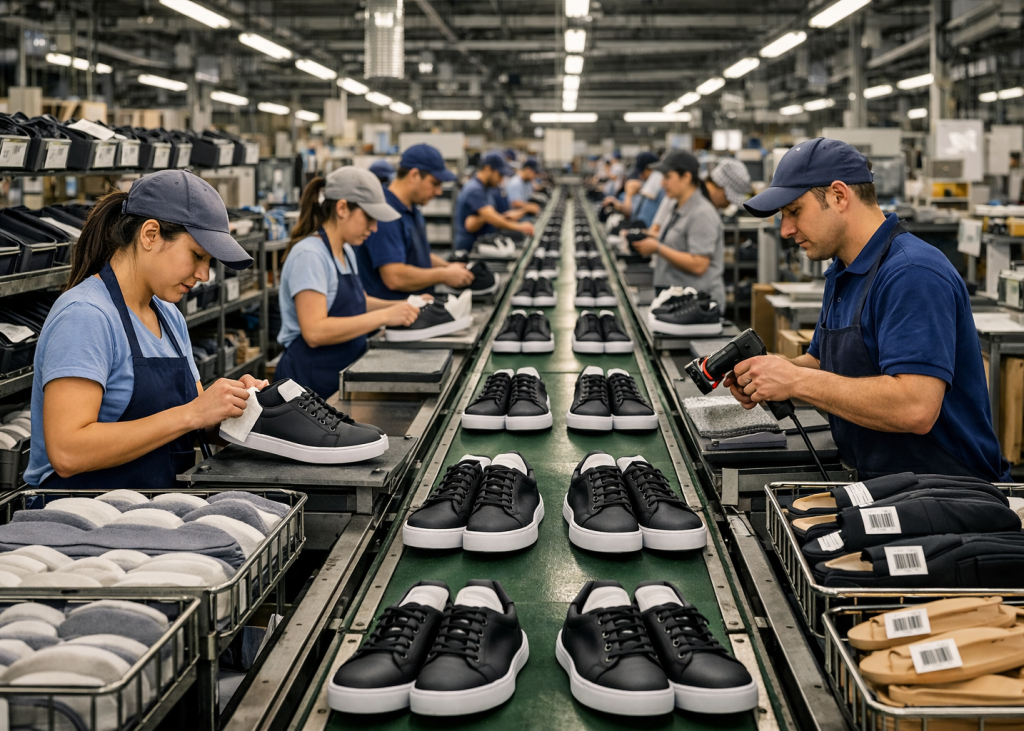
At this stage, conditioned uppers, insoles, lasts, and accessories are systematically organized and introduced into the assembly line. This is not a simple material movement step. Instead, it is a highly controlled synchronization process that directly impacts productivity, line balance, and quality consistency.
A well-managed feeding system ensures that each workstation receives the correct pair at the right time. Conversely, poor feeding discipline leads to bottlenecks, idle time, and line inefficiencies.
Material Preparation Before Line Feeding
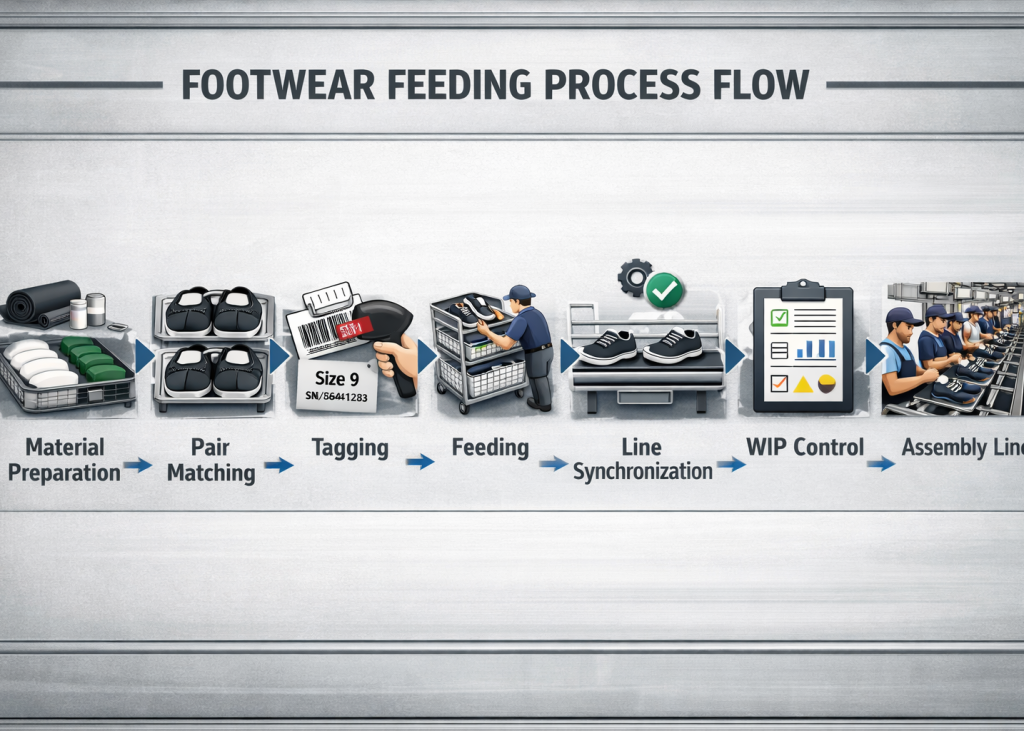
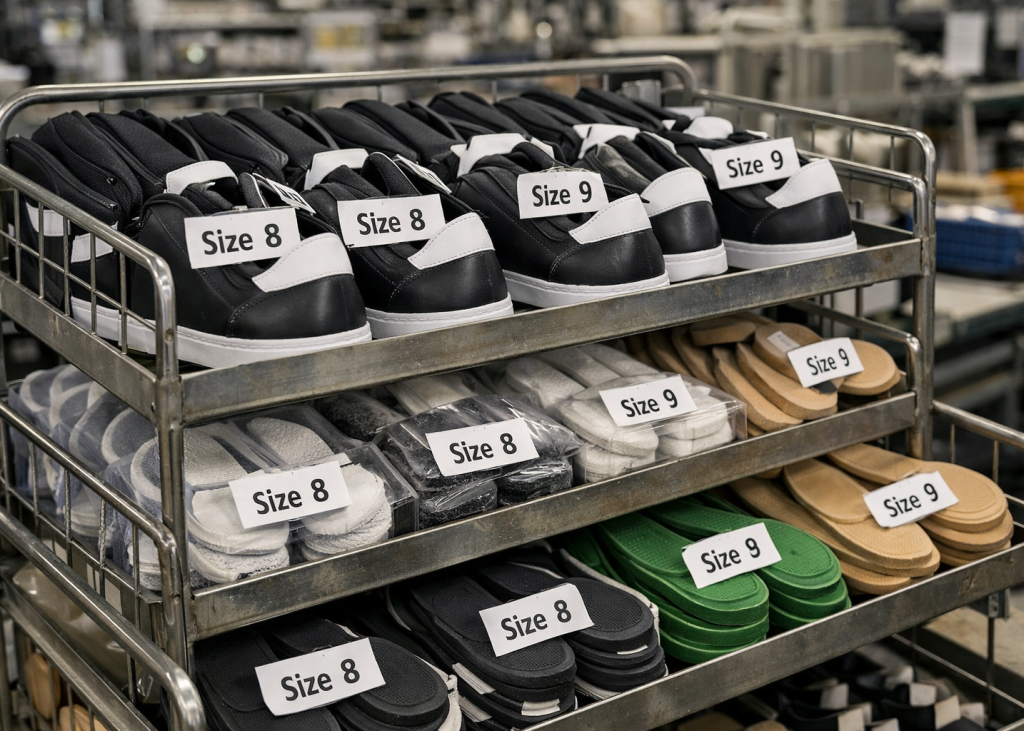
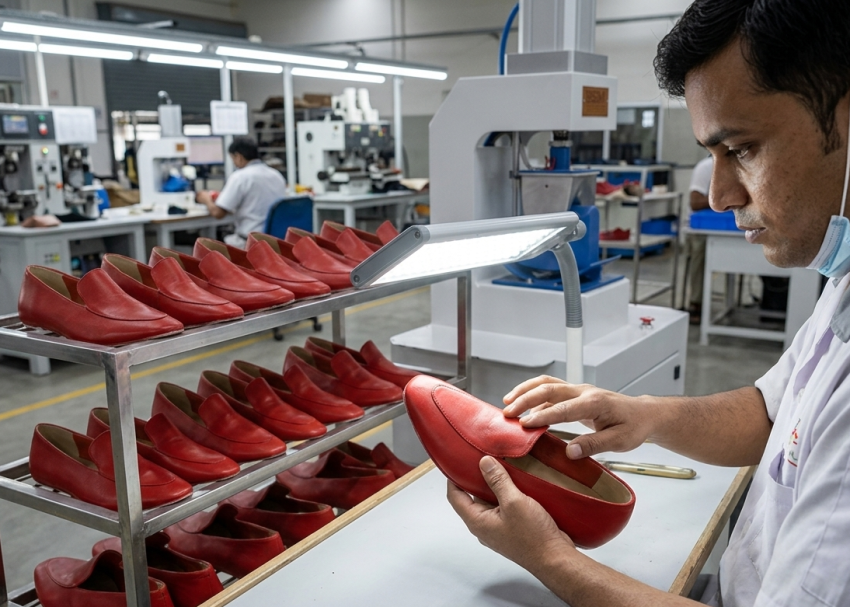
Before feeding begins, all components must be verified, matched, and staged in a structured manner. This ensures that no incomplete or mismatched sets enter the assembly line.
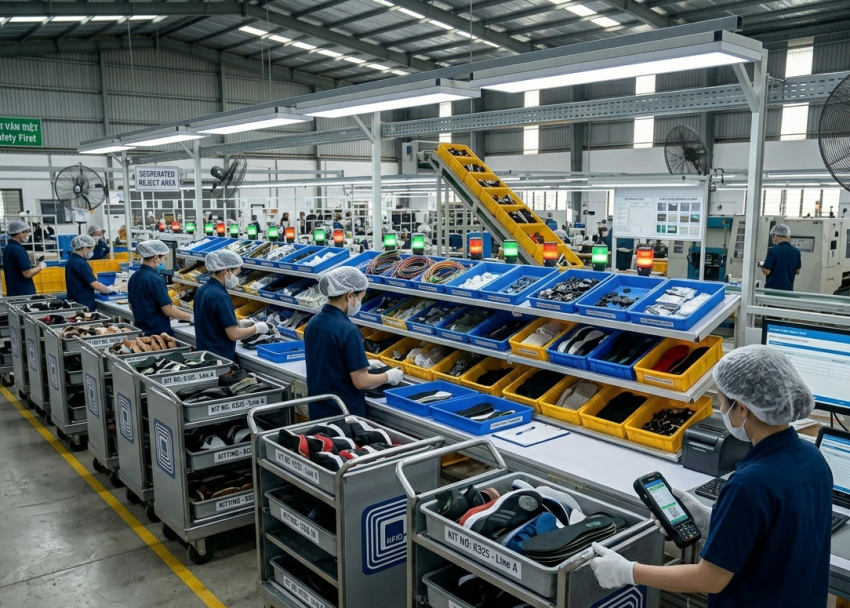
A complete kit typically includes the upper, insole, last, sock liner, and required accessories. Operators or supervisors check these kits for size, color, and order accuracy. Following this, materials are arranged in trolleys, racks, or conveyors based on production sequence. As a result, feeding becomes smooth and predictable.
Moreover, the chances of line stoppage due to missing components are minimized.
Key Control Points
- Ensure 100% component matching before feeding
- Maintain size and color segregation clearly
- Avoid mixing different orders in the same trolley
- Verify last and upper pairing accuracy
Expert Tip: Use color-coded trays for quick identification
Pair Matching and Identification System
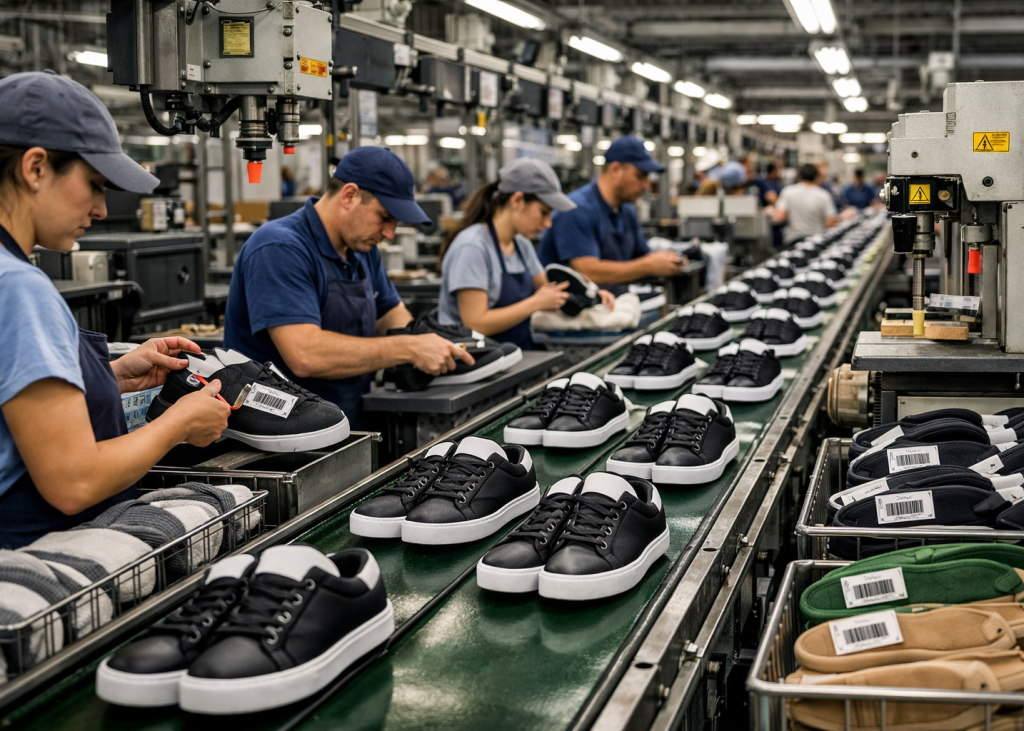
Each pair must be uniquely identified and tracked throughout the assembly process. Therefore, factories implement tagging systems such as barcode labels, RFID tags, or manual identification cards.
These identification systems ensure that the right upper is matched with the correct last and accessories. Additionally, they enable traceability in case of quality issues or rework.
Furthermore, digital tracking systems help supervisors monitor real-time production flow and identify delays instantly.
Key Control Points
- Use barcode or RFID for accuracy
- Avoid manual errors in tagging
- Ensure tags remain intact during handling
- Maintain traceability till packing stage
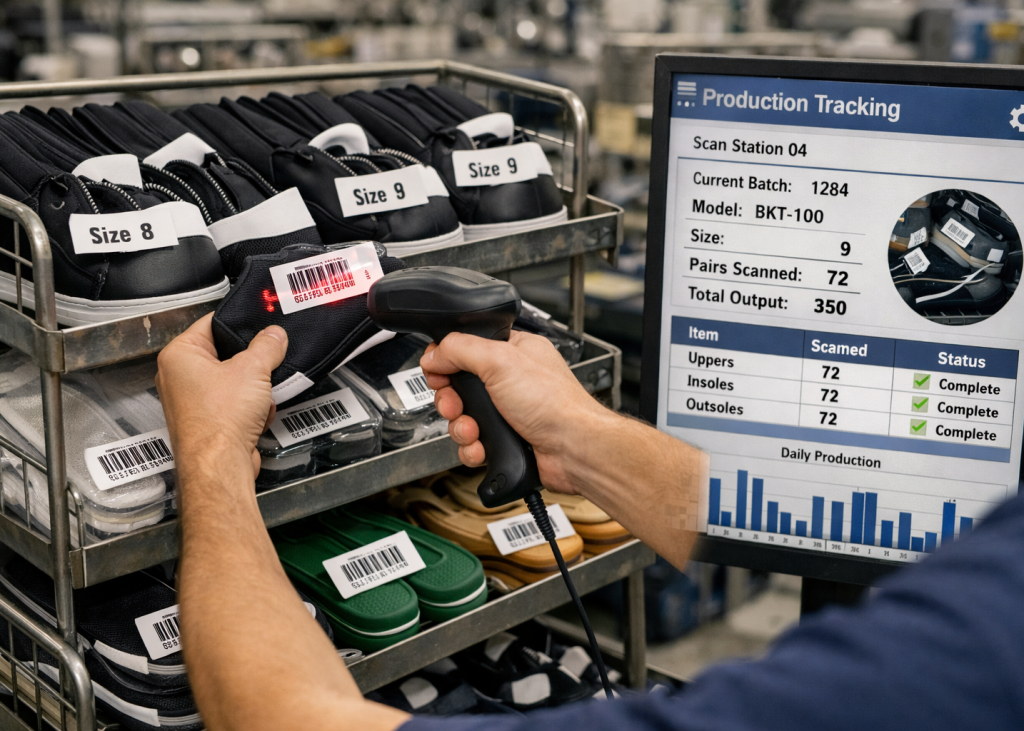
Pro Tip: Implement digital dashboards for real-time tracking
Feeding Methods: Manual vs Conveyor-Based
Feeding can be executed manually or through automated conveyor systems, depending on factory scale and investment level.
In manual feeding, operators move trolleys and supply materials to each station. This method is flexible but depends heavily on operator discipline. On the other hand, conveyor-based feeding ensures continuous movement of pairs with minimal human intervention.
Automated systems improve consistency, reduce handling errors, and support higher production volumes. However, they require proper line balancing and maintenance.
Key Control Points
- Align feeding method with production volume
- Maintain consistent flow without overloading
- Ensure smooth trolley or conveyor movement
- Train operators for standardized handling
Pro Tip: Train feeding operators on line balance concepts
Line Synchronization with Takt Time
Feeding must be aligned with the takt time of the assembly line. Takt time defines the pace at which each pair should move to meet production targets.
If feeding is faster than takt time, excess inventory builds up between stations. Conversely, slow feeding causes idle time and reduces efficiency.
Therefore, feeding must be carefully controlled to match the exact rhythm of the line. This synchronization ensures balanced workload across all stations.
Key Control Points
- Match feeding speed with takt time
- Avoid overfeeding and underfeeding
- Monitor station-wise flow regularly
- Adjust feeding based on bottleneck areas
Pro Tip: Maintain buffer stock only at critical stations
Work-In-Progress (WIP) Control During Feeding
Controlled WIP is essential to maintain smooth production flow. Excess WIP leads to congestion, while insufficient WIP causes interruptions.
During feeding, only a limited number of pairs should be introduced into the line. This ensures visibility, control, and faster issue detection.
Lean manufacturing principles recommend maintaining optimal WIP levels to improve efficiency and reduce waste.
Key Control Points
- Maintain minimum and maximum WIP limits
- Avoid piling up materials between stations
- Ensure continuous but controlled flow
- Monitor WIP visually on the line
Pro Tip: Conduct daily audits of feeding efficiency
Feeding Sequence and Line Balancing
The sequence in which materials are fed plays a critical role in maintaining line balance. Each station must receive work at a consistent rate to avoid delays.
Feeding must follow the predefined production sequence. Additionally, variations in operation time between stations must be considered while planning feeding.
Balanced feeding ensures that no station becomes a bottleneck. As a result, overall line efficiency improves significantly.
Key Control Points
- Follow strict feeding sequence
- Balance workload across stations
- Identify and correct bottlenecks quickly
- Maintain uniform flow across the line
Pro Tip: Use standard operating procedures (SOPs) for feeding
Handling and Ergonomics in Feeding
Material handling during feeding must be efficient and ergonomic. Poor handling leads to operator fatigue, product damage, and reduced productivity.
Trolleys should be designed for easy movement. Moreover, workstation height and material placement must support operator comfort. Efficient ergonomics not only improve productivity but also reduce injury risk and improve consistency.
Key Control Points
- Use ergonomic trolleys and racks
- Avoid excessive lifting or bending
- Ensure easy accessibility of materials
- Maintain safe and clean working environment
Pro Tip: Introduce visual management systems on shop floor
Common Feeding Problems and Their Impact
Feeding issues can quickly disrupt the entire assembly line. Common problems include mismatched pairs, delayed feeding, excess WIP, and poor coordination.
These issues result in production delays, quality defects, and increased operational costs. Therefore, continuous monitoring and quick corrective actions are essential. A disciplined feeding system ensures stable production and consistent output.
Key Control Points
- Implement corrective actions immediately
- Identify feeding delays early
- Prevent mismatched component entry
- Reduce waiting time between stations
Expert Tip: Continuously improve based on production data

Conclusion
Feeding to the assembly line is not just a logistical step; it is a critical control function that determines the efficiency of the entire production process. When executed correctly, it ensures smooth workflow, balanced operations, and consistent quality.
By implementing structured feeding systems, synchronized flow, and strict control measures, factories can significantly improve productivity and reduce operational losses. In the next blog, we will exploreToe Gathering Stitching (Strobel-Specific) in Footwear Manufacturing, a key operation that directly impacts shoe fit and construction integrity.
Frequently Asked Questions – FAQs
1. What is feeding in footwear assembly?
It is the process of supplying complete and matched shoe components into the assembly line in a controlled sequence.
2. Why is feeding important in production?
It ensures smooth workflow, prevents bottlenecks, and maintains line efficiency.
3. What is takt time in feeding?
Takt time is the production pace required to meet demand, and feeding must match this speed.
4. What happens if feeding is not controlled?
It leads to delays, excess WIP, mismatched pairs, and reduced productivity.
5. Which feeding method is better: manual or conveyor?
Conveyor systems are better for high-volume production, while manual feeding suits smaller setups.
6. How can feeding efficiency be improved?
By using automation, proper planning, operator training, and real-time monitoring.
7. What is WIP control in feeding?
It involves maintaining optimal work-in-progress levels to ensure smooth production flow.