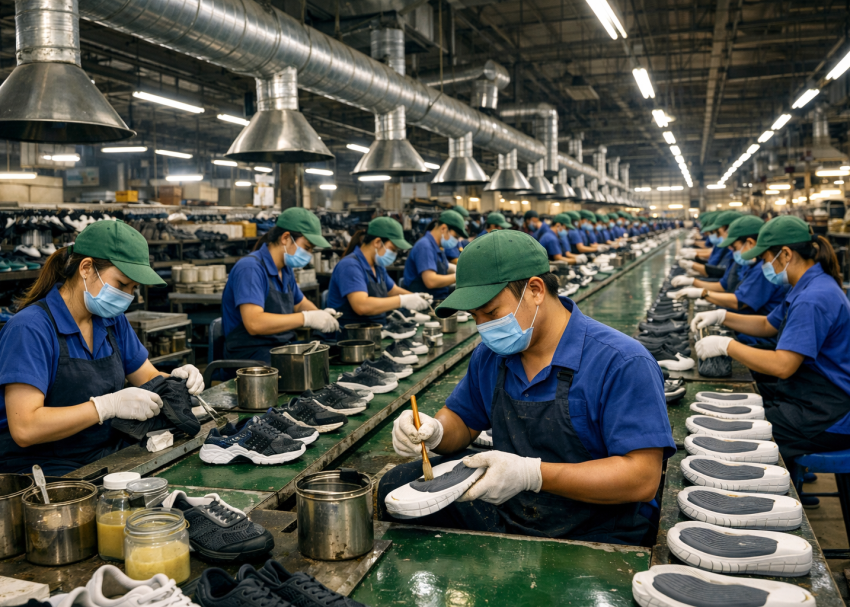
Washing / Priming in Footwear Manufacturing – Full Shoe Assembly Series
Successful footwear bonding depends on far more than adhesive selection. Before any cement is applied, the bonding surfaces must be prepared to ensure the adhesive can properly wet, penetrate, and interact with the materials being joined. While roughing creates the mechanical texture needed for adhesion, the freshly prepared surfaces remain vulnerable to contamination from dust, mold-release agents, processing oils, plasticizers, and environmental pollutants. If these contaminants remain on the bonding area, they can significantly reduce bond strength and long-term durability.
This is where washing and priming become critical. These processes transform a mechanically prepared surface into a chemically active bonding surface capable of achieving reliable adhesion. Washing removes residual contamination left behind after roughing, while priming enhances surface energy and improves compatibility between the substrate and adhesive system. Together, these operations create the foundation for strong, durable bonds capable of withstanding repeated flexing, humidity exposure, heat aging, and demanding wear conditions.
In modern footwear manufacturing, washing and priming are among the most closely controlled preparation stages in bottom assembly. Athletic footwear, safety footwear, outdoor footwear, and other performance-driven products often rely on material-specific primer systems to achieve required durability standards. A mismatch between substrate material and primer chemistry can remain undetected during production, only appearing later as sole separation, edge lifting, hydrolysis failure, or bond deterioration during laboratory testing and consumer use.
For this reason, leading footwear factories establish strict controls over primer selection, viscosity, application methods, flash-off timing, environmental conditions, and material traceability. Even small deviations in these parameters can affect adhesive performance and create costly quality issues downstream.
This article explores the complete washing and priming process used in footwear manufacturing, including cleaning methods, primer technologies, material-specific requirements, application techniques, quality control practices, common defects, and factory best practices that help ensure consistent bonding performance.
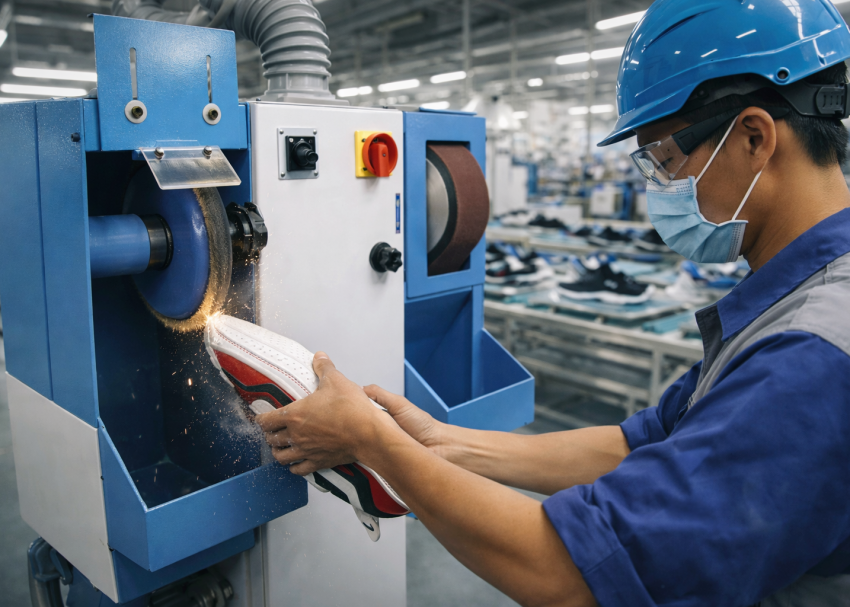
Understanding Washing in Footwear Manufacturing
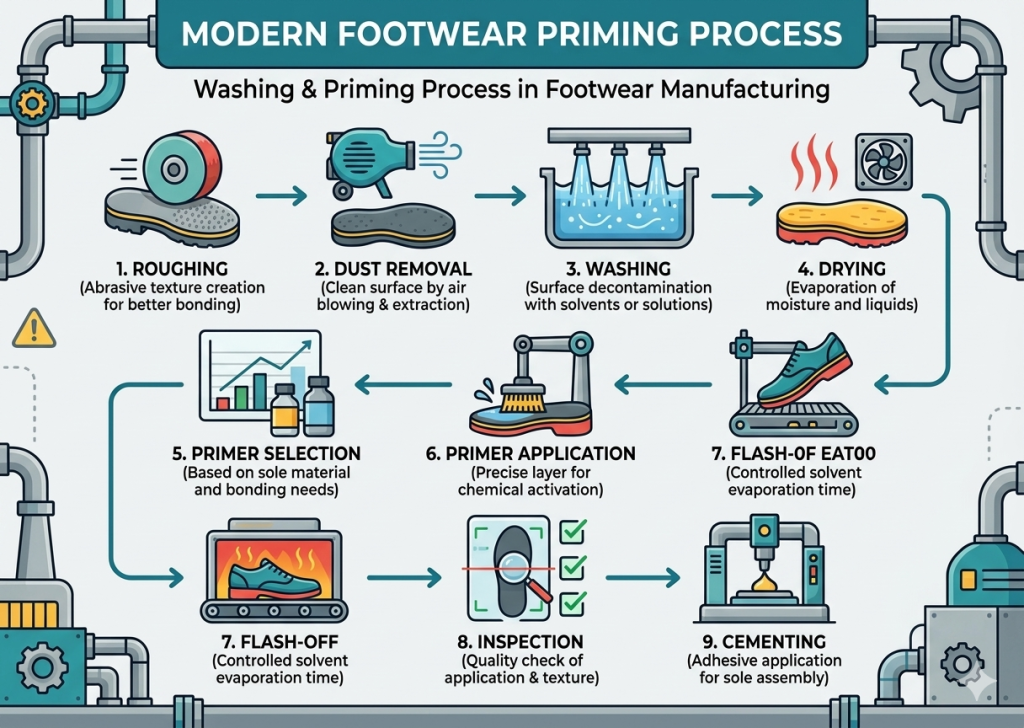
Washing is the controlled cleaning process performed immediately after roughing to remove dust particles, oils, release agents, and contaminants from bonding surfaces before primer or adhesive application. This process ensures the substrate remains chemically clean and capable of achieving high surface energy for proper adhesive wetting.
In footwear manufacturing, washing is not simply a cleaning activity. Instead, it is a controlled chemical preparation step that directly impacts final bond strength. Roughing creates fresh exposed material layers, but these surfaces quickly attract airborne contamination, operator handling oils, and static dust accumulation. As a result, delayed washing or improper solvent selection significantly reduces bonding reliability.
Factories typically perform washing within minutes after roughing to maintain the activated surface condition. The cleaning media may include solvent-based cleaners, MEK substitutes, acetone systems, alcohol-based cleaners, water-based cleaning agents, or specialized substrate-compatible washing chemicals depending on environmental regulations and material sensitivity.
Furthermore, washing removes microscopic loose particles that interfere with primer penetration. If roughing dust remains trapped within the bonding interface, the adhesive layer bonds to dust instead of the actual substrate. Eventually, this creates cohesive failure or bond-line delamination during flexing and hydrolysis testing.
The washing process also stabilizes the surface before chemical activation. Without proper washing, primers cannot uniformly react with the substrate because contaminants block molecular interaction zones. Therefore, washing directly supports primer efficiency and long-term bond durability.
Key Control Points
- Perform washing immediately after roughing
- Use substrate-compatible cleaning chemicals
- Avoid over-wetting the material surface
- Prevent operator hand contamination after washing
Expert Tip: Never allow roughened surfaces to remain exposed for extended periods before washing and priming. Surface energy declines rapidly after roughing.
Purpose of Priming in Footwear Bonding
Priming is the chemical activation process that prepares difficult-to-bond materials for strong adhesive interaction by increasing surface energy and improving molecular compatibility between the substrate and adhesive system.
In modern footwear manufacturing, many materials naturally resist bonding. PU, rubber, EVA, TPU, TPR, and synthetic components often contain low-energy surfaces, waxes, additives, or molded skin layers that prevent proper adhesive wetting. Therefore, primers act as chemical bridges that improve adhesive penetration and cross-linking capability.
Additionally, primers enhance both initial tack performance and long-term aging resistance. A properly selected primer promotes stronger interfacial bonding, which becomes critical during repeated flexing, heat exposure, humidity aging, and hydrolysis testing. Without correct priming, bond strength may initially appear acceptable but gradually fail after environmental conditioning tests.
Factories use different primer systems depending on substrate chemistry. Some primers soften the surface for better adhesive penetration, while reactive primers chemically interact with the substrate. Others function as adhesion promoters that increase molecular attraction between incompatible materials.
Timing also plays a major role in primer effectiveness. Once roughing and washing expose a fresh activated surface, contamination begins immediately. Therefore, factories maintain strict time windows between roughing, washing, priming, and cementing operations to preserve maximum surface energy.
Moreover, primer thickness control remains extremely important. Excessive primer creates weak films and solvent entrapment, whereas insufficient primer leaves inactive zones. Consequently, precision application becomes essential for consistent bonding quality.
Key Control Points
- Match primer chemistry with substrate material
- Maintain controlled primer thickness
- Monitor flash-off timing carefully
- Prevent contamination after primer application
Pro Tip: Always filter primers before spray application. Microscopic contamination particles frequently cause coating inconsistency and nozzle blockage.
Surface Energy and Adhesive Wetting
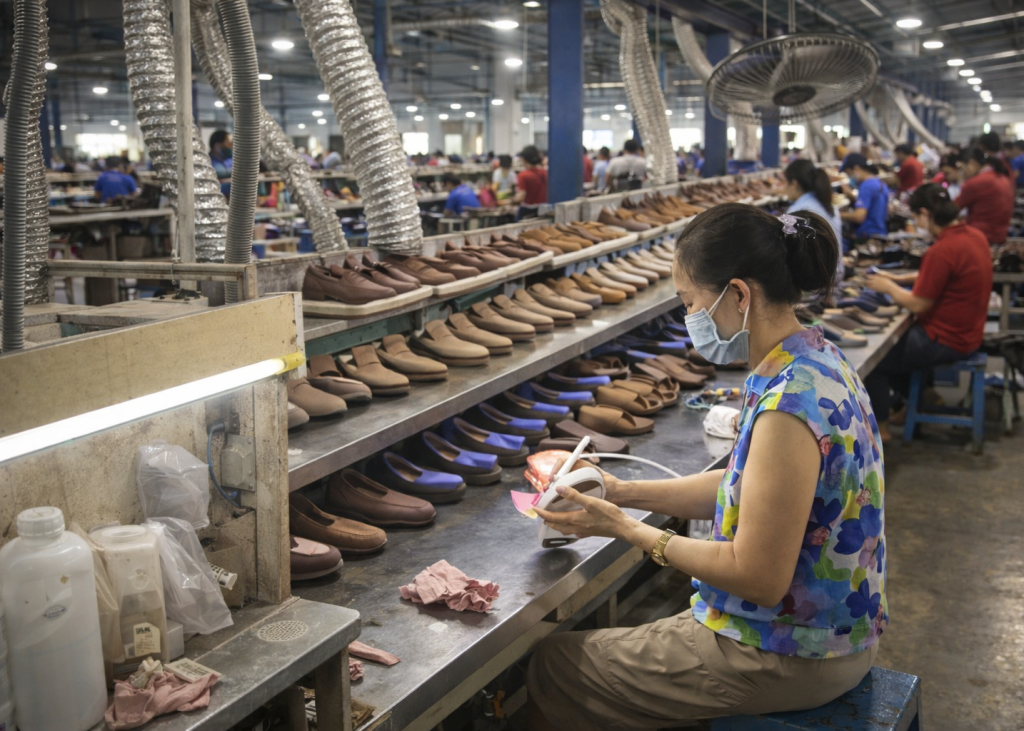
Surface energy refers to the ability of a material surface to attract and spread adhesive uniformly across the bonding area. Higher surface energy improves adhesive wetting, penetration, and chemical interaction.
Many footwear bonding failures originate from poor surface energy conditions rather than weak adhesive strength itself. Even premium cement systems cannot achieve reliable bonding if the substrate surface remains chemically inactive or contaminated.
After roughing, the substrate surface temporarily achieves elevated surface energy because fresh material layers become exposed. However, this activated condition gradually declines due to oxidation, contamination, humidity absorption, and airborne particle deposition. Therefore, washing and priming must occur within controlled time limits.
Proper adhesive wetting creates uniform contact across the bonding interface. When wetting is poor, adhesives form isolated beads or uneven films instead of spreading consistently. As a result, weak spots develop across the bond line, eventually causing edge lifting or localized sole separation.
Different substrates exhibit different surface energy characteristics. Rubber compounds may require halogenation-compatible primers, while EVA materials often require aggressive activation chemistry. Similarly, PU substrates need compatible reactive systems that support cross-linking performance.
Factories often conduct dyne-level testing or practical wetting evaluations to verify surface activation quality. In high-end athletic footwear production, some factories additionally monitor environmental humidity because moisture directly influences surface energy stability and solvent evaporation behavior.
Key Control Points
- Maintain short intervals after roughing
- Avoid touching activated surfaces by hand
- Monitor environmental humidity conditions
- Verify adhesive wetting consistency regularly
Pro Tip: Maintain separate brushes for different primer systems. Cross-contamination between chemistries weakens bonding reliability.
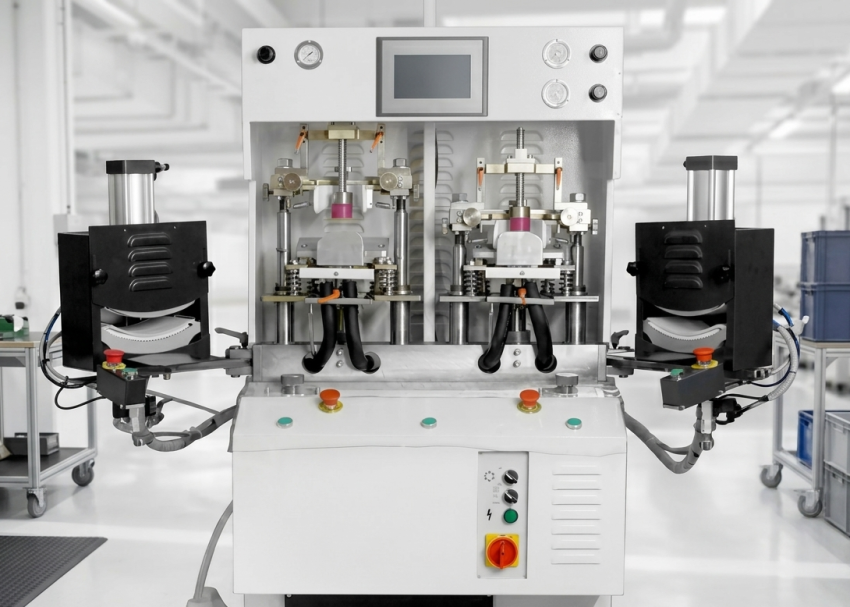
Types of Primers Used in Footwear Manufacturing
Footwear factories use different primer systems depending on substrate type, adhesive chemistry, environmental regulations, and required durability performance.
Solvent-Based Primers
Solvent-based primers remain widely used because they provide strong penetration, fast drying, and excellent activation capability for difficult bonding surfaces.
These primers are commonly used for rubber, PU, and synthetic substrates requiring aggressive surface preparation.
Additionally, solvent-based systems evaporate quickly, allowing faster production flow. However, factories must control ventilation, VOC exposure, and flammability risks carefully.
Key Control Points
- Monitor viscosity regularly
- Control flash-off duration precisely
- Maintain explosion-proof ventilation systems
- Store solvents under controlled conditions
Water-Based Primers
Water-based primers support environmentally compliant manufacturing while reducing VOC emissions and operator exposure risks. Many international footwear brands increasingly require water-based systems to improve sustainability compliance.
Although water-based systems reduce chemical hazards, they often require longer drying times and stricter environmental control. High humidity conditions may significantly impact drying consistency and bonding performance.
Key Control Points
- Maintain controlled drying temperature
- Prevent moisture entrapment
- Monitor humidity continuously
- Ensure complete drying before cementing
Reactive Primers
Reactive primers chemically interact with both the substrate and adhesive system to create enhanced cross-linking performance.
These systems are commonly used for high-performance sports footwear and hydrolysis-resistant bonding applications.
Reactive primers provide excellent long-term durability under heat, flexing, and moisture exposure.
However, pot life control becomes extremely important because reactive systems gradually lose effectiveness after mixing.
Key Control Points
- Follow mixing ratios accurately
- Monitor pot life continuously
- Record batch traceability data
- Discard expired mixed material immediately
Pro Tip: Calibrate viscosity measurement procedures across all shifts to avoid process variation between operators.
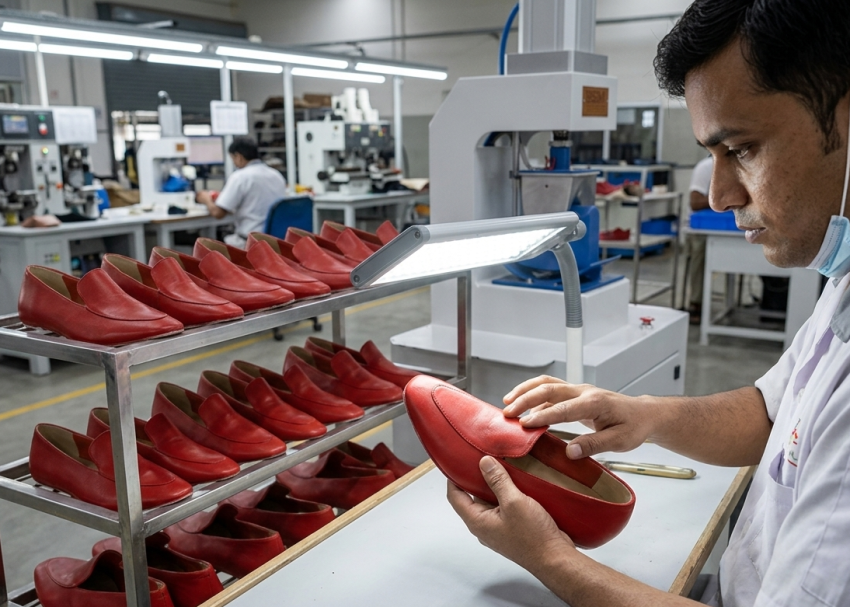
Material-Specific Primer Selection

Correct primer selection represents one of the most important technical decisions in footwear bonding operations. A mismatch between substrate chemistry and primer system often causes hidden bond failures that appear only after aging tests.
PU Outsole Priming
PU outsoles require carefully controlled primers because polyurethane surfaces are sensitive to moisture and hydrolysis conditions. Reactive PU-compatible primers improve cross-linking performance and long-term durability.
Additionally, operators must avoid excessive solvent exposure because aggressive chemicals may damage the PU surface structure.
Key Control Points
- Control hydrolysis-sensitive conditions
- Use PU-compatible reactive systems
- Avoid over-application
- Maintain low humidity storage
Rubber Outsole Priming
Rubber outsoles often contain mold-release agents, waxes, and anti-oxidants that interfere with bonding. Therefore, proper washing and primer activation become essential before cementing.
Some rubber compounds additionally require halogenation systems to improve adhesion performance.
Key Control Points
- Remove mold-release contamination fully
- Verify roughing quality before priming
- Maintain correct flash-off timing
- Monitor compound compatibility
Pro Tip: Install humidity monitoring near primer application zones. Environmental instability directly impacts flash-off behavior.
EVA Priming
EVA materials present bonding challenges because of their low surface energy and soft cellular structure. Aggressive activation systems often become necessary to achieve stable adhesion.
Furthermore, over-roughing or excessive solvent exposure may damage EVA foam structure and reduce dimensional stability.
Key Control Points
- Use EVA-compatible activation chemistry
- Avoid excessive solvent saturation
- Maintain gentle roughing parameters
- Prevent foam deformation
Leather Priming
Leather surfaces typically require lighter primer systems because excessive chemical loading may stiffen the material or discolor finished surfaces.
Natural leather also absorbs chemicals differently depending on finish type, moisture content, and coating structure.
Key Control Points
- Prevent staining on finished leather
- Use low-aggression primer systems
- Monitor absorption consistency
- Protect cosmetic appearance
Pro Tip: Conduct periodic solvent evaporation studies to optimize flash-off timing during seasonal weather changes.

Primer Application Methods
Brush Application
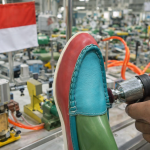
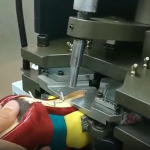
Brush application remains common in factories because it provides flexible manual control. Operators can selectively apply primers to narrow bonding zones and complex geometries.
However, manual brush application depends heavily on operator skill. Uneven coating thickness, contamination, and inconsistent flash-off timing frequently occur in uncontrolled operations.
Key Control Points
- Maintain clean brushes regularly
- Avoid excessive coating thickness
- Standardize operator techniques
- Replace contaminated brushes immediately
Roller Application
Roller systems support controlled primer transfer for flat bonding surfaces and continuous production environments.
This method improves repeatability and reduces overspray losses.
However, roller contamination buildup may gradually transfer defects across multiple components if cleaning frequency becomes inadequate.
Key Control Points
- Clean rollers periodically
- Monitor transfer consistency
- Prevent primer buildup
- Maintain stable roller pressure
Pro Tip: Implement barcode-based lot traceability for primers and adhesives to simplify failure investigation.
Flash-Off Time Control
Flash-off time refers to the controlled evaporation period between primer application and adhesive coating. This stage allows solvents or water carriers to evaporate while leaving the active chemical layer properly prepared for bonding.
Inadequate flash-off remains one of the most common hidden process failures in footwear manufacturing. If solvents remain trapped beneath the adhesive layer, the bond line becomes unstable during heat aging and flex testing.
Conversely, excessive flash-off may over-dry the surface and reduce chemical activity. Therefore, factories establish precise flash-off windows depending on material type, ambient temperature, humidity, and primer chemistry.
Environmental conditions significantly influence flash-off performance. High humidity slows evaporation, while excessive airflow may cause surface skinning before internal solvent release completes. Advanced factories therefore use controlled drying tunnels, infrared systems, or temperature-monitored flash-off chambers to stabilize the process.
Key Control Points
- Follow specified flash-off windows strictly
- Monitor humidity and temperature continuously
- Prevent trapped solvent conditions
- Standardize drying parameters across shifts
Pro Tip: Train operators to recognize subtle visual differences between proper and over-dried primer films.
Common Washing and Priming Defects
Sole Separation After Aging
Poor primer compatibility or incomplete surface activation frequently causes sole separation after humidity or hydrolysis testing. The bond may initially pass production inspection but gradually weaken during environmental exposure.
Key Control Points
- Maintain proper flash-off timing
- Verify material-primer compatibility
- Conduct aging validation testing
- Monitor hydrolysis resistance
Bubbling and Blistering
Trapped solvents or moisture within the bond interface create bubbling during heat exposure or wear conditions.
Poor drying control commonly causes this defect.
Key Control Points
- Maintain environmental stability
- Ensure full solvent evaporation
- Avoid excessive coating thickness
- Monitor drying tunnel performance
Edge Lifting/Lip Opening
Edge lifting usually develops when primer coverage becomes inconsistent near bonding edges. Contamination or insufficient coating thickness often weakens edge adhesion first.
Key Control Points
- Improve operator inspection standards
- Ensure complete edge coverage
- Prevent contamination during handling
- Verify coating thickness consistency
Weak Peel Strength
Weak peel strength develops when surface energy remains insufficient or contamination blocks adhesive interaction zones.
Key Control Points
- Maintain process timing discipline
- Improve washing effectiveness
- Verify roughing consistency
- Use correct primer chemistry
Quality Control in Washing and Priming Operations
Quality control during washing and priming directly influences final shoe durability, especially for athletic and export-grade footwear. Consequently, factories implement both visual and laboratory verification systems.
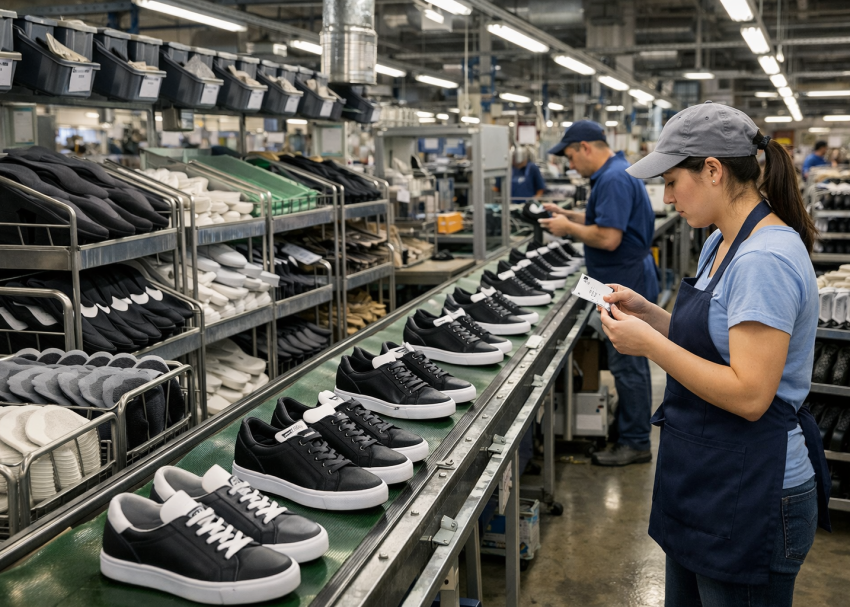
Operators first inspect roughing cleanliness and confirm that all loose particles are removed before primer application. Supervisors then verify coating uniformity, flash-off timing, and environmental conditions.
Additionally, factories monitor primer viscosity regularly because solvent evaporation gradually changes application characteristics. Variations in viscosity directly affect coating thickness and penetration performance.
Laboratory teams often conduct peel strength testing, hydrolysis aging, humidity exposure testing, and flex testing to validate bonding reliability. In advanced facilities, primer batches are traceable by production shift to simplify root-cause analysis during customer complaints.
Furthermore, FIFO management becomes extremely important because expired primer chemistry may lose activation capability despite appearing visually normal.
Key Control Points
- Enforce strict FIFO management
- Record primer lot traceability
- Monitor viscosity at defined intervals
- Conduct regular peel-strength testing
Conclusion
Washing and priming form the chemical foundation of successful footwear bonding. Although these operations may appear secondary compared to roughing or cementing, they directly determine whether the adhesive system can achieve stable molecular interaction and long-term durability.
Modern footwear manufacturing increasingly relies on advanced materials with complex bonding behavior. Therefore, factories must carefully control washing chemistry, primer compatibility, flash-off timing, environmental conditions, and contamination prevention. Even minor process deviations can create hidden failures that only appear after hydrolysis aging, flex testing, or customer wear conditions.
Additionally, strict traceability, FIFO discipline, viscosity monitoring, and operator training remain essential for maintaining consistent production quality. High-performing factories treat washing and priming not as simple preparation steps but as precision-controlled chemical engineering operations within the shoe assembly process.
In the next blog of TheFootwearEdge Full Shoe Assembly Series, we will discuss Primary & Secondary Cementing in Footwear Manufacturing, including adhesive chemistry, coating methods, drying systems, activation processes, and bonding quality controls used in modern footwear factories.
Frequently Asked Questions – FAQs
Why is washing necessary after roughing in footwear manufacturing?
Washing removes roughing dust, oils, mold-release agents, and contaminants that interfere with adhesive bonding performance.
What happens if the wrong primer is used?
Incorrect primer chemistry can cause weak bonding, hydrolysis failure, sole separation, edge lifting, and poor peel strength.
Why is flash-off time important?
Flash-off time allows solvents or water carriers to evaporate properly before adhesive application. Incorrect flash-off weakens the bond line.
Which materials require special primers?
PU, EVA, rubber, TPU, TPR, and synthetic materials often require material-specific primer systems for reliable adhesion.
What causes bubbling in footwear bonding?
Trapped solvents, excessive coating thickness, or incomplete drying commonly cause bubbling and blistering defects.
How do factories control primer quality?
Factories monitor viscosity, lot traceability, flash-off timing, coating thickness, humidity, and peel strength testing.
What is the biggest mistake in washing and priming operations?
Delays between roughing and priming frequently reduce surface energy and increase contamination risk, leading to weak bonding..