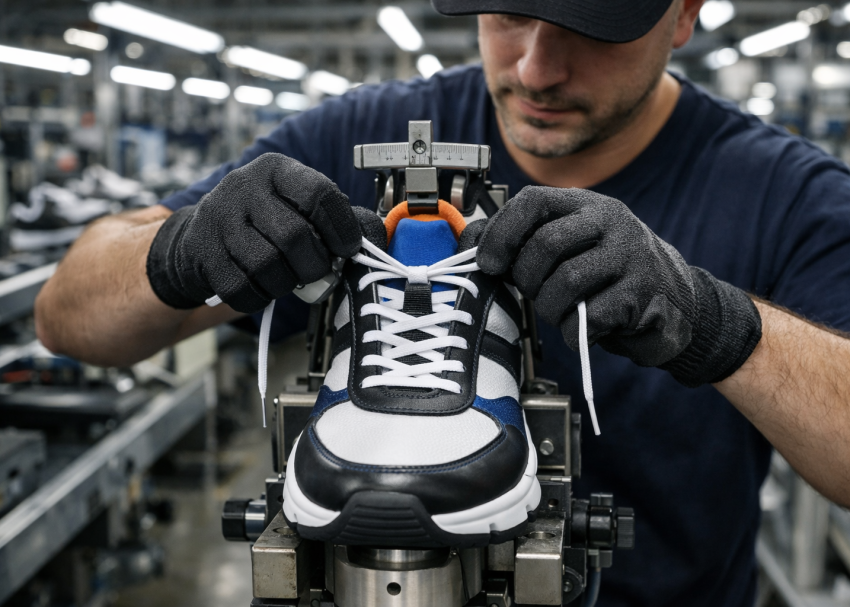
Lace Tightening & Positioning in Footwear Manufacturing – Full Shoe Assembly Series
In the previous blog, Side/Waist & Seat/Heel Lasting in Footwear Manufacturing – Full Shoe Assembly Series, we discussed how the upper is shaped, tensioned, and permanently formed over the last to achieve dimensional stability and correct footwear geometry. However, after lasting operations are completed, another critical adjustment directly influences fit consistency, aesthetic balance, and customer comfort—lace tightening and positioning.
Lace tightening and positioning is not merely a cosmetic correction. Instead, it is a controlled assembly operation that standardizes throat opening width, balances eyelet alignment, stabilizes upper tension, and ensures consistent fit performance across production pairs. Even minor variation in lace centering or opening width can create visible asymmetry, uneven vamp tension, poor fitting feedback, and downstream finishing rejection.
Therefore, modern footwear factories increasingly use visual gauges, throat opening templates, centering fixtures, and digital lace tension monitoring systems to achieve repeatable results. Furthermore, sports footwear and technical performance shoes demand even tighter tolerance because lace pressure distribution directly affects lockdown performance and wearer comfort.
This article explains the complete lace tightening and positioning process, including operational sequence, machine systems, quality standards, defect prevention, process control methods, and global machinery suppliers used in modern footwear manufacturing plants.
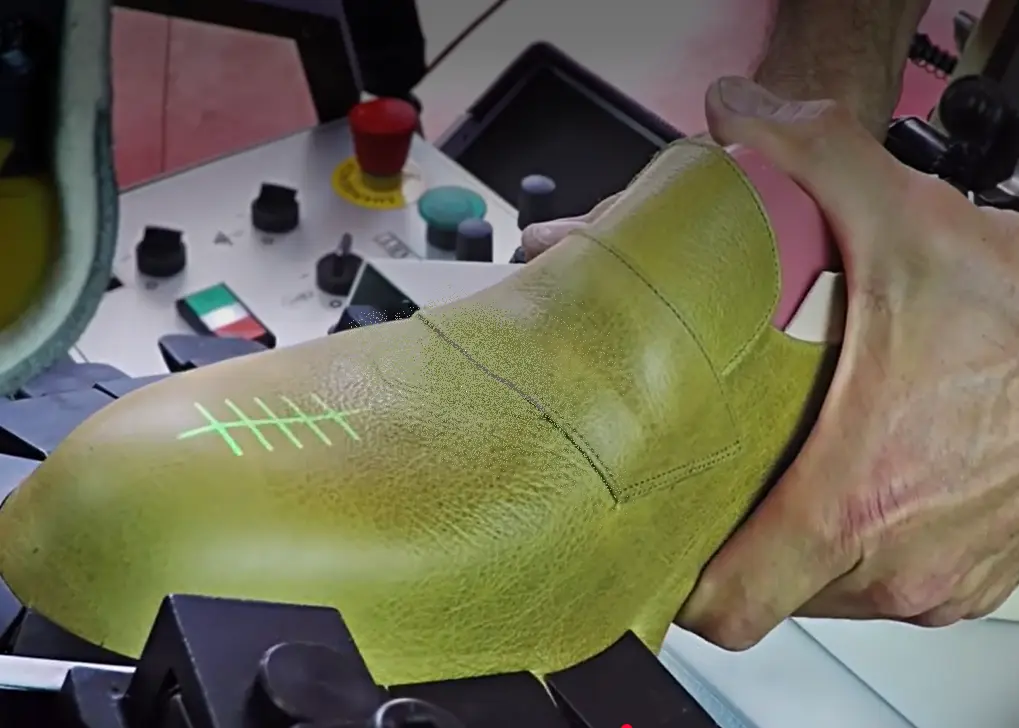
Understanding Lace Tightening & Positioning in Footwear Assembly
Lace tightening and positioning is the controlled adjustment of shoelaces after or during lasting to ensure symmetrical throat opening width, balanced lace tension, centered tongue position, and uniform eyelet alignment across pairs.
During lasting, operators usually loosen laces to allow free upper movement over the last.
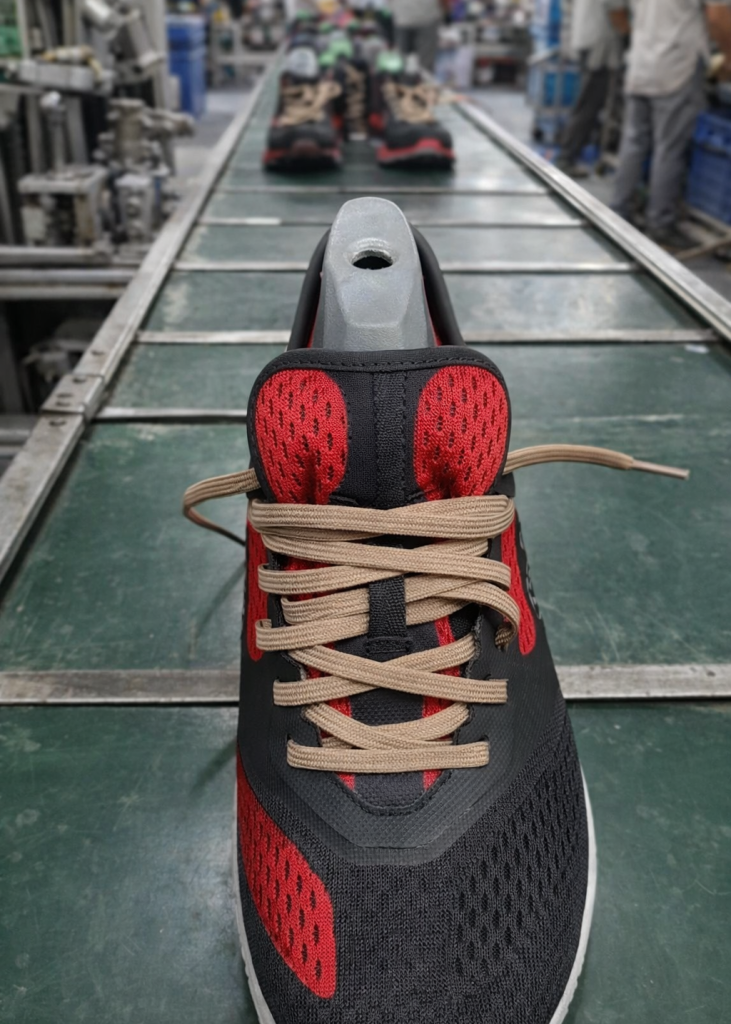
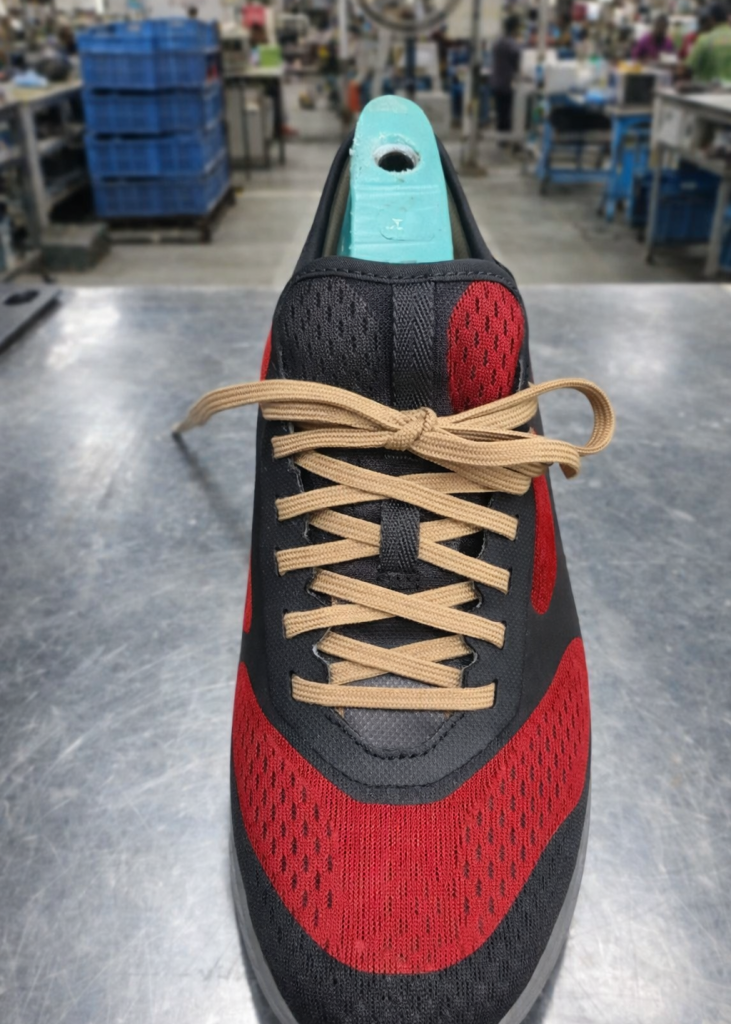
Once lasting stabilizes the upper shape, the laces are retightened according to defined specifications. The operation restores intended upper tension while maintaining consistent visual appearance. This process directly affects:
- Fit accuracy
- Foot entry comfort
- Tongue centering
- Upper tension balance
- Vamp shape stability
- Aesthetic symmetry
- Pair matching consistency
Moreover, improper lace positioning can distort quarter alignment, shift tongue placement, or create uneven pressure zones during wear testing.
Key Control Points
- Maintain throat opening width within specification tolerance
- Ensure equal lace exposure on both sides
- Verify tongue remains centered during tightening
- Confirm eyelet rows remain symmetrical
Expert Tip: Use standardized throat width gauges for every size range instead of relying on visual estimation alone.


Role of Lace Positioning in Fit Consistency
Lace tightening controls how the upper wraps around the foot. Therefore, inconsistent tension immediately affects fitting performance.
If one side of the throat opening is tighter than the other, the upper pulls asymmetrically around the vamp. Consequently, wearers experience pressure imbalance, loose heel grip, or localized discomfort. In technical athletic footwear, even slight tension deviation influences lockdown and foot stability during movement.
Factories standardize throat opening dimensions using positioning gauges because visual judgment alone produces high operator variation. Furthermore, digital measurement tools now allow objective throat width verification with precise tolerance control.
Consistent lace positioning also improves downstream operations including:
- Sockliner insertion
- Shape retention
- Packing presentation
- Pair visual matching
- Retail shelf appearance
Key Control Points
- Standardize opening width using fixed gauges
- Prevent excessive vamp compression
- Maintain balanced quarter tension
- Monitor left-right pair symmetry
Pro Tip: Train operators to tighten progressively from lower eyelets upward to stabilize upper pressure distribution evenly.
Timing of Lace Tightening During Assembly
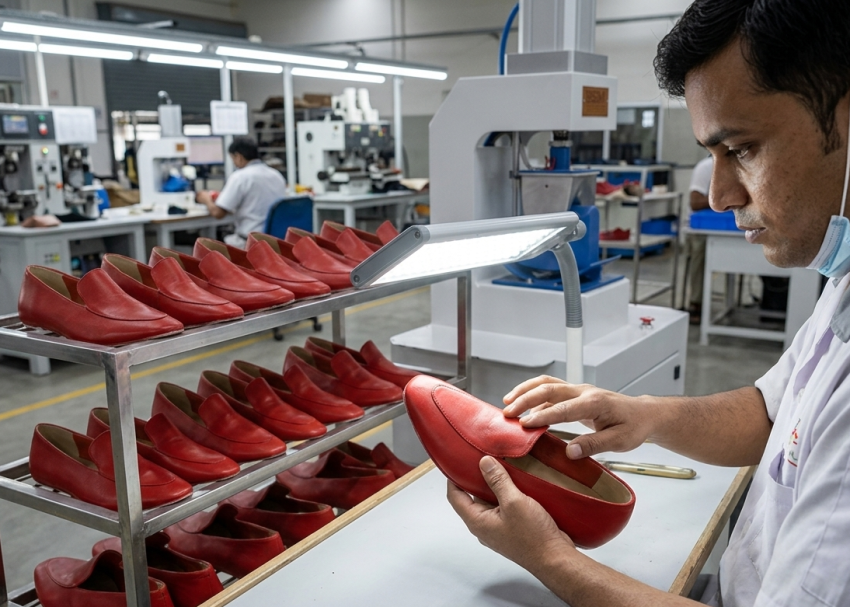
Factories perform lace tightening at different stages depending on footwear category, construction method, and assembly line layout.
In cemented athletic footwear, operators commonly loosen laces before toe lasting and side lasting. After lasting stabilizes the upper, operators re-tension and reposition the laces prior to seat pressing or finishing.
In vulcanized or casual footwear, factories may perform partial tightening during upper preparation and final adjustment after bottom attachment. Timing is important because premature tightening can restrict upper movement during lasting. Conversely, delayed tightening may allow upper deformation or throat shape variation. Additionally, automated production systems synchronize lace positioning with conveyor-based assembly stations to maintain throughput efficiency.
Key Control Points
- Loosen laces sufficiently before lasting
- Re-tighten only after upper stabilization
- Prevent upper distortion during adjustment
- Synchronize timing with assembly flow
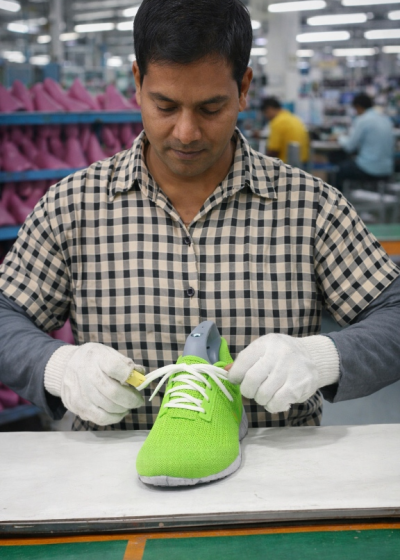
Pro Tip: Install bright neutral-color LED lighting at lace positioning stations to improve symmetry detection accuracy.


Standard Lace Tightening Procedure
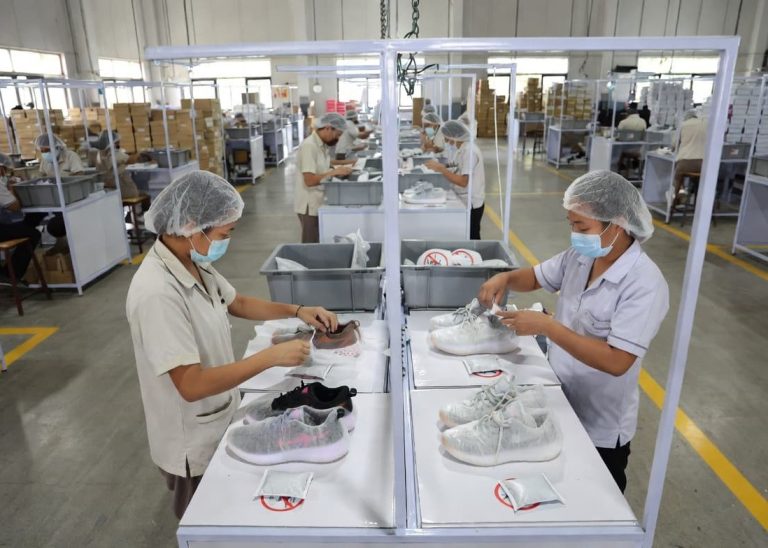
The lace tightening process follows a standardized operational sequence to achieve repeatable visual and dimensional results. Operators first inspect lace routing through all eyelets to confirm proper threading sequence. Next, they center the tongue and align both quarter openings symmetrically. Then, operators gradually tension the laces from lower eyelets upward to distribute pressure evenly.
Instead of pulling aggressively from the top eyelets only, progressive tightening stabilizes the entire upper structure uniformly. After tightening, operators verify throat opening width using gauges or templates.
Factories producing premium footwear often use digital lace tension devices that quantify tightening force. These systems reduce operator subjectivity and improve pair consistency. Finally, the completed pair undergoes visual symmetry inspection before transfer to the next process.
Key Control Points
- Tighten progressively from bottom upward
- Maintain centered tongue alignment
- Avoid uneven lace force distribution
- Verify opening width after adjustment
Pro Tip: Use temporary tongue holding clips during adjustment for athletic footwear with padded tongues.


Importance of Throat Opening Width Control
Throat opening width is one of the most critical dimensional checkpoints in lace positioning operations. The throat opening defines the visible spacing between eyelet rows after tightening. If the opening becomes too narrow, the shoe appears compressed and may fit too tightly.
On the other hand, excessive width creates loose fit appearance and inconsistent pair matching.
Factories establish standard throat width tolerances according to shoe size and model specifications. For example, athletic footwear commonly maintains tolerance within ±1 mm to preserve fit consistency.
Moreover, inconsistent throat width creates downstream packing and merchandising issues because asymmetrical shoes become visually obvious in retail display conditions. Modern factories increasingly use laser-based or digital measurement systems to improve repeatability and reduce inspection dependency.
Key Control Points
- Maintain throat width within specification
- Measure both left and right shoes
- Reject asymmetrical opening appearance
- Calibrate gauges regularly
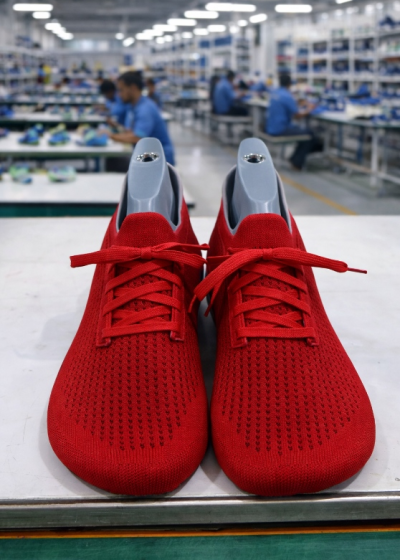
Pro Tip: Implement hourly first-piece verification checks to detect drift before mass defects occur.

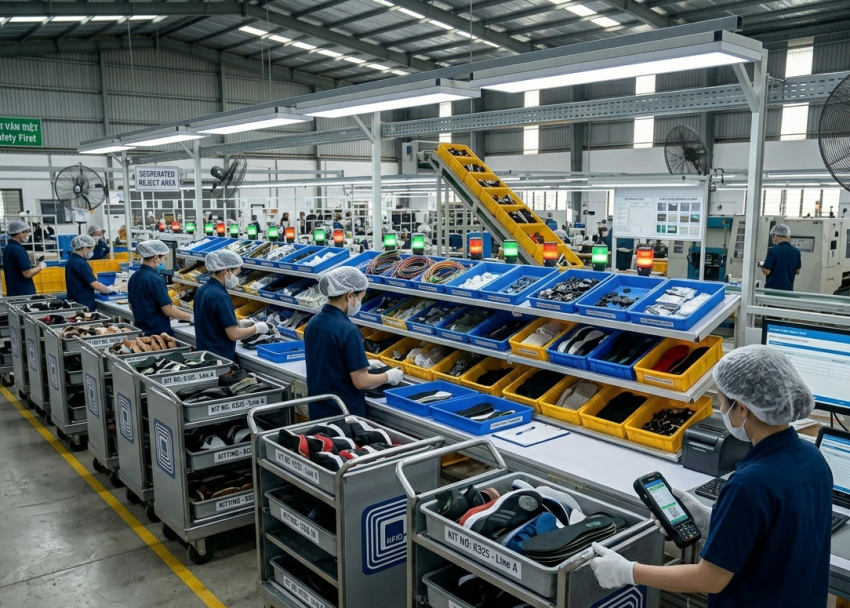
Eyelet Alignment & Visual Symmetry Control
Eyelet alignment strongly influences footwear aesthetics. Even when the shoe fits correctly, uneven eyelet positioning creates visible imbalance that customers immediately notice. During lace tightening, operators ensure both eyelet rows remain parallel and centered relative to the tongue. If one quarter panel shifts excessively, the entire upper loses symmetry.
Factories use visual templates, alignment markings, and positioning fixtures to maintain consistency.
Additionally, high-end footwear manufacturers increasingly implement camera inspection systems for automated symmetry detection. Proper eyelet alignment also prevents:
- Lace twisting
- Uneven pressure zones
- Tongue drift
- Quarter distortion
- Poor shelf presentation
Because consumers visually evaluate symmetry instantly, factories treat lace positioning as both a functional and cosmetic operation.
Key Control Points
- Keep eyelet rows parallel
- Prevent tongue shifting
- Inspect pair symmetry under lighting
- Control quarter panel balance
Pro Tip: Digitally record throat width measurements for high-value performance footwear production.
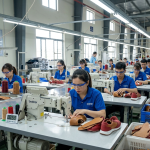
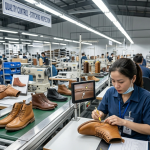
Tongue Centering During Lace Adjustment
Tongue centering is essential for both appearance and wearer comfort. When operators tighten laces unevenly, the tongue migrates laterally. Consequently, the shoe develops asymmetrical pressure distribution and poor visual presentation.
Factories therefore combine tongue positioning with lace tightening as a single controlled operation. Operators manually align tongue centerlines with vamp reference marks before final tightening. Athletic footwear factories frequently use temporary tongue clips or positioning fixtures to prevent movement during adjustment.
Furthermore, improperly centered tongues can create:
- Lace bite discomfort
- Pressure hotspots
- Poor branding visibility
- Customer fitting complaints
Key Control Points
- Align tongue center before tightening
- Prevent lateral tongue movement
- Verify branding alignment visually
- Recheck after final tensioning
Pro Tip: Separate lace positioning standards by footwear category because casual and athletic shoes require different tension behavior.


Common Defects in Lace Tightening & Positioning
Several quality issues originate directly from poor lace adjustment practices. The most common defect is uneven throat opening width between left and right shoes. Additionally, twisted laces, tongue drifting, excessive upper compression, and asymmetrical eyelet spacing frequently occur when operators rush the process.
Improper tightening also contributes to fitting complaints after consumer use because upper tension distribution becomes unstable. Factories minimize defects through operator training, visual standards, standardized gauges, and inline auditing.
Common Defects
- Uneven throat opening
- Off-centered tongue
- Excessively tight upper
- Loose lace appearance
- Twisted lace routing
- Asymmetrical eyelet spacing
- Pair mismatch appearance
Key Control Points
- Audit operators frequently
- Use defect reference boards
- Verify pair appearance side-by-side
- Implement first-piece approval
Pro Tip: Use defect sample boards directly at workstations to reinforce operator visual standards continuously.

Quality Inspection Standards for Lace Positioning
Quality inspectors evaluate lace positioning using both visual and dimensional criteria. Inspectors compare left-right symmetry under standardized lighting conditions while measuring throat opening width with approved gauges. Additionally, they assess tongue centering, lace routing accuracy, and eyelet alignment.
Factories commonly establish visual grading standards to simplify operator judgment and reduce subjectivity. Inspection frequency depends on production volume and customer quality requirements. However, high-performance footwear typically requires stricter inspection intervals.
Inspection Criteria
- Throat opening width tolerance
- Eyelet row symmetry
- Tongue center alignment
- Lace routing correctness
- Pair matching appearance
- Upper tension consistency
Key Control Points
- Standardize inspection lighting
- Use approved measurement gauges
- Conduct hourly process audits
- Maintain visual defect libraries

Conclusion
Lace tightening and positioning is a critical assembly control operation that directly affects footwear fit, symmetry, comfort, and retail presentation. Although the process appears simple, improper execution can create significant dimensional variation, fitting complaints, and visual defects across production pairs.
Therefore, modern footwear factories increasingly standardize lace adjustment through controlled tightening sequences, throat opening gauges, operator training, and automated inspection technologies. Furthermore, maintaining consistent upper tension and eyelet alignment improves both product quality and downstream production stability.
As footwear manufacturing moves toward higher precision and smart factory integration, lace positioning will continue evolving from a manual adjustment task into a measurable, data-controlled quality process.
In the next blog of TheFootwearEdge Full Shoe Assembly Series, we will discuss Heel / Seat Pressing & Crowning in Footwear Manufacturing, including seat shaping, heel conformity, wrinkle prevention, and dimensional stabilization techniques used after lasting operations.
Frequently Asked Questions – FAQs
Why is lace tightening important in footwear manufacturing? Lace tightening controls upper tension, throat opening width, tongue alignment, and fit consistency. Improper tightening creates asymmetrical appearance and fitting problems.
What is throat opening width in footwear? Throat opening width refers to the spacing between eyelet rows after lace tightening. Factories maintain controlled tolerances to ensure pair consistency and proper fit.
Why are laces loosened before lasting? Operators loosen laces before lasting to allow free upper movement over the last and prevent upper distortion during shaping operations.
What causes uneven lace appearance in shoes? Uneven tightening force, poor tongue centering, improper eyelet alignment, and inconsistent operator technique commonly cause asymmetrical lace appearance.
How do factories measure lace tension consistency? Modern factories use digital lace tension gauges, throat opening templates, and visual inspection standards to monitor consistency.
What defects occur due to improper lace positioning? Common defects include uneven throat opening, off-centered tongue, excessive upper compression, twisted laces, and pair mismatch appearance.
Can lace tightening affect footwear comfort? Yes. Uneven lace tension creates pressure imbalance, discomfort, poor lockdown performance, and fitting complaints during wear.