Roughing and Buffing Operation in Outsole Process: Outsole (Stock Fitting) Assembly Series
Surface preparation determines the success of every adhesive bond in footwear manufacturing. Even when premium adhesives and modern pressing equipment are used, poor surface preparation often leads to bond failure. Therefore, roughing and buffing remain among the most important operations in the outsole assembly process.
In the previous blog, Trimming Operation in Outsole Process, we discussed how trimming removes excess material and creates accurate outsole dimensions before assembly. Once trimming is complete, the bonding surfaces still require preparation because many outsole materials have smooth, glossy, or contaminated surfaces that reduce adhesive performance.
This stage solves that problem by mechanically preparing the bonding area. Roughing and buffing create microscopic surface irregularities that allow adhesives to penetrate more effectively and form strong mechanical anchorage. As a result, outsole adhesion becomes more reliable, durable, and consistent throughout production.
Although the operation appears straightforward, experienced footwear manufacturers know that incorrect roughing depth, poor tool condition, or incomplete surface coverage can significantly reduce bond strength. Consequently, strict process control and regular machine maintenance are essential for producing high-quality footwear.
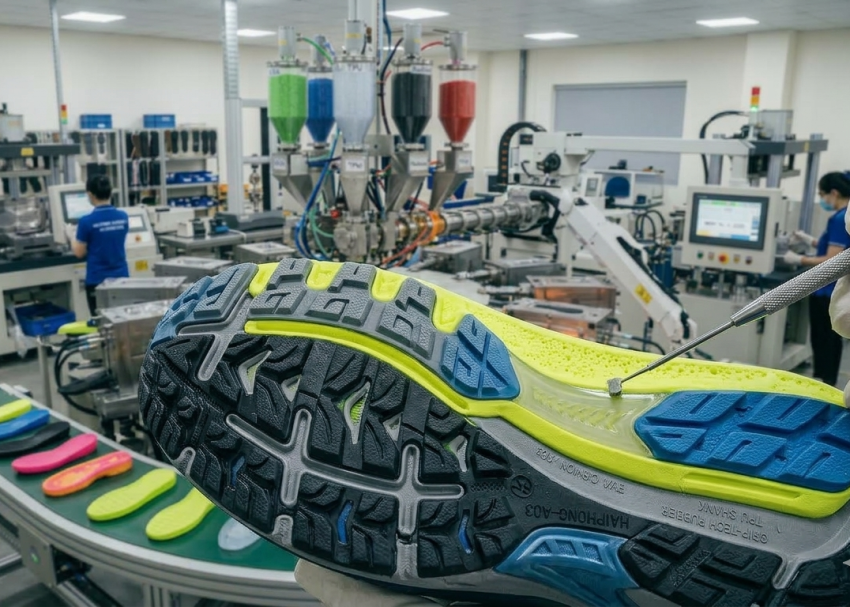
Understanding Roughing and Buffing in Footwear Manufacturing
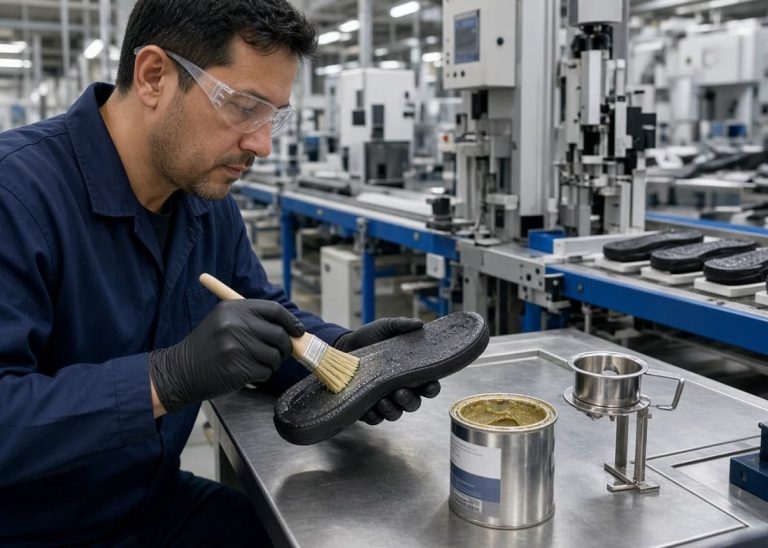
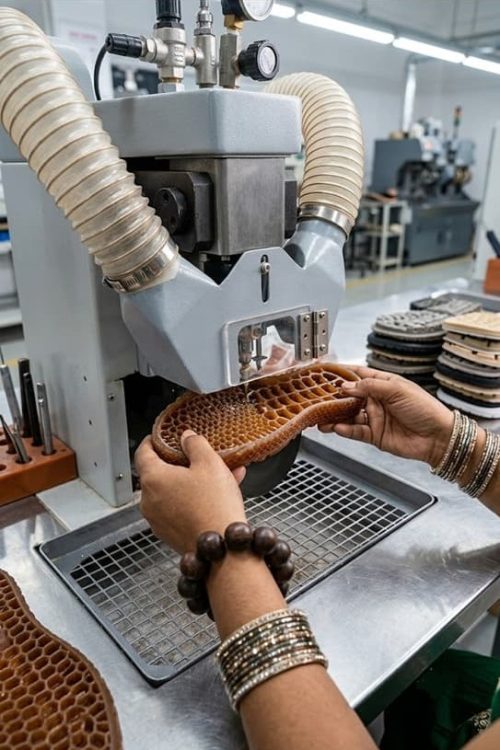
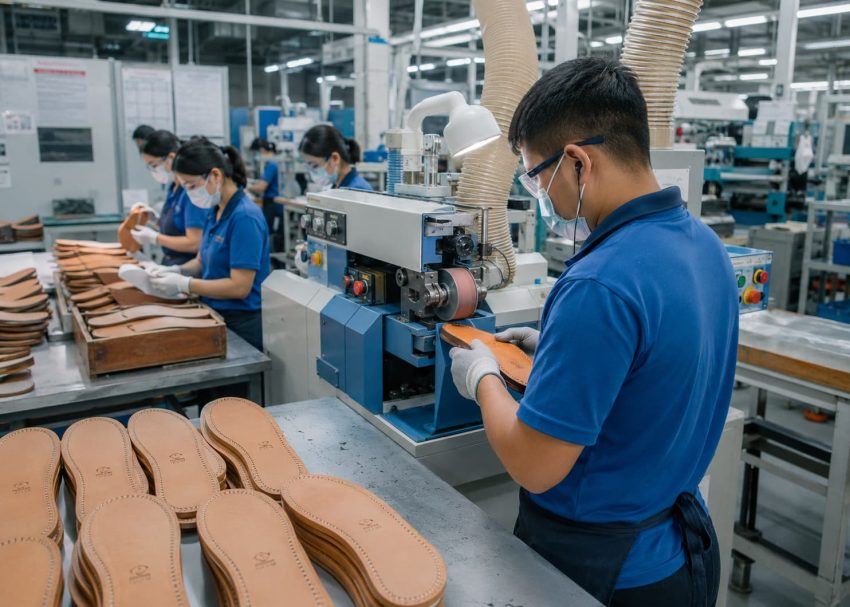
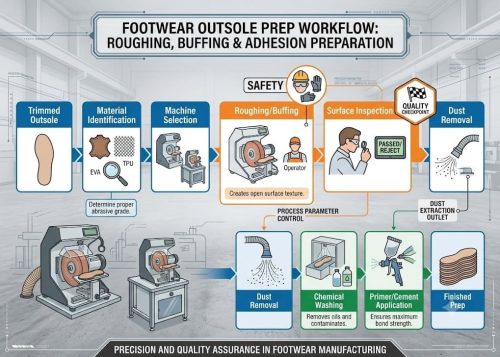
Roughing and buffing are mechanical surface preparation operations performed before adhesive application. During the process, the smooth outer layer of the outsole or upper component is lightly abraded using specialized abrasive wheels, brushes, or automatic roughing equipment.
The objective is not to remove excessive material. Instead, the process exposes fresh material while creating a controlled rough surface that increases the available bonding area. This microscopic texture enables adhesive to penetrate surface irregularities and establish a stronger mechanical lock after curing.
Different footwear materials respond differently during roughing. Leather fibers open easily, while rubber compounds require controlled abrasion to expose fresh rubber. EVA, TPU, and TPR each demand different abrasive tools and operating speeds because excessive heat or pressure can damage the material surface. Modern footwear factories often standardize roughing parameters for each outsole material to ensure repeatable bonding quality.
Machine settings, abrasive grit, feed rate, and operator technique are validated during product development before mass production begins.
Key Control Points
- Ensure complete roughing of the designated bonding area.
- Avoid excessive material removal.
- Match abrasive type with outsole material.
- Remove dust immediately after roughing.
Expert Tip: Standardize abrasive grit for every outsole material and record it in the production SOP.
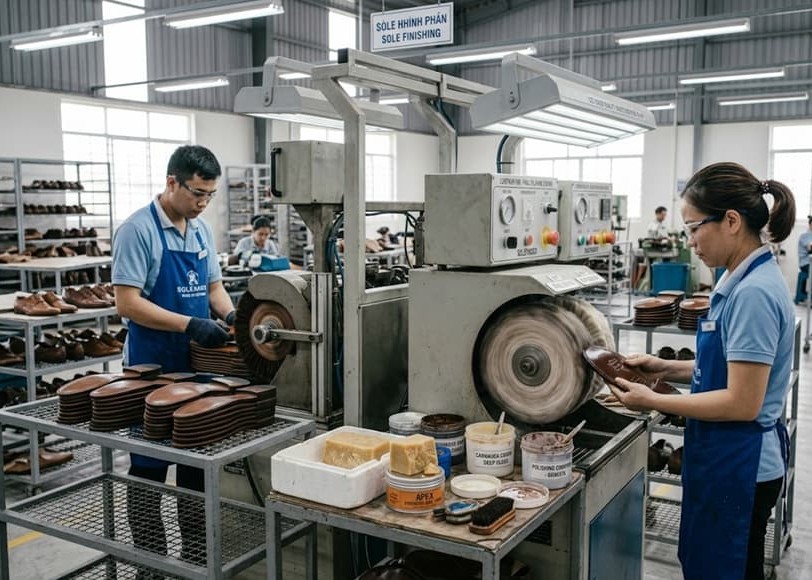
Materials Commonly Subjected to Roughing
Different outsole materials require different roughing techniques because each material has unique hardness, elasticity, and surface characteristics. Selecting the correct abrasive and machine settings improves adhesive performance while preventing unnecessary material damage.
Leather
Leather outsoles naturally develop smooth grain surfaces after finishing. Before cement application, the finished surface must be removed to expose fresh leather fibers that readily absorb adhesive.
Controlled roughing produces an even fibrous surface without cutting too deeply into the leather structure. Excessive roughing weakens leather thickness and may affect outsole appearance after finishing.
Typical abrasive grit:
- 80–100 grit: Heavy leather sole preparation
- 100–120 grit: Standard outsole bonding surface
- 150 grit: Light finishing before primer application
Key Control Points
- Remove finish uniformly.
- Maintain consistent roughing depth.
- Avoid burning caused by excessive pressure.
- Inspect fiber exposure across the entire bonding area.
Rubber
Rubber compounds often contain mold-release agents, waxes, or processing oils that reduce adhesive bonding.
Roughing removes these surface contaminants while exposing fresh rubber suitable for cement application.
Natural rubber and synthetic rubber require slightly different abrasive selections. Softer compounds need gentle abrasion, whereas harder compounds may require coarser abrasive wheels.
Typical abrasive grit:
- 60–80 grit: Hard rubber compounds
- 80–100 grit: Standard outsole rubber
- 100–120 grit: Fine finishing
Key Control Points
- Eliminate mold-release residues.
- Maintain even surface texture.
- Prevent localized overheating.
- Clean rubber dust thoroughly.
Expert Tip: Replace worn abrasive wheels before cutting efficiency decreases, rather than waiting for visible damage.
EVA (Ethylene Vinyl Acetate)
EVA midsoles and outsoles are lightweight but relatively soft. Consequently, roughing must be carefully controlled because excessive pressure quickly removes material and alters dimensional accuracy.
Operators normally use finer abrasive wheels at moderate rotational speed to create a uniform bonding surface without tearing the foam structure.
Typical abrasive grit:
- 100–120 grit: Standard EVA
- 120–150 grit: Soft-density EVA
- 150–180 grit: Fine finishing
Key Control Points
- Avoid deep grooves.
- Prevent foam tearing.
- Keep wheel pressure consistent.
- Verify complete surface coverage.
TPU (Thermoplastic Polyurethane)
TPU possesses a dense and relatively smooth surface that provides excellent abrasion resistance but lower adhesive affinity. Roughing increases mechanical anchorage by exposing fresh TPU material.
Because TPU generates heat quickly, operators should minimize excessive wheel pressure to avoid glazing or melting.
Typical abrasive grit:
- 80–100 grit: Standard TPU
- 100–120 grit: Fine TPU preparation
Key Control Points
- Prevent heat build-up.
- Maintain uniform abrasion.
- Avoid surface melting.
- Remove abrasive dust before washing.
Expert Tip: Clean roughing dust immediately using compressed air or vacuum extraction. Dust contamination significantly reduces adhesive bonding performance.
TPR (Thermoplastic Rubber)
TPR combines rubber-like flexibility with thermoplastic processing characteristics. Although it roughs easily, overheating may create glossy areas that reduce adhesive strength.
Consistent wheel speed and controlled feed rate help achieve reliable bonding surfaces.
Typical abrasive grit:
- 80–100 grit: General TPR
- 100–120 grit: Fine surface preparation
Key Control Points
- Produce uniform surface roughness.
- Avoid polished patches.
- Control wheel temperature.
- Inspect entire bonding area.
Crepe Rubber
Crepe rubber possesses a naturally textured structure but still requires surface preparation before cementing. Roughing removes oxidation, surface contamination, and loose particles while exposing fresh rubber.
Since crepe is comparatively soft, excessive abrasion may distort the bonding profile.
Typical abrasive grit:
- 100–120 grit: General crepe preparation
- 120–150 grit: Light finishing
Key Control Points
- Preserve material profile.
- Remove oxidized surface.
- Prevent edge damage.
- Clean loose particles completely.
Expert Tip: Verify roughing coverage under adequate lighting before sending components to the chemical washing process.
Equipment Used for Roughing and Buffing
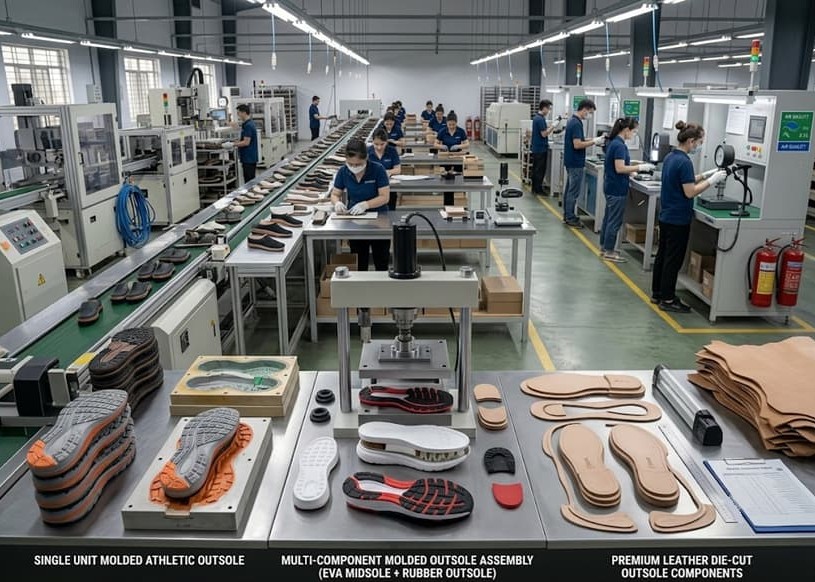
Machine selection directly influences productivity, consistency, and bonding quality. Small factories often rely on manual roughing equipment, whereas large-scale footwear manufacturers increasingly adopt automated systems that deliver repeatable results with minimal operator variation.
Emery Wheel Roughing Machines
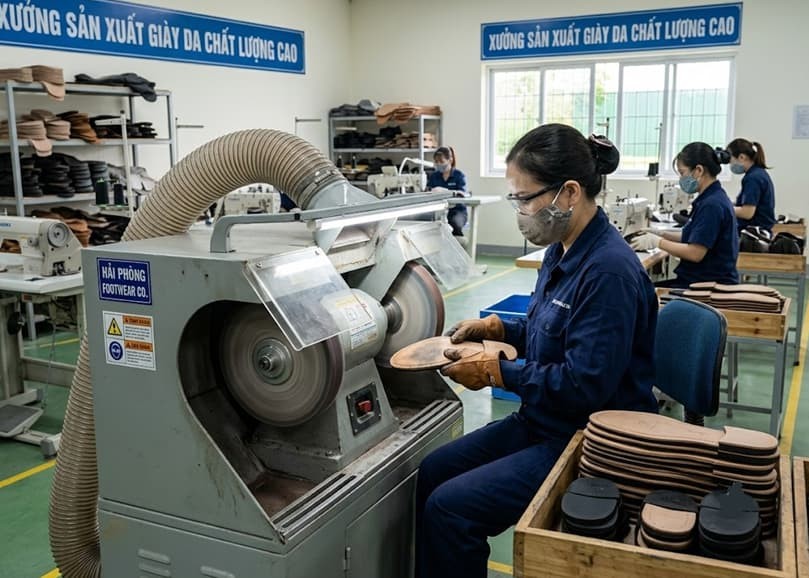
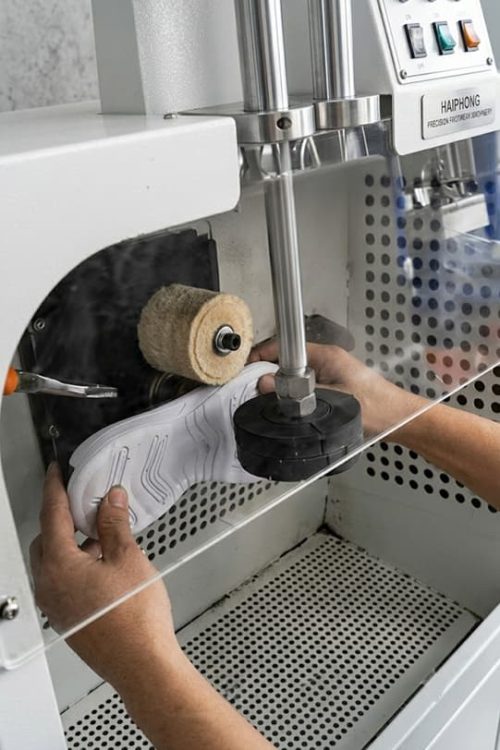
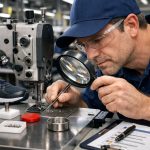
The emery wheel roughing machine remains the most widely used equipment in footwear factories. An electric motor rotates an abrasive wheel at controlled speed while the operator manually guides the outsole against the abrasive surface.
Different abrasive wheels are selected according to material type, required roughness, and production volume. Wheels are replaced regularly because worn abrasives reduce cutting efficiency and generate excessive heat. Modern machines also incorporate dust extraction systems, adjustable work rests, LED lighting, and variable-speed controls to improve operator safety and process consistency.
Advantages
- Suitable for multiple outsole materials
- Low investment cost
- Easy abrasive replacement
- Flexible for small production batches
- High operator control
Limitations
- Operator skill greatly influences quality
- Lower production speed
- Variation between operators
- Requires frequent wheel dressing
Expert Tip: Validate roughing parameters separately for leather, EVA, TPU, TPR, rubber, and crepe instead of using one setting for every material.

Metal Brush Machines
Metal brush roughing machines use rotating steel wire brushes instead of abrasive wheels. Rather than aggressively removing material, they clean, activate, and lightly roughen the bonding surface. These machines are commonly used for softer materials, light surface preparation, or as a secondary operation after emery wheel roughing.
The rotating brush removes loose fibers, oxidation, dust, and minor contaminants while producing a more uniform surface texture. Because the operation generates less heat than abrasive wheels, it is particularly suitable for delicate materials.
Advantages
- Lower risk of over-roughing
- Produces consistent surface cleaning
- Less heat generation
- Longer tool life than abrasive wheels
Limitations
- Not suitable for heavy material removal
- Lower cutting capability on hard compounds
- Requires periodic brush replacement
Expert Tip: Dress abrasive wheels regularly to maintain cutting efficiency and reduce heat generation.
Automatic Roughing Machines
Modern footwear factories increasingly use CNC and robotic roughing systems to improve consistency and reduce operator dependency.
These machines follow programmed tool paths, ensuring every outsole receives identical surface preparation regardless of production shift.
Automatic systems are particularly valuable for sports footwear, safety shoes, and premium leather shoes where adhesive performance must remain highly consistent across thousands of pairs. Integrated vision systems, automatic depth adjustment, dust extraction, and programmable recipes further improve repeatability while reducing rework and material waste.
Advantages
- High production capacity
- Excellent process consistency
- Reduced operator variation
- Lower rejection rates
- Suitable for complex outsole profiles
Limitations
- Higher investment cost
- Requires skilled programming
- Regular preventive maintenance is essential
Expert Tip: Measure peel strength whenever a new abrasive specification or supplier is introduced.

Common Roughing and Buffing Defects
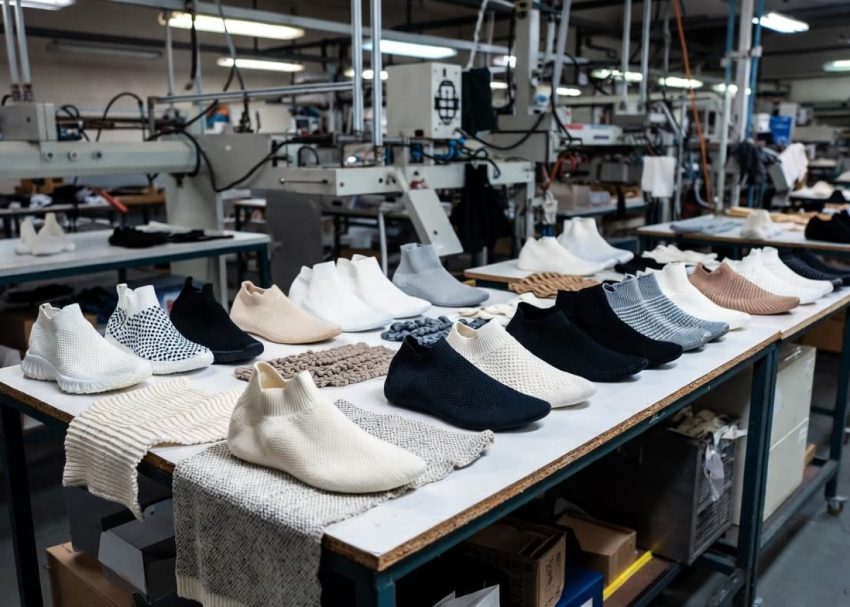
Even a minor variation during roughing can reduce adhesive performance. Therefore, routine inspection and process monitoring are essential before chemical washing and cement application.
Insufficient Roughing
Incomplete surface preparation leaves smooth areas where adhesive cannot achieve adequate mechanical anchorage. Bond failure often begins at these locations during flexing or peel testing.
Corrective Actions
- Increase surface coverage.
- Replace worn abrasive wheels.
- Verify operator technique.
- Inspect under proper lighting.
Over-Roughing
Excessive abrasion removes unnecessary material, weakens the component, and may expose internal layers or reinforcement materials.
Corrective Actions
- Reduce wheel pressure.
- Standardize roughing depth.
- Train operators regularly.
- Monitor material thickness.
Expert Tip: Never leave roughed components exposed for long periods before chemical washing, as dust and oxidation can reduce bonding performance.
Burn Marks
High wheel speed, excessive pressure, or dull abrasives generate frictional heat that burns leather or melts thermoplastic materials. Burned surfaces generally show poor adhesive bonding.
Corrective Actions
- Replace dull abrasive wheels.
- Reduce contact pressure.
- Maintain correct machine speed.
- Allow adequate cooling.
Surface Contamination
Dust, loose particles, oils, or fingerprints remaining after roughing reduce adhesive wetting and bond strength.
Corrective Actions
- Vacuum or air-clean every component.
- Store prepared parts in clean containers.
- Minimize handling before washing.
- Maintain housekeeping around roughing machines.
Expert Tip: Record abrasive wheel life and replacement intervals as part of preventive maintenance.


Critical Process Control Points
A controlled roughing process produces repeatable adhesive performance throughout mass production. Most leading footwear manufacturers include the following checkpoints in their standard operating procedures.
| Control Point | Quality Requirement |
|---|---|
| Roughing depth | Uniform without excessive material removal |
| Surface coverage | 100% bonding area prepared |
| Cleanliness | Completely free from dust and loose particles |
| Tool condition | Sharp abrasive wheels or brushes |
| Machine speed | Validated for each material |
| Operator inspection | Visual confirmation before next process |
Expert Tip: Calibrate automatic roughing machines during every new production style to ensure consistent roughing depth.

Conclusion
Roughing and buffing are among the most influential operations in outsole assembly because they establish the foundation for durable adhesive bonding. Proper surface preparation increases mechanical anchorage, removes contaminants, and exposes fresh material that allows adhesives to perform as intended.
Whether the factory processes leather, rubber, EVA, TPU, TPR, or crepe, consistent roughing depth, complete surface coverage, clean working conditions, and well-maintained equipment remain essential quality requirements.
When these controls are standardized, manufacturers achieve stronger bonds, fewer delamination failures, and more consistent production quality.
In the next blog of the Outsole (Stock Fitting) Assembly Series, we will explore Chemical Washing Operations in Outsole Process, where properly roughed surfaces are chemically cleaned and activated before primer and adhesive application.
Frequently Asked Questions (FAQs)
It removes the smooth surface layer and creates microscopic irregularities that improve adhesive penetration and mechanical bonding.
Leather, rubber, EVA, TPU, TPR, and crepe are among the most common materials requiring surface preparation.
Smooth areas remain on the bonding surface, reducing adhesive strength and increasing the risk of outsole separation.
Yes. Excessive abrasion removes unnecessary material, weakens components, and may reduce bond consistency.
Residual dust acts as a barrier between the adhesive and the substrate, reducing bond strength.
The emery wheel roughing machine remains the most widely used equipment due to its versatility and relatively low investment cost.
Chemical washing removes remaining dust and activates the prepared surface before primer and cement application.
Posts you make Like
Troubleshooting Adhesive Bond Failures in Footwear Manufacturing…