Stock Fitting Assembly and Outsole Finishing Operations
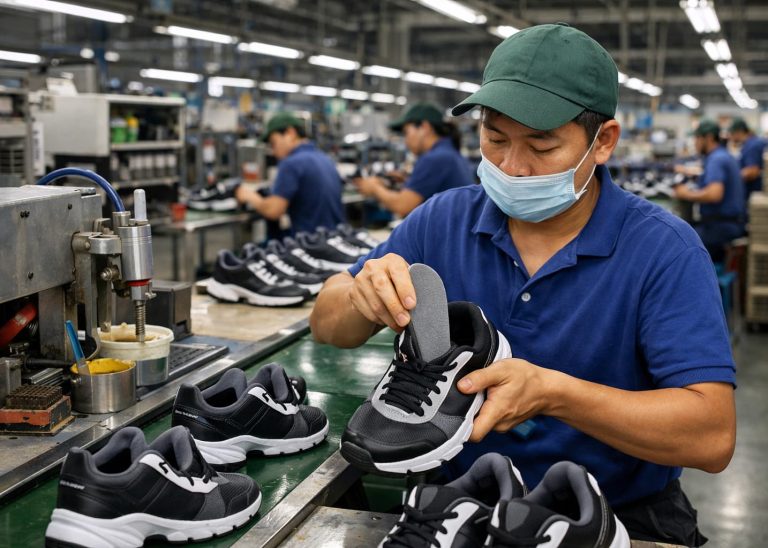
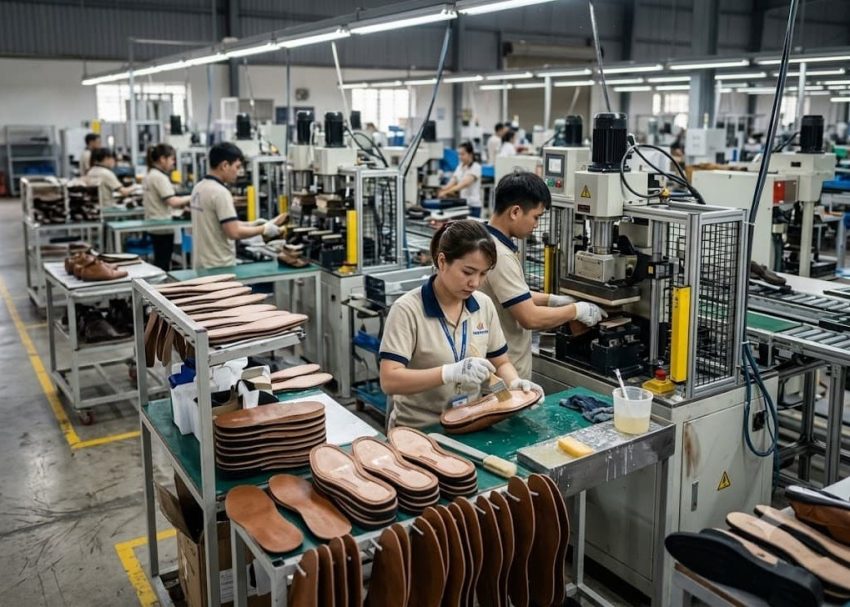
After all outsole components have been prepared, inspected, treated, decorated, and conditioned, they move into the Stock Fitting Assembly area. This department is responsible for converting individual outsole components into a complete outsole package ready for shoe assembly.
The quality achieved during stock fitting directly affects bonding performance, dimensional stability, durability, appearance, and overall product quality. Consequently, many footwear factories consider stock fitting one of the most critical stages in outsole manufacturing.
Although the exact process varies depending on construction type and materials, the following operations represent the most common stock fitting activities used throughout the footwear industry.

Kitting Operations
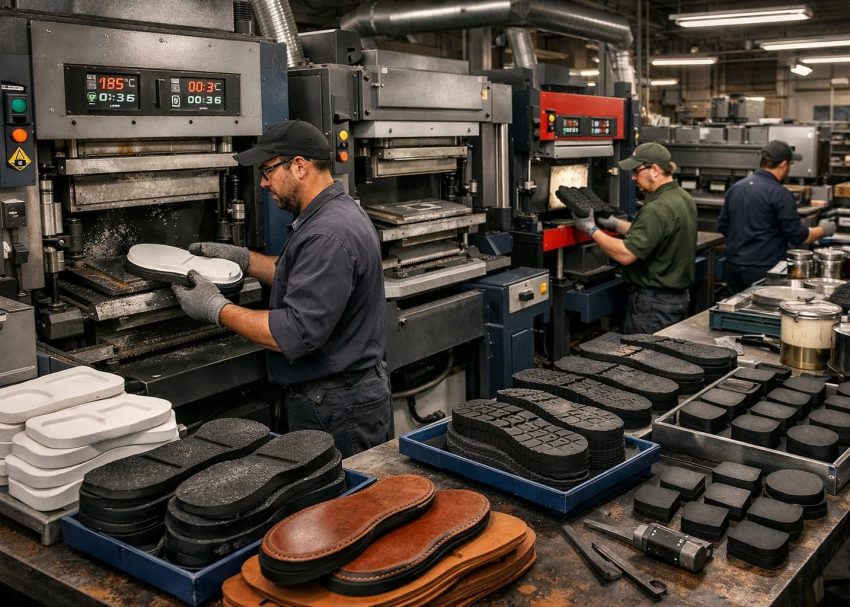
Before assembly can begin, all outsole components must be organized according to production requirements. This activity is known as kitting.
Kitting ensures that every assembly operator receives the correct components in the correct size and quantity. Since outsole assemblies may contain multiple components such as midsoles, outsoles, heels, wedges, shanks, inserts, and welts, proper kitting prevents assembly errors and production interruptions.
Modern footwear factories often perform kitting according to purchase order size ratios to support lean production flow.
Typical Components Included
- Outsole & Midsole
- Heel
- Shank
- Welt & Wedge
- Decorative inserts
Benefits
- Improved productivity
- Reduced assembly errors
- Better material control
- Faster line feeding
Key Control Points
- Size verification
- Component completeness
- Ratio accuracy
- PO identification
Expert Tip: Validate bonding systems before bulk production.
Feeding to Assembly Line
Once kits are prepared, they are transferred to the assembly line. In traditional factories, materials were often moved in large batches. However, lean manufacturing systems now promote smaller quantities and continuous flow.
Components are normally transported using carts, trolleys, racks, or specialized feeding systems designed to support efficient production. Each kit contains all components required to assemble one outsole pair. Feeding Methods are Trolleys, Flow racks, Assembly Carts, Lean Feeding Systems.
Key Control Points
- Correct sequence
- Material protection
- FIFO compliance
- Production traceability
Pro Tip: Monitor adhesive viscosity every shift.

Priming Operations
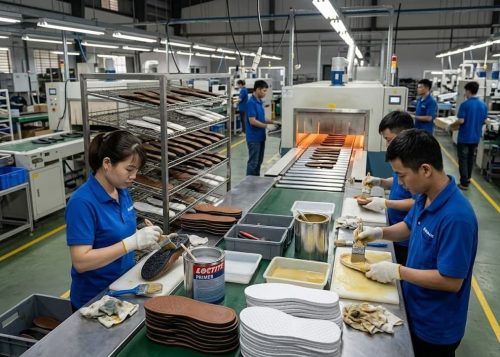
Many outsole materials require primers before adhesive application. Primers improve surface compatibility and create stronger chemical bonds between materials and adhesives.
The primer selected depends entirely on material type. A primer suitable for rubber may be ineffective for TPU or EVA. Therefore, footwear manufacturers validate primer systems during product development and bonding trials.
Benefits
- Improved adhesion
- Enhanced bond durability
- Better surface activation
- Reduced bond failure
Key Control Points
- Correct primer selection
- Uniform application
- Drying conditions
- Shelf-life monitoring
Expert Tip: Maintain strict open-time discipline.
Primary Cement Coating
Following primer application, the first adhesive coating is applied. This layer establishes the foundation for bonding and helps create an effective adhesive film on the component surface.
The adhesive selected depends on the materials being joined. Modern footwear manufacturing commonly uses solvent-based, water-based, or specialized reactive adhesive systems. Consistency is critical because uneven adhesive application can create weak bonding areas.
Common Adhesive Types
- PU Adhesive
- Neoprene Adhesive
- Water-Based Adhesive
- Reactive Adhesive Systems
Common Defects
- Insufficient coating
- Excess coating
- Contamination
- Uneven coverage
Key Control Points
- Coating thickness
- Application consistency
- Adhesive viscosity
- Environmental conditions
Pro Tip: Calibrate tunnel dryer temperatures regularly.


Secondary Cement Coating
Many outsole constructions require a second adhesive coat to achieve optimal bond strength. The second coating increases adhesive film thickness and improves bonding reliability, particularly for difficult materials and demanding applications.
Proper drying between coats is essential. Applying a second coat too early may trap solvents, while excessive drying may reduce bonding effectiveness. Benefits are – Increased bond strength, Improved durability, Better surface coverage, Enhanced bonding reliability
Key Control Points
- Inter-coat drying
- Adhesive thickness
- Coverage consistency
- Process timing
Pro Tip: Inspect pressing molds for wear.

Drying and Activation
After adhesive application, the components must be dried and activated before assembly. Drying removes solvents or moisture from the adhesive system. Activation restores adhesive tackiness and prepares the surfaces for bonding.
Modern footwear factories commonly use conveyorized tunnel dryers with precisely controlled temperatures and conveyor speeds. The required temperature depends on both the adhesive system and material type. Consequently, outsole and upper materials often require different activation temperatures.
Equipment Used
- Short Activator
- Infrared Activator
- Tunnel Dryer
- Conveyorized Oven
Common Defects
- Under-activation
- Overheating
- Incomplete drying
- Bonding failure
Key Control Points
- Temperature control
- Conveyor speed
- Dwell time
- Activation consistency
Pro Tip: Verify UV treatment expiry before assembly.
Outsole Attaching
Outsole attaching is the operation where prepared components are joined together. This operation frequently relies on highly skilled operators because alignment accuracy directly affects product appearance and performance. The most critical factor is maintaining the specified open time. Once activation is completed, assembly must occur within the approved timeframe to ensure maximum bond strength.
In many factories, attachment occurs within 30 to 60 seconds after activation. Common challenges are Alignment accuracy, Open time compliance, Material positioning, Appearance consistency.
Key Control Points
- Heel alignment
- Toe alignment
- Open time monitoring
- Bonding surface contact
Pro Tip: Use separate cleaning materials for different outsole colors.
Posts you make Like

Troubleshooting Adhesive Bond Failures in Footwear Manufacturing…
Outsole Pressing
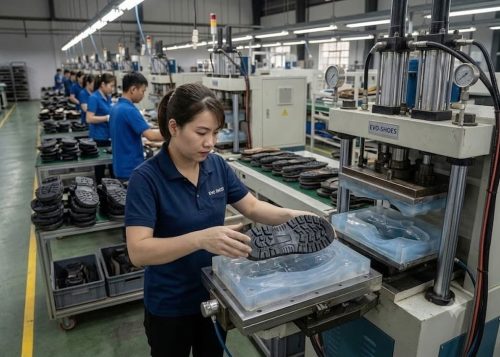
Immediately after attachment, the outsole assembly enters the pressing operation. Pressing applies pressure to maximize contact between adhesive layers and eliminate trapped air.
Different outsole constructions require different pressing technologies. Therefore, footwear factories typically operate multiple sole pressing machines. Proper pressure, time, and tooling selection are essential for achieving durable bonds.
Machines Used
- Hydraulic Sole Press
- Pneumatic Sole Press
- Side Press Machine
- Universal Sole Press
Common Defects
- Incomplete bonding
- Air pockets
- Poor pressure distribution
- Sole separation
Key Control Points
- Pressure setting
- Pressing time
- Mold suitability
- Tooling condition
Pro Tip: Maintain traceability from component receipt to packing.
Chilling Operations
Many adhesive systems involve heat activation. Consequently, components often remain warm after pressing. Chilling stabilizes the assembly by rapidly reducing temperature and helping the adhesive achieve final strength.
Most high-volume factories use tunnel chilling systems with controlled dwell times and temperatures. This operation improves dimensional stability and reduces handling-related bonding issues.
Equipment Used
- Tunnel Chiller
- Conveyor Chiller
- Cooling Chamber
Benefits
- Faster bond stabilization
- Improved dimensional control
- Reduced distortion
- Enhanced production flow
Key Control Points
- Temperature control
- Exposure time
- Conveyor speed
- Product spacing
Pro Tip: Conduct periodic bond strength testing.
Stage Inspection II – Assembly Inspection
Before moving to finishing operations, assembled outsoles undergo a detailed inspection. Inspectors verify alignment, bonding quality, appearance, dimensions, and workmanship. Detecting issues at this stage prevents defective products from entering the finishing department.
Inspection criteria area alignment, bonding quality, Appearance, dimensions, Traceability.
Key Control Points
- Inspection standards
- Sampling frequency
- Defect classification
- Documentation
Pro Tip: Implement preventive maintenance for critical assembly machines.
Heel Nailing
Heel nailing is primarily used in dress footwear, formal footwear, and high-heel constructions. Specialized machines drive buttress nails through the outsole and into the heel structure, creating additional mechanical reinforcement.
Although adhesives provide substantial bonding strength, heel nailing offers additional security and durability. Machines used are Automatic Heel Nailing Mahcine, Buttress Nailing Machine.
Key Control Points
- Nail position
- Nail penetration
- Heel alignment
- Holding strength
Edge Scouring
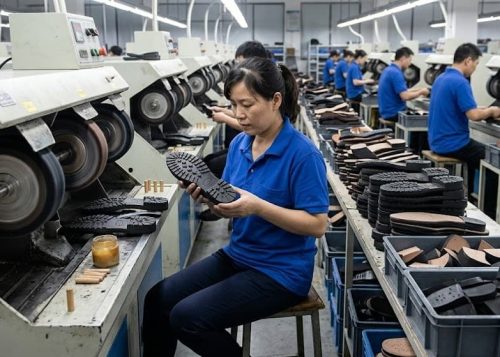
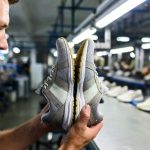
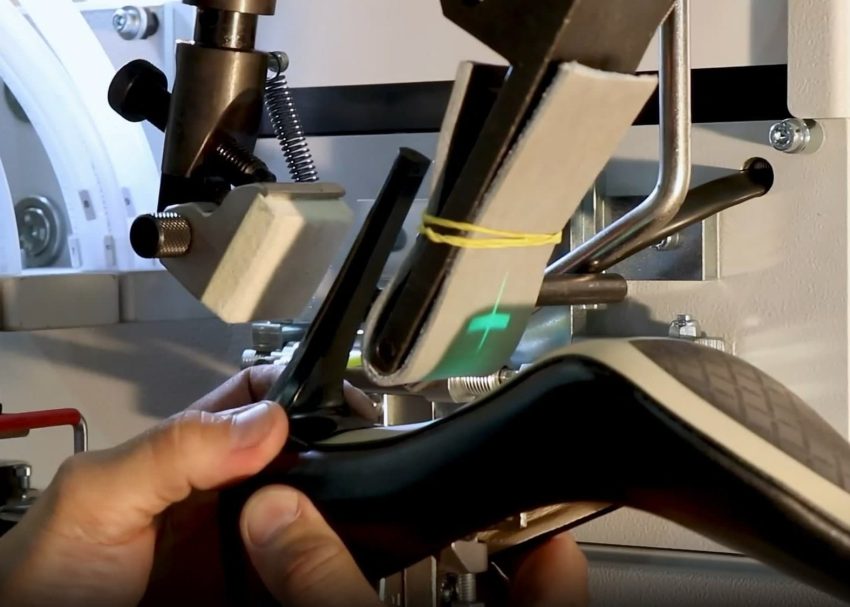
Edge scouring is one of the most important finishing operations for premium outsoles. The process removes unevenness, improves smoothness, and prepares the outsole edge for coloring and polishing. Scouring typically occurs in three stages.
Rough Scouring
- Removes major unevenness
- Eliminates trimming marks
- Levels outsole edges
Medium Scouring
- Smooths edge surfaces
- Refines contour accuracy
- Reduces roughness
Fine Scouring
- Creates premium finish
- Improves surface quality
- Enhances edge appearance
Key Control Points
- Grit selection
- Surface temperature
- Edge uniformity
- Burn prevention
Filler Application
Fillers are applied to eliminate minor imperfections and create a smoother edge profile. The operation often occurs before and between scouring stages. Without fillers, excessive friction during finishing may create burn marks or visible imperfections.
Types of Fillers
- Natural filler
- Colored filler
- Wax-based filler
Benefits
- Improved smoothness
- Reduced imperfections
- Better finishing quality
- Enhanced appearance
Key Control Points
- Filler compatibility
- Application consistency
- Drying quality
- Surface smoothness
Edge Coloring and Waxing
Edge coloring gives the outsole its final visual identity. Specialized edge inks, pigments, and coloring systems are used to achieve the required appearance. Waxes further enhance the finish by sealing the edge and increasing luster.
This operation is particularly important in premium leather footwear where edge quality strongly influences customer perception. Materials used are Edge Inks, Pigments, Waxes, Specialty finishes.
Key Control Points
- Color consistency
- Coverage quality
- Drying control
- Shine uniformity
Padding Operations
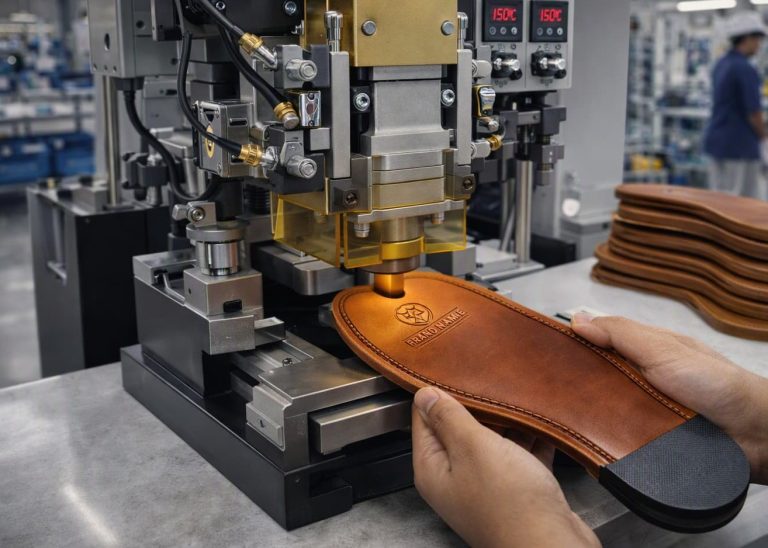
Padding is performed using leather wheels, felt wheels, or cotton wheels. The operation compresses and seals the edge surface while producing a refined appearance. Padding is often considered a signature finishing operation in premium leather outsole manufacturing.
Materials Used
- Leather strips
- Hard felt wheels
- Cotton wheels
Benefits
- Edge sealing
- Surface refinement
- Premium appearance
- Enhanced smoothness
Key Control Points
- Wheel condition
- Pressure control
- Surface quality
- Consistency
Brushing and Polishing
Brushing and polishing create the final aesthetic effect required by the product, especially for Leather Outsoles. Different brush materials produce different finishing characteristics. Luxury footwear which is ideally made using Leather bends frequently undergoes multiple brushing and polishing stages before approval.
Brush Types
- Horsehair
- Cotton
- Wool
Benefits
- Increased luster
- Rich appearance
- Enhanced color depth
- Premium finish
Key Control Points
- Brush condition
- Surface temperature
- Shine consistency
- Appearance approval
Repairing and Cleaning
Before final inspection, every outsole undergoes cleaning and repair activities. Operators remove excess adhesive, stains, dirt, handling marks, and other appearance defects. This operation helps ensure the product meets customer quality expectations. Cleaning Materials used are Mild cleaners, Crepe rubber, Rubber Blocks & Specialized cleaning agents.
Key Control Points
- Stain removal
- Surface protection
- Appearance consistency
- Material compatibility
Final Inspection
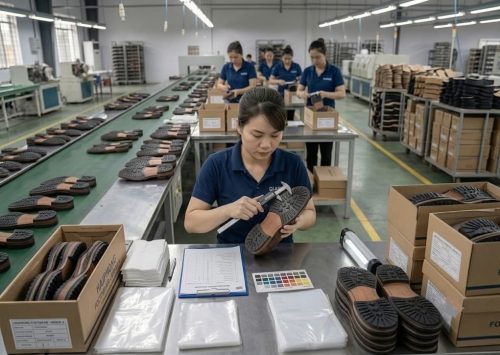
Final inspection represents the last quality gate before packing. Inspectors verify every critical specification to ensure compliance with customer standards.
Inspection results often determine shipment approval. Inspection Tools required area Inner cavity templates, Heel height gauges, Toe Spring gauges, Logo verification standards & Measurement charts.
Key Control Points
- Specification compliance
- Appearance quality
- Functional requirements
- Documentation accuracy
Packing Operations
Proper packing protects the finished outsole during storage and transportation. Different outsole materials require different protection methods. The objective is to ensure products reach shoe assembly operations without damage. Packaging Materials used are Polybags, Protective paper, Partition boards, Cartons.
Key Control Points
- Material protection
- Size identification
- Quantity accuracy
- Transit safety
Conclusion
Outsole manufacturing is far more complex than simply producing the bottom part of a shoe. It involves numerous preparation, assembly, finishing, and inspection operations that collectively determine product durability, appearance, comfort, and performance.
Although every footwear factory follows its own process flow depending on construction type, materials, and customer requirements, the fundamental objective remains the same: produce a high-quality outsole assembly that consistently meets specification requirements while supporting efficient manufacturing.
Throughout this Outsole (Stock Fitting) Assembly Series, we will explore each operation individually, including machinery, process parameters, common defects, troubleshooting methods, quality controls, and best practices used by leading footwear manufacturers worldwide.
This concludes the Full Outsole Manufacturing Overview. Next Blog: Components Receipt & Incoming Inspection in Outsole Manufacturing – Building Quality from the First Material Received.
Frequently Asked Questions (FAQs)
What is stock fitting in footwear manufacturing?
Stock fitting is the process of assembling outsole components such as midsoles, heels, shanks, wedges, and outsoles before shoe assembly.
Why is roughing important?
Roughing increases surface area and improves adhesive bonding performance.
Why is UV treatment used for EVA?
UV treatment increases surface energy and improves adhesive compatibility.
What is open time during outsole assembly?
Open time is the allowable period between activation and attachment for effective bonding.
Why is chilling required after pressing?
Chilling stabilizes the bond and reduces distortion caused by heat activation.
What is the purpose of edge scouring?
Edge scouring smooths outsole edges and prepares them for finishing operations.
Which operation most affects bond strength?
Surface preparation, priming, adhesive application, activation, and pressing collectively determine bond strength.