Splitting and Levelling in Outsole Process: Outsole (Stock Fitting) Assembly Series
In the previous article, Cutting Operations in Outsole Process: Outsole (Stock Fitting) Assembly Series, we discussed how leather bends are accurately cut into outsole blanks while maximizing material utilization and maintaining grain direction. Although cutting produces correctly shaped components, the leather thickness often remains inconsistent because natural hides vary across different areas.
Therefore, the next manufacturing stage focuses on splitting and levelling. These two operations create a uniform leather thickness before the outsole proceeds to snuffing, finishing, and assembly. Consistent thickness improves moulding quality, adhesive bonding, dimensional accuracy, and the overall appearance of the finished footwear.
Modern footwear factories rely on precision band knife splitting and levelling machines capable of removing very small amounts of leather while maintaining excellent dimensional consistency. Combined with routine inspection and machine calibration, these processes help manufacturers reduce variation, improve productivity, and achieve consistent product quality.
This article explains the complete splitting and levelling process, the machines involved, quality requirements, common defects, and best manufacturing practices used in today’s footwear industry.
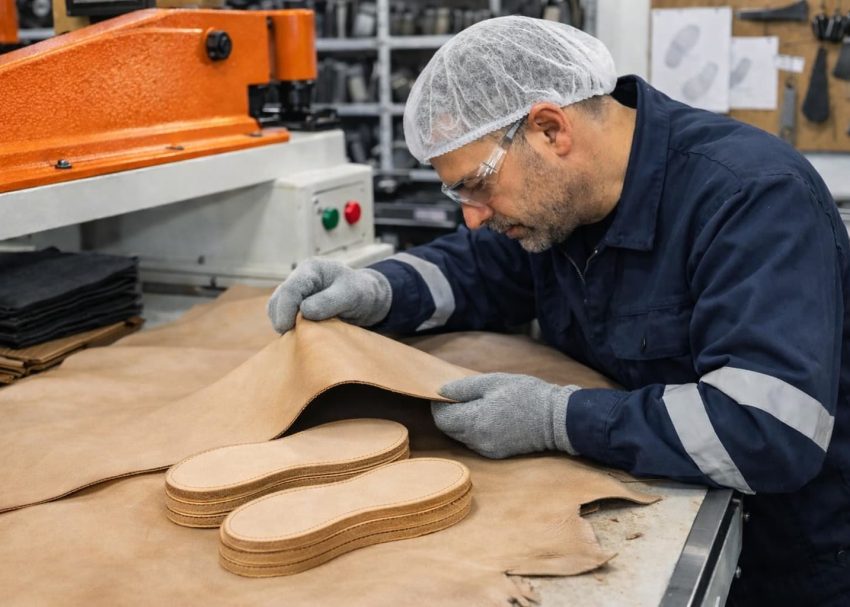
Why Splitting and Levelling Are Essential
Unlike synthetic materials, leather is a natural product. Every hide develops differently during the animal’s life, resulting in variations in fibre density and thickness. Even after tanning, leather bends rarely maintain the same thickness from heel to toe or from one edge to another.
If these variations remain unchanged, several downstream manufacturing problems may occur. Adhesive pressure becomes uneven, moulding quality decreases, outsole fitting becomes inconsistent, and cosmetic defects become more noticeable after finishing. Splitting and levelling eliminate these variations by producing outsole blanks with a controlled and consistent thickness.
As a result, every subsequent manufacturing process becomes easier to control, while product quality improves significantly.
The primary objectives are to:
- Achieve uniform leather thickness.
- Improve bonding performance.
- Enhance assembly accuracy.
- Reduce production variation.
- Improve finished appearance.
- Minimize material rejection.
By establishing a consistent material profile at an early stage, manufacturers reduce costly adjustments later in production.
Expert Tip: Split leather from the flesh side to protect the grain surface.
Leather Thickness Variation
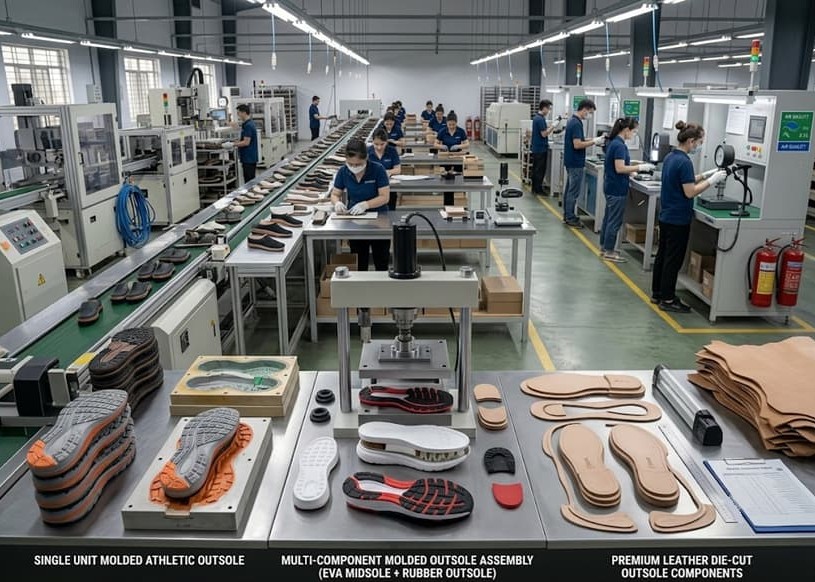
Leather thickness varies naturally because different areas of the hide perform different biological functions during the animal’s growth. Some sections contain denser fibre structures, while others are softer or more elastic. Stretching during tanning, moisture absorption, and storage conditions can also influence thickness.
For outsole manufacturing, these differences may appear small, but even minor variations can affect product performance. An outsole that is thicker on one side than the other may create assembly mismatches or uneven bonding pressure.
Factories therefore inspect incoming leather before production begins. Hides with excessive variation, severe defects, or poor fibre quality are separated or rejected according to customer specifications.
Good production planning also groups leather bends with similar thickness ranges, reducing machine adjustments and improving process consistency.
Key Control Points
- Inspect incoming leather before production.
- Separate hides by thickness range.
- Reject severely damaged material.
- Record average thickness for process planning.
Expert Tip: Acclimatize leather to the factory environment before processing.
Splitting Process
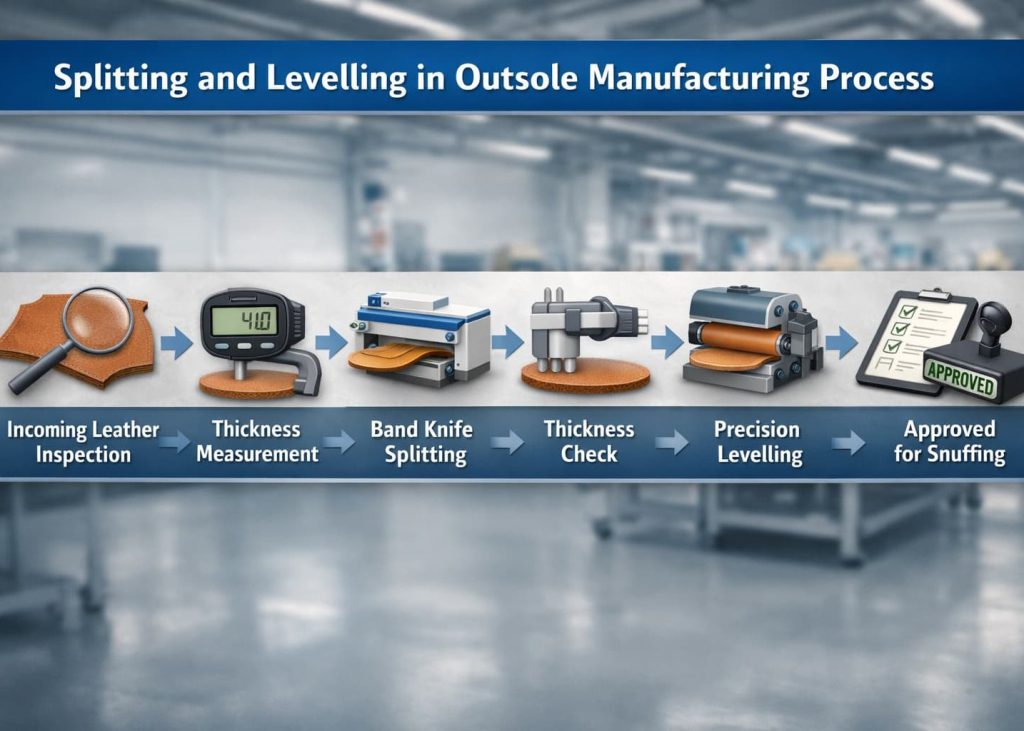
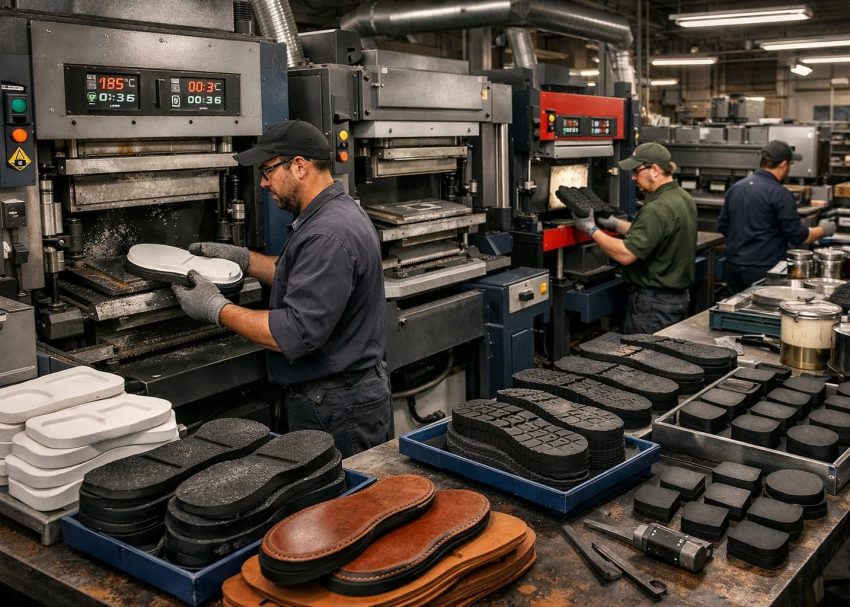
Splitting is the controlled removal of excess leather from the flesh side of the outsole component until the required thickness is achieved. The operation maintains the grain surface while reducing the material to a precise dimension.
The process begins by reviewing the production specification and setting the required finished thickness on the machine. The operator checks blade condition, feed roller pressure, and machine calibration before production starts.
Once the setup is approved, the outsole blank enters the feed rollers. A continuously rotating band knife removes a thin layer of leather while the rollers maintain a stable feed speed. The removed leather exits separately, and the processed outsole moves to thickness inspection.
Proper splitting provides several advantages:
- Consistent material thickness
- Improved moulding performance
- Better adhesive contact
- Reduced assembly variation
- Improved dimensional stability
- Higher production efficiency
Key Control Points
- Measure thickness at scheduled intervals.
- Confirm target thickness before production.
- Feed leather smoothly without twisting.
- Monitor blade sharpness regularly.
Expert Tip: Replace dull blades before surface quality deteriorates.
Levelling Process
Although splitting removes most thickness variation, slight inconsistencies may still remain because of natural fibre density differences. Levelling performs the final correction by creating a highly uniform thickness across the entire outsole. Unlike splitting, levelling removes only a minimal amount of material. Its primary purpose is to eliminate localized high spots and produce a flat, consistent component ready for finishing and assembly.
Before levelling begins, operators inspect each outsole for knife marks, edge damage, or other visible defects. Components that fail inspection are removed before additional processing.
After levelling, inspectors measure the outsole at multiple locations, including the toe, ball, waist, heel, medial edge, and lateral edge. This inspection confirms that thickness remains consistent throughout the component rather than only at the centre.
A well-levelled outsole offers several manufacturing benefits:
- Uniform bonding surface
- Improved finishing quality
- Better moulding consistency
- Enhanced dimensional accuracy
- Reduced assembly adjustments
- Improved product appearance
Key Control Points
- Verify machine calibration daily.
- Check thickness at multiple locations.
- Maintain stable feed speed.
- Remove defective components immediately.
Expert Tip: Standardize machine setup sheets for every leather grade.

Machines Used
Modern footwear factories use precision equipment to achieve accurate leather thickness while maintaining high production efficiency.
Band Knife Splitting Machine
The band knife splitting machine is the primary machine used to remove excess leather. It uses a continuously rotating steel blade that slices material from the flesh side while feed rollers move the outsole through the cutting zone.
Major components include-Endless band knife, Feed rollers, Pressure rollers, Thickness adjustment mechanism, Blade sharpening system, Safety guards, Waste collection system. The machine delivers excellent repeatability, making it suitable for both medium- and high-volume footwear production.
Precision Levelling Machine
After splitting, the levelling machine performs the final thickness correction. It removes minor irregularities and produces a consistently flat outsole surface, improving bonding quality and assembly accuracy.
Modern machines feature precise adjustment mechanisms, stable feeding systems, and improved safety features that help maintain production consistency.
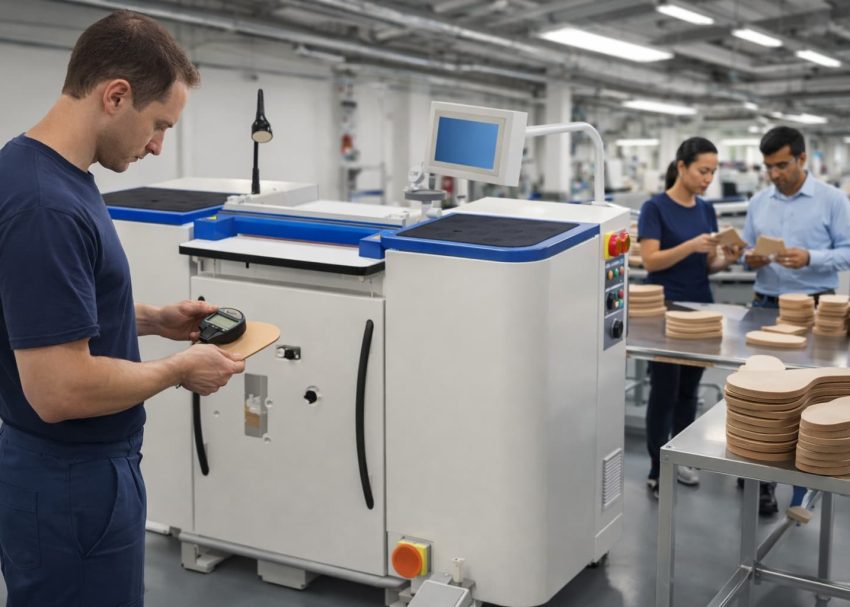
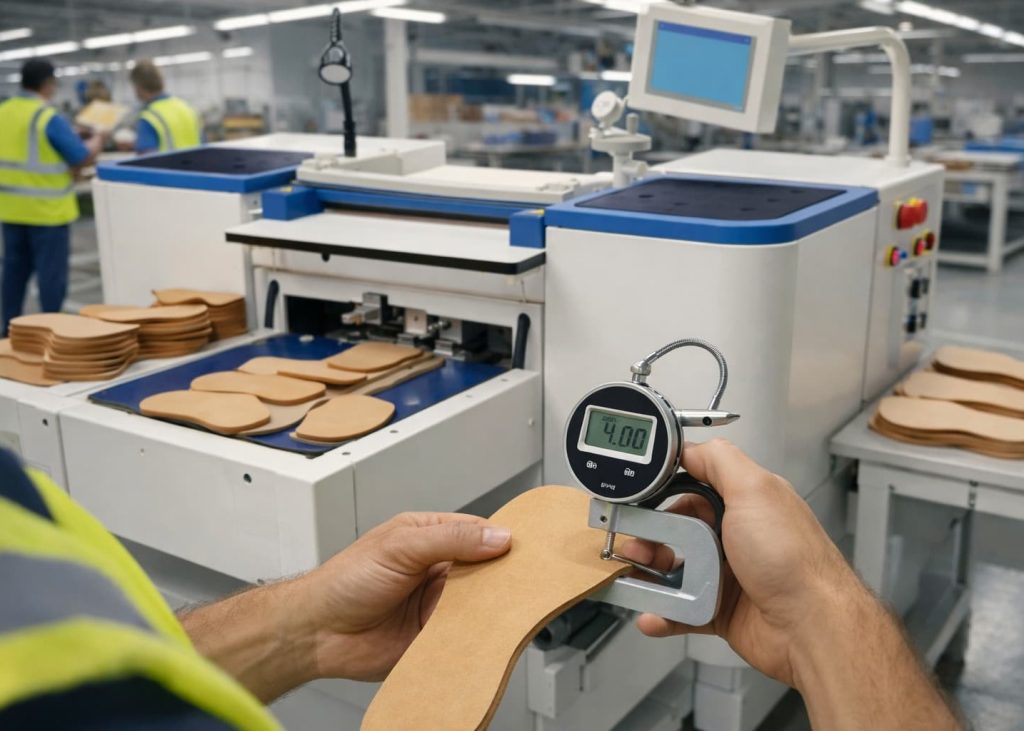
Thickness Gauge
A calibrated thickness gauge is an essential quality control instrument. Operators use it before splitting, after splitting, after levelling, and during routine production checks.
Measurements should always be taken at several locations rather than a single point to ensure complete thickness consistency throughout the outsole.
Pro Tip: Measure thickness at multiple locations rather than only the centre.
Machine Setup and Process Control
Correct machine setup determines the success of splitting and levelling operations. Before production begins, operators should verify: Finished thickness specification, Blade sharpness, Blade alignment, Feed roller pressure, Machine calibration, Feed speed, Leather condition.
Throughout production, routine inspections help identify machine drift before defects develop. Recording machine settings for each leather grade also reduces setup time during future production runs and improves repeatability.
Pro Tip: Use Statistical Process Control (SPC) charts to monitor thickness trends and detect variation early.

Benefits of Splitting and Levelling
Splitting and levelling are preparation processes, but their impact extends throughout the entire outsole manufacturing workflow. Producing leather outsole blanks with a consistent thickness enables factories to standardize machine settings, reduce production variation, and improve product quality.
Consistent Thickness
Uniform leather thickness is the primary objective of these operations. Standardized thickness allows each outsole to behave consistently during snuffing, cementing, finishing, and final assembly.
Improved Bonding Performance
A level bonding surface ensures that adhesives spread evenly and receive uniform pressure during sole attachment. This improves bond strength and reduces the risk of sole separation.
Better Assembly Accuracy
Outsoles with consistent thickness fit more accurately with insoles, midsoles, and uppers. Consequently, assembly operators spend less time making manual adjustments, improving productivity.
Enhanced Product Appearance
Uniform leather thickness creates smoother edges, cleaner finishing, and a more premium appearance after polishing and edge treatment.
Reduced Material Waste
Stable processes reduce rework, component rejection, and unnecessary leather consumption, lowering overall production costs.
Pro Tip: Inspect blade sharpness at the start of every shift.

Common Defects and Their Prevention
Although splitting and levelling are highly controlled processes, defects may still occur because of incorrect machine settings, worn blades, inconsistent feeding, or poor material quality. Early detection and corrective action prevent defective components from progressing to the next manufacturing stage.
Knife Marks
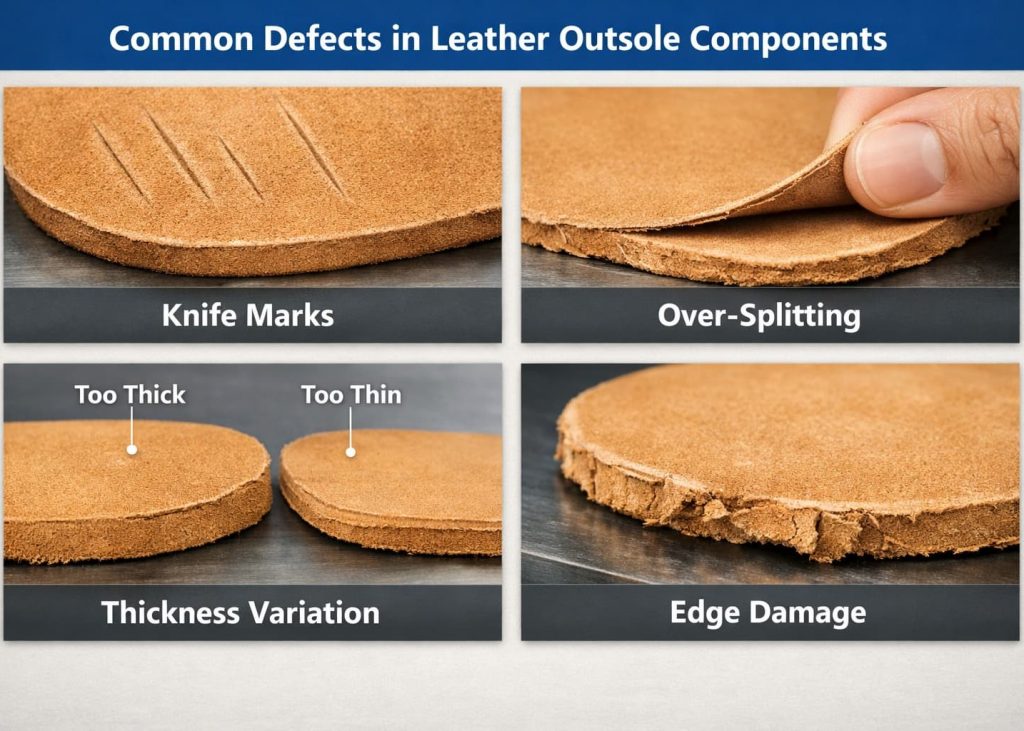
Knife marks appear as visible grooves or scratches caused by dull blades, poor blade alignment, or unstable feeding.
Possible Causes
- Dull band knife
- Incorrect blade tension
- Uneven feeding
- Roller contamination
Corrective Actions
- Replace or sharpen the blade.
- Verify blade alignment.
- Clean feed rollers regularly.
- Maintain a constant feed speed.
Over-Splitting
Over-splitting occurs when excessive material is removed, resulting in leather that is thinner than specification. Because structural strength is reduced, these components are generally rejected.
Possible Causes
- Incorrect thickness setting
- Calibration error
- Operator setup mistake
Corrective Actions
- Verify specifications before production.
- Perform first-piece approval.
- Measure thickness frequently.
- Lock approved machine settings.
Pro Tip: Standardize machine settings for each leather grade.
Thickness Variation
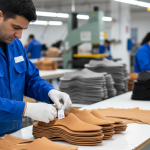
Uneven thickness across the outsole can affect moulding, bonding, and assembly quality.
Possible Causes
- Uneven leather density
- Roller slippage
- Incorrect feed speed
- Poor calibration
Corrective Actions
- Calibrate machines routinely.
- Replace worn rollers.
- Group leather according to thickness.
- Increase in-process inspections.
Edge Damage
Edge damage includes tearing, crushing, or irregular edges caused by poor feeding or worn machine components.
Possible Causes
- Incorrect feeding angle
- Dull blade
- Excessive roller pressure
- Damaged guide plates
Corrective Actions
- Feed leather correctly.
- Maintain blade sharpness.
- Inspect guide plates.
- Handle leather carefully during transport.
Pro Tip: Store leather under controlled temperature and humidity.
Posts you make Like
Troubleshooting Adhesive Bond Failures in Footwear Manufacturing…
Quality Control and Inspection
Effective quality control begins before splitting and continues until every outsole component is approved for the next manufacturing process.
Incoming Inspection
Inspect incoming leather for:
- Thickness variation
- Surface defects
- Fibre quality
- Moisture condition
- Leather grade
First-Piece Inspection
After machine setup, verify:
- Thickness
- Surface quality
- Edge condition
- Dimensional accuracy
Production should begin only after approval.
In-Process Inspection
Measure thickness at multiple locations throughout production using a calibrated thickness gauge. Sampling frequency should follow factory quality standards or customer requirements.
Final Inspection
Before transferring components to the next process, inspectors verify:
- Final thickness
- Surface finish
- Edge quality
- Cleanliness
- Specification compliance
Key Control Points
- Calibrate gauges regularly.
- Record inspection results.
- Use Statistical Process Control (SPC) where applicable.
- Investigate recurring defects promptly.
Pro Tip: Replace worn rollers before they affect feeding consistency.
Safety Practices
Band knife splitting machines operate with continuously moving blades. Therefore, strict safety procedures are essential. Follow these best practices:
- Wear cut-resistant gloves when handling blades.
- Never bypass machine safety guards.
- Test emergency stop buttons daily.
- Disconnect power before maintenance.
- Follow Lockout/Tagout (LOTO) procedures.
- Keep work areas clean and free from leather waste.
- Provide machine-specific operator training.
- Conduct routine preventive maintenance.
A strong safety culture protects employees while improving machine reliability and reducing downtime.
Pro Tip: Record machine parameters for future production batches.
Conclusion
Splitting and levelling are fundamental preparation processes that ensure leather outsole components meet the thickness requirements necessary for high-quality footwear manufacturing. By producing consistent material dimensions, these operations improve bonding performance, moulding accuracy, assembly precision, and finished product appearance.
Reliable machinery, accurate machine setup, routine thickness monitoring, and preventive maintenance are equally important for maintaining process stability. Combined with skilled operators and systematic quality control, these practices help manufacturers reduce defects, improve productivity, and deliver consistent footwear quality.
In the next article, we will examine Snuffing Operations in Outsole Process: Outsole (Stock Fitting) Assembly Series, where the leather surface is prepared to achieve stronger adhesive bonding before outsole attachment.
Pro Tip: Analyse defect trends monthly to support continuous improvement.
Frequently Asked Questions (FAQs)
Splitting removes excess material, while levelling performs fine thickness correction.
A band knife splitting machine is the industry standard.
Using a calibrated thickness gauge at multiple locations on the outsole.
Dull blades, poor alignment, inconsistent feeding, or contaminated rollers.
Typically before production, after maintenance, and according to the factory’s preventive maintenance schedule.
It creates a uniform leather thickness, improving bonding, moulding, and assembly accuracy.