Cutting Operations in Outsole Process: Outsole (Stock Fitting) Assembly Series
In the previous article, Outsole Component Receipt and Incoming Inspection: Outsole (Stock Fitting) Assembly Series, we discussed how outsole materials are received, identified, inspected, and approved before entering production. Material inspection ensures that only conforming leather, rubber, EVA, TPU, TPR, fibreboard, and synthetic sheets proceed to the manufacturing floor. However, material approval alone does not guarantee a quality outsole. The next operation—cutting—determines whether those approved materials are transformed into precise components or become unnecessary waste.
Cutting is the first manufacturing process that physically converts raw outsole materials into production-ready components. Every operation that follows, including splitting, levelling, roughing, cementing, stock fitting, outsole pressing, and final inspection, depends on the dimensional accuracy established during this stage. If a component is cut incorrectly, subsequent operations cannot restore the original dimensions without replacing the part. Consequently, cutting is often regarded as one of the most critical quality control stages in outsole manufacturing.
Modern footwear factories no longer view cutting as simply separating material into different shapes. Instead, it is a controlled engineering process that combines accurate machinery, well-maintained cutting dies, efficient material planning, trained operators, and continuous quality verification. The objective is to produce outsole components that consistently meet engineering drawings while maximising material utilisation and supporting high production efficiency.
This article explains how professional footwear factories organise cutting operations, prepare materials before cutting begins, and establish quality controls that support consistent production throughout the outsole assembly process.
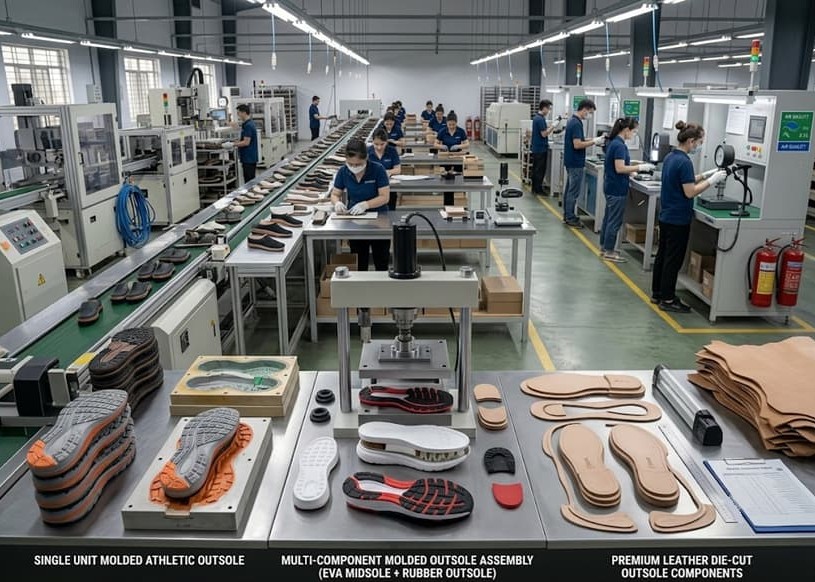
Understanding Cutting Operations in Outsole Manufacturing
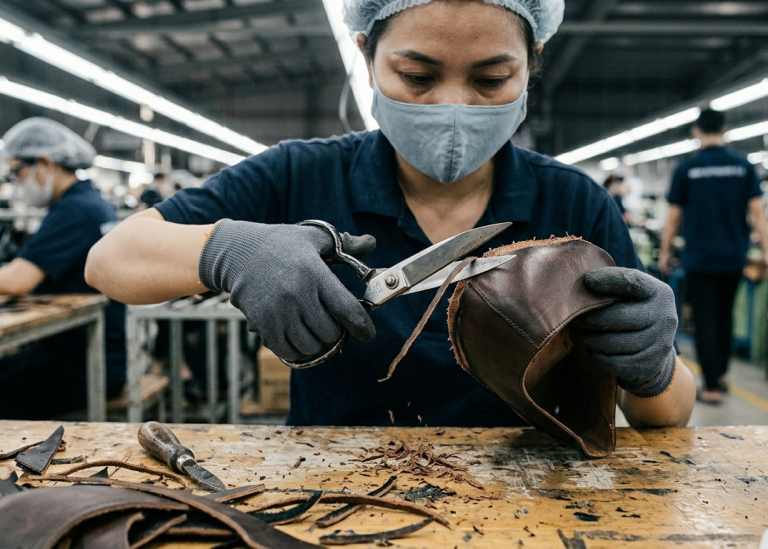
Cutting operations mark the beginning of component manufacturing in the outsole department. Their primary purpose is to convert approved raw materials into accurately shaped outsole parts that comply with engineering drawings and customer specifications. Although the task appears straightforward, successful cutting requires careful coordination between production planning, machine setup, operator skill, and quality control.
Every outsole component has defined dimensions, profile geometry, and tolerance limits established during product development. These requirements ensure that the outsole fits correctly with the corresponding upper, insole, and other shoe components during assembly. If cutting deviates from these specifications, production problems quickly emerge in downstream operations. Oversized components may require trimming after bonding, while undersized parts often create visible gaps that cannot be repaired. As a result, a seemingly minor cutting error can lead to costly rework or product rejection.
Unlike manual workshops where cutting depends largely on operator experience, modern footwear factories follow standardised production procedures. Before production begins, planners issue the approved technical drawing, cutting die, production order, and material batch details. Operators verify that the correct material type, thickness, hardness, and colour have been supplied. Only after these checks are completed does the cutting process commence.
Material characteristics also influence the cutting approach. Genuine leather requires careful inspection because every hide contains natural variations such as scars, wrinkles, vein marks, insect bites, and differences in fibre density. Operators position cutting dies to avoid these imperfections while maintaining the specified grain direction. Rubber sheets, EVA boards, fibreboard, and synthetic materials generally offer more consistent quality, but they still require correct orientation to preserve surface textures, embossed patterns, or printed designs.
Benefits of Accurate Cutting
When cutting operations are properly controlled, manufacturers experience improvements across several production areas:
- Consistent component dimensions throughout the production batch.
- Better fit during stock fitting and outsole assembly.
- Reduced trimming and rework during later operations.
- Lower material wastage and improved production yield.
- Stable product appearance that meets customer expectations.
- Faster production flow with fewer assembly interruptions.
Key Control Points
- Confirm production documents before machine setup.
- Verify material specification against the production order.
- Inspect the first cut component before starting bulk production.
- Record dimensional measurements according to the quality plan.
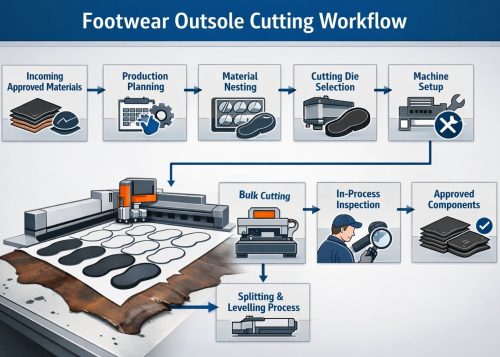
Expert Tip: Monitor material utilization as a key production performance indicator rather than simply measuring total scrap.
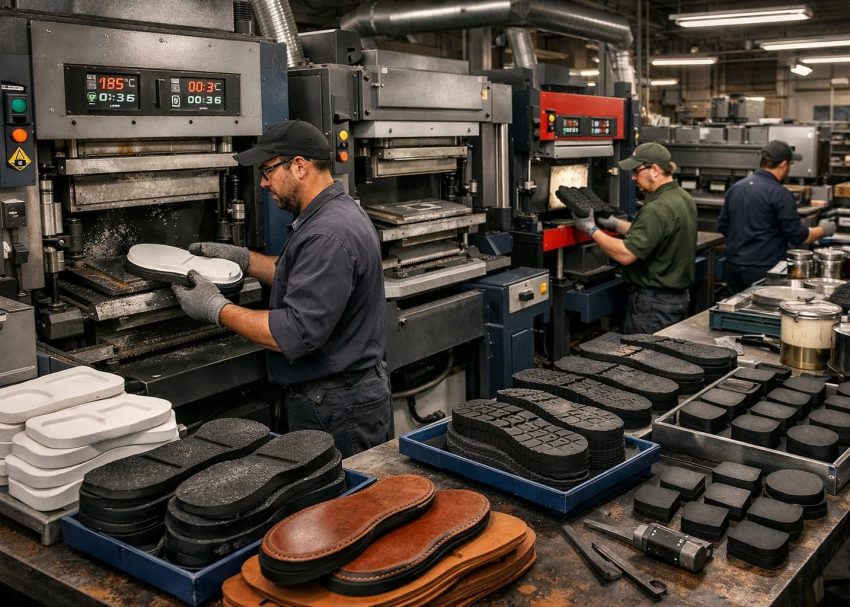
Material Planning and Nesting Before Cutting
Accurate cutting begins long before the cutting press is activated. One of the most important preparation activities is material planning, commonly known as nesting. This process determines how outsole components are arranged on leather hides or synthetic sheets to achieve maximum material utilisation without compromising product quality.
In many footwear factories, outsole materials account for a significant percentage of the total manufacturing cost. Consequently, improving material utilisation by even one or two percent can generate substantial annual savings, particularly in high-volume production facilities. Effective nesting therefore supports both quality objectives and cost reduction initiatives.
The nesting process starts with a review of the production order, component sizes, material type, and customer quality requirements. Production planners determine the most efficient arrangement of cutting dies while considering several technical factors, including grain direction, natural defects, sheet dimensions, and component spacing. The objective is not simply to place as many components as possible on the material but to achieve the best balance between quality, productivity, and material yield.
Leather requires the highest level of planning because every hide is unique. Natural defects such as healed scars, wrinkles, insect bites, loose grain, and vein marks must be avoided for visible outsole components. Experienced operators carefully inspect each hide before positioning cutting dies, ensuring that premium-quality areas are reserved for the most critical components. This manual assessment remains an important skill even in factories equipped with advanced cutting technology.
Synthetic materials provide greater consistency, allowing planners to position dies closer together. Nevertheless, operators must still consider surface textures, embossed patterns, printed graphics, and reinforcement direction where applicable. Incorrect orientation may not affect component dimensions, but it can create unacceptable appearance variations after assembly.
Factors Considered During Nesting
Professional production planners evaluate several variables before approving a nesting layout:
- Material dimensions and usable area.
- Leather grain direction and fibre orientation.
- Natural defects and surface quality.
- Component size combinations.
- Customer appearance requirements.
- Cutting die spacing.
- Production quantity.
- Material thickness consistency.
Common Nesting Mistakes
Even experienced operators occasionally encounter planning errors that reduce production efficiency. The most common issues include:
- Ignoring natural leather defects during die placement.
- Placing cutting dies too close together, increasing the risk of incomplete cuts.
- Mixing different material batches without authorisation.
- Failing to maintain grain direction for leather components.
- Prioritising maximum yield over customer appearance standards.
Most of these problems can be prevented through operator training, first-piece approval, and regular production audits.
Key Control Points
- Review nesting layout before bulk production begins.
- Separate different material batches to maintain traceability.
- Verify leather grain direction during die placement.
- Compare planned and actual material utilisation after production.
- Record scrap percentages for continuous improvement activities.
Expert Tip: Establish first-piece approval before releasing every production batch, even when repeat styles are manufactured.
Cutting Machines Used in Outsole Manufacturing
Once the cutting layout has been approved and materials are prepared, the next step is selecting the appropriate cutting machine. Machine selection is not based solely on production volume; it also depends on material type, outsole design, required accuracy, and factory investment.
Professional footwear factories often use more than one cutting machine because each offers distinct advantages for different production requirements. High-volume production generally relies on hydraulic or travelling head cutting presses, while sample development and small production runs frequently use swing arm presses. In recent years, CNC cutting systems have also become increasingly popular for automated and highly flexible manufacturing.
This section explains the operating principles, applications, and quality considerations of the three most common cutting machines used in outsole manufacturing.
Expert Tip: Encourage operators to report recurring leather defects to the incoming inspection team so supplier performance can be reviewed.
Hydraulic Cutting Press
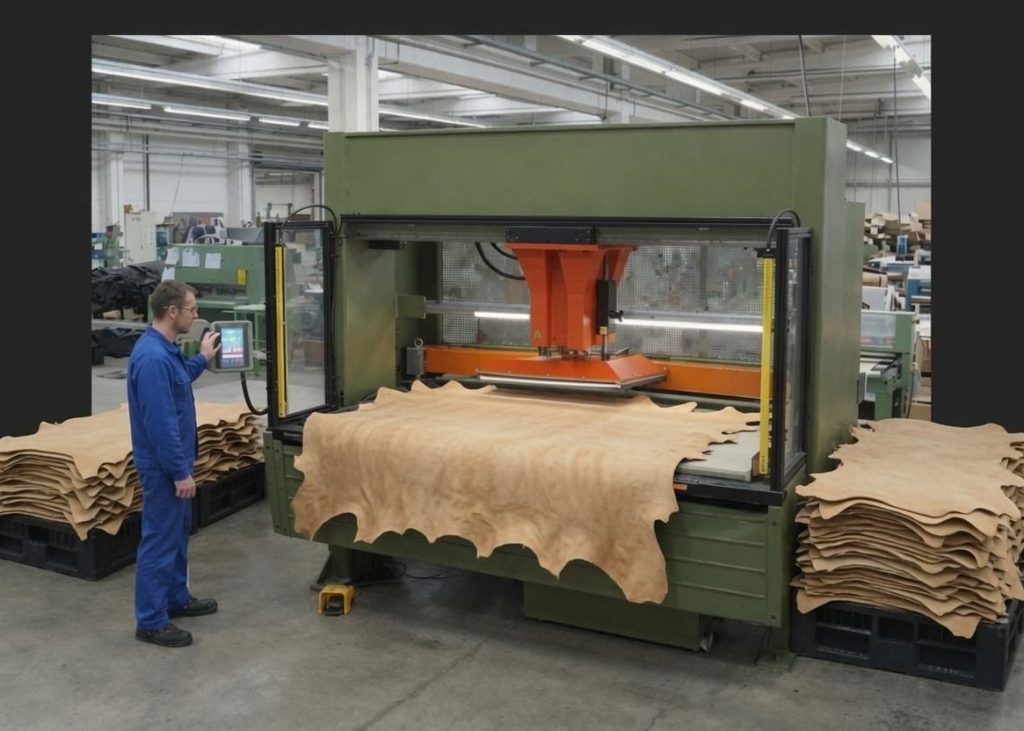
The hydraulic cutting press is the most widely used cutting machine in outsole manufacturing because it provides high cutting force, excellent dimensional consistency, and reliable performance across a wide variety of materials. Whether the factory produces leather outsoles for formal footwear or rubber and synthetic outsoles for casual shoes, the hydraulic cutting press is often the primary production machine.
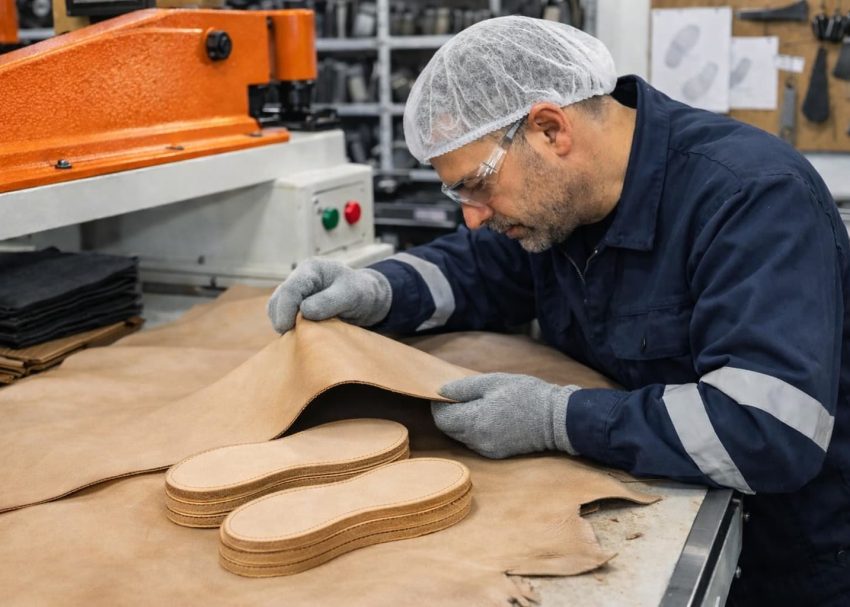
The machine operates through a hydraulic system that applies controlled pressure to a moving platen. During operation, the outsole material is placed on a cutting board, the steel rule cutting die is positioned over the material, and the hydraulic platen descends with sufficient force to drive the die completely through the material. Once the cutting cycle is complete, the platen automatically returns to its starting position, allowing the operator to remove the finished components and prepare for the next cycle.
One of the greatest strengths of hydraulic cutting technology is its ability to maintain uniform pressure across the entire cutting surface. Consistent pressure produces clean edges, accurate dimensions, and repeatable results throughout long production runs. Operators can also adjust cutting pressure according to material thickness and hardness, making the machine suitable for processing leather, rubber sheets, EVA, fibreboard, synthetic sheets, and composite outsole materials.
Modern hydraulic cutting presses are equipped with programmable controls, automatic stroke adjustment, digital production counters, and safety features such as two-hand operation and light curtains. These improvements increase production efficiency while reducing operator fatigue and improving workplace safety.
Despite their advanced features, hydraulic cutting presses require disciplined setup and maintenance. Incorrect pressure settings, damaged cutting boards, worn cutting dies, or uneven platen alignment can quickly affect component quality. Therefore, regular calibration and preventive maintenance are essential to maintain consistent production standards.
Typical Applications
Hydraulic cutting presses are commonly used for:
- Leather outsole blanks
- Rubber outsole sheets
- EVA outsole components
- Fibreboard insoles and midsoles
- Synthetic outsole materials
- High-volume production orders
Advantages
- Excellent dimensional accuracy
- High cutting force for thick materials
- Stable production quality
- Adjustable pressure for different materials
- Suitable for continuous production
- Long machine service life
Limitations
Although hydraulic cutting presses offer many advantages, they also have certain limitations:
- Higher initial investment than manual cutting equipment.
- Larger floor space requirements.
- Regular hydraulic system maintenance is necessary.
- Less suitable for frequent prototype changes compared with CNC systems.
Factory Quality Controls
To maintain cutting quality, production teams normally verify:
- Hydraulic pressure before each production shift.
- Platen parallelism and cutting board condition.
- First-piece dimensional accuracy.
- Cutting die sharpness throughout production.
- Random component measurements during bulk production.
Key Control Points
- Verify hydraulic pressure before production starts.
- Replace damaged cutting boards immediately.
- Measure first-off components before bulk cutting.
- Monitor cutting die wear throughout the production run.
Expert Tip: Store cutting dies in dedicated racks to prevent edge damage and reduce setup time.

Swing Arm Cutting Press
The swing arm cutting press is widely used in sample rooms, development departments, repair workshops, and factories producing small production batches. Although it offers lower production capacity than hydraulic cutting presses, it provides excellent flexibility and precise operator control, particularly when cutting genuine leather.
Unlike a fixed hydraulic press, the swing arm machine features a movable cutting head that rotates over the worktable. The operator manually positions the swing arm above the cutting die before initiating the cutting cycle. This design provides a clear view of the material surface, allowing operators to position cutting dies carefully around natural leather defects or printed patterns.
This visibility makes the swing arm press particularly valuable when working with premium leather. Since every hide contains unique characteristics, operators can inspect the leather and position dies to avoid scars, wrinkles, loose grain, or insect bite marks. Consequently, the machine helps maximise usable material while maintaining the appearance standards required by premium footwear brands.
Another advantage is its quick setup. Cutting dies can be changed rapidly without lengthy machine adjustments, making the swing arm press ideal for prototype development, sample production, customer approvals, and limited production runs.
Typical Applications
The swing arm cutting press is suitable for:
- Sample development
- Short production runs
- Genuine leather cutting
- Prototype manufacturing
- Product development departments
- Replacement component production
Advantages
- Excellent visibility during die positioning
- Ideal for natural leather inspection
- Quick die changes
- Compact machine footprint
- Lower investment cost
- Easy operator training
Limitations
Factories should also recognise the machine’s limitations:
- Lower production speed.
- Higher operator dependency.
- Less suitable for high-volume manufacturing.
- Manual positioning may reduce productivity for repetitive production.
Factory Quality Controls
Supervisors generally verify:
- Smooth swing arm movement.
- Hydraulic pressure consistency.
- Die positioning accuracy.
- First-piece dimensional verification.
- Daily lubrication of moving components.
Key Control Points
- Confirm swing arm movement before production.
- Position cutting dies away from visible leather defects.
- Maintain correct hydraulic pressure for each material type.
- Inspect component dimensions after every die change.
Pro Tip: Review scrap patterns weekly to identify opportunities for improved nesting layouts and material savings.


Choosing the Right Cutting Machine
Selecting the appropriate cutting machine involves more than comparing production capacity. Factory engineers evaluate several technical and commercial factors before deciding which equipment best suits a particular production requirement.
Production volume is often the first consideration. Large footwear factories producing thousands of outsole components per day generally rely on hydraulic or travelling head cutting presses because they provide higher throughput and consistent performance. In contrast, development departments and sample rooms prefer swing arm presses due to their flexibility and quick setup.
Material type also influences machine selection. Leather benefits from the operator visibility offered by swing arm presses, whereas uniform rubber or EVA sheets are efficiently processed using hydraulic cutting systems. Factories producing a wide variety of materials often install multiple machine types to maximise production flexibility.
Machine Selection Considerations
- Production volume
- Material characteristics
- Required dimensional accuracy
- Product complexity
- Available factory space
- Investment budget
- Maintenance capability
- Future automation plans
Pro Tip: Do not select cutting machines based solely on production speed. Consider material characteristics, operator skill, and future production flexibility.

Advanced Cutting Technologies, Benefits, Defects, and Quality Control
This section discusses travelling head cutting presses, CNC cutting systems, the production advantages of accurate cutting, common cutting defects, and the quality practices that help factories achieve consistent results.
Traveling Head Cutting Press
The traveling head cutting press is designed for high-volume footwear production where speed, consistency, and efficient material utilisation are essential. Unlike a fixed hydraulic cutting press, the cutting head moves across the worktable, allowing operators to cut different areas of the material without repositioning large sheets repeatedly. This reduces handling time and improves overall productivity.
The machine consists of a movable hydraulic head that travels horizontally along guide rails. Operators position the cutting die on the material, move the cutting head directly above the die, and activate the cutting cycle. After cutting, the head travels to the next position while the material remains largely stationary. This arrangement makes the machine particularly suitable for large leather hides and wide synthetic sheets.
Because the cutting head can access a much larger working area, operators spend less time moving heavy materials. As a result, production output increases while operator fatigue decreases. The machine also supports larger cutting dies and multiple-die layouts, making it an excellent choice for high-volume outsole production.
Typical Applications
Travelling head cutting presses are commonly used for:
- High-volume leather outsole production
- Rubber sheet cutting
- EVA sheet processing
- Multi-component cutting layouts
- Large-format synthetic materials
- Continuous production lines
Advantages
- Higher production capacity than swing arm presses.
- Reduced material handling.
- Suitable for large material sheets.
- Consistent cutting pressure.
- Improved operator productivity.
- Better utilisation of working area.
Limitations
- Higher equipment investment.
- Larger installation space.
- Requires skilled maintenance personnel.
- Not economical for very small production batches.
Key Control Points
- Verify guide rail alignment regularly.
- Inspect hydraulic pressure consistency.
- Maintain clean working surfaces.
- Perform first-piece dimensional verification after every machine setup.
Pro Tip: Record hydraulic pressure settings for each material type to reduce setup time during repeat orders.
Posts you make Like

Troubleshooting Adhesive Bond Failures in Footwear Manufacturing…
CNC Cutting Systems
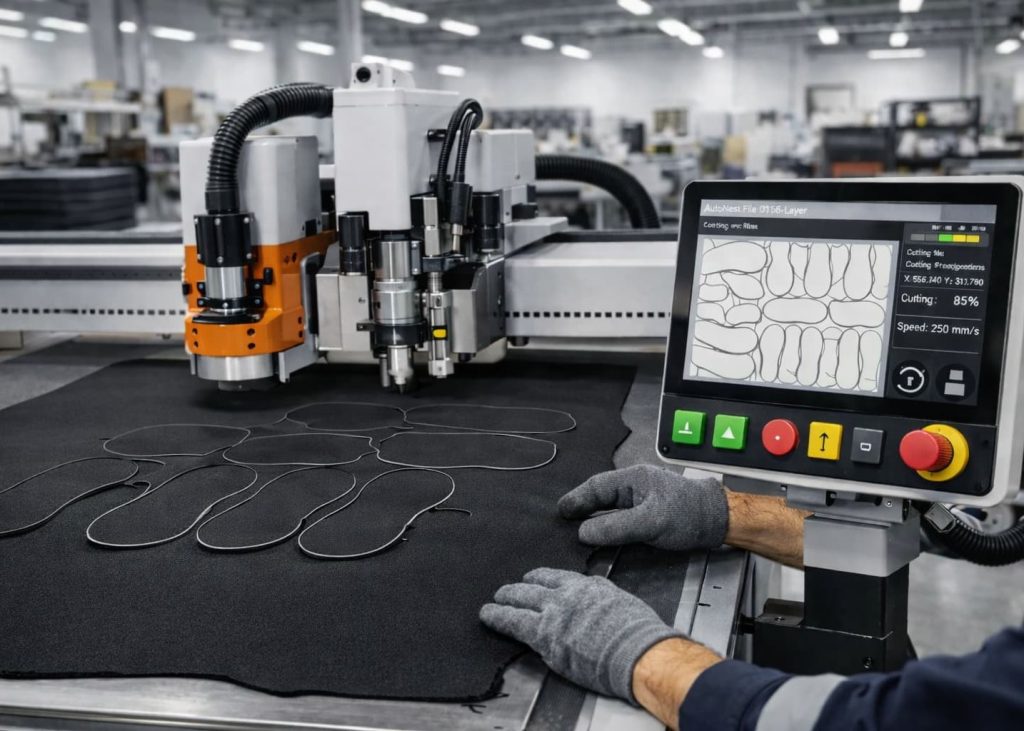
As footwear manufacturing moves towards digital production, CNC (Computer Numerical Control) cutting systems are becoming increasingly common, particularly in factories producing multiple styles or customised footwear. Unlike traditional die-cutting methods, CNC systems use computer-controlled cutting tools that follow digital design files with exceptional precision.
The cutting process begins by importing the approved CAD pattern into the CNC control software. The system automatically calculates cutting paths and positions components according to the selected nesting programme. Depending on the material being processed, the machine may use oscillating knives, rotary blades, drag knives, or laser-assisted cutting technologies.
One of the greatest advantages of CNC cutting is flexibility. Since physical cutting dies are not required, new designs can be introduced quickly without waiting for die manufacturing. This capability significantly reduces product development time and supports rapid style changes, making CNC systems particularly valuable for fashion footwear, sample development, and small-batch production.
Typical Applications
CNC cutting systems are widely used for:
- Product development
- Sample manufacturing
- Fashion footwear
- Customised footwear
- Small and medium production batches
- Automated manufacturing facilities
Advantages
- No cutting dies required.
- High dimensional accuracy.
- Rapid style changes.
- Excellent material utilisation.
- Digital production records.
- Reduced development lead time.
Limitations
- High initial investment.
- Requires trained programmers.
- Higher maintenance complexity.
- Slower than die cutting for some high-volume products.
Key Control Points
- Verify CAD files before production.
- Calibrate cutting tools regularly.
- Monitor tool wear continuously.
- Validate first-piece dimensions after every programme change.
Pro Tip: Replace cutting boards before excessive wear affects dimensional accuracy.
Benefits of Accurate Cutting
Accurate cutting delivers benefits that extend well beyond the cutting department. Since cutting establishes the dimensional foundation for every subsequent operation, maintaining precision improves production efficiency throughout the entire outsole manufacturing process.
The most immediate advantage is improved assembly fit. Components produced within specified tolerances align correctly during stock fitting, reducing operator adjustments and minimising assembly delays. This improves workflow while reducing labour costs associated with rework and manual correction.
Material utilisation also improves considerably. Efficient nesting combined with precise cutting reduces scrap generation, enabling manufacturers to obtain more components from each leather hide or synthetic sheet. Over large production volumes, even a small improvement in material yield produces significant financial savings.
Accurate cutting also contributes to better product appearance. Clean edges, uniform dimensions, and consistent component profiles produce visually attractive finished footwear that meets customer quality expectations. Furthermore, stable component dimensions improve bonding consistency during outsole attachment, reducing the risk of visible gaps or misalignment.
Production Benefits
- Improved stock fitting accuracy.
- Lower material waste.
- Reduced rework.
- Better product appearance.
- Faster assembly operations.
- Improved production planning.
- Stable quality performance.
- Lower manufacturing cost.
Pro Tip: Schedule preventive maintenance based on machine operating hours rather than waiting for production problems.
Common Cutting Defects and Corrective Actions
Even with advanced machinery, cutting defects can occur if machines, materials, or operating procedures are not properly controlled. Early identification of these defects prevents unnecessary production losses and protects downstream processes.
1. Undersized Components
Undersized components are smaller than the specified dimensions and often create assembly gaps during outsole attachment.
Common Causes
- Incorrect cutting die.
- Excessive die wear.
- Incorrect engineering revision.
- Measurement errors.
Corrective Actions
- Verify cutting die dimensions.
- Replace worn dies.
- Review engineering documentation.
- Conduct first-piece approval.
2. Oversized Components
Oversized parts extend beyond specified dimensions and usually require trimming after assembly.
Common Causes
- Damaged cutting die.
- Excessive material movement.
- Improper die positioning.
Corrective Actions
- Inspect die condition.
- Improve material positioning.
- Retrain operators.
3. Jagged or Rough Edges
Poor edge quality reduces appearance and may interfere with later finishing operations.
Common Causes
- Blunt cutting die.
- Insufficient cutting pressure.
- Worn cutting board.
Corrective Actions
- Sharpen cutting dies.
- Adjust hydraulic pressure.
- Replace cutting boards.
4. Incomplete Cutting
The material remains partially attached after cutting, requiring manual trimming.
Common Causes
- Low hydraulic pressure.
- Thick material.
- Uneven platen alignment.
Corrective Actions
- Increase cutting pressure.
- Verify material specification.
- Inspect machine alignment.
5. Material Distortion
Soft materials such as EVA may deform during cutting.
Common Causes
- Excessive pressure.
- Incorrect cutting board.
- Poor material support.
Corrective Actions
- Reduce cutting pressure.
- Use appropriate cutting surfaces.
- Support material correctly.
Pro Tip:
Train operators to identify abnormal cutting sounds or increased operating force, as these often indicate die wear or hydraulic issues.
Train operators to recognise early signs of die wear instead of waiting for visible defects.
Quality Control During Cutting Operations
Quality control begins before production starts and continues until the final production batch is completed. Professional footwear factories establish multiple inspection stages to detect problems before defective components proceed to downstream operations.
First-piece inspection remains the most important checkpoint. Before bulk production begins, inspectors verify dimensions, profile accuracy, material orientation, and overall appearance against approved engineering drawings. Only after successful approval is full production authorised.
During production, operators perform regular dimensional checks using calibrated measuring equipment. Supervisors monitor machine pressure, die condition, cutting board wear, and material utilisation. Random inspections throughout the shift ensure that cutting quality remains stable despite production volume or operator changes.
After production, scrap rates and material utilisation are analysed to identify improvement opportunities. These production records support continuous improvement programmes and help engineers optimise future nesting layouts.
Key Control Points
- First-piece approval before bulk production.
- Periodic dimensional inspection.
- Monitor cutting die sharpness.
- Verify hydraulic pressure during production.
- Inspect cutting board condition daily.
- Record material utilisation for every production order.
Pro Tip: Keep spare cutting dies available for high-volume production styles to minimize downtime during sharpening.
Review nesting efficiency regularly to identify additional material-saving opportunities.
Conclusion
Cutting operations establish the dimensional accuracy for every outsole component before it enters subsequent manufacturing processes. Regardless of whether a factory uses a hydraulic cutting press, swing arm press, travelling head press, or CNC cutting system, the objective remains the same—produce components that consistently meet engineering specifications while maximising material utilisation and maintaining production efficiency.
In the next article of TheFootwearEdge – Outsole (Stock Fitting) Assembly Series, we will explore “Splitting and Levelling in Outsole Process“, where outsole components are brought to the required thickness and surface uniformity before moving to further preparation and assembly operations.
Pro Tip:
Analyse cutting defects monthly rather than only investigating customer complaints.
Maintain separate maintenance schedules for machines and cutting dies.
Frequently Asked Questions (FAQs)
Why is cutting considered one of the most critical operations in outsole manufacturing?
Because it establishes the dimensional accuracy for every downstream operation. Incorrectly cut components cannot usually be corrected later without replacing the material.
Which cutting machine is most commonly used in footwear factories?
Hydraulic cutting presses remain the most common because they provide high cutting force, consistent accuracy, and suitability for a wide range of outsole materials.
Why is nesting important before cutting?
Nesting maximises material utilisation, reduces scrap, improves production efficiency, and lowers manufacturing costs without compromising component quality.
What causes incomplete cutting?
The most common causes include insufficient hydraulic pressure, worn cutting dies, damaged cutting boards, excessive material thickness, and poor machine alignment.
When should cutting dies be sharpened?
Dies should be inspected regularly and sharpened whenever edge quality begins to deteriorate or increased cutting force is required to achieve complete cuts.
Can CNC cutting systems completely replace hydraulic cutting presses?
Not always. CNC systems offer excellent flexibility for prototypes, customised products, and small production batches, whereas hydraulic cutting presses remain more economical for high-volume manufacturing.
Which quality inspection is most important during cutting?
First-piece approval is the most critical inspection because it verifies dimensions, profile accuracy, and material orientation before bulk production begins.
Pro Tip:
Use statistical process control (SPC) for high-volume production where dimensional consistency is critical.
Replace cutting boards before excessive wear begins affecting product quality.