Trimming Operation in Outsole Process: Precision Template-Guided Profile Trimming | Outsole (Stock Fitting) Assembly Series
In the previous blog, Outsole Moulding Operations in Outsole Process, we explored how outsole blockers are manufactured using moulding technologies to achieve the required thickness, construction, and basic shape before entering the stock fitting department. However, moulding is only one method of producing an outsole blocker. Depending on the footwear construction, outsole blockers may also be prepared by cutting, laminating, pressing, or combining multiple materials before they reach the next manufacturing stage.
Regardless of how the blocker is produced, many footwear factories intentionally manufacture the component slightly larger than its final dimensions. This additional material, known as the Profile Trimming Allowance, enables manufacturers to achieve excellent dimensional accuracy during a dedicated profile trimming operation rather than relying solely on the initial manufacturing process.
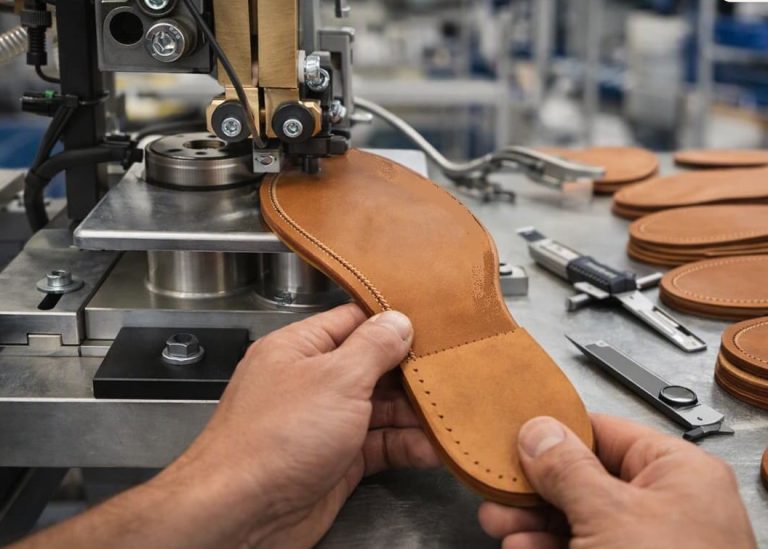
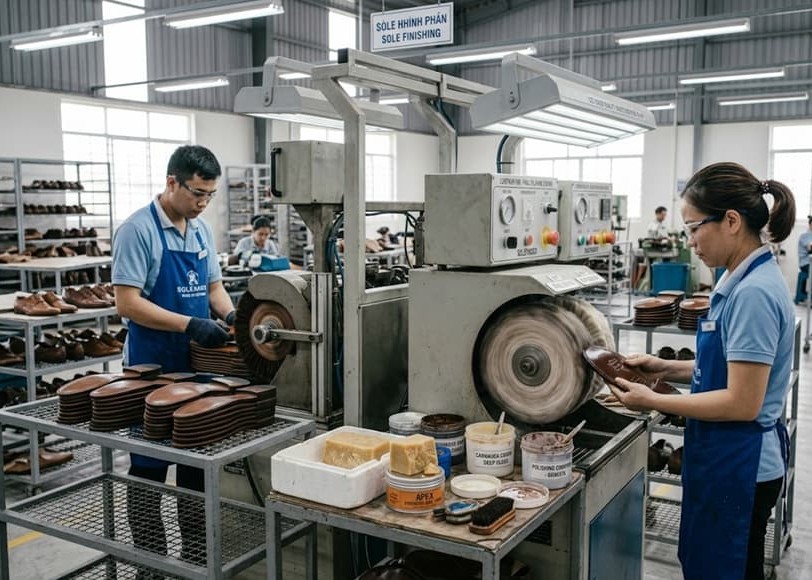
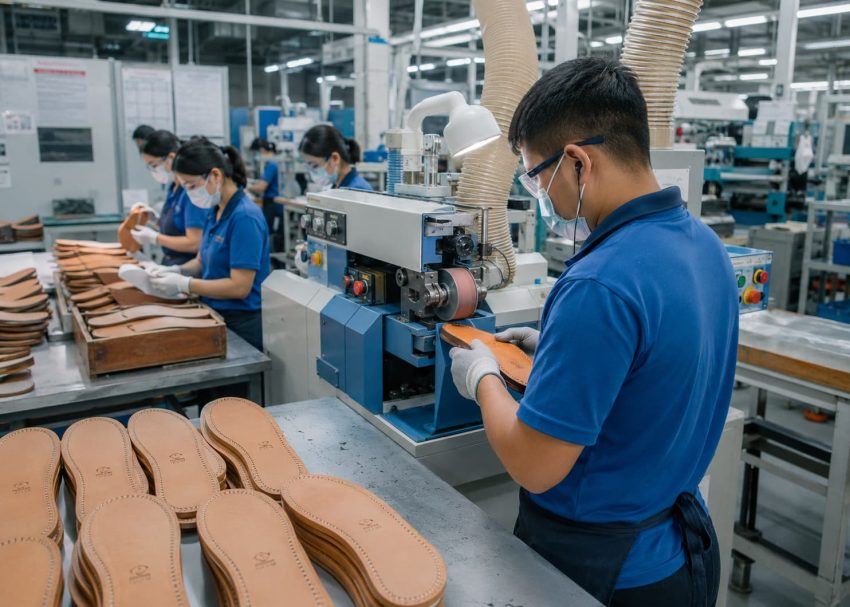
The Profile Trimming Operation is therefore one of the most important precision finishing processes in footwear manufacturing. Using a High-Speed Profile Trimming Machine, an operator guides the outsole blocker against a size-specific trimming template while a cam follower mechanism controls the cutting path. As the cutter removes the profile trimming allowance, the oversized blocker is transformed into a dimensionally accurate outsole ready for the next stock fitting operations.
Although this process is most commonly associated with outsole blockers, the same trimming principle is also widely used for midsoles, stacked heels, top lifts, and other footwear components requiring precise profile dimensions.
Understanding the Profile Trimming Operation
Profile trimming is a precision machining operation used to remove the Profile Trimming Allowance from oversized footwear components. Unlike mould flash removal, where thin excess material is removed from mould parting lines, profile trimming establishes the final engineered outline of the component according to the approved design.
The trimming operation begins after the blocker has completed its primary manufacturing process. Depending on the footwear construction, the blocker may be moulded, die-cut, laminated, pressed, or assembled from multiple material layers. Since slight dimensional variations naturally occur during these processes, manufacturers intentionally leave sufficient profile trimming allowance around the perimeter.
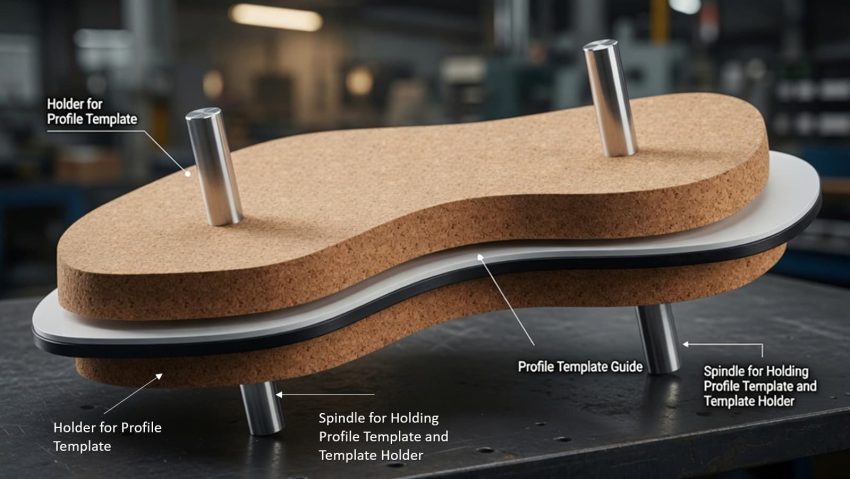
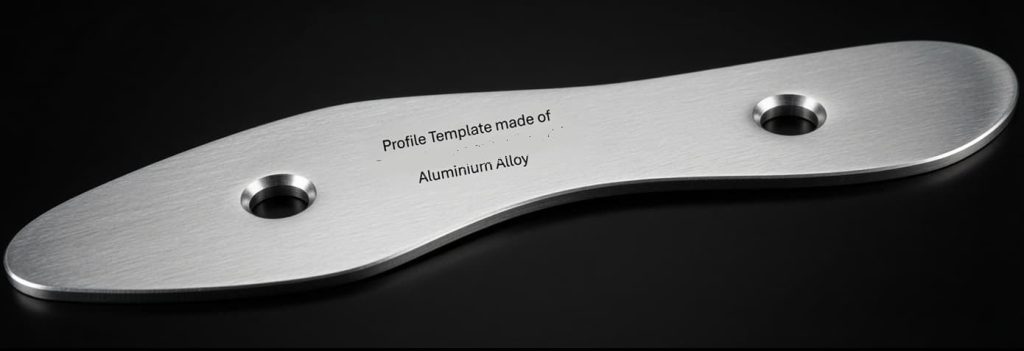
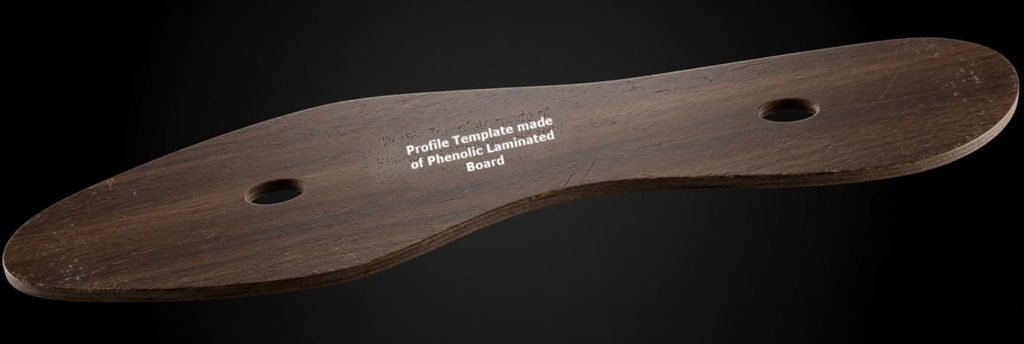
During trimming, the operator selects the correct size template corresponding to the outsole style and shoe size. The template acts as the master profile for the finished component. As the blocker is guided around the cutter, a hardened cam follower remains in continuous contact with the template edge. Because the cutter maintains a fixed distance from the guide roller, only the excess profile trimming allowance is removed.
This mechanical guidance system produces consistent dimensions regardless of operator experience or production volume. Every blocker trimmed using the same template follows an identical cutting path, resulting in highly repeatable profile accuracy throughout the production run.
Instead of depending entirely on moulding or cutting accuracy, the final outsole dimensions are established during this dedicated trimming process. Consequently, subsequent stock fitting operations begin with a component that already matches the approved engineering profile.
Key Control Points
- Confirm blocker quality before trimming.
- Select the correct size-specific template.
- Maintain continuous cam follower contact.
- Inspect finished profile before transferring to the next process.
Expert Tip: Use dedicated templates for every outsole size and style.
Why Profile Trimming Allowance is Provided
Producing every outsole blocker to its exact finished dimensions during the initial manufacturing stage is neither practical nor economical. Material behaviour, mould tolerances, pressing conditions, and cutting variations can all influence the blocker dimensions. Therefore, manufacturers intentionally provide a Profile Trimming Allowance, enabling the final profile to be created under controlled conditions.
The trimming allowance acts as a machining margin that compensates for normal manufacturing variation. Instead of rejecting blockers with minor dimensional differences, factories rely on the trimming operation to achieve the precise profile required for assembly.
This approach also improves consistency across production batches. Since every finished outsole profile is generated using the same precision template, dimensional repeatability depends primarily on the trimming system rather than slight variations during blocker preparation.
Another important advantage is improved edge quality. During earlier manufacturing processes, the blocker edges may experience minor deformation, compression, or handling damage. The trimming operation removes these irregularities together with the profile trimming allowance, leaving a clean and uniform edge.
Another important reason for producing oversized outsole blockers is size grouping, which significantly reduces tooling investment. Instead of manufacturing separate cutting dies and moulds for every individual shoe size, factories often use one blocker for a group of sizes. For example, a men’s US size range of 6–15 may be produced using only five blocker groups (6–7.5, 8–9, 9.5–10.5, 11–13, and 14–15). During profile trimming, each grouped blocker is accurately trimmed to its final size using the appropriate size-specific template. This approach reduces cutting die and mould costs, simplifies inventory management, and allows the same blocker to be shared across multiple footwear styles with similar outsole constructions.
Key Control Points
- Maintain uniform profile trimming allowance.
- Avoid excessive allowance that increases trimming time.
- Verify blocker dimensions before trimming.
- Standardize trimming allowance for each outsole style.
Expert Tip: Clearly identify templates with style number, size, and revision level.

Components Commonly Requiring Profile Trimming
Although outsole blockers represent the largest application, profile trimming is used throughout footwear manufacturing wherever dimensional accuracy is essential.
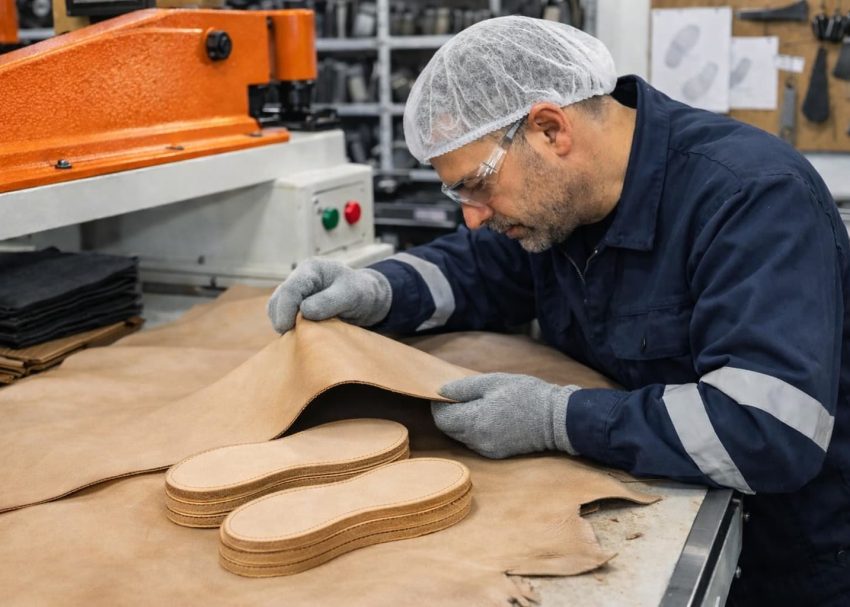
Leather Outsole Blockers
Leather outsole blockers are frequently prepared with profile trimming allowance before final shaping. Premium formal shoes, Goodyear welted footwear, stitched constructions, and many handcrafted products rely on precision trimming to achieve clean and consistent outsole profiles.
Since leather remains visible in many finished shoes, profile accuracy and edge quality directly influence the overall appearance of the footwear.
Key Control Points
- Use sharp cutters to prevent fibre tearing.
- Verify template selection.
- Inspect edge smoothness.
- Compare with approved master samples.
Expert Tip: Replace worn templates before dimensional drift occurs.
Synthetic Outsole Blockers
Synthetic blockers manufactured from fibreboard, resin-based materials, engineered composites, or laminated constructions are also commonly profile trimmed.
These materials generally provide consistent cutting characteristics, allowing factories to maintain excellent dimensional repeatability using template-guided trimming machines.
Key Control Points
- Prevent localized overheating.
- Maintain continuous cutter movement.
- Replace worn cutters promptly.
- Inspect edge finish.
Rubber and Composite Outsole Blockers
Certain rubber and composite outsole constructions are intentionally manufactured with profile trimming allowance before entering stock fitting.
Template-guided trimming removes the excess material while maintaining the designed outsole geometry.
Key Control Points
- Monitor cutter wear regularly.
- Prevent layer separation.
- Maintain uniform edge quality.
- Verify overall dimensions.
Expert Tip: Record cutter life to establish preventive replacement schedules.
Working Principle of Template-Guided Profile Trimming
The profile trimming machine operates using a highly accurate mechanical guidance system that enables the finished outsole profile to match the approved engineering design.
The process begins by selecting the correct size-specific trimming template. Each outsole size has its own dedicated template manufactured according to the approved technical drawing. Depending on factory preference and production volume, templates are commonly manufactured from Phenolic laminated board or aluminum alloy to provide long service life while maintaining dimensional stability.
The template is mounted securely on the trimming machine, and the outsole blocker is positioned against it. A hardened cam follower guide roller, typically matching the template guide thickness, remains in constant contact with the template edge throughout the trimming operation. Beside the guide roller, a high-speed vertical carbide cutter rotates at high speed.
As the operator rotates the outsole around the cutter, the cam follower continuously follows the template profile. Since the cutter and guide roller maintain a fixed relationship, only the profile trimming allowance extending beyond the template is removed. The remaining material forms the finished outsole profile with excellent dimensional consistency.
This simple but highly effective mechanical principle allows factories to produce identical outsoles regardless of production volume. Even when different operators perform the trimming operation, the finished dimensions remain consistent because the template—not operator judgement—controls the cutter path. For this reason, template-guided trimming continues to be one of the most reliable profile-finishing methods used in footwear manufacturing.
Typical Factory Workflow
- Receive oversized blocker.
- Perform visual inspection.
- Select correct size template.
- Install or verify template.
- Check cutter condition.
- Position blocker against template.
- Rotate blocker while maintaining continuous cam follower contact.
- Complete profile trimming.
- Inspect edge quality.
- Verify dimensions.
- Transfer to the Roughing and Buffing department.
Key Control Points
- Maintain smooth and continuous operator movement.
- Avoid excessive force against the cutter.
- Replace damaged templates immediately.
- Confirm profile accuracy during first-piece approval.
Expert Tip: Store templates individually to prevent accidental damage.

High-Speed Profile Trimming Machine
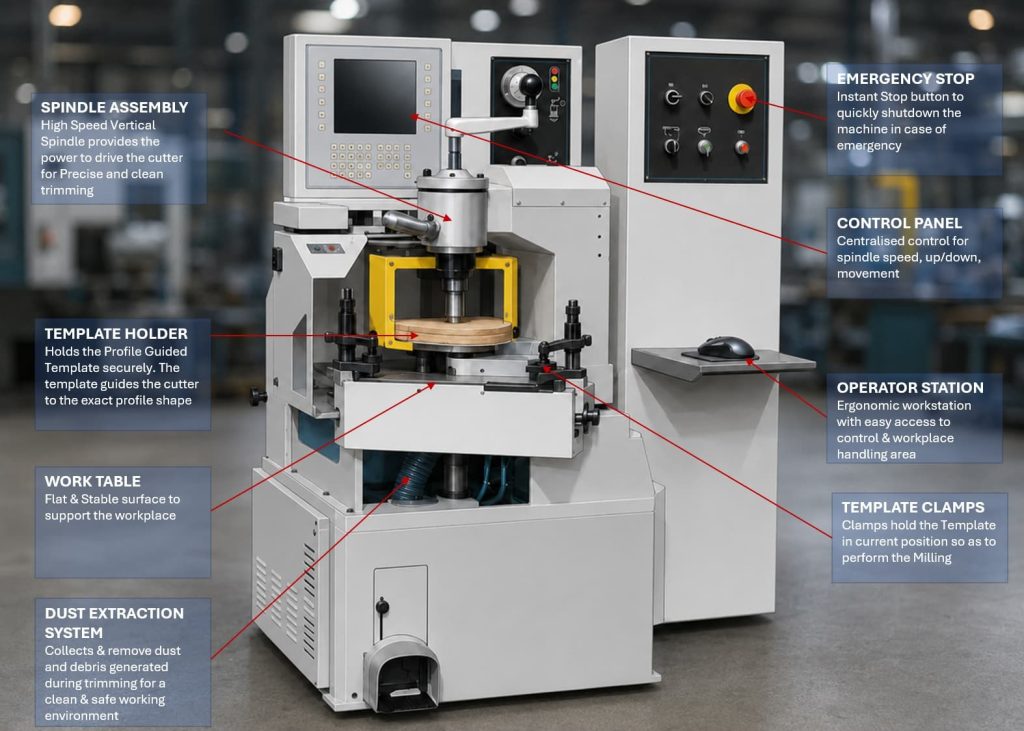
The High-Speed Profile Trimming Machine is the heart of this operation. Although different manufacturers use names such as Template-Guided Sole Trimming Machine, Profile Trimming Machine, or High-Speed Sole Cutter, the operating principle remains essentially the same.
The machine is designed to remove the profile trimming allowance quickly while maintaining excellent dimensional repeatability. A high-speed spindle drives a vertical carbide cutter capable of producing clean cuts on leather, synthetic materials, rubber, fibreboard, and composite constructions.
The machine’s accuracy depends largely on the relationship between three components—the trimming template, cam follower, and rotating cutter. Together, these components create a mechanically controlled trimming path that minimizes dimensional variation and reduces dependence on operator skill.
Modern machines are also equipped with safety guards, dust extraction systems, ergonomic worktables, emergency stop switches, and robust motors suitable for continuous production in footwear factories.
Key Control Points
- Check cutter sharpness before every shift.
- Inspect cam follower rotation and wear.
- Verify correct template installation.
- Monitor machine vibration and spindle performance.
Expert Tip: Always perform first-piece approval after template or cutter changes.
Trimming Different Footwear Materials
Although the operating principle of a High-Speed Profile Trimming Machine remains the same, each material behaves differently during cutting. Therefore, cutter selection, spindle condition, feed pressure, and operator technique should be adjusted according to the material being processed. Understanding these differences helps maintain edge quality, improves productivity, and extends cutter life.
Midsole Profile Trimming
Many leather, fibreboard, EVA, PU, rubber, and composite midsoles are manufactured slightly oversized after moulding, laminating, or die cutting. Profile trimming removes the excess material and produces the exact midsole outline required for assembly.
Accurate midsole dimensions are essential because the component must align correctly with both the upper and outsole. Poor profile accuracy may affect bonding quality, visual appearance, and overall footwear fit.
Key Control Points
- Use the correct size-specific template.
- Inspect overall profile dimensions.
- Prevent melting or edge damage.
- Verify smooth edge quality.
Expert Tip: Use aluminium templates for high-volume production due to their lighter weight and easier handling.

Stacked Heel Profile Trimming
Premium leather footwear frequently uses stacked leather heels constructed by bonding several leather lifts together. After assembly, the heel block usually contains excess material around its perimeter.
A template-guided profile trimming machine removes this excess allowance and establishes the final heel profile before sanding and finishing operations. Since the heel remains visible in the finished shoe, profile accuracy directly affects product appearance.
Top Lift Profile Trimming
Top lifts manufactured from rubber, TPU, TPR, leather, or composite materials may also require profile trimming before heel assembly. This operation ensures that the top lift matches the heel profile accurately and provides a clean, consistent appearance after assembly.
Expert Tip: Consider hardened steel templates for long production runs or abrasive materials where maximum durability is required.

Why the Same Trimming Principle is Used
Whether trimming an outsole, midsole, stacked heel, or top lift, the objective remains identical: produce a component that matches the approved engineering profile with excellent dimensional repeatability.
The combination of a size-specific trimming template, cam follower mechanism, and high-speed rotating cutter enables footwear manufacturers to standardize profile trimming across multiple departments while reducing dimensional variation and improving assembly quality.
Key Control Points
- Use dedicated templates for each component.
- Replace worn templates before dimensional variation occurs.
- Maintain cutter sharpness.
- Conduct first-piece approval after every setup change.
Expert Tip: Store templates individually to prevent accidental damage or distortion.

Benefits of Template-Guided Profile Trimming
A template-guided trimming system provides significant advantages over manual trimming because the finished profile is determined by the precision template rather than operator judgement.
Accurate Component Profile
Every component is trimmed according to the approved engineering profile, ensuring dimensional consistency throughout production.
Better Assembly Fit
Accurate profile trimming allows components to align correctly during roughing, cementing, outsole attachment, heel assembly, and other stock fitting operations.
Superior Edge Appearance
Cleanly trimmed edges require less manual finishing and improve the overall appearance of premium footwear.
Consistent Production Quality
Since every size has its own template, profile accuracy remains consistent across different operators, production batches, and manufacturing shifts.
Reduced Rework and Rejection
Accurate trimming minimizes dimensional defects that could otherwise result in assembly problems, excessive rework, or rejected components.
Expert Tip: Maintain a preventive cutter replacement schedule instead of waiting for defects to appear.


Common Defects During Profile Trimming
Despite using precision machinery, poor maintenance, incorrect setup, or operator error can still create trimming defects.
Over-Trimming
Material is removed beyond the approved profile, producing an undersized component.
Possible Causes
- Incorrect template
- Worn cam follower
- Improper cutter adjustment
- Excessive operator pressure
Corrective Actions
- Verify template before production.
- Check cutter alignment.
- Replace worn guide rollers.
- Conduct first-piece inspection.
Under-Trimming
Excess profile trimming allowance remains on the component.
Possible Causes
- Dull cutter
- Incorrect setup
- Incomplete trimming path
Corrective Actions
- Replace cutter.
- Repeat trimming if permitted.
- Inspect the complete perimeter.
Expert Tip: Always verify template revision before starting a new production order.

Chipped Leather Edges
Leather fibres tear instead of being cleanly cut.
Possible Causes
- Worn cutter
- Excessive cutting pressure
- Poor leather quality
Corrective Actions
- Replace cutter.
- Reduce feed pressure.
- Inspect incoming leather quality.
Burn Marks on Synthetic Materials
Excessive friction creates heat that discolours or melts the edge.
Possible Causes
- Dull cutter
- Slow feed movement
- Excessive contact time
Corrective Actions
- Replace cutter.
- Maintain continuous movement.
- Check spindle performance.
Wavy or Uneven Profile
The finished profile deviates from the template.
Possible Causes
- Worn template
- Damaged cam follower
- Irregular operator movement
Corrective Actions
- Replace worn templates.
- Inspect guide roller condition.
- Retrain operators.
Expert Tip: Keep a master sample at each trimming workstation for quick profile comparison.
Quality Inspection and Dimensional Verification
Quality inspection should begin immediately after profile trimming.
Early inspection prevents defective components from moving into roughing, bonding, and assembly operations where correction becomes more difficult and costly.
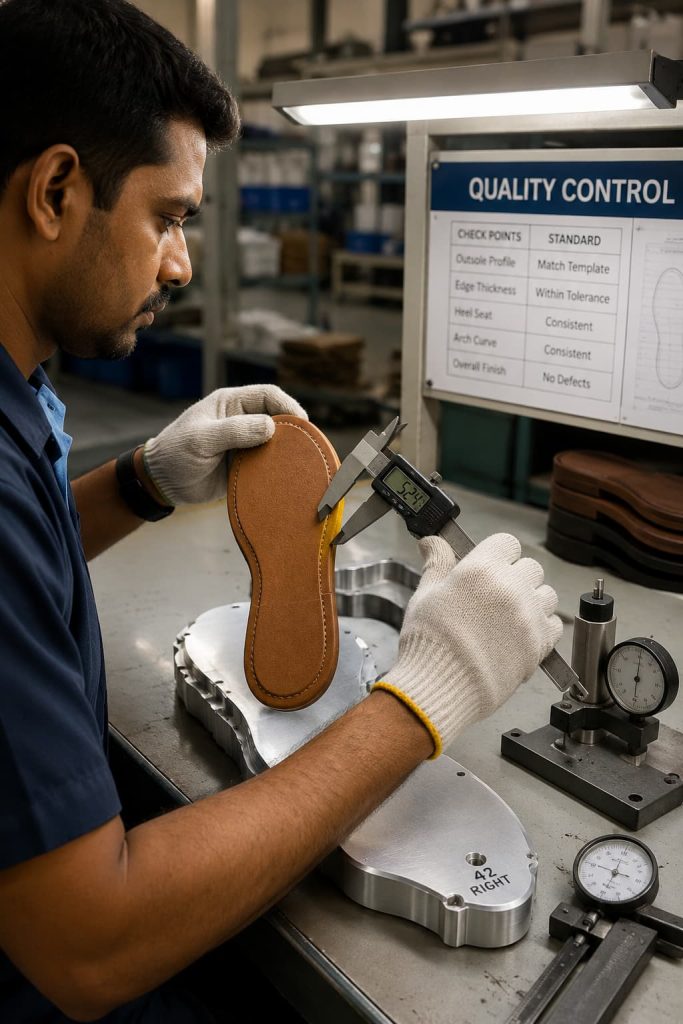
Inspectors should first verify that the correct size template was used and confirm that the complete Profile Trimming Allowance has been removed. The finished profile should then be compared with the approved master sample or profile gauge to ensure dimensional accuracy.
Visual inspection should focus on edge smoothness, profile continuity, toe shape, waist contour, heel profile, and left-right symmetry. Any chipped edges, burn marks, cutter marks, or remaining excess material should be identified before the component is approved.
Key Control Points
- Conduct first-piece approval.
- Inspect templates regularly.
- Monitor cutter condition.
- Record recurring defects for continuous improvement.
Expert Tip: Inspect the cam follower regularly because wear directly affects dimensional accuracy.
Factory Best Practices
Leading footwear manufacturers treat profile trimming as a precision operation rather than a simple cutting process. Templates should be identified by style number, size, and revision level to prevent incorrect selection. Worn templates should be replaced promptly because even small dimensional changes can affect assembly accuracy.
Preventive maintenance should include routine inspection of spindle bearings, carbide cutters, cam followers, and dust extraction systems. Cutter life should be monitored and recorded so replacements occur before edge quality deteriorates.
Operators should also receive regular training on correct handling techniques, smooth component rotation, and quality inspection standards. Although the template controls the cutting path, operator consistency still influences edge finish and productivity.
Expert Tip: Perform hourly quality audits during high-volume production.
Cutter Selection and Cutting Parameters for Profile Trimming
The performance of a High-Speed Profile Trimming Machine depends not only on the machine itself but also on the correct selection of the cutting tool. Cutter geometry, cutting material, spindle speed, and feed rate should be matched to the outsole material to achieve a clean edge, maintain dimensional accuracy, and maximize cutter life. Most footwear factories use solid carbide profile cutters because they provide excellent wear resistance, maintain a sharp cutting edge for longer production runs, and generate smoother finishes than conventional high-speed steel (HSS) cutters.
HSS cutters may still be used for softer materials or low-volume production, but carbide cutters are the preferred choice in modern footwear manufacturing.
Companies such as Templier are recognized within the footwear industry for manufacturing high-precision profile cutters and template systems that deliver excellent dimensional accuracy and long service life. The final cutter selection, however, should always consider the outsole material, thickness, production volume, and machine manufacturer’s recommendations.
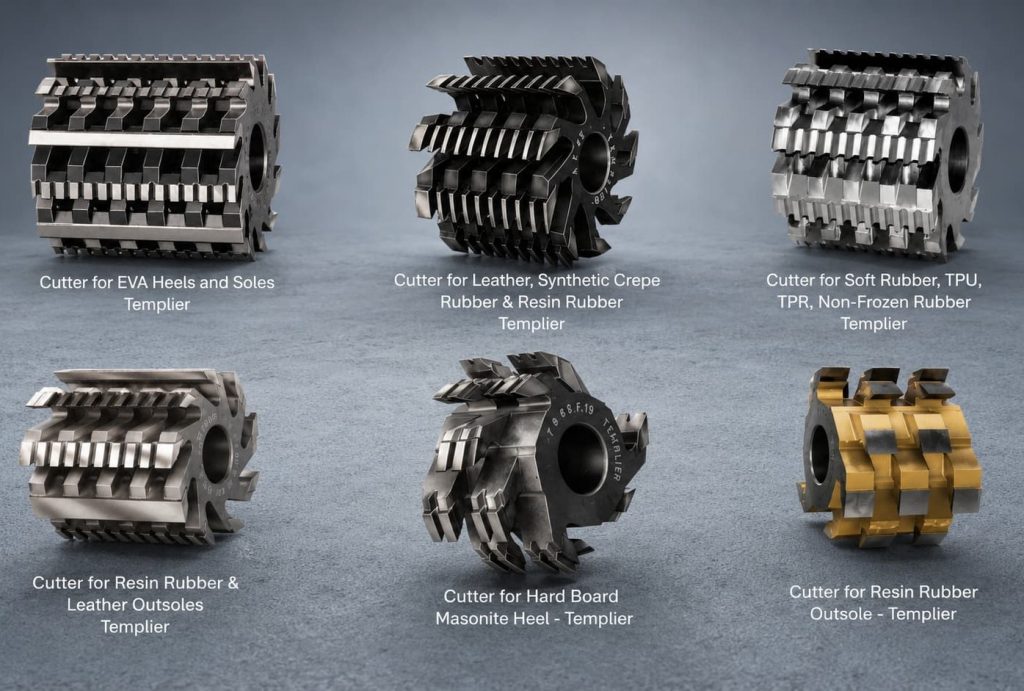
Common Cutter Types Used in Footwear Profile Trimming
| Cutter Type | Typical Application | Advantages |
|---|---|---|
| Solid Carbide Straight Cutter | Leather, fibreboard, synthetic materials | Long tool life, excellent edge finish, high dimensional accuracy |
| Carbide Spiral Up-Cut Cutter | Thick leather and composite materials | Efficient chip removal and cooler cutting |
| Carbide Compression Cutter | Laminated and multi-layer constructions | Reduces edge chipping and layer separation |
| High-Speed Steel (HSS) Cutter | Soft materials and low-volume production | Lower cost and easy re-sharpening |
| Diamond-Coated Carbide Cutter | Highly abrasive composite materials | Exceptional wear resistance and extended cutter life |
Recommended Cutting Parameters
The values below represent typical industrial operating ranges. Actual settings should always be optimized according to machine capability, cutter diameter, material characteristics, and supplier recommendations.
| Material | Recommended Cutter | Typical Spindle Speed (RPM) | Feed Characteristics |
|---|---|---|---|
| Leather | Solid Carbide Straight Cutter | 12,000–18,000 | Moderate, smooth and continuous feed |
| Fibreboard | Solid Carbide Straight Cutter | 15,000–20,000 | Medium feed to maintain edge quality |
| Synthetic Materials | Carbide Straight or Compression Cutter | 15,000–22,000 | Continuous feed to prevent heat build-up |
| EVA Midsole | Carbide Straight Cutter | 12,000–18,000 | Light, steady feed to avoid edge tearing |
| Rubber | Carbide Spiral Cutter | 10,000–16,000 | Slower feed with sharp cutters |
| TPU / TPR | Carbide Compression Cutter | 12,000–18,000 | Uniform feed to minimize melting |
| Composite Materials | Carbide Compression or Diamond-Coated Cutter | 10,000–16,000 | Controlled feed to avoid delamination |
Note: These RPM ranges are industry-typical values. Always follow the recommendations of the machine manufacturer and cutter supplier, and optimize settings during first-piece trials before mass production.
Factors Influencing Cutter Performance
Several production variables determine trimming quality and cutter life. Understanding these factors enables factories to maintain consistent dimensional accuracy while reducing tooling costs.
- Cutter Sharpness: A sharp cutter produces cleaner edges, lower cutting forces, and longer spindle life.
- Cutter Geometry: Straight, spiral, and compression cutters perform differently depending on material type.
- Spindle Speed: Incorrect spindle speed may cause poor edge quality, excessive heat, or accelerated cutter wear.
- Feed Rate: Excessive feed pressure increases cutter loading, while very slow feeding may create friction and burn marks on synthetic materials.
- Material Hardness: Dense rubber and composite materials require greater cutting forces than leather or EVA.
- Dust Extraction: Effective chip removal reduces heat build-up and improves surface finish.
- Machine Rigidity: A stable spindle and worktable reduce vibration and help maintain profile accuracy.
Key Control Points
- Select the cutter according to the outsole material.
- Replace cutters before edge quality deteriorates.
- Maintain clean, vibration-free spindle operation.
- Record cutter life to establish preventive replacement intervals.
- Optimize spindle speed and feed rate during first-piece approval.
- Inspect the trimmed edge after every cutter change.
Conclusion
The Profile Trimming Operation is a critical precision process that transforms oversized footwear components into accurately profiled parts ready for stock fitting and assembly. Whether the component is an outsole blocker, midsole, stacked heel, or top lift, template-guided trimming ensures excellent dimensional consistency, clean edge quality, and reliable assembly performance.
By combining size-specific templates, a cam-guided trimming system, and a High-Speed Profile Trimming Machine, footwear manufacturers can standardize profile accuracy across multiple materials and product constructions. This not only improves appearance but also reduces rework, enhances bonding quality, and supports efficient high-volume production.
In the next article of TheFootwearEdge – Outsole (Stock Fitting) Assembly Series, we will explore Roughing and Buffing Operations in Outsole Process, where the accurately profile-trimmed outsole is mechanically prepared to create a strong and durable adhesive bond during outsole attachment.
Frequently Asked Questions (FAQs)
Profile trimming removes the Profile Trimming Allowance from oversized footwear components, producing the exact dimensions required for stock fitting and assembly.
No. Flash trimming removes thin excess material created at mould parting lines. Profile trimming establishes the final engineered outline of an outsole, midsole, stacked heel, or top lift using a precision template.
Factories commonly perform profile trimming on:
Leather outsole blockers
Synthetic outsole blockers
Rubber outsole blockers
Fibreboard components
Composite outsole constructions
Midsoles
Stacked heels
Top lifts
Templates provide the exact profile for each shoe size and style. They ensure every component follows the same cutting path, resulting in excellent dimensional consistency and repeatability.
Typical defects include:
Over-trimming
Under-trimming
Chipped leather edges
Burn marks on synthetic materials
Wavy profiles
Cutter marks
Incorrect template selection
Accurate profile trimming ensures proper alignment between the outsole, upper, midsole, and heel components. This improves bonding quality, appearance, and overall footwear consistency.
The next operation is typically Roughing and Buffing, where the bonding surfaces are mechanically prepared before adhesive application.
Posts you make Like

Troubleshooting Adhesive Bond Failures in Footwear Manufacturing…