

Documentation & Shipping Readiness in Footwear Manufacturing – Full Shoe Assembly Series
A footwear shipment may appear ready once production is complete, cartons are packed, and quality inspections have been approved. However, experienced manufacturers know that some of the most critical shipment risks emerge after the last pair leaves the production line.
Before products can move from the factory warehouse to international customers, every shipment must pass through a comprehensive documentation and compliance verification process. Purchase orders, packing lists, commercial invoices, test reports, certificates, shipping instructions, and customs-related documents must all align accurately. A single error in quantity, product description, certification, or export paperwork can disrupt delivery schedules and create unnecessary costs.
In today’s global footwear industry, export operations involve far more than manufacturing products. Factories must coordinate with sourcing offices, freight forwarders, testing laboratories, customs authorities, shipping lines, and brand compliance teams. As supply chains become increasingly complex, documentation accuracy has become just as important as product quality.
Many shipment delays are not caused by production shortages or quality failures but by documentation discrepancies discovered shortly before vessel departure. Missing certificates, incorrect carton information, invoice mismatches, or non-compliant export documents can lead to customs holds, buyer chargebacks, missed vessel cutoffs, and costly demurrage charges.


Why Documentation and Shipping Readiness Matter

Shipping documentation serves as the official evidence that products have been manufactured, inspected, packed, and prepared according to customer requirements. A footwear shipment may contain tens of thousands of pairs distributed across hundreds or thousands of cartons. Buyers depend on documentation to verify that the shipment matches purchase order requirements before the goods even arrive at destination ports.
Incorrect documentation creates risks throughout the supply chain. Customs authorities may stop shipments for verification. Freight forwarders may refuse bookings. Buyers may reject inventory receipts. Financial institutions may reject payment documentation under Letter of Credit conditions.
Furthermore, major brands increasingly conduct documentation audits as part of supplier performance evaluations. Factories with strong documentation control systems generally achieve better delivery performance and fewer logistics disruptions.
Well-managed documentation systems provide: Faster customs clearance, Improved shipment accuracy, Reduced logistics delays, Better buyer confidence, Lower compliance risk, Faster payment processing, Improved traceability, Stronger audit readiness.
Key Control Points
- Verify all documents before shipment approval.
- Match documentation against purchase order requirements.
- Ensure latest approved document versions are used.
- Maintain complete digital and physical records.
Expert Tip: Create a shipment documentation dashboard that displays document completion status in real time.


Purchase Order Verification Before Shipment
Before preparing export documents, the factory must verify shipment details against the original purchase order. The purchase order serves as the primary reference document throughout manufacturing and shipping activities. Every shipping document eventually traces back to information contained within the PO.
Documentation teams begin by reviewing:
- Purchase order numbers
- Style numbers
- Article numbers
- Buyer references
- Quantity requirements
- Color allocations
- Size breakdowns
- Delivery dates
- Shipping terms
- Destination information
The verification process confirms that production output exactly matches buyer commitments.
For example, a buyer may order:
- Style A – 15,000 pairs
- Style B – 20,000 pairs
- Style C – 10,000 pairs
If production ships a different quantity without approval, documentation immediately becomes non-compliant.
Additionally, shipment terms such as FOB, CIF, EXW, or DDP directly influence document preparation requirements. Therefore, documentation teams must validate commercial terms before generating export paperwork. Many footwear factories use ERP systems that automatically compare shipment quantities against approved purchase orders. These systems help prevent human error and improve document accuracy.
Key Control Points
- Verify style and quantity accuracy.
- Confirm destination details.
- Match shipping terms with buyer requirements.
- Check approved PO revisions.
Pro Tip: Never issue a commercial invoice before final carton reconciliation is completed.


Packing List Preparation and Verification

The packing list is one of the most critical documents in footwear exports. A packing list provides detailed information about how products are packed inside cartons and containers. Customs authorities, freight forwarders, buyers, and warehouse operators rely heavily on packing lists during shipment processing.
The document typically contains:
- Purchase order numbers
- Style numbers
- Product descriptions
- Color information
- Size breakdowns
- Carton numbers
- Carton quantities
- Net weight
- Gross weight
- Carton dimensions
- Total shipment quantity
Factories often perform carton reconciliation before finalizing the packing list. During reconciliation, warehouse teams verify:
- Packed pairs
- Carton counts
- Size distribution
- Mixed carton configurations
- Pallet quantities
Modern barcode systems significantly improve packing list accuracy by automatically capturing carton-level data.
Because footwear shipments often contain multiple styles and size assortments, packing list accuracy becomes essential. The documentation team gathers carton-level information directly from packing operations and warehouse records. Every carton count must match physical inventory. If a discrepancy exists between physical inventory and packing list information, shipment release should be blocked until corrective action is completed.
Key Control Points
- Verify carton quantities physically.
- Match size breakdowns accurately.
- Confirm gross and net weight calculations.
- Validate barcode-generated data.
Pro Tip: Use barcode-integrated packing systems to reduce manual data entry errors.


Commercial Invoice Generation and Control
The commercial invoice represents the financial value of the shipment and serves as one of the most important customs documents. Unlike packing lists, which focus on physical quantities, commercial invoices provide commercial and financial information about exported goods.
Typical invoice details include:
- Seller information
- Buyer information
- Invoice number
- Purchase order reference
- Product description
- Harmonized System (HS) codes
- Unit price
- Total shipment value
- Currency
- Country of origin
- Shipping terms
Customs authorities use invoice information to calculate:
- Import duties
- Taxes
- Tariffs
- Trade compliance requirements
Consequently, invoice errors can create major customs clearance problems. Footwear factories normally coordinate closely with finance departments before invoice issuance. Pricing information must match approved buyer contracts.
Furthermore, product descriptions must remain consistent across:
- Commercial invoice
- Packing list
- Customs declaration
- Certificate of origin
- Shipping documents
Any inconsistency can trigger customs inspections or buyer disputes. Digital invoice approval workflows have become increasingly common because they improve visibility and reduce processing time.
Key Control Points
- Verify product pricing.
- Confirm correct HS codes.
- Ensure description consistency.
- Obtain finance department approval.
Pro Tip: Maintain a master document checklist for every customer because documentation requirements vary significantly by brand and country.


Certificate of Conformity Management
Many international footwear buyers require Certificates of Conformity (CoC) before shipment approval. A Certificate of Conformity confirms that products meet specified standards, regulations, and buyer requirements.
Depending on destination markets, conformity certificates may address:
- Product safety
- Chemical compliance
- Material requirements
- Restricted substances
- Labeling requirements
- Performance specifications
The documentation team collects certificates from approved testing laboratories, certification agencies, or internal compliance departments.
Before attaching a certificate to shipment records, documentation personnel verify:
- Style references
- Testing scope
- Certificate validity dates
- Applicable regulations
- Buyer requirements
Particular attention should be given to expiration dates because some certificates remain valid only for specific periods.
Global footwear brands increasingly require electronic certificate management systems to improve traceability and audit readiness.
Key Control Points
- Verify certificate validity.
- Match certificates to shipment styles.
- Confirm regulatory compliance.
- Maintain digital certificate archives.
Pro Tip: Assign a dedicated documentation coordinator for every major customer to improve accountability and reduce communication gaps.


Test Report Management and Verification
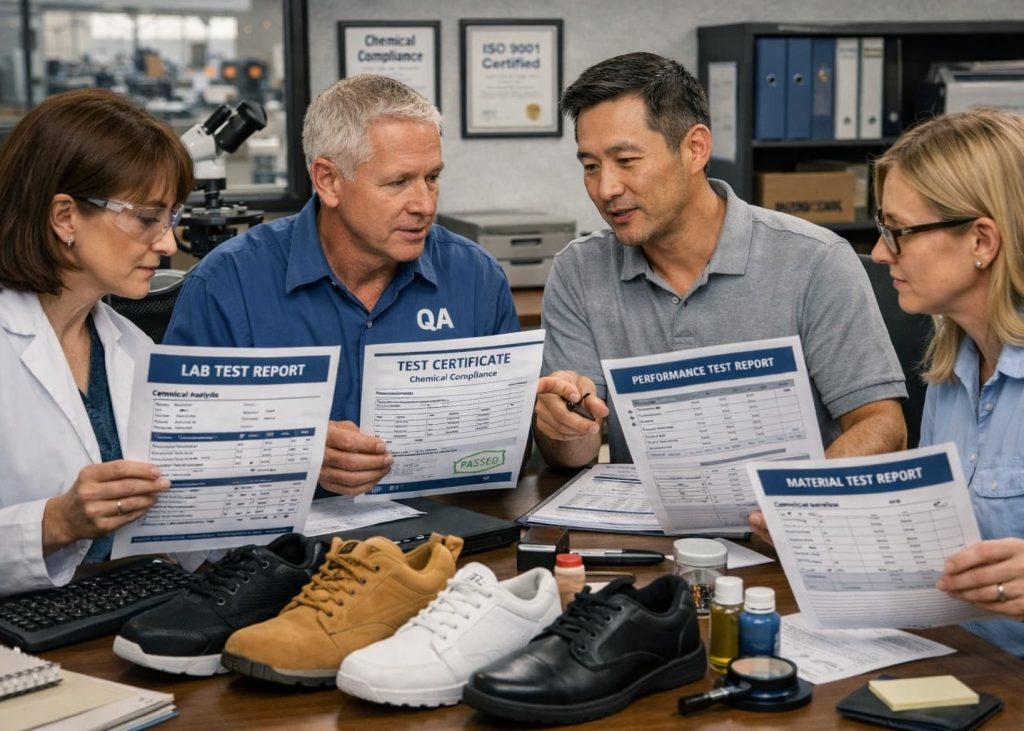
Product testing has become a standard requirement in the global footwear industry. Most international brands require documented evidence that footwear products comply with applicable performance, safety, chemical, and regulatory standards before shipment approval.
Test reports provide objective confirmation that products meet buyer specifications and regulatory requirements. Documentation teams must ensure that all required reports are available, approved, and linked to the correct shipment before export release.
Depending on buyer requirements, test reports may cover:
- Physical performance testing
- Chemical compliance testing
- Durability testing
- Bond strength testing
- Slip resistance testing
- Flex testing
- Color fastness testing
- Restricted substance testing
- Packaging compliance testing
Documentation personnel should verify that the laboratory report matches:
- Style number
- Material reference
- Production batch
- Testing standard
- Buyer protocol
- Approval status
Particular attention must be given to production timing.
Many brands require testing to be performed on actual production samples rather than development samples. A test report generated from an incorrect sample source may not satisfy buyer requirements. Factories should also maintain traceability between test reports and production lots. This linkage becomes valuable during customer audits, regulatory inspections, or complaint investigations.
Many footwear manufacturers now integrate laboratory approvals directly into ERP systems. Shipment documentation cannot proceed until all mandatory testing requirements receive approval.
Key Control Points
- Verify report validity and approval status.
- Match reports with actual production styles.
- Confirm buyer-specific testing protocols.
- Maintain traceability to production batches.
Pro Tip: Use automated document comparison tools to identify inconsistencies between invoices, packing lists, and purchase orders.


Material Safety Data Sheet (MSDS) Documentation
Many footwear materials contain chemicals that require safety documentation during transportation and international trade.
Material Safety Data Sheets (MSDS), sometimes referred to as Safety Data Sheets (SDS), provide detailed information regarding:
- Chemical composition
- Handling procedures
- Storage requirements
- Transportation classifications
- Emergency measures
- Hazard identification
- Environmental considerations
Although finished footwear products may not always require MSDS documentation, certain materials used during production or shipped with products may require compliance documentation depending on destination regulations.
Common footwear-related materials requiring safety documentation include:
- Adhesives
- Primers
- Solvents
- Cleaning chemicals
- Certain coatings
- Specialty inks
- Hazardous substances
Documentation teams work closely with suppliers and chemical manufacturers to obtain the latest approved versions of safety documents.
Version control is especially important because regulatory requirements frequently change.
Using outdated safety documentation can create customs delays or regulatory compliance issues. Digital document management systems help ensure that only current approved versions remain available for shipment processing.
Key Control Points
- Use current approved MSDS versions.
- Verify transportation classifications.
- Confirm destination-country requirements.
- Maintain supplier documentation records.
Pro Tip: Maintain a regulatory compliance calendar that tracks certificate expiration dates and testing renewal requirements.


Certificate of Origin Preparation
The Certificate of Origin (COO) identifies the country where the footwear products were manufactured. This document plays a major role in international trade because many countries apply different duty rates based on product origin.
Footwear factories exporting globally often ship products under various trade agreements. Therefore, origin documentation must be prepared carefully and accurately.
The Certificate of Origin typically includes:
- Exporter information
- Importer information
- Product description
- Quantity information
- Country of manufacture
- Trade agreement references
- Authorized certification details
Incorrect origin declarations can result in:
- Customs penalties
- Duty reassessments
- Shipment delays
- Buyer disputes
- Regulatory investigations
Documentation teams must verify that origin claims align with manufacturing records and applicable trade rules.
Many countries now require electronic certificate submission systems. Consequently, factories increasingly use digital trade platforms to generate and manage origin documentation. For multinational footwear sourcing programs, origin verification has become particularly important because production may involve materials from multiple countries while assembly occurs in another country.
Key Control Points
- Verify manufacturing country records.
- Confirm trade agreement eligibility.
- Ensure customs compliance.
- Validate certificate authorization.
Pro Tip: Conduct weekly documentation audits instead of waiting until shipment week. Early detection significantly reduces export risks.


Letter of Credit (LC) Compliance Verification
For many footwear export transactions, especially large-volume international orders, payment occurs through a Letter of Credit (LC). Under LC arrangements, banks review shipment documents before releasing payment. Even minor documentation discrepancies may result in payment delays or rejection. As a result, LC compliance verification becomes a critical responsibility before shipment submission.
Documentation teams carefully review:
- Invoice details
- Packing lists
- Shipping dates
- Certificate requirements
- Product descriptions
- Quantity declarations
- Origin information
- Vessel details
Every document must match LC requirements exactly.
Common LC-related errors include:
- Incorrect spelling
- Quantity differences
- Date mismatches
- Missing signatures
- Inconsistent product descriptions
- Missing supporting documents
Many experienced exporters perform a dedicated LC audit before final document submission.
This audit typically involves cross-functional participation from:
- Documentation department
- Finance department
- Export department
- Logistics department
- Commercial department
A structured verification process significantly reduces payment risks and shipment disputes.
Key Control Points
- Review all LC clauses carefully.
- Verify consistency across all documents.
- Check signatures and approvals.
- Complete LC audit before submission.
Pro Tip: Assign a dedicated documentation coordinator for every major customer to improve accountability and reduce communication gaps.

Digital Document Management Systems
Modern footwear factories manage thousands of documents annually. Manual document storage methods often create inefficiencies, retrieval difficulties, and version-control problems. Digital Document Management Systems (DMS) help factories maintain control over export documentation throughout the shipment lifecycle.
A well-designed system allows authorized users to:
- Upload documents
- Track revisions
- Control approvals
- Monitor status
- Retrieve records instantly
- Manage audit trails
- Prevent unauthorized changes
Digital systems improve efficiency because information becomes accessible across departments without physical document transfers.
Common documents stored electronically include:
- Packing lists
- Commercial invoices
- Test reports
- Certificates
- Audit reports
- Purchase orders
- Shipping instructions
- Compliance approvals
Cloud-based systems have become increasingly popular because they support global access and improve business continuity.
Furthermore, buyer audits frequently require rapid retrieval of historical shipment records. Factories using organized digital systems can respond significantly faster than those relying on paper-based archives.
Key Control Points
- Control document access permissions.
- Maintain revision history.
- Ensure regular data backups.
- Archive records systematically.
Pro Tip: Use automated document comparison tools to identify inconsistencies between invoices, packing lists, and purchase orders.


Documentation Audit Before Shipment Release
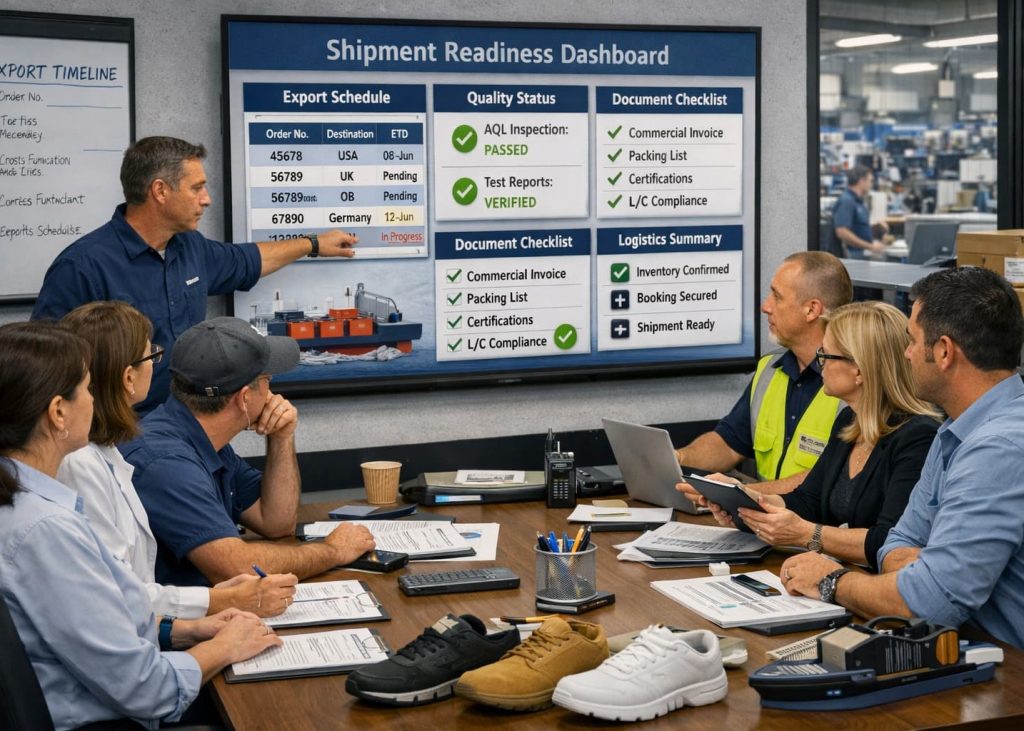
Before shipment authorization, leading footwear manufacturers conduct a comprehensive documentation audit. This audit functions as the final verification stage before products enter the export process. The objective is straightforward: identify and correct documentation issues before they become shipping problems.
During the audit, documentation teams review:
- Purchase orders
- Packing lists
- Commercial invoices
- Certificates
- Test reports
- Shipping instructions
- Compliance approvals
- Customs documentation
Many factories utilize standardized audit checklists to ensure consistency and reduce the possibility of omissions. The documentation audit also confirms that all mandatory approvals have been completed by responsible departments.
Only after successful audit completion should shipment release authorization be granted. Every document is checked against approved master records.
Key Control Points
- Conduct independent document review.
- Verify all supporting documents.
- Confirm departmental approvals.
- Resolve discrepancies before release.
Pro Tip: Maintain a regulatory compliance calendar that tracks certificate expiration dates and testing renewal requirements.


Pre-Shipment Documentation Checklist
As shipment dates approach, footwear factories must ensure that every required document has been prepared, reviewed, approved, and filed correctly. This is achieved through a structured Pre-Shipment Documentation Checklist.
The checklist serves as a control mechanism that prevents missing documents, incorrect information, and approval gaps from disrupting shipment schedules. Since export shipments often involve multiple departments, the checklist provides a common reference point for all stakeholders.
A comprehensive footwear shipment checklist typically includes verification of:
- Purchase Order accuracy
- Production completion status
- Final AQL approval
- Packing List approval
- Commercial Invoice approval
- Certificate of Origin availability
- Test Report completion
- Certificate of Conformity approval
- MSDS/SDS availability (if applicable)
- Shipping Mark approval
- Carton Label verification
- Freight booking confirmation
- Customs documentation readiness
- Letter of Credit compliance (if applicable)
- Buyer shipping approval
Each item should include responsible ownership and sign-off authority. This accountability ensures that critical documentation does not remain incomplete because of unclear responsibilities.
Many factories implement a “No Checklist Completion, No Shipment Release” policy. This practice significantly reduces last-minute documentation crises.
Additionally, digital checklist systems provide better visibility by allowing management teams to monitor document readiness status in real time.
Key Control Points
- Use customer-specific documentation checklists.
- Assign document ownership clearly.
- Obtain all required approvals before shipment.
- Prevent shipment release until checklist completion.
Pro Tip: Conduct weekly documentation audits instead of waiting until shipment week. Early detection significantly reduces export risks.


Shipping Readiness Review Meeting
Documentation readiness alone does not guarantee shipment readiness. Therefore, leading footwear manufacturers conduct a formal Shipping Readiness Review Meeting before container loading authorization. This cross-functional review ensures that all operational, quality, logistics, and compliance requirements have been completed.
The meeting typically includes representatives from:
- Production
- Quality Assurance
- Planning
- Warehouse
- Logistics
- Documentation
- Commercial Department
- Senior Management
During the review, the team evaluates shipment readiness from multiple perspectives.
Key discussion topics include:
Production Status
The team confirms that all ordered quantities have been completed and packed according to buyer requirements.
Quality Status
Final inspection approvals, AQL audit reports, corrective actions, and quality release status are reviewed
.
Documentation Status
The documentation team confirms that all required export documents have been prepared and approved.
Logistics Status
Freight bookings, container availability, vessel schedules, and port cutoff dates are verified.
Compliance Status
Testing reports, certifications, and buyer approvals are confirmed before shipment authorization. Only after all departments confirm readiness should management approve shipment release.
This structured review helps prevent costly situations where products are physically ready but documentation or logistics requirements remain incomplete.
Key Control Points
- Conduct cross-functional review meetings.
- Confirm readiness across all departments.
- Review vessel cutoff deadlines.
- Document management approval decisions.
Pro Tip: Create a “Shipment War Room” during peak shipping seasons where production, logistics, quality, and documentation teams review shipment readiness daily.


Departmental Responsibilities in Shipping Readiness

Successful shipping readiness depends on coordinated teamwork across multiple factory functions. Each department plays a distinct role in ensuring shipment accuracy and compliance.
Production Department Responsibilities
The production team confirms that manufacturing quantities match purchase order requirements and that all products have completed required operations.
Production teams also support traceability verification when documentation personnel require manufacturing records.
Key Control Points
- Confirm production completion.
- Verify quantity accuracy.
- Maintain manufacturing records.
- Support shipment traceability.
Quality Department Responsibilities
The quality department verifies that products have successfully passed all inspection requirements before shipment approval. Quality personnel provide: Final inspection reports, AQL audit reports, Corrective action closure records, Quality release authorization. Without quality approval, shipment documentation should not proceed.
Key Control Points
- Verify final quality approval.
- Maintain inspection records.
- Confirm corrective action closure.
- Support buyer audit requirements.
Pro Tip: Track documentation-related shipment delays as a Key Performance Indicator (KPI). Measuring delays often reveals recurring process weaknesses.


Warehouse Department Responsibilities
The warehouse team controls physical inventory and shipment preparation activities.
Responsibilities include:
- Carton verification
- Pallet verification
- Shipment consolidation
- Inventory reconciliation
- Container preparation
Warehouse records frequently serve as the source data for packing list preparation.
Key Control Points
- Verify carton counts.
- Confirm physical inventory accuracy.
- Maintain pallet traceability.
- Support shipment reconciliation.
Logistics Department Responsibilities
The logistics team coordinates transportation and shipping activities.
Their responsibilities include:
- Freight booking
- Carrier coordination
- Vessel scheduling
- Container arrangements
- Port communication
- Customs coordination
Logistics personnel must closely monitor shipping deadlines because vessel cutoff failures can create significant delays.
Key Control Points
- Confirm booking status.
- Monitor vessel schedules.
- Track port cutoff deadlines.
- Coordinate carrier communication.
Documentation Department Responsibilities
The documentation department acts as the central control point for export paperwork.
Responsibilities include:
- Document preparation
- Document verification
- Compliance verification
- Record management
- Customer documentation submission
This department ensures that every document accurately reflects shipment details and complies with customer requirements.
Key Control Points
- Verify document accuracy.
- Maintain version control.
- Coordinate approvals.
- Ensure compliance readiness.
Pro Tip: Use barcode-driven carton management systems to eliminate manual quantity reconciliation.
Develop customer-specific documentation manuals to reduce dependency on individual employee knowledge.


Incorrect Product Descriptions
Different wording across documents can create customs complications. For example, one document may reference: “Sports Footwear”, while another states: “Casual Athletic Shoes“. Although both may describe the same product, inconsistencies often trigger questions during customs review.
Key Control Points
- Standardize descriptions.
- Use approved customer terminology.
- Apply document templates consistently.
Expired Certificates
Expired test reports, compliance certificates, or conformity documents can stop shipment approval processes.
This issue becomes more common when factories manage multiple brands and regulatory requirements.
Key Control Points
- Monitor expiration dates.
- Maintain compliance calendars.
- Review certificates before shipment planning.
Incorrect Shipping Marks
Carton markings that differ from shipping documents frequently create warehouse and distribution problems. Incorrect shipping marks may result in:
- Inventory misidentification
- Receiving delays
- Buyer complaints
- Distribution center confusion
Key Control Points
- Verify shipping mark approval.
- Match carton labels with documentation.
- Conduct pre-shipment verification audits.
Pro Tip: Perform a mock customs review before major export shipments to identify potential compliance risks.
Establish escalation procedures for unresolved documentation discrepancies at least 72 hours before vessel cutoff.

Best Practices for Documentation Excellence
World-class footwear manufacturers treat documentation as a strategic business process rather than a clerical activity.
The most successful factories typically implement several best practices:
Establish Standardized Document Templates
Standardized formats improve consistency and reduce preparation errors.
Implement Digital Approval Workflows
Electronic approvals improve visibility and accelerate document processing.
Create Customer-Specific Documentation Profiles
Different customers require different documents. Customer profiles simplify compliance management.
Conduct Internal Documentation Audits
Routine audits identify process weaknesses before shipment deadlines approach.
Train Cross-Functional Teams
Documentation accuracy improves when production, quality, warehouse, and logistics teams understand documentation requirements.
Utilize ERP Integration
Integrated systems reduce manual entry and improve data consistency across departments.
Maintain Electronic Archives
Digital archives improve retrieval speed during audits, disputes, and customer inquiries.
Key Control Points
- Standardize document preparation processes.
- Automate approvals whenever possible.
- Train teams regularly.
- Continuously monitor documentation performance.
Pro Tip: Maintain backup copies of all export documents in secure cloud storage for rapid retrieval during customs or buyer audits.
Require both Production Manager and Quality Manager sign-off on the Pre-Shipment Documentation Checklist before shipment authorization.


Conclusion
Documentation and shipping readiness represent the final administrative control stage before footwear products leave the factory and enter the global supply chain. Although production, quality control, packing, and final inspections determine product quality, accurate documentation determines whether the shipment can move smoothly through customs, logistics networks, and customer receiving operations.
Successful footwear manufacturers recognize that documentation is not simply paperwork. It is a critical business process that protects delivery performance, customer satisfaction, regulatory compliance, and financial recovery.
In the next article, Container Stuffing in Footwear Manufacturing – Full Shoe Assembly Series, we will examine how footwear factories load export containers, maximize container utilization, protect products during transportation, maintain shipment traceability, and ensure safe global delivery from factory to destination markets.


Frequently Asked Questions (FAQs)
Why is documentation considered as important as product quality in footwear exports?
Even if footwear products pass all quality inspections, shipments can still be delayed or rejected due to documentation errors. Customs authorities, freight forwarders, banks, and buyers rely on documentation to verify compliance, ownership, value, and shipment accuracy.
What is the most important document in a footwear export shipment?
There is no single most important document because each serves a different purpose. However, the Commercial Invoice, Packing List, Certificate of Origin, and Final AQL Approval are typically considered critical documents required for customs clearance and buyer acceptance.
What happens if the packing list quantity does not match the commercial invoice?
Quantity discrepancies can trigger customs inspections, buyer disputes, shipment holds, payment delays, and additional verification requests. Therefore, factories should perform carton reconciliation before document issuance.
Why do footwear brands require test reports before shipment?
Test reports verify that footwear products comply with performance, safety, chemical, and regulatory requirements. These reports help brands reduce product liability risks and ensure compliance with destination-country regulations.
What is a Certificate of Origin in footwear exports?
A Certificate of Origin confirms the country where the footwear was manufactured. Customs authorities use this document to determine duty rates, trade agreement eligibility, and import compliance requirements.
How can footwear factories reduce documentation-related shipment delays?
Factories can reduce delays by implementing digital document management systems, standardized templates, customer-specific checklists, cross-functional shipment reviews, and pre-shipment documentation audits.
Why is a pre-shipment documentation checklist necessary?
The checklist ensures that all required documents, approvals, certifications, and shipment records are completed before container loading. It acts as the final control mechanism to prevent shipment delays and compliance failures.