Footbed / Sock Attaching in Footwear Manufacturing – Full Shoe Assembly Series
Every shoe is judged first by how it feels on the foot. Regardless of how advanced the outsole, upper materials, or construction methods may be, the wearer immediately notices the comfort, fit, and underfoot support provided inside the shoe. This is why footbed or sock attaching is a critical operation in footwear manufacturing.
The footbed, often referred to as the sock liner, forms the direct interface between the foot and the shoe. It influences cushioning performance, pressure distribution, moisture management, interior aesthetics, and overall wearing comfort. A properly attached footbed creates a smooth, stable surface that enhances the footwear experience, while poor attachment can result in wrinkles, movement, uneven support, and premature wear.
Although the operation itself appears straightforward, achieving consistent quality requires careful control of material preparation, adhesive application, positioning accuracy, and pressing conditions. Manufacturers must ensure that every footbed is correctly aligned and securely bonded to prevent internal slippage and maintain the intended comfort characteristics throughout the product’s life.
As consumer expectations for comfort continue to rise across athletic, casual, safety, and lifestyle footwear categories, footbed attachment has become an important quality-control process that directly influences product performance, customer satisfaction, and brand reputation.
Understanding Footbed / Sock Attaching in Footwear Manufacturing
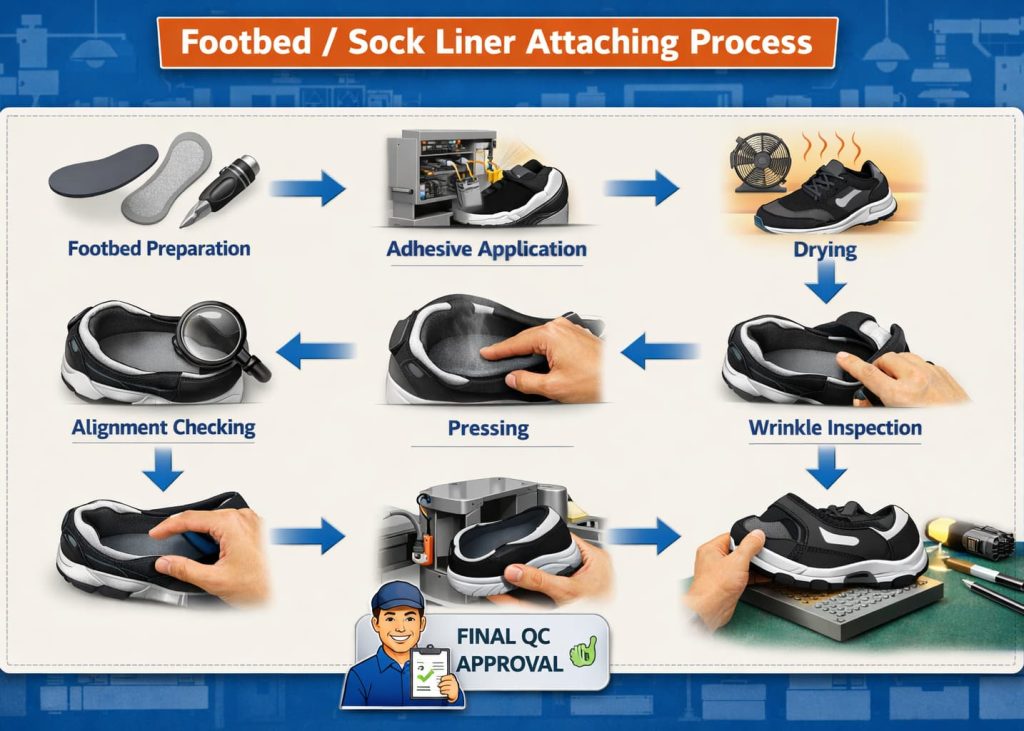
The footbed or sock liner is the internal top layer placed inside the shoe above the lasting board or strobel construction. Depending on the footwear category, this component may provide cushioning, moisture absorption, comfort enhancement, branding visibility, arch support, or finishing appearance.
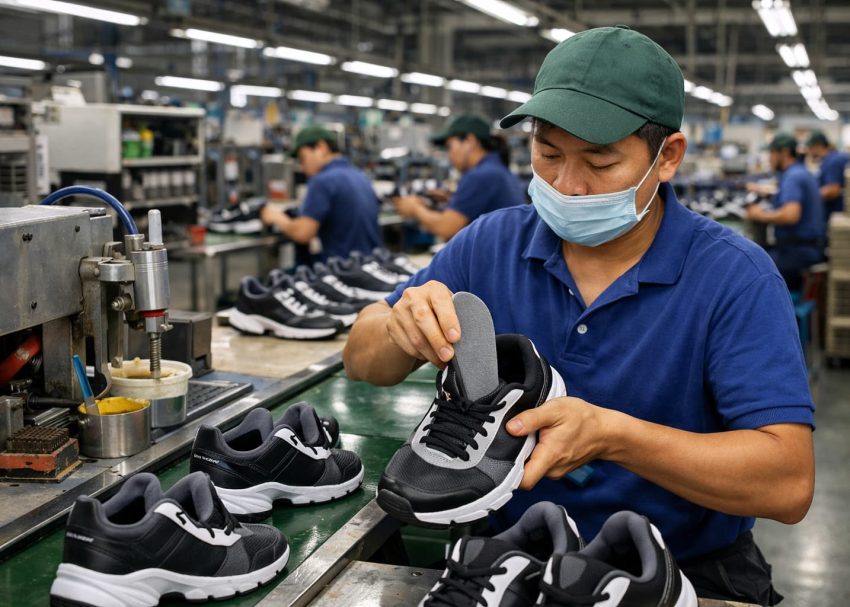
The operation involves accurately positioning and securing the footbed inside the shoe using adhesive bonding temporarily or Permanent or just Insert without Adhesive. Operators must ensure wrinkle-free placement while maintaining correct alignment with heel centerlines and toe direction.
In athletic footwear, sock liners commonly use molded EVA, PU foam, Ortholite, latex foam, or memory foam constructions, just inserted without adhesive. In formal footwear, thinner leather or synthetic socks are frequently attached primarily for appearance and smooth interior finishing. Safety footwear often includes anti-fatigue or impact-resistant footbeds with additional attachment requirements. Since the consumer’s foot remains in direct contact with this component, even minor defects become immediately noticeable during wear trials.
Key Control Points
- Ensure correct left-right matching before insertion
- Verify adhesive spread consistency across bonding zones
- Maintain wrinkle-free placement during pressing
- Check heel seating alignment after attachment
Expert Tip: Use vacuum-assisted positioning jigs for highly contoured footbeds. This improves wrinkle control and placement repeatability in sports footwear production.
Importance of Accurate Footbed Positioning
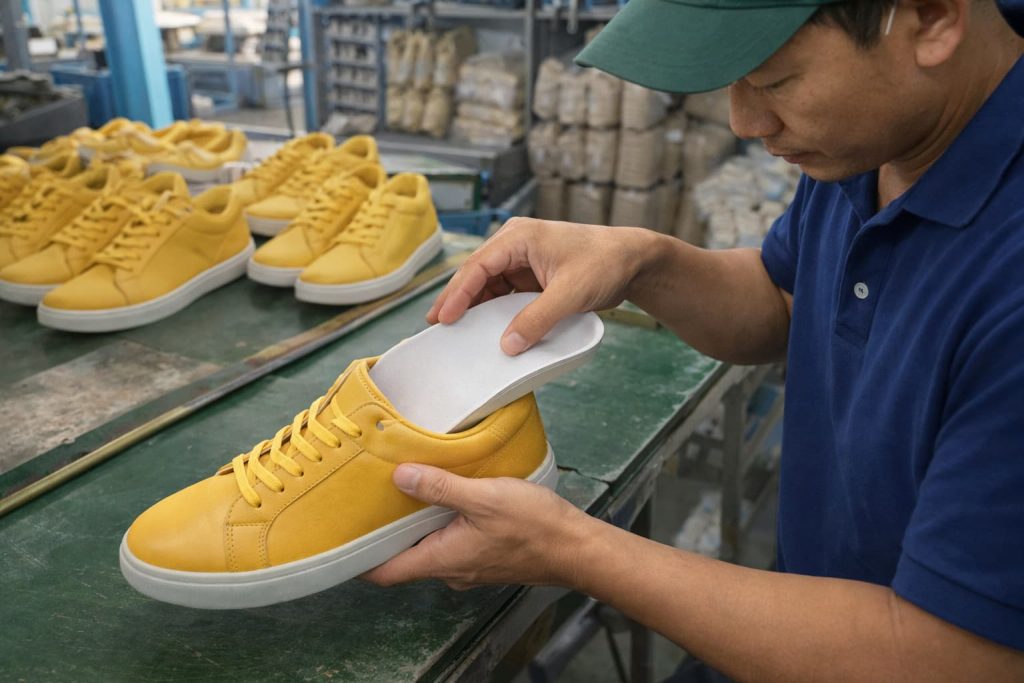
Proper positioning controls both comfort performance and product appearance. If the footbed shifts even slightly from the centerline, the wearer may experience uneven pressure distribution, heel instability, or arch discomfort. In addition, misalignment affects visual presentation inside the shoe. Premium brands maintain strict cosmetic standards because consumers often inspect the internal finish immediately after opening the shoe box.
Factories also focus heavily on toe area alignment. Incorrect placement can create curling edges or lifted front corners that become uncomfortable during walking. Similarly, poor heel seating may produce movement noise, slippage, or uneven compression during use.
Moreover, incorrect attachment can create long-term durability failures. Loose bonding gradually weakens during repeated flexing, sweating, and temperature exposure. Eventually, the footbed may detach completely, resulting in customer complaints and return claims. For this reason, many factories classify sock attaching as both a comfort-critical and customer-perception-critical operation.
Key Control Points
- Align heel centerline precisely with shoe center
- Prevent toe-side lifting after pressing
- Verify edge seating around contour curves
- Confirm no foam twisting inside cavity
Pro Tip: Conduct periodic shear testing instead of relying only on visual inspection. Many bonding failures become visible only after repeated flexing.
Footbed and Sock Materials Used in Manufacturing
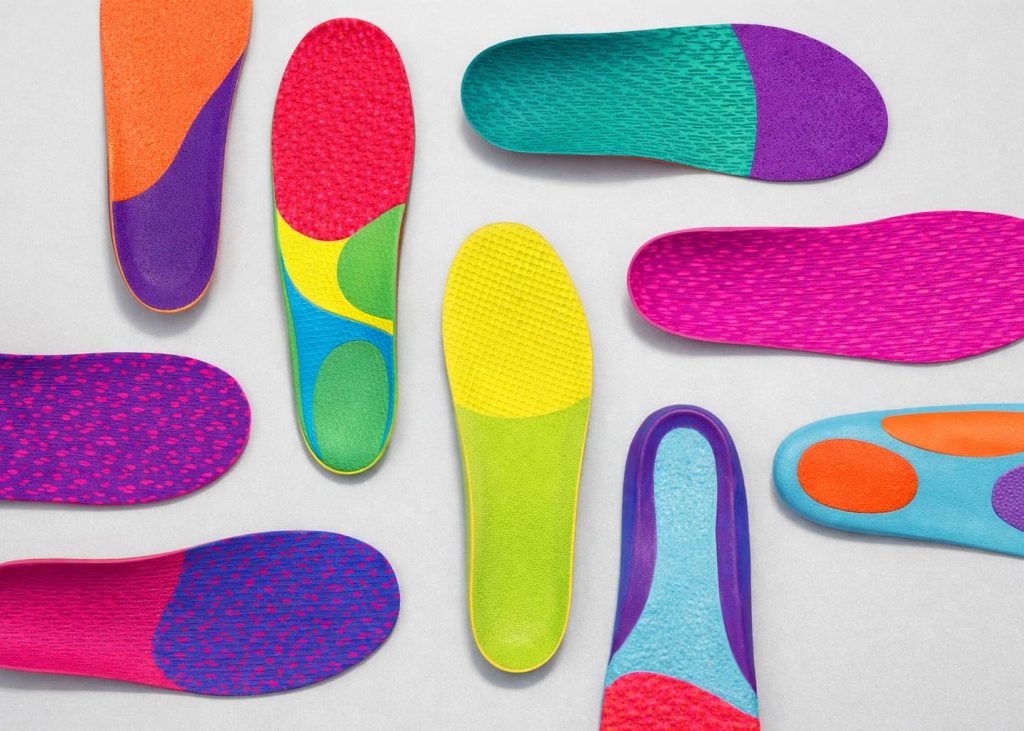
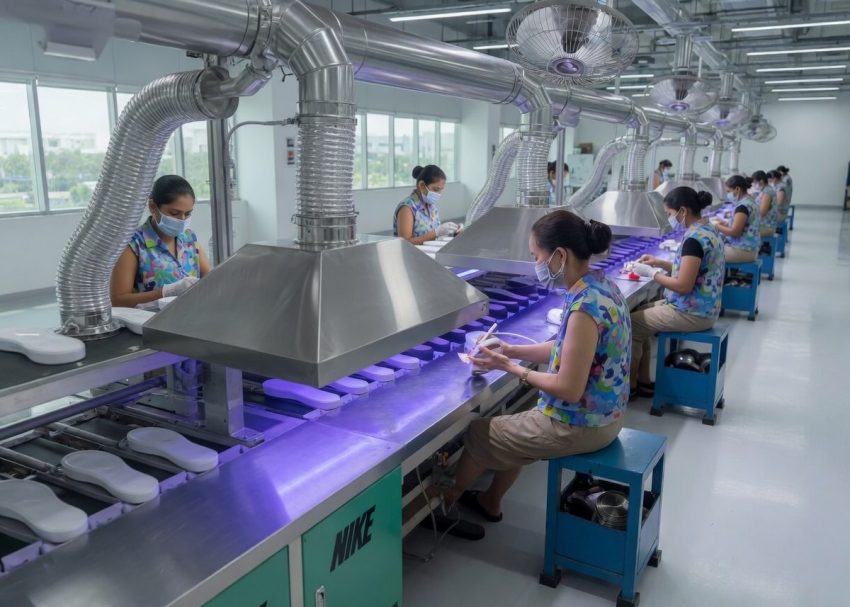
Different footwear categories require different sock constructions based on comfort targets, cost level, and performance requirements.
Sports footwear typically uses molded EVA or PU footbeds with cushioning zones, perforation holes, moisture control fabrics, and anti-slip bottom coatings. Running shoes frequently include contoured heel cups and arch support structures for better ergonomics.
Casual footwear commonly uses compressed foam with fabric lamination to improve comfort while maintaining cost efficiency. Meanwhile, formal footwear often applies thin synthetic, leather socks mainly for interior aesthetics and branding presentation.
Safety footwear uses higher-density constructions capable of supporting prolonged standing conditions. Some designs incorporate anti-static properties, puncture resistance layers, or energy-return cushioning systems.
Luxury footwear may include genuine leather sock liners combined with foam backing to provide premium comfort and moisture absorption. The material selection directly influences adhesive choice, pressing pressure, curing time, and bonding strength requirements.
Key Control Points
- Verify foam density consistency before use
- Check fabric lamination bonding condition
- Confirm material flexibility for curved interiors
- Ensure correct footbed thickness specification
Pro Tip: Use dedicated alignment templates for each size range to reduce operator dependency and improve consistency.
Adhesive Application Methods for Sock Attaching
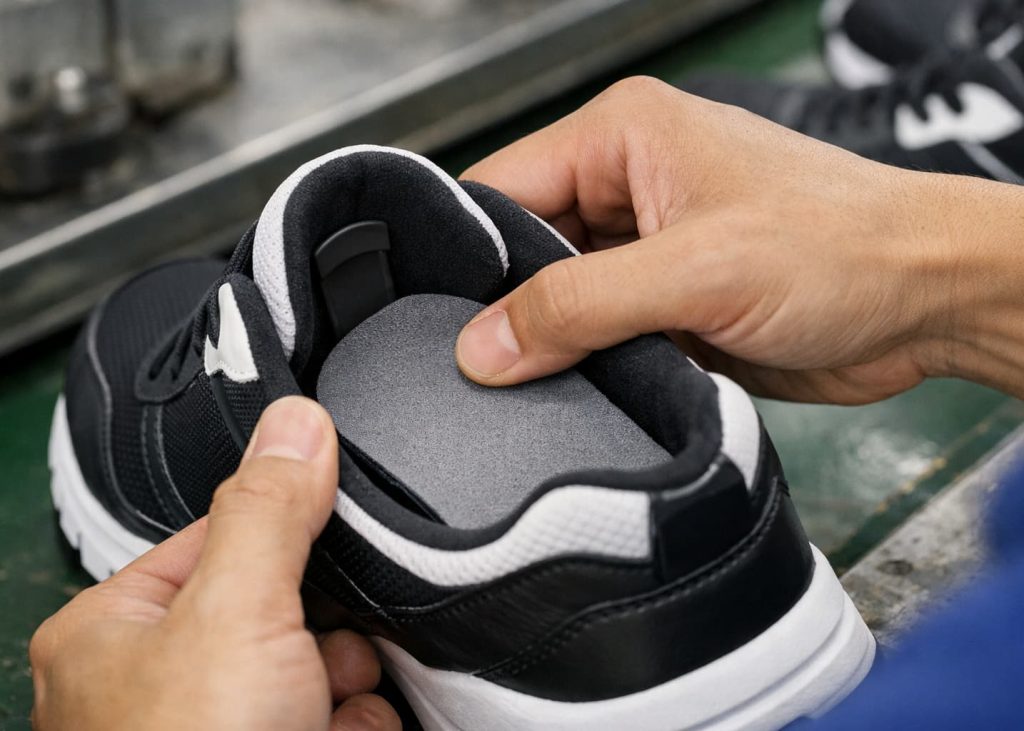
Adhesive application plays a major role in attachment reliability. Factories use different systems depending on production speed, footwear construction, and material compatibility. The most common method involves applying water-based or solvent-based adhesive to the shoe bottom interior and footbed underside. After drying to proper tack condition, operators position the sock carefully before pressing.
Some production lines use spray guns for faster adhesive coverage, while others use roller coating or brush application for better precision control. Automated dispensing systems are increasingly used in high-volume sports footwear factories to achieve consistent adhesive quantity.
Over-application creates seepage, hard spots, and visible glue stains. Under-application increases detachment risk during wear. Therefore, adhesive quantity control becomes extremely important. Temperature and humidity also influence adhesive performance. Poor environmental control can affect open time, tack level, and final bond strength.
Key Control Points
- Maintain consistent adhesive coating thickness
- Avoid adhesive contamination on top surface
- Monitor tack time before placement
- Control temperature and humidity during bonding
Pro Tip: Control adhesive room temperature carefully because unstable environmental conditions directly affect tack performance and bonding reliability.
Positioning and Alignment During Attachment
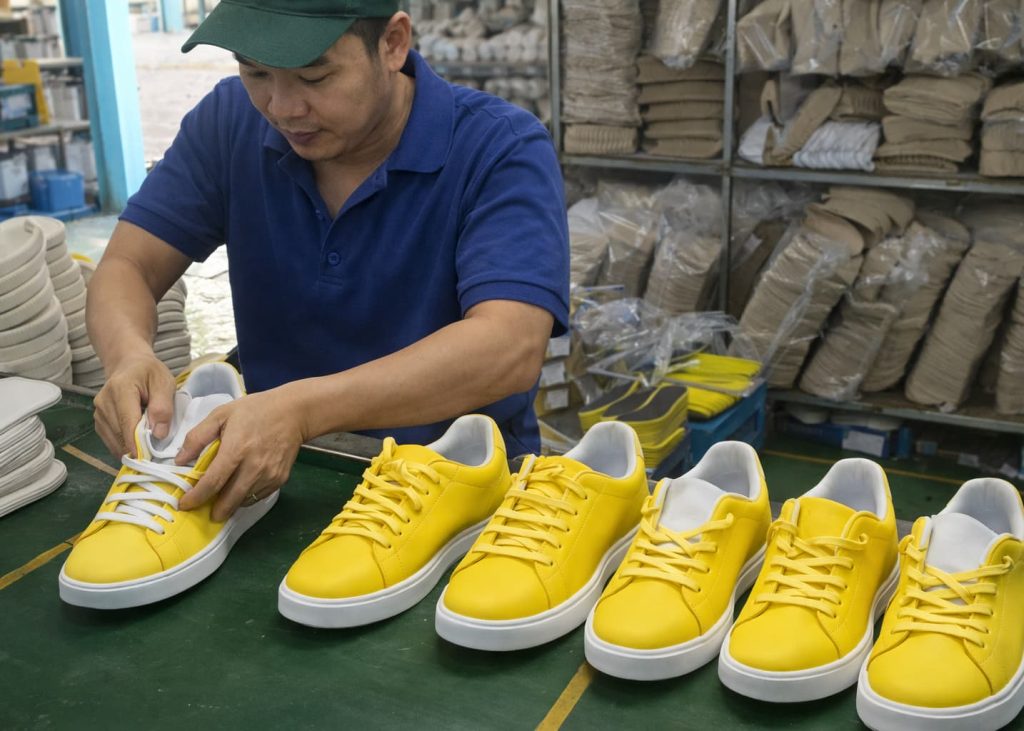
Positioning accuracy determines the final visual and functional quality of the shoe interior. The heel area is usually positioned first because it acts as the primary reference point. After heel seating, the operator gradually places the remaining portion toward the toe area while eliminating trapped air and wrinkles.
Factories producing premium athletic footwear often use dedicated alignment fixtures for each size to minimize operator variation. Additionally, curved sidewall designs require extra care because foam compression may distort positioning during pressing if alignment is not controlled properly.
Key Control Points
- Match heel curve with shoe contour accurately
- Eliminate trapped air during placement
- Prevent edge folding near toe spring area
- Use positioning templates for repeatability
Pro Tip: Introduce heel-first pressing methods to minimize trapped air and toe wrinkle formation.
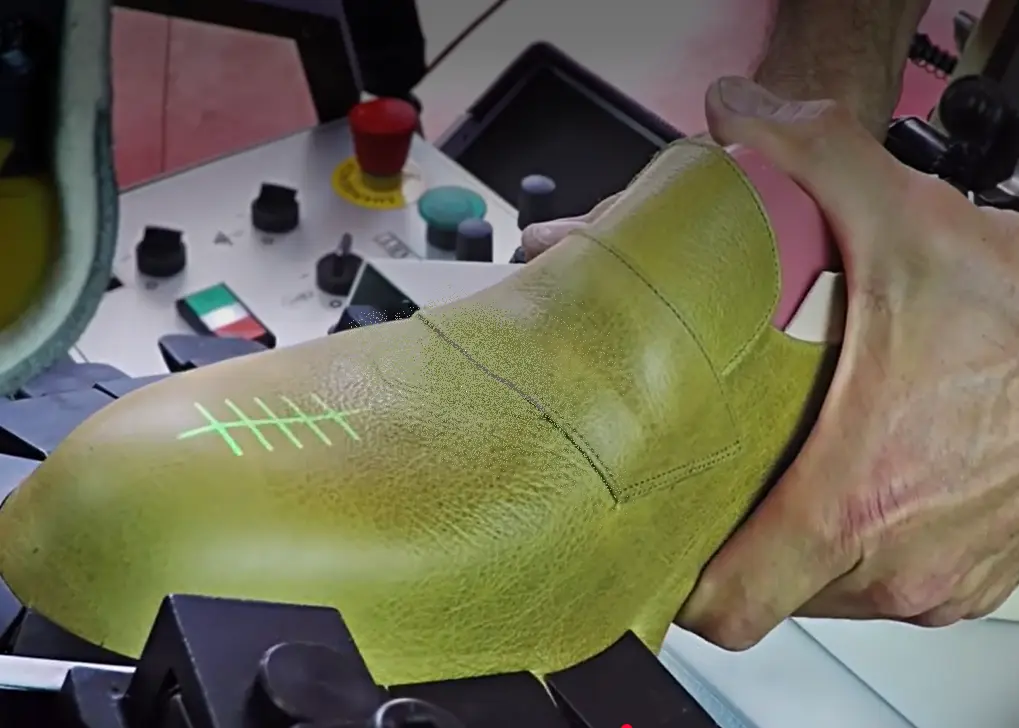
Pressing Operations After Sock Placement
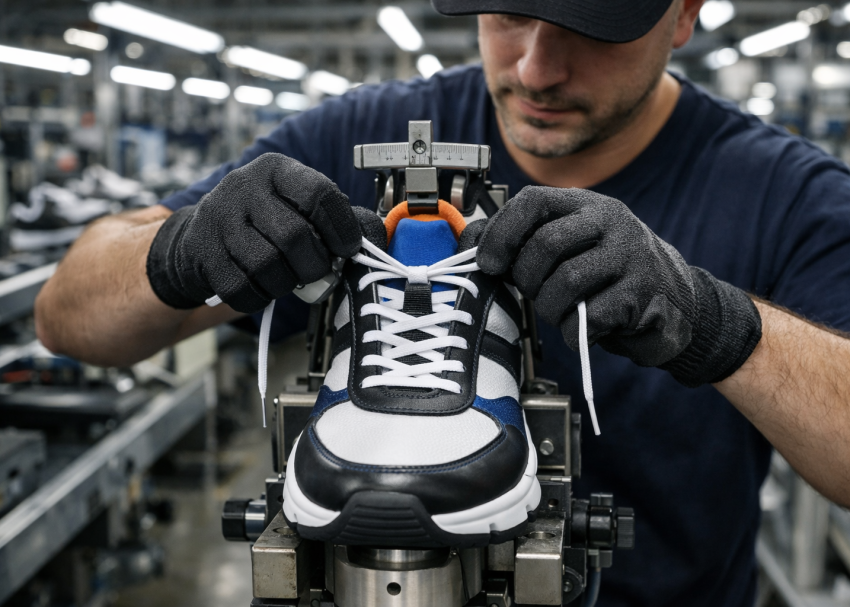
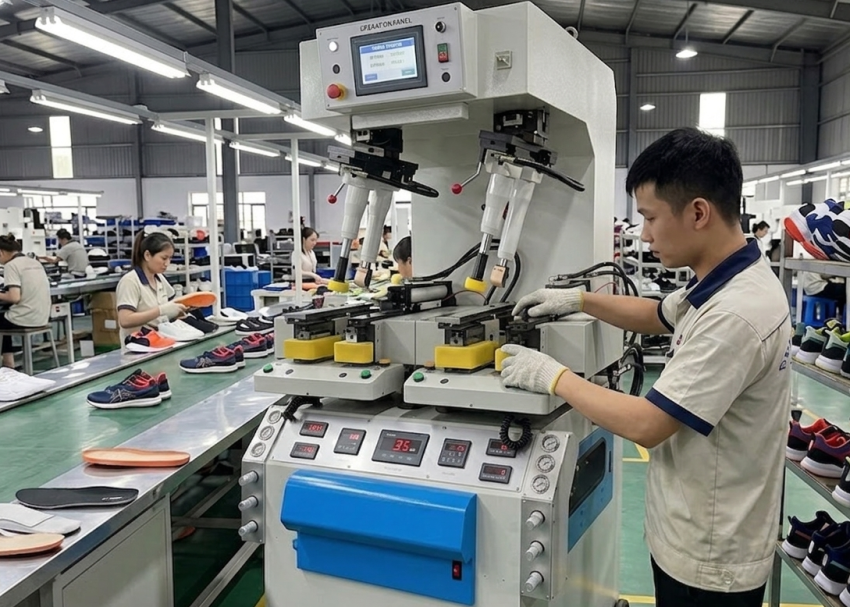
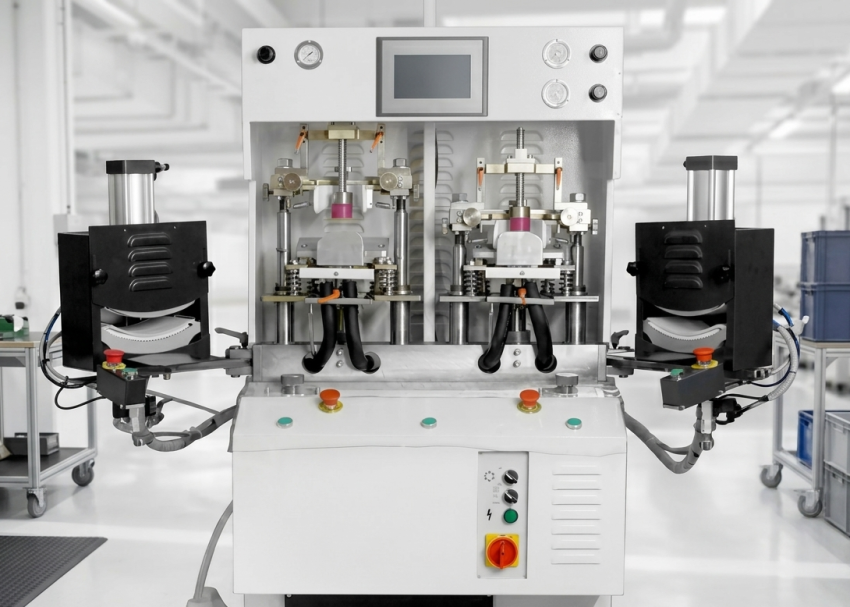
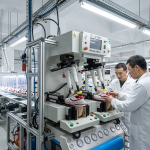
After positioning, the shoe enters the pressing stage to secure full adhesive contact between the footbed and internal shoe surface. Manual pressing is commonly used in small-scale production. However, high-volume factories prefer pneumatic or hydraulic pressing systems to improve consistency and reduce operator fatigue.
Pressing pressure must remain balanced. Excessive pressure can deform cushioning foam, while insufficient pressure creates weak bonding zones. Some factories use roller pressing systems that gradually compress the footbed from heel to toe. Pressing duration also affects bonding stability. Premature removal may weaken adhesion, especially in high-density foam constructions.
Key Control Points
- Maintain uniform pressure distribution
- Avoid foam collapse during compression
- Verify full edge bonding after pressing
- Monitor pressing cycle consistency
Pro Tip: Implement UV inspection lighting for light-colored sock liners to identify glue contamination more effectively.

Wrinkle Prevention and Surface Appearance Control
Wrinkle-free attachment is essential because internal surface irregularities directly affect wearer comfort. Even small wrinkles may cause discomfort, or pressure points during walking. Wrinkles usually occur because of improper positioning, uneven adhesive drying, incorrect pressing direction, or excessive material flexibility.
Factories reduce wrinkle formation by using pre-shaped footbeds, and gradual heel-to-toe pressing techniques. Operators must also control insertion speed carefully. Fast placement can trap air beneath the sock liner, creating bubbles or uneven bonding zones.
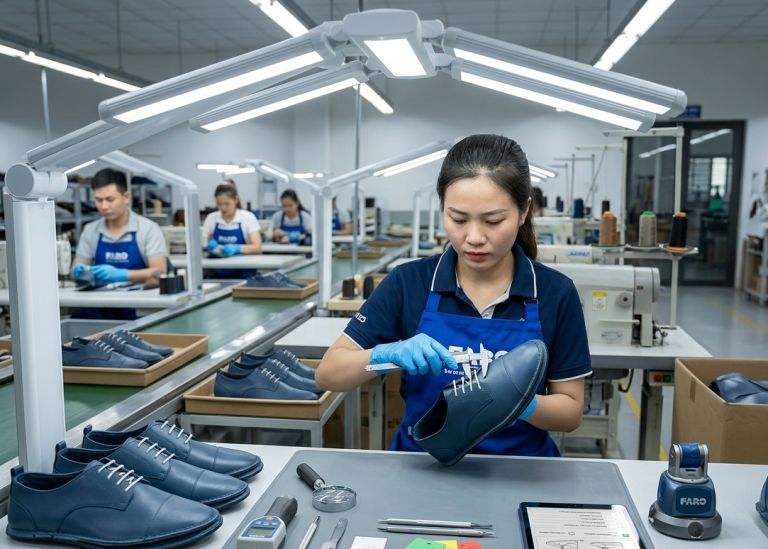
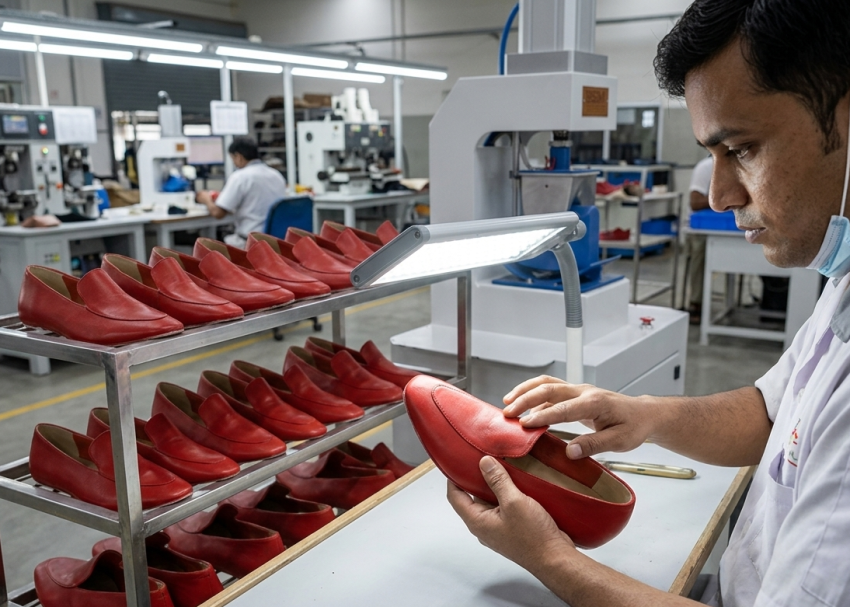
Visual inspection under proper lighting helps identify wrinkles, edge lifting, glue marks, and contamination immediately after pressing. Premium footwear brands often use tactile hand inspection in addition to visual inspection because minor unevenness becomes noticeable during actual wear.
Key Control Points
- Inspect toe flex area for wrinkle formation
- Remove trapped air before pressing completion
- Verify smooth surface under inspection lighting
- Prevent adhesive lumps beneath sock liner
Pro Tip: Store molded footbeds properly before use because deformation during storage can affect final seating accuracy.
Bond Strength Testing and Quality Verification
Quality verification ensures the attached footbed remains stable throughout the product’s life cycle. Factories conduct periodic shear tests and peel tests to verify adhesive performance. These tests measure the bonding strength between the sock liner and shoe base under controlled force conditions.
Inspectors also perform manual pull checks around heel corners and toe edges. Weak zones frequently appear in high-flex regions or curved sidewall areas. Wear simulation testing may also be conducted for performance footwear. This helps evaluate bond durability under repetitive flexing and perspiration exposure.
In addition, dimensional verification ensures the footbed remains properly seated after pressing and curing. Comfort-focused brands monitor return claim data carefully because loose footbeds are among the most common internal comfort complaints in footwear manufacturing.
Key Control Points
- Perform periodic peel strength verification
- Inspect heel and toe edge adhesion manually
- Monitor high-flex zones for weak bonding
- Record defect trends for corrective action
Pro Tip: Track return claims related to loose footbeds separately to identify recurring process weaknesses early
Common Defects in Footbed / Sock Attaching
Several manufacturing defects can occur during this operation if process controls are weak. Loose bonding is one of the most common issues and usually results from poor adhesive tack, contamination, or insufficient pressure. Wrinkling occurs when the sock liner shifts during insertion or pressing.
Misalignment defects create uneven appearance and poor comfort perception. Glue seepage causes cosmetic rejection, especially in light-colored socks. Air bubbles may develop because of rapid placement or poor pressing technique. Additionally, curled toe edges may appear when the material memory exceeds bonding strength.
Key Control Points
- Monitor glue seepage frequency
- Check edge lifting near toe curves
- Identify air bubbles during inspection
- Verify correct curing before packing
Productivity and Line Balancing Considerations
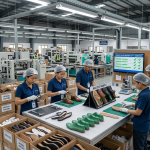
Although sock attaching appears to be a low-complexity operation, poor line balancing can create assembly bottlenecks. Cycle time depends on adhesive drying, placement accuracy, pressing duration, and inspection frequency. High-speed lines often separate adhesive preparation and insertion operations to improve efficiency.
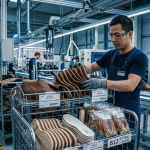
Many factories use pre-coated footbeds to reduce operator workload and maintain consistent adhesive quantity. However, manual skill still remains important for complex constructions, fashion footwear, and contoured designs requiring visual adjustment during placement.
Efficient workstation ergonomics also improve operator consistency and reduce fatigue-related alignment errors.
Key Control Points
- Balance drying time with line speed
- Separate adhesive and placement stations when needed
- Maintain ergonomic operator working height
- Monitor productivity versus defect ratio
Conclusion
Footbed / sock attaching is far more than a simple finishing operation inside footwear manufacturing. It directly influences comfort perception, cushioning feel, internal appearance, and long-term customer satisfaction. Accurate positioning, proper adhesive control, wrinkle prevention, and reliable bonding are essential for achieving consistent product quality. Even minor process variation can create visible comfort defects that immediately affect consumer experience.
As footwear constructions become more comfort-focused and performance-oriented, factories continue investing in better positioning systems, advanced adhesives, vacuum-assisted attachment methods, and automated pressing technologies.
In the next blog of TheFootwearEdge Full Shoe Assembly Series, we will discuss Repairing / Cleaning in Footwear Manufacturing, where final appearance correction, defect removal, stain cleaning, and finishing preparation are performed before inspection and packing.
Frequently Asked Questions – FAQs
What is the purpose of footbed or sock attaching in footwear manufacturing?
The process secures the internal footbed or sock liner inside the shoe to improve comfort, cushioning stability, interior appearance, and underfoot support.
Which adhesives are commonly used for sock attaching?
Factories commonly use water-based adhesives, solvent-based adhesives, pressure-sensitive systems, or automated spray adhesive applications depending on material compatibility.
Why do footbeds become loose after production?
Loose footbeds usually result from insufficient adhesive coverage, incorrect tack timing, contamination, weak pressing pressure, or poor curing conditions.
How do factories prevent wrinkles during sock attaching?
Factories use vacuum-assisted positioning, controlled heel-to-toe placement, balanced pressing pressure, and proper material conditioning to reduce wrinkles.
What materials are used for sock liners?
Common materials include EVA foam, PU foam, Ortholite, latex foam, synthetic leather, genuine leather, textile laminations, and memory foam constructions.
Why is alignment important in sock attaching?
Incorrect alignment affects comfort balance, heel seating, arch positioning, and overall internal appearance, which can lead to customer dissatisfaction.
What quality tests are performed after sock attaching?
Factories conduct peel tests, shear tests, manual pull checks, wrinkle inspection, alignment verification, and wear simulation testing for quality validation.