Chemical Washing Operations in Outsole Process: Outsole (Stock Fitting) Assembly Series
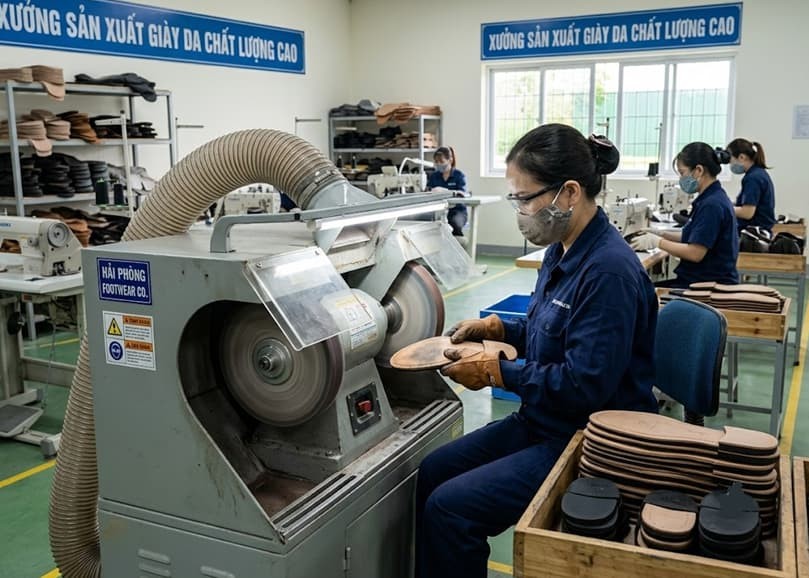
Before an outsole receives primer or adhesive, its bonding surface must be perfectly clean. In the previous article, Roughing and Buffing Operation in Outsole Process, the outsole surface was mechanically prepared by removing the outer skin and increasing surface roughness. However, mechanical preparation alone cannot eliminate mould release agents, oils, waxes, fingerprints, dust, and other contaminants. Therefore, footwear manufacturers perform chemical washing as the next essential operation.
Chemical washing creates a chemically clean bonding surface without damaging the outsole material. As a result, primers penetrate more uniformly, adhesives wet the surface more effectively, and final bond strength becomes significantly more consistent. When this process is controlled correctly, factories experience fewer bonding failures, reduced rework, and improved long-term product durability.

Purpose of Chemical Washing in Outsole Manufacturing
Chemical washing is a controlled surface-cleaning process performed after roughing and before primer application. Its objective is to remove contaminants that interfere with adhesive bonding while preserving the physical properties of the outsole.
Different outsole materials contain different levels of mould release compounds and processing additives. Consequently, the washing chemical must always match the outsole material. Using an unsuitable solvent may soften the surface, create stains, or reduce adhesion instead of improving it.
A properly washed outsole provides a clean, active surface that allows the primer and adhesive to develop maximum bond strength during shoe assembly.
Key Control Points
- Select the approved chemical for each outsole material.
- Wash only the bonding area.
- Prevent contamination after cleaning.
- Follow the specified drying time before the next operation.
Expert Tip:
Validate every cleaning chemical using laboratory bond testing before production.
Use colour-coded containers to prevent accidental chemical mix-ups.

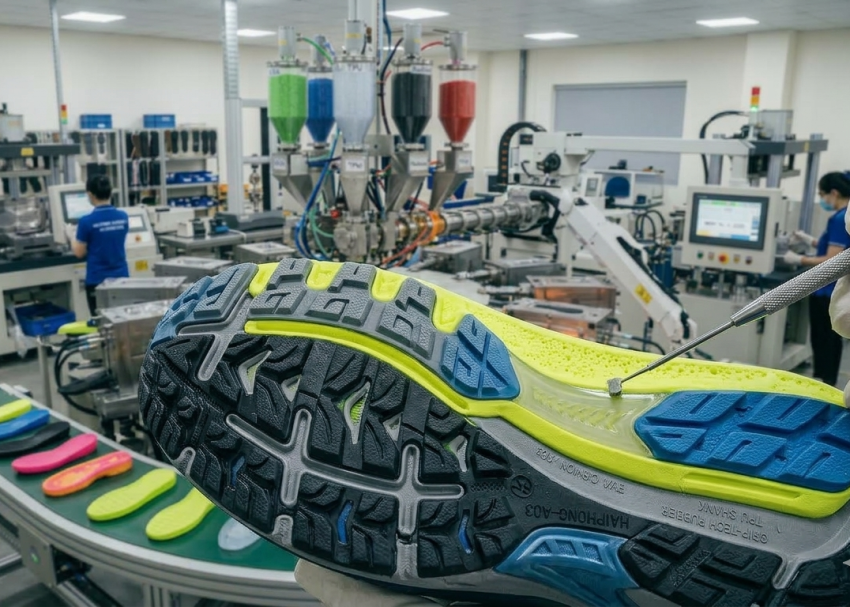
Outsole Materials That Require Chemical Washing
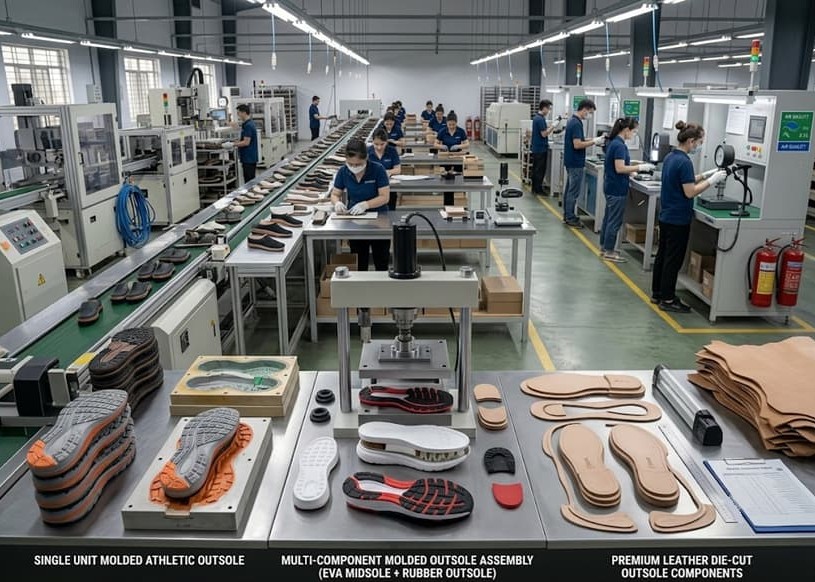
Not every outsole behaves the same during bonding. Material chemistry determines the cleaning method, solvent selection, and drying requirements. Therefore, footwear factories validate washing procedures during product development before production begins.
Rubber Outsoles
Rubber outsoles frequently retain mould release agents and processing waxes after moulding. Even after roughing, these residues may remain embedded inside the surface texture. Chemical washing removes these contaminants and improves adhesive penetration.
Most performance, safety, and outdoor footwear manufacturers consider chemical washing mandatory for rubber components before primer application.
Key Control Points
- Remove mould release residue completely.
- Avoid excessive solvent soaking.
- Inspect for surface discoloration.
- Allow complete solvent evaporation.
EVA Outsoles
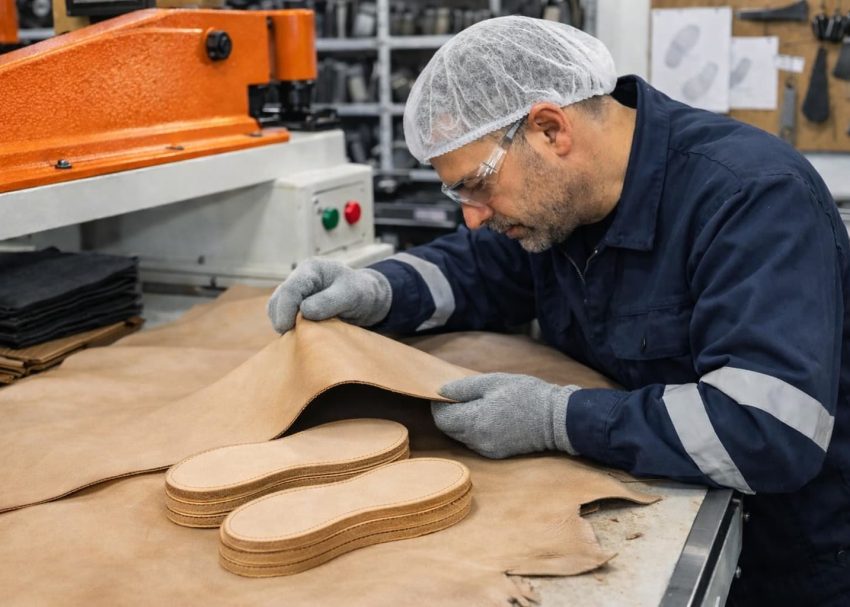
EVA is lightweight and relatively soft. Although it normally carries less surface contamination than rubber, mould release residues and factory handling contamination can still reduce bonding performance.
Factories usually employ fast-evaporating cleaning chemicals that clean without attacking the cellular structure of EVA. Excessive solvent exposure should always be avoided because it may soften or distort the bonding surface.
Key Control Points
- Use only EVA-approved chemicals.
- Minimize contact time.
- Prevent swelling of the material.
- Verify complete drying before priming.
Expert Tip:
Replace wiping cloths frequently to avoid transferring contamination.
Monitor workplace ventilation continuously to ensure safe solvent evaporation.
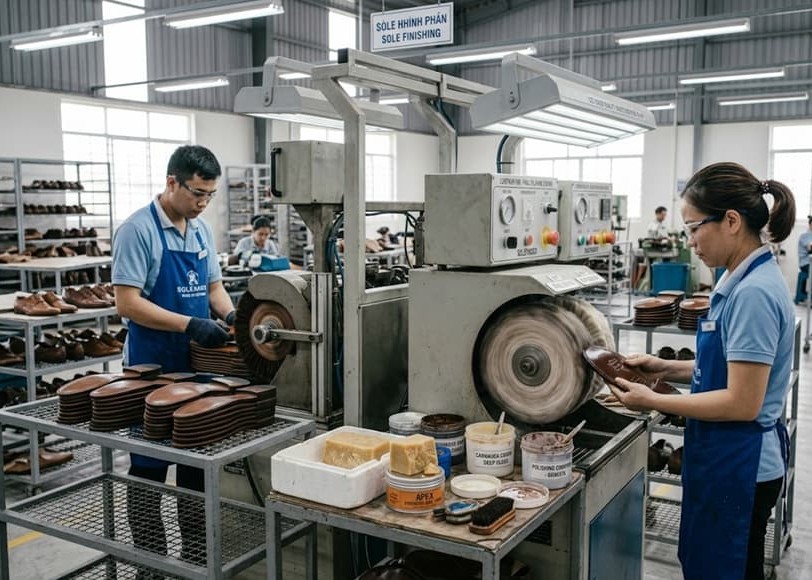
TPR Outsoles
Thermoplastic Rubber combines rubber-like flexibility with thermoplastic processing. However, its surface often contains processing oils and mould release compounds that interfere with adhesives.
Controlled chemical washing produces a cleaner surface and significantly improves primer effectiveness.
Key Control Points
- Use validated TPR-compatible solvents.
- Apply uniformly across the bonding area.
- Inspect for remaining oily patches.
- Store cleaned parts in dust-free conditions.
TPU Outsoles
TPU generally exhibits excellent dimensional stability but often requires careful cleaning before primer application because of surface additives remaining from moulding.
Since TPU chemistry varies among suppliers, manufacturers normally qualify specific cleaning chemicals during laboratory bonding trials.
Key Control Points
- Follow supplier-approved chemicals.
- Avoid aggressive solvents.
- Confirm complete evaporation.
- Protect cleaned surfaces from contamination.
Expert Tip: Train operators to recognize incomplete cleaning and surface staining.

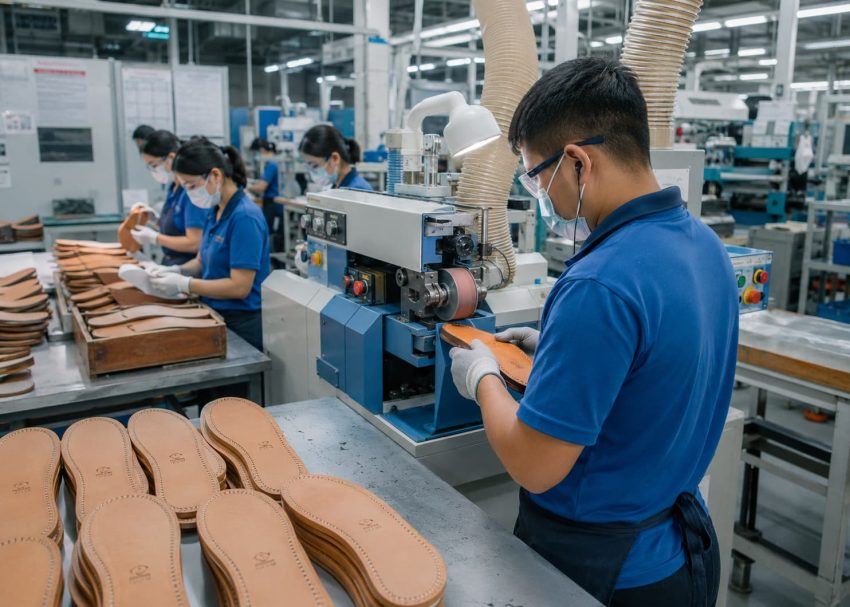
Selecting the Correct Washing Chemical
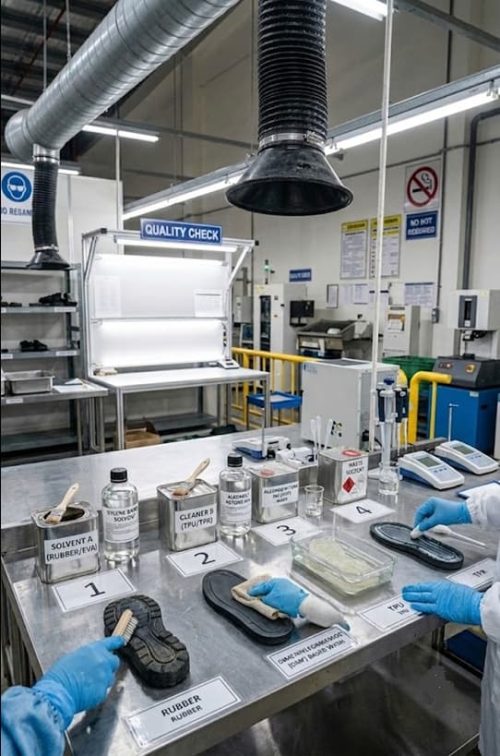
Chemical selection directly influences bonding quality. A chemical that performs well on rubber may damage EVA or fail to clean TPU effectively. Consequently, footwear manufacturers qualify each cleaning chemical according to outsole material, adhesive system, environmental regulations, and customer requirements. Common chemical categories include hydrocarbon cleaners, ketone-based cleaners, alcohol-based cleaners, and specially formulated footwear cleaning solutions.
Many factories increasingly adopt low-VOC or environmentally compliant formulations to improve worker safety and reduce emissions while maintaining bond performance.
Before introducing a new chemical into production, technical teams conduct laboratory peel tests, ageing evaluations, and production validation trials. This systematic approach ensures compatibility with the outsole material, primer, adhesive, and production process.
Key Control Points
- Never substitute chemicals without validation.
- Verify compatibility with primer and adhesive.
- Follow supplier technical data sheets.
- Monitor chemical shelf life and storage conditions.
Expert Tip: Record batch numbers of cleaning chemicals for complete production traceability.

Benefits of Chemical Washing
A controlled chemical washing process delivers benefits throughout footwear production. Instead of merely cleaning the outsole, it prepares the surface for reliable adhesive bonding and consistent production quality.
First, it removes mould release agents, processing oils, waxes, and dust that reduce adhesive contact. Second, it improves primer penetration, allowing a more uniform chemical interaction between the outsole and adhesive. Third, it reduces bonding defects, minimizing rework, customer complaints, and warranty returns.
Furthermore, consistent chemical washing improves production repeatability across different shifts, operators, and manufacturing locations. As a result, factories achieve more stable bond strength and higher overall process capability.
Key Control Points
- Improves adhesive bonding.
- Enhances primer effectiveness.
- Reduces bonding failures.
- Increases production consistency.
Expert Tip: Keep cleaned outsoles covered until primer application.

Standard Chemical Washing Procedure
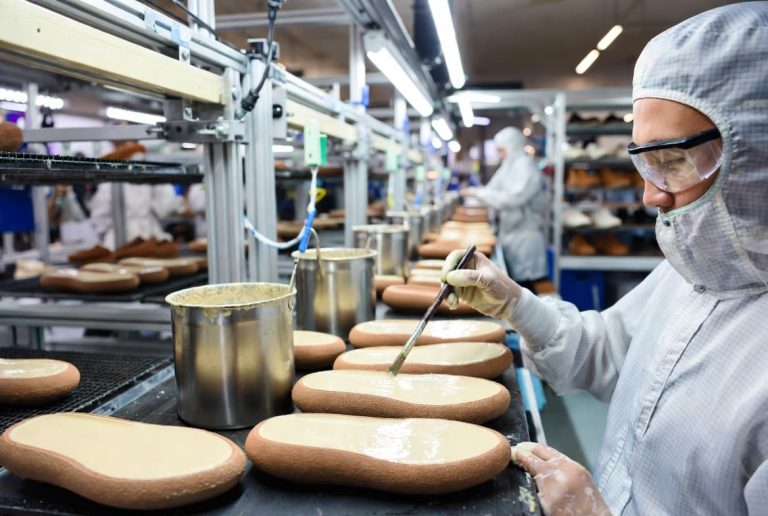
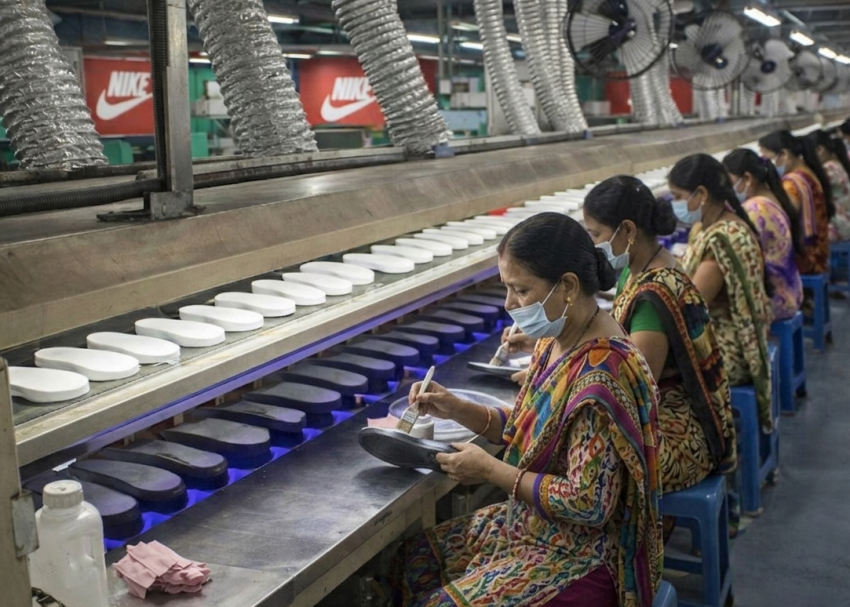
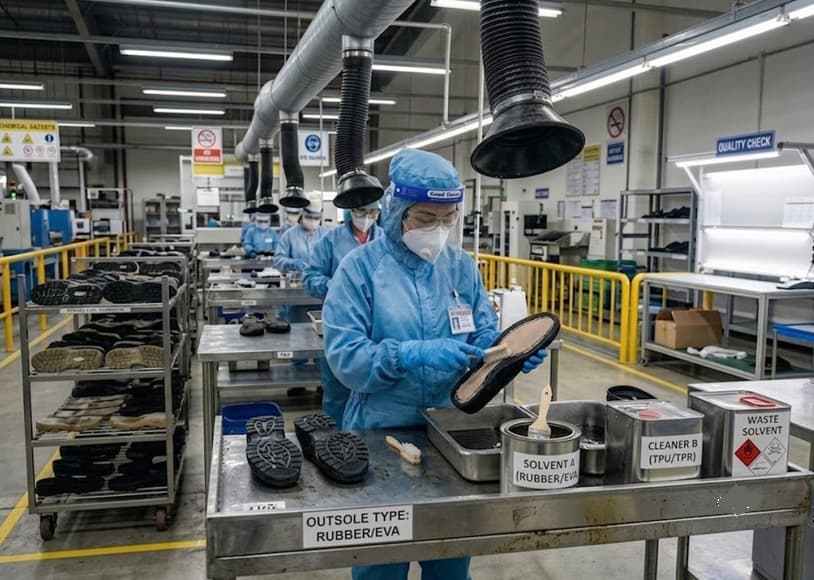
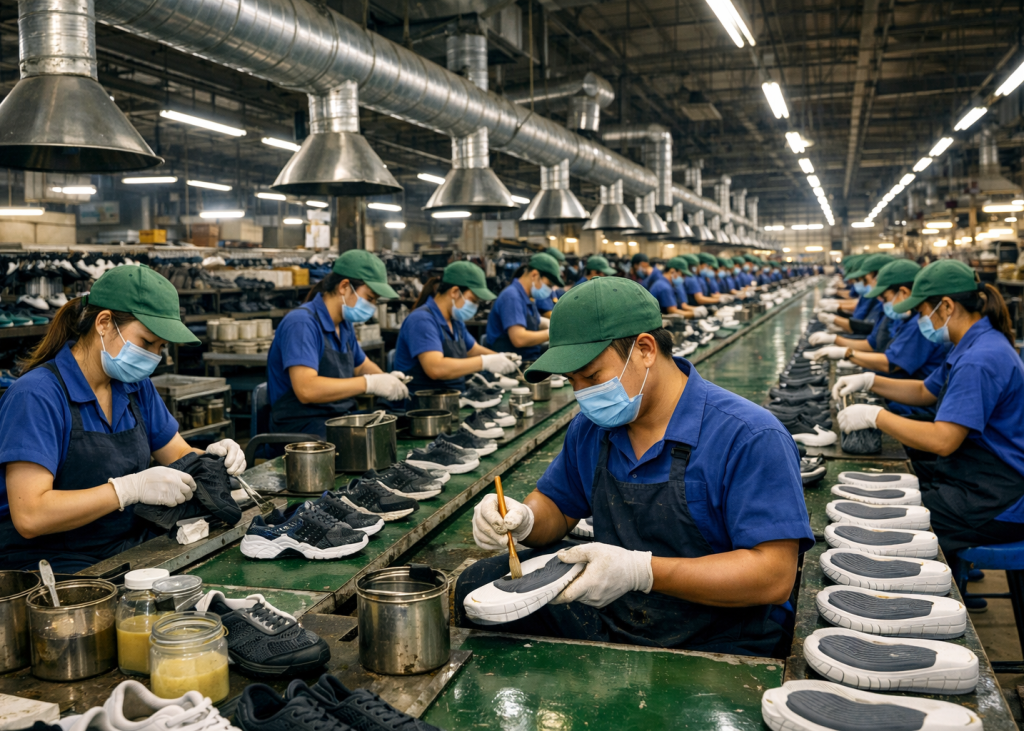
Although factory procedures vary according to outsole material and customer specifications, the overall workflow remains consistent across most footwear manufacturing facilities. The operator first confirms that the outsole has completed roughing and visual inspection. Next, the approved cleaning chemical is applied using a lint-free cloth, sponge, brush, or automated wiping system. The chemical dissolves oils, mould release agents, and other contaminants from the prepared bonding area.
After cleaning, the outsole is placed on designated drying racks where the solvent evaporates completely under controlled ventilation. Operators then visually inspect the bonding surface for cleanliness, staining, residue, or incomplete coverage. Only after successful inspection does the outsole proceed to primer application. Maintaining this sequence prevents contamination between operations and helps ensure consistent adhesive performance.
Standard Process Flow
- Receive roughened outsole.
- Verify correct material and chemical.
- Apply approved cleaning chemical.
- Wipe the bonding area uniformly.
- Allow controlled evaporation.
- Perform visual quality inspection.
- Transfer to primer application.
Key Control Points
- Maintain consistent wiping pressure.
- Replace contaminated cleaning cloths regularly.
- Never touch cleaned bonding surfaces with bare hands.
- Observe the specified drying time before the next process.
Expert Tip: Periodically audit washing consistency across all production shifts.

Common Chemical Washing Defects
Chemical washing is a simple operation, yet even small process variations can reduce bonding performance. Most failures originate from incorrect chemical selection, inconsistent application, poor drying conditions, or contamination after cleaning. Therefore, factories should monitor the washing process through standardized work instructions, operator training, and routine quality audits.
Incomplete Cleaning
Residual mould release agents, waxes, or oils remain on the bonding surface when insufficient chemical is applied or wiping is inconsistent. Consequently, primer cannot wet the surface uniformly, resulting in weak adhesive bonding.
Key Control Points
- Inspect the entire bonding area.
- Use clean lint-free wiping cloths.
- Replace contaminated chemicals promptly.
- Follow the approved wiping method.
Chemical Residue
Applying excessive chemical or allowing contaminated solvent to remain on the outsole can leave a residue after evaporation. This residue acts as a barrier between the primer and outsole surface.
Key Control Points
- Apply only the recommended quantity.
- Allow complete evaporation.
- Keep cleaning containers covered.
- Replace dirty solvent regularly.
Expert Tip:
Standardize wiping direction to improve cleaning consistency.
Replace solvent containers before contamination becomes visible.
Surface Staining
Some chemicals may discolor the outsole, particularly light-coloured materials. Although staining may not always reduce bond strength, it can create cosmetic quality issues.
Key Control Points
- Validate chemicals before production.
- Test on coloured materials.
- Control exposure time.
- Inspect appearance under standard lighting.
Material Attack
Aggressive solvents may soften, swell, crack, or distort EVA, TPU, or TPR components. Material damage often leads to poor adhesion and rejected products.
Key Control Points
- Never substitute chemicals without approval.
- Follow supplier recommendations.
- Monitor solvent exposure time.
- Conduct routine material compatibility tests.
Expert Tip:
Use dedicated cloths for each chemical type.
Audit solvent evaporation time during seasonal temperature changes.

Quality Inspection After Chemical Washing
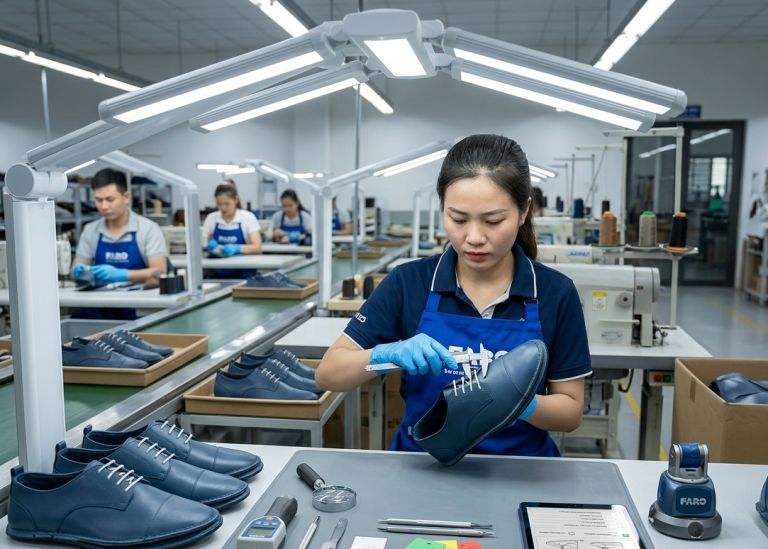
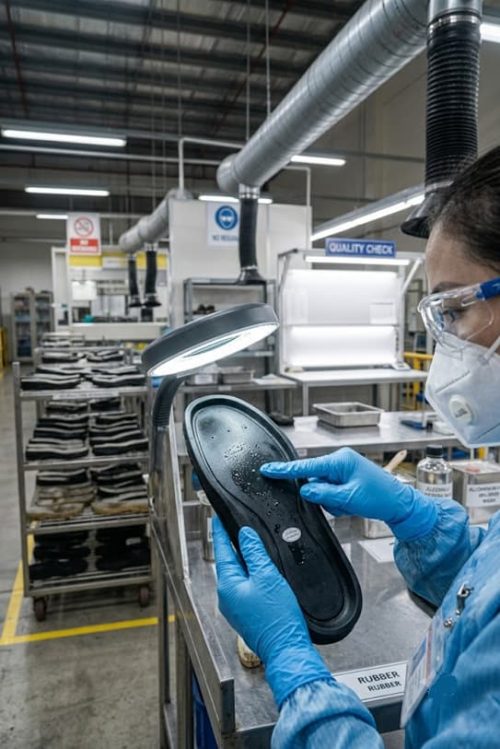
Every chemically washed outsole should pass a visual inspection before primer application. Operators verify that the bonding surface is clean, dry, free from stains, and free from visible contaminants. Random production samples may also undergo laboratory peel testing to confirm that the cleaning process consistently supports the required bond strength.
Factories generally maintain process records for chemical batch numbers, operator identification, drying time, and inspection status. This traceability simplifies root-cause analysis whenever bonding issues occur during production or customer testing.
Key Control Points
- Confirm complete drying.
- Check for residue or staining.
- Protect cleaned surfaces from dust.
- Maintain process traceability.
Expert Tip:
Keep washing and priming stations close together to minimise recontamination.
Review bond test results regularly to identify process trends.
Safety and Environmental Controls
Most chemical washing agents are volatile organic compounds (VOCs). Therefore, safe handling is essential to protect workers and comply with environmental regulations.
Workstations should include effective local exhaust ventilation, explosion-proof electrical equipment where required, approved chemical storage cabinets, and clearly labelled containers. Operators should wear chemical-resistant gloves, safety glasses, and appropriate respiratory protection whenever specified by the Safety Data Sheet (SDS).
Many footwear manufacturers are also replacing traditional solvent cleaners with low-VOC or environmentally preferred alternatives to reduce emissions while maintaining bonding performance.
Key Control Points
- Ensure adequate ventilation.
- Wear approved PPE.
- Store chemicals safely.
- Dispose of waste according to regulations.
Expert Tip:
Include chemical washing in routine layered process audits.
Train operators to identify early signs of material attack.


Common Chemicals Used for Rubber, EVA, TPU & TPR Outsoles
Selecting the correct cleaning chemical is one of the most important decisions in the outsole preparation process. Although the objective is always to remove mould release agents, oils, waxes, and handling contamination, different outsole materials react differently to cleaning agents. Consequently, footwear manufacturers validate every chemical during product development to ensure it is compatible with the outsole material, primer, adhesive, and customer performance requirements.
Many factories also comply with environmental regulations such as REACH, ZDHC, and customer Restricted Substance Lists (RSL). Therefore, modern footwear manufacturers increasingly use approved low-VOC or specialty cleaning formulations instead of general-purpose industrial solvents. Regardless of the chemical selected, operators should always follow the chemical supplier’s Technical Data Sheet (TDS) and Safety Data Sheet (SDS).
Commonly Used Cleaning Chemicals
| Cleaning Chemical | Suitable Outsole Material | Primary Purpose | Evaporation Speed | Important Precautions |
|---|---|---|---|---|
| Acetone | Rubber, TPU (validated applications) | Removes oils, mould release agents, grease and light contamination | Very Fast | Highly flammable. May attack some plastics and EVA if used excessively. |
| Methyl Ethyl Ketone (MEK) | Rubber, TPU (customer approved) | Excellent cleaning and surface activation before priming | Fast | Strong solvent. Use only where approved and ensure adequate ventilation. |
| Isopropyl Alcohol (IPA) | EVA, TPU, TPR | Removes fingerprints, light oils and dust without aggressive surface attack | Fast | Suitable for light cleaning but less effective against heavy mould release residues. |
| Heptane-Based Cleaner | Rubber, TPR | Removes waxes and mould release compounds while minimizing material attack | Medium | Use only approved grades and avoid prolonged exposure. |
| Ethyl Acetate | Rubber, TPU | General surface cleaning before primer application | Fast | Flammable. Validate compatibility with coloured components. |
| Footwear Surface Cleaner (Proprietary Blend) | Rubber, EVA, TPU, TPR | Balanced cleaning performance developed specifically for footwear bonding | Medium | Follow supplier recommendations and storage requirements. |
| Low-VOC Water-Based Cleaner | EVA and selected rubber compounds | Environmentally friendly surface cleaning with reduced solvent emissions | Medium | Drying time may be longer than solvent-based cleaners. |
| Specialty Adhesion Promoter Cleaner | Difficult-to-bond TPU and engineered compounds | Cleans while improving surface energy before primer application | Medium | Use only as specified by adhesive and outsole suppliers. |

Best Practices for Chemical Selection
Rather than choosing a cleaner based solely on availability or cost, manufacturers should evaluate the complete bonding system. Laboratory peel tests, production trials, and ageing evaluations help determine whether the selected chemical consistently delivers the required bond strength.
When introducing a new outsole supplier or adhesive system, the washing process should also be revalidated. Even materials with the same commercial name may contain different additives or mould release agents that influence cleaning performance. Therefore, standardization, validation, and operator training remain essential for maintaining consistent bonding quality.
Key Control Points
- Replace contaminated cleaning chemicals according to factory procedures.
- Always use customer-approved and validated cleaning chemicals.
- Never interchange solvents without technical approval.
- Store chemicals in sealed, labelled containers away from heat sources.
- Review compatibility whenever outsole material, primer, or adhesive changes.
Conclusion
Chemical washing is far more than a cleaning operation. It establishes the chemical foundation for reliable adhesive bonding by removing contaminants that mechanical roughing cannot eliminate. When manufacturers combine the correct cleaning chemical, controlled application, adequate drying, and disciplined quality inspection, they achieve stronger adhesion, lower rejection rates, and improved production consistency.
Within the Outsole (Stock Fitting) Assembly Series, chemical washing bridges the gap between mechanical surface preparation and chemical activation. Mastering this process ensures that every outsole enters the primer stage with an optimally prepared bonding surface.
Next in the Series: UV Priming for EVA Components Operations in Outsole Process, where we explore how ultraviolet primers improve adhesion on EVA outsoles before adhesive application.
Frequently Asked Questions (FAQs)
Roughing increases surface area, while chemical washing removes oils, mould release agents, waxes, and contaminants that interfere with adhesive bonding.
No. Rubber, EVA, TPU, and TPR require validated chemicals because their surface chemistry differs significantly.
Residual solvent may reduce primer performance, weaken adhesive bonding, and increase the risk of sole separation.
Not always. The requirement depends on outsole material, adhesive system, customer specifications, and validated manufacturing procedures.
Incomplete cleaning caused by inconsistent wiping or contaminated solvent is one of the most frequent causes of bonding failure.
Fingerprints transfer skin oils that contaminate the bonding surface and reduce adhesive performance.
Factories typically perform visual inspection, process audits, and laboratory adhesion testing to confirm cleaning effectiveness.