Embossing Operations in Outsole Process: Outsole (Stock Fitting) Assembly Series
In the previous blog, “Grooving and Channeling Operations in Outsole Process: Outsole (Stock Fitting) Assembly Series,” we explored how grooves, stitch channels, flex lines, and adhesive recesses are precisely machined into outsoles to improve assembly accuracy and product performance. These operations prepare the outsole for subsequent manufacturing stages while ensuring reliable bonding, stitching, and flexibility.
The next important stock fitting operation is embossing. Unlike grooving, which removes material, embossing reshapes the outsole surface by applying controlled heat and pressure to create permanent impressions. These impressions may include brand logos, company trademarks, size markings, decorative textures, product identification codes, or functional surface patterns.
Although embossing appears to be a simple decorative process, it demands precise control of temperature, pressure, dwell time, and tooling alignment. Even small variations can produce blurred logos, shallow impressions, double marks, or material damage. Consequently, footwear manufacturers establish strict process controls to achieve consistent embossing quality across every production batch.
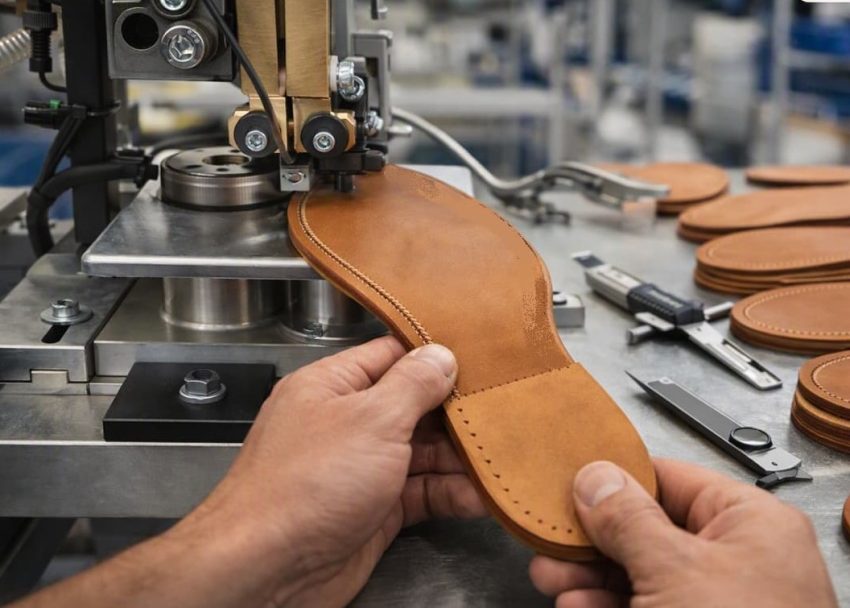
Understanding Embossing Operations in Outsole Manufacturing
Embossing is a controlled forming operation that permanently transfers a raised or recessed design onto the outsole surface. Instead of removing material through cutting or milling, embossing reshapes the material by compressing it with specially manufactured engraved dies under controlled heat and pressure.
The finished impression becomes an integral part of the outsole. Since no separate ink or label is applied, embossed markings remain visible throughout the product’s service life, even under repeated flexing and abrasion.
Depending on the outsole material and product design, embossing may be carried out before stock fitting is completed, after machining operations, or near the final stages before outsole assembly. Modern footwear factories use embossing for much more than aesthetics.
It serves branding, product identification, traceability, quality control, and customer recognition while maintaining a clean and professional appearance. Typical information transferred during embossing includes:
- Brand logos
- Company trademarks
- Shoe size
- Material identification
- Production codes
- Country of origin
- Decorative textures
- Product model numbers
Key Control Points
- Verify embossing die condition before production.
- Confirm correct outsole orientation.
- Ensure embossing location matches engineering drawings.
- Inspect every first-off sample before mass production.
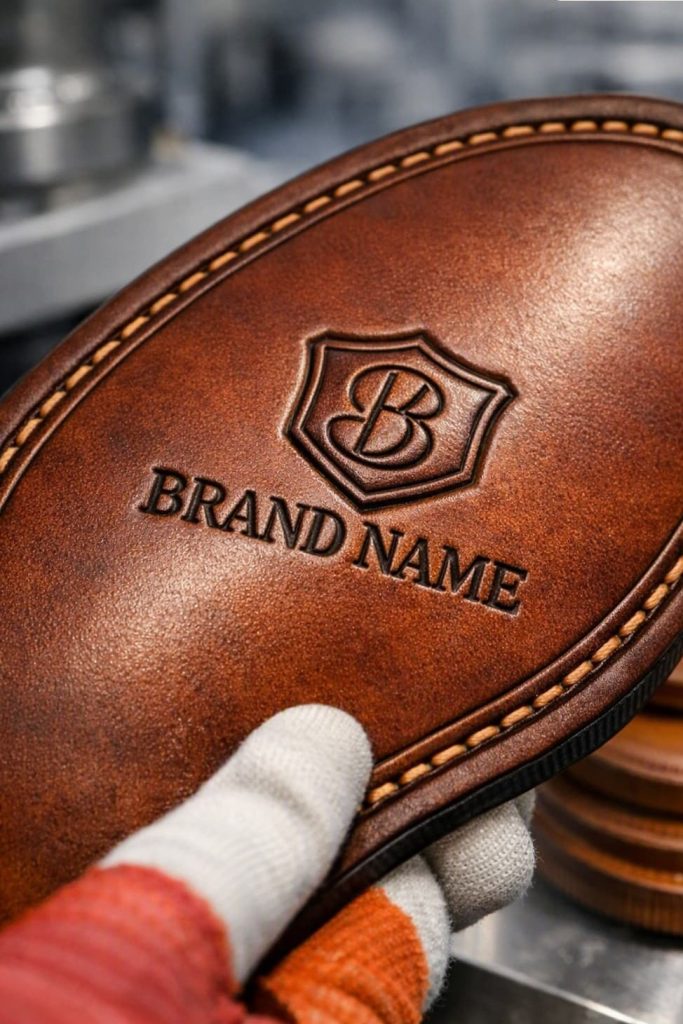
Expert Tip: Always perform embossing after all machining operations such as milling, grooving, or channeling whenever the embossed area may be affected by subsequent cutting. This prevents damage to logos and identification marks.
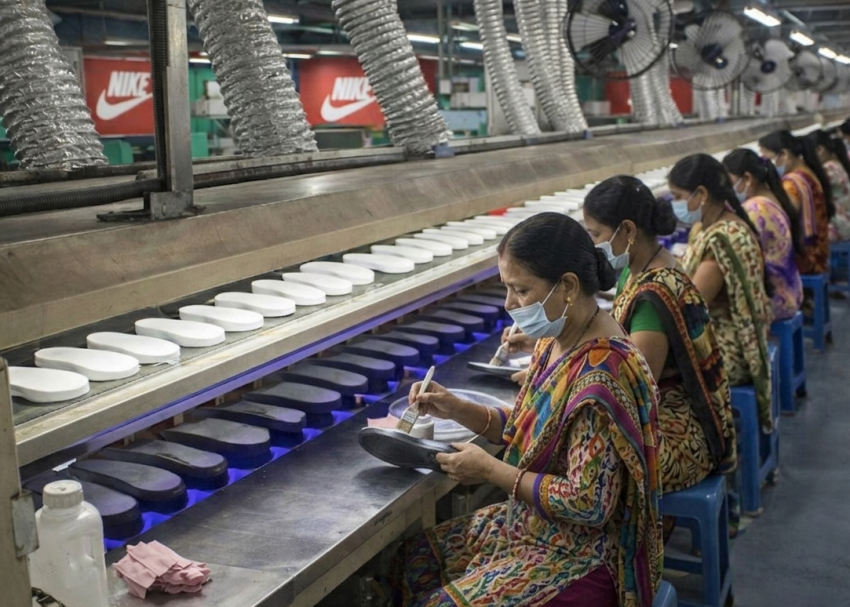

Why Embossing is an Important Operation
Every outsole carries information that identifies both the product and its manufacturer. Embossing provides a permanent method of incorporating this information directly into the outsole without using printed labels or surface coatings that may wear away during use.
For premium footwear brands, embossed logos reinforce brand identity and create a higher perceived product value. Consumers often associate crisp, deep, and uniform embossing with superior manufacturing quality.
Embossing also supports production traceability. Many factories emboss mould numbers, cavity numbers, date codes, or production identification marks that simplify quality investigations whenever manufacturing issues arise.
In addition, embossed textures can enhance the visual appeal of leather, rubber, TPU, TPR, EVA, PVC, and PU outsoles by creating premium-looking surface finishes without adding extra manufacturing steps. From a production perspective, embossing is economical because one operation can simultaneously improve aesthetics, product identification, and manufacturing traceability.
Benefits of Embossing
- Permanent product identification
- Improved brand visibility
- Professional product appearance
- Better manufacturing traceability
- Reduced dependency on printed labels
- Increased product value perception
- Consistent identification throughout product life
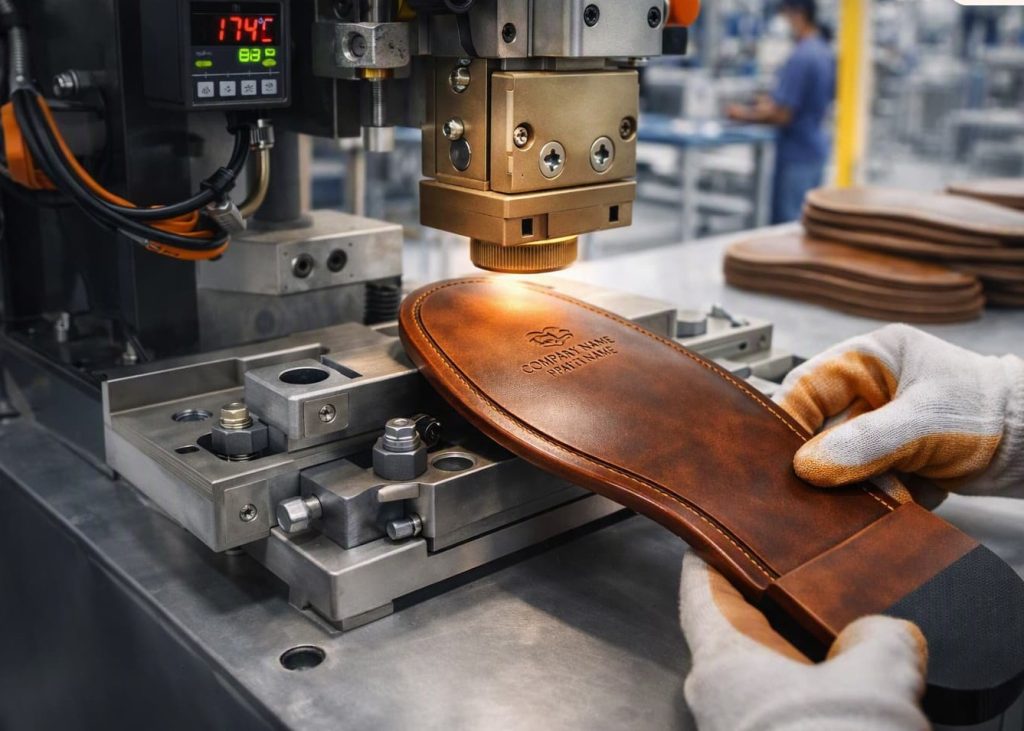
Expert Tip: Use dedicated locating fixtures for every outsole model. Proper fixtures eliminate operator variation, improve positioning accuracy, and significantly reduce misaligned embossing defects.
Common Embossing Applications in Footwear Outsoles
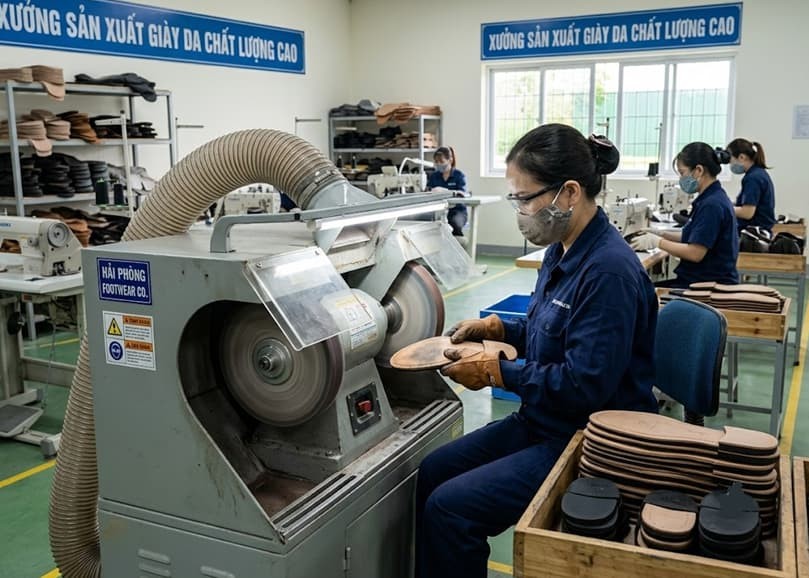
Although logos receive the greatest attention, outsole embossing serves many different purposes throughout footwear manufacturing. The application varies depending on footwear category, customer requirements, and product design.
Brand Logos
Most footwear manufacturers emboss company logos directly onto the heel or waist area of the outsole. Since these locations experience relatively low wear compared with tread areas, the logo remains visible for a longer period.
Luxury brands often require extremely fine details with sharp edges, making die manufacturing and process control particularly important.
Size Markings
Almost every outsole includes embossed size information such as UK, US, EU, or CM sizing. Permanent size markings eliminate confusion during assembly and improve customer satisfaction.
Factories producing multiple size ranges rely heavily on accurate embossing to avoid costly mismatching between uppers and outsoles.
Decorative Patterns
Embossing is widely used to create leather-like grains, geometric textures, woven appearances, carbon-fiber effects, and premium decorative finishes. These textures improve aesthetics without significantly increasing manufacturing costs.
Decorative embossing may cover only a small branding area or extend across large portions of the outsole, depending on the footwear design.
Product Identification
Many manufacturers emboss internal identification codes that simplify production tracking and warranty investigations. Examples include:
- Production batch numbers
- Mould cavity numbers
- Factory identification
- Material codes
- Manufacturing dates
These markings allow factories to quickly identify production history whenever customer complaints or quality investigations occur.
Expert Tip: Clean embossing dies regularly during production. Even small amounts of rubber residue or dust can reduce impression sharpness and cause incomplete logo transfer.
Heat Embossing Process
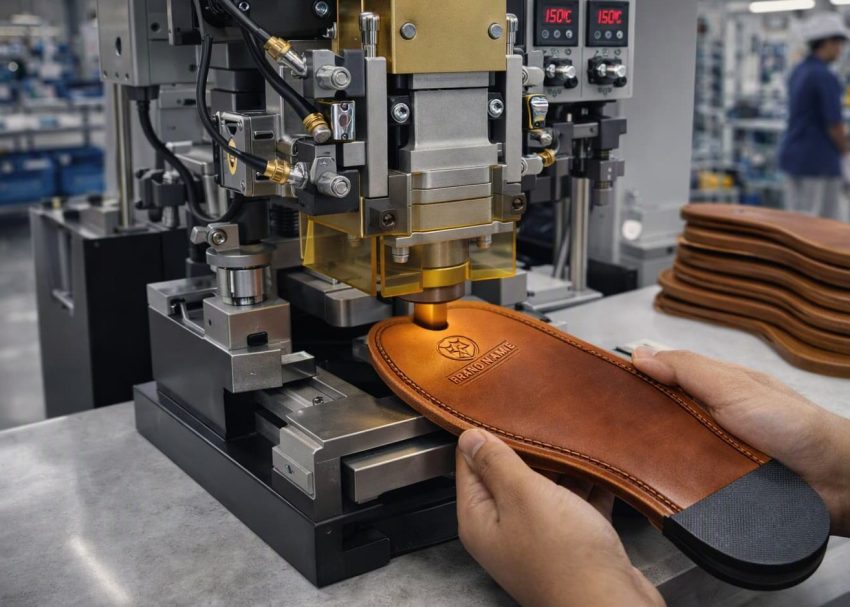
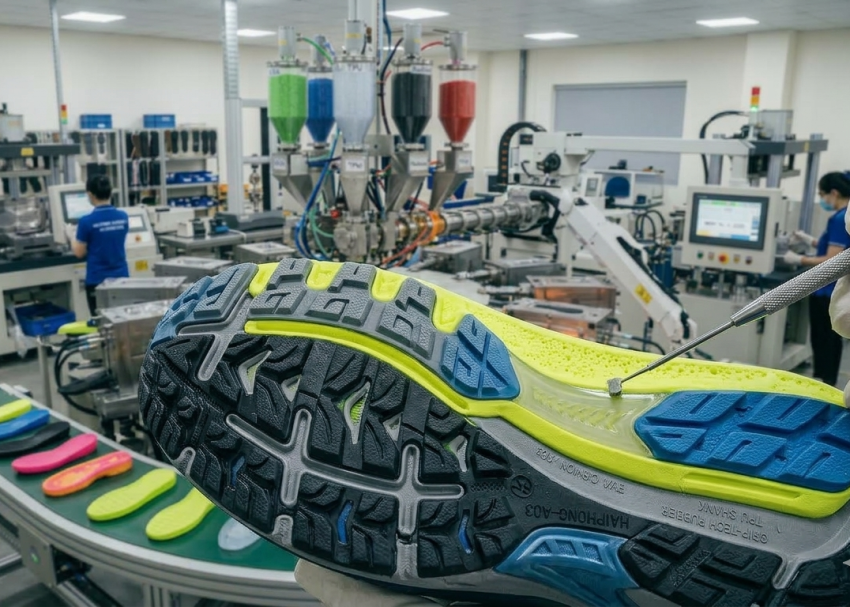
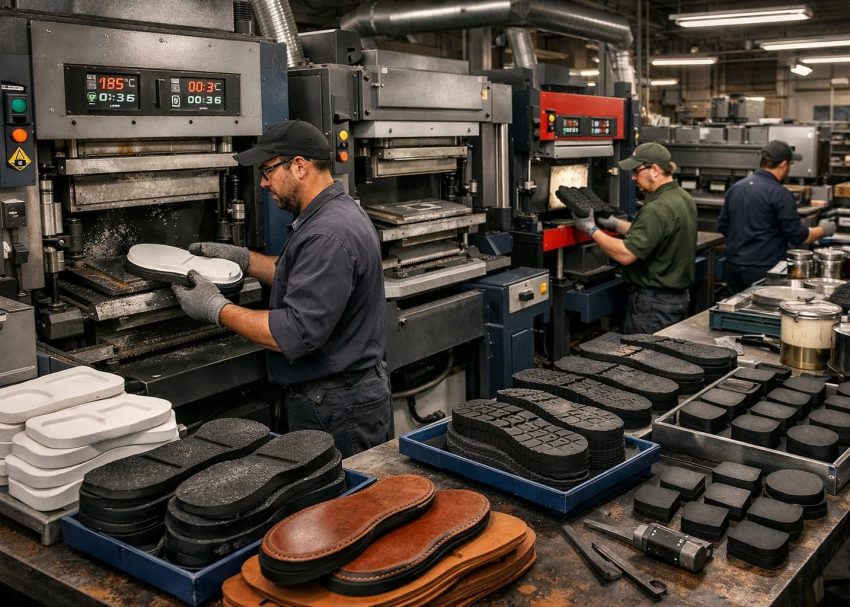
Heat embossing is the most common embossing method used in outsole manufacturing. In this process, an engraved metal die is heated to a predetermined temperature before contacting the outsole under controlled hydraulic or pneumatic pressure.
The combination of heat and pressure softens the material surface momentarily, allowing the engraved pattern to form a permanent impression. After cooling, the material retains the embossed design without affecting the structural integrity of the outsole. The exact process parameters depend on outsole material, hardness, thickness, and design complexity.
Rubber compounds generally require different settings than TPU, EVA, PVC, or PU because each material responds differently to heat transfer and compression.
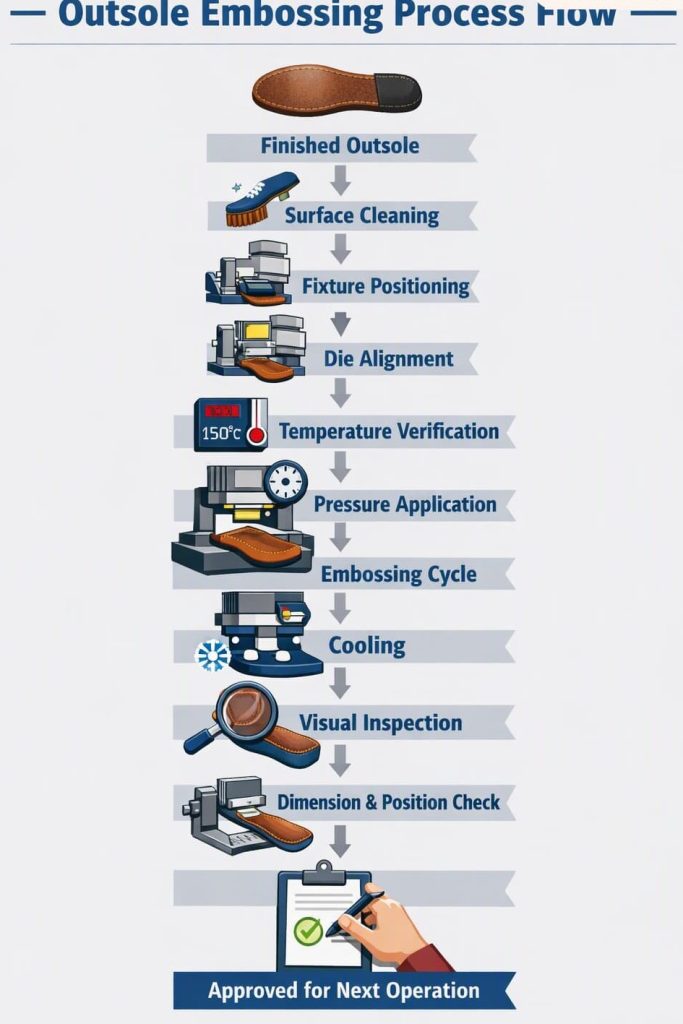
A typical factory embossing sequence includes:
- Cleaning the outsole surface.
- Positioning the outsole in the fixture.
- Aligning the embossing die.
- Heating the die to the required temperature.
- Applying controlled pressure.
- Maintaining the specified dwell time.
- Releasing pressure.
- Cooling the embossed area.
- Performing visual inspection.
- Transferring approved parts to the next operation.
Proper synchronization of temperature, pressure, and dwell time is essential. Excessive heat can distort the outsole, while insufficient heat may produce incomplete or shallow impressions.
Expert Tip: Approve embossing quality using the first production sample at the beginning of every shift, after die changes, or whenever process parameters are adjusted.
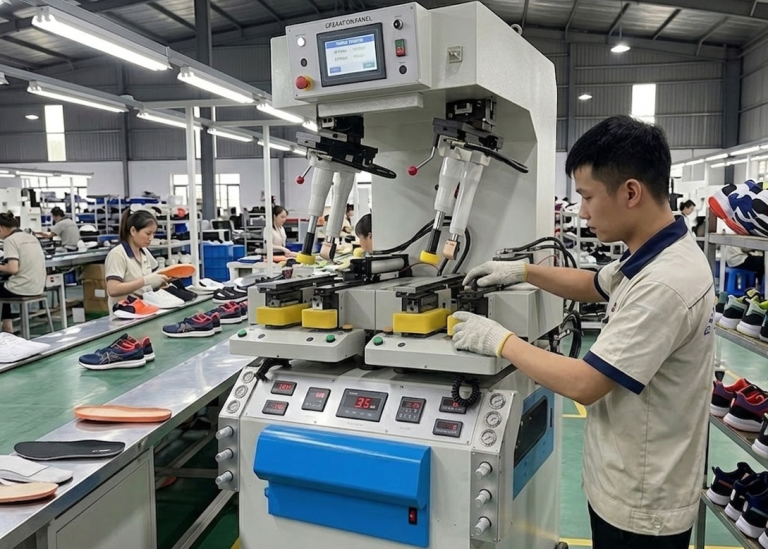
Heat Embossing Machine
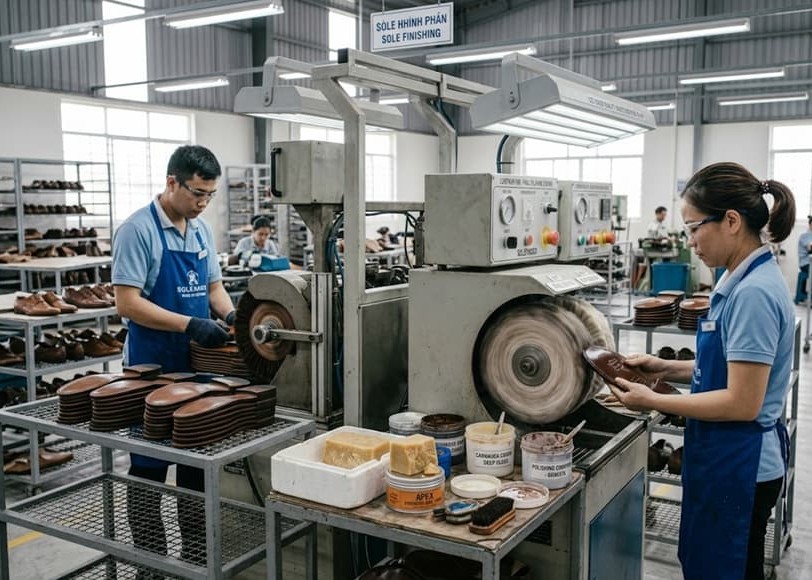
Among all embossing equipment used in footwear factories, the Heat Embossing Machine is the most widely adopted for rubber, TPR, TPU, EVA, PVC, and leather outsoles. It uses a heated engraved die to permanently transfer logos, sizes, identification marks, or decorative patterns onto the outsole surface.
The machine consists of a heated platen, embossing die, pressure mechanism, adjustable fixture, temperature controller, and cycle timer. During operation, the outsole is positioned in a dedicated fixture to ensure repeatable alignment. Once the die reaches the preset temperature, it descends onto the outsole with controlled pressure for a specified dwell time before retracting automatically.
Modern heat embossing machines feature digital temperature controllers, programmable timers, and adjustable pressure settings. These controls improve process repeatability and reduce operator dependency, making them suitable for both high-volume production and premium footwear requiring fine logo details. Heat embossing is particularly effective because it creates permanent impressions without removing material or adding inks, labels, or coatings that may deteriorate during product use.
Typical Applications
- Brand logos
- Shoe sizes
- Product identification
- Decorative textures
- Factory identification marks
- Model numbers
Key Control Points
- Stabilize die temperature before production.
- Use approved positioning fixtures.
- Inspect the first embossed outsole after machine setup.
- Clean the die surface regularly to prevent residue build-up.
Expert Tip: Store embossing dies in protective cases with anti-rust treatment. Even minor scratches can reduce logo quality and require expensive die refurbishment.

Hydraulic Embossing Press
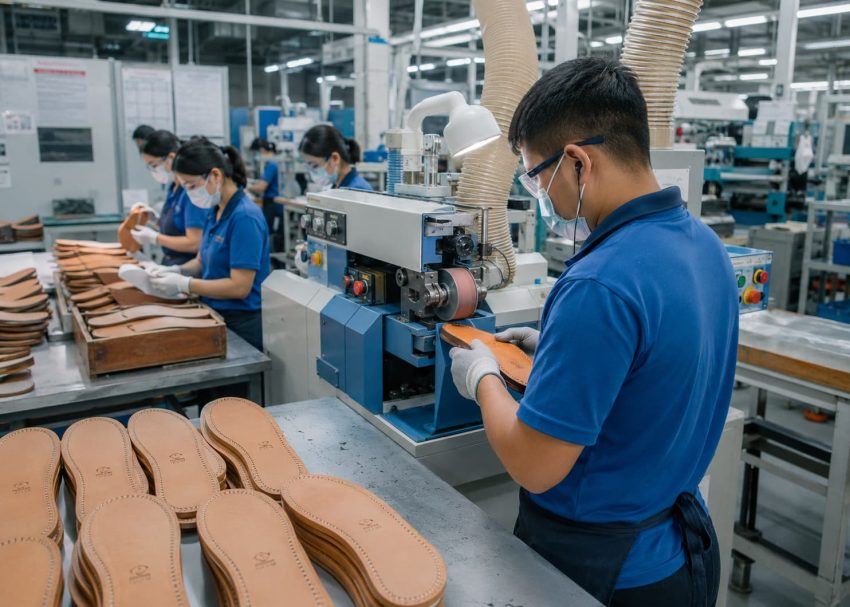
For larger outsoles or designs requiring deeper impressions, factories often use a Hydraulic Embossing Press. Hydraulic systems provide higher and more uniform pressing force than pneumatic machines, making them ideal for thick rubber compounds and heavy-duty safety footwear.
Unlike smaller heat embossing machines, hydraulic presses maintain constant pressure throughout the embossing cycle. This consistent force ensures uniform impression depth across the entire logo or pattern, even when embossing large surface areas.
Hydraulic presses also support interchangeable dies, allowing manufacturers to switch between different shoe models with minimal downtime. Digital pressure regulation further improves consistency between production batches. Because excessive hydraulic force can permanently deform the outsole, technicians must carefully balance pressure, temperature, and dwell time according to the material specification.
Advantages
- Higher embossing force
- Uniform impression depth
- Excellent repeatability
- Suitable for thick materials
- Better performance for large logos and decorative textures
Key Control Points
- Verify hydraulic pressure before each production run.
- Check die parallelism to avoid uneven impressions.
- Inspect embossing depth at multiple locations.
- Replace worn seals to maintain stable pressure.
Expert Tip: Develop material-specific embossing standards. Rubber, TPU, EVA, PVC, and leather all require different process settings for optimum results.

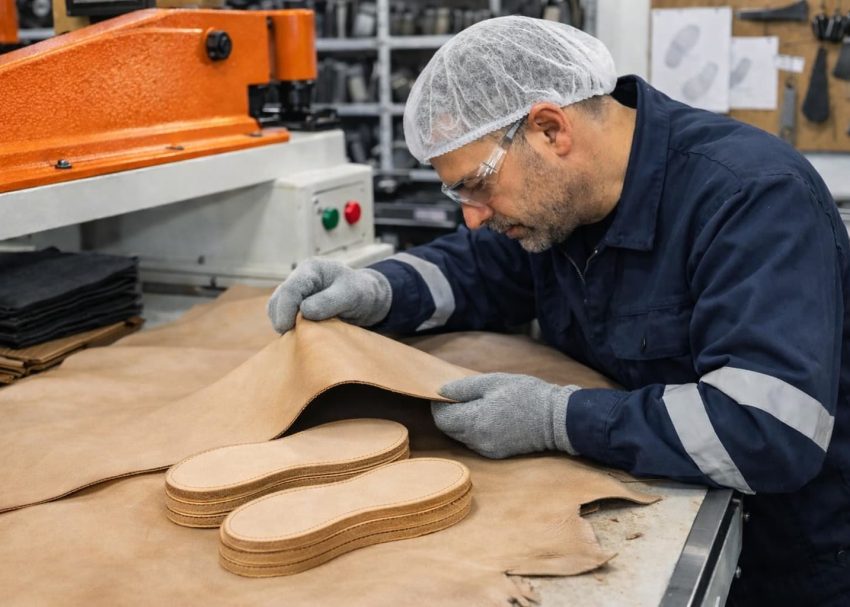
Hot Stamp Press
A Hot Stamp Press combines heat, pressure, and metallic or colored foils to create decorative branding on selected footwear products. Unlike conventional embossing, which only forms an impression, hot stamping transfers a thin decorative layer while simultaneously embossing the design.
This process is commonly used on premium casual footwear, fashion shoes, and leather outsoles where gold, silver, black, or colored logos enhance product appearance.
The heated die presses the foil against the outsole surface, causing the decorative layer to bond permanently to the material. Precise control of temperature and dwell time is essential because excessive heat can damage both the foil and the outsole surface. Although hot stamping is less common for heavy-duty industrial footwear, it remains popular in premium fashion and luxury segments.
Typical Applications
- Metallic logos
- Premium branding
- Decorative product names
- Luxury footwear identification
- Limited edition markings
Key Control Points
- Select foil compatible with outsole material.
- Maintain consistent die temperature.
- Replace damaged foil rolls promptly.
- Inspect color transfer after setup.
Expert Tip: Include embossing quality in preventive maintenance audits. Machine calibration, platen flatness, temperature accuracy, and fixture wear directly influence impression consistency.

Critical Process Parameters for Consistent Embossing
Successful embossing depends on controlling several process variables simultaneously. Even when high-quality machines and precision dies are used, inconsistent settings can produce unacceptable impressions.
Temperature Control
Temperature determines how effectively the outsole material softens during embossing. Every outsole material has an optimum processing range that allows permanent deformation without causing burning, discoloration, or distortion.
If the temperature is too low, the embossed pattern may appear shallow or incomplete. Conversely, excessive temperature may melt the surface, blur fine details, or damage surrounding material. Operators should verify die temperature using calibrated controllers and periodically confirm readings during long production runs.
Pressure Control
Pressure forces the die into the softened outsole material, creating the required impression depth. Uniform pressure is essential to achieve sharp edges and consistent logo definition. Insufficient pressure results in weak impressions, while excessive pressure may produce deep marks, material distortion, or unwanted surface deformation. Hydraulic systems typically provide better pressure consistency than manual equipment, especially for larger embossing areas.
Dwell Time
Dwell time refers to the period during which the heated die remains in contact with the outsole. It directly influences the clarity and permanence of the embossed design. Short dwell times often produce incomplete impressions because the material does not soften sufficiently. Excessively long dwell times can overheat the material, causing deformation or glossy burn marks.
Factories normally establish standard dwell times through process trials for each outsole material and design.
Expert Tip: Whenever a new logo or decorative design is introduced, conduct trial embossing on production material before releasing the tooling for mass production. This validates die quality, process parameters, and impression appearance while minimizing production risk..

Common Embossing Defects and Their Prevention
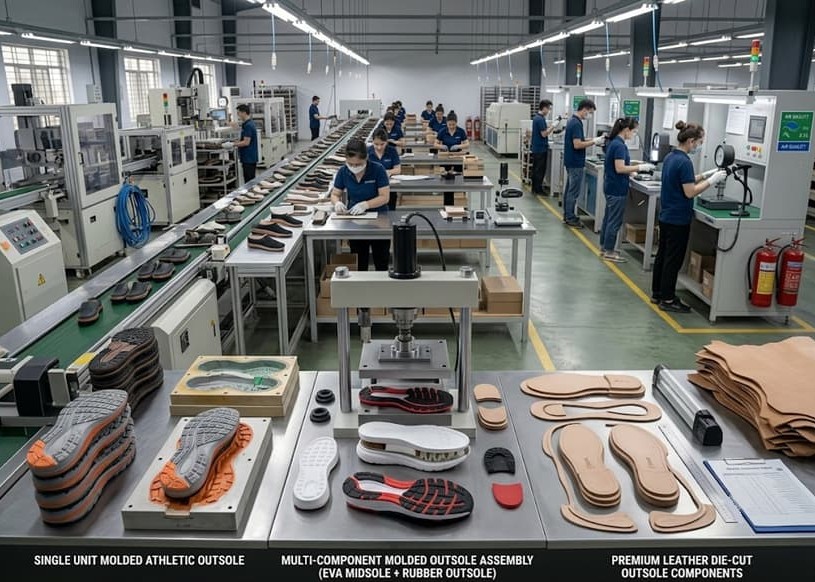
Despite modern machinery, embossing defects can occur when tooling, process settings, or material conditions are not properly controlled. Early identification helps reduce scrap and rework.
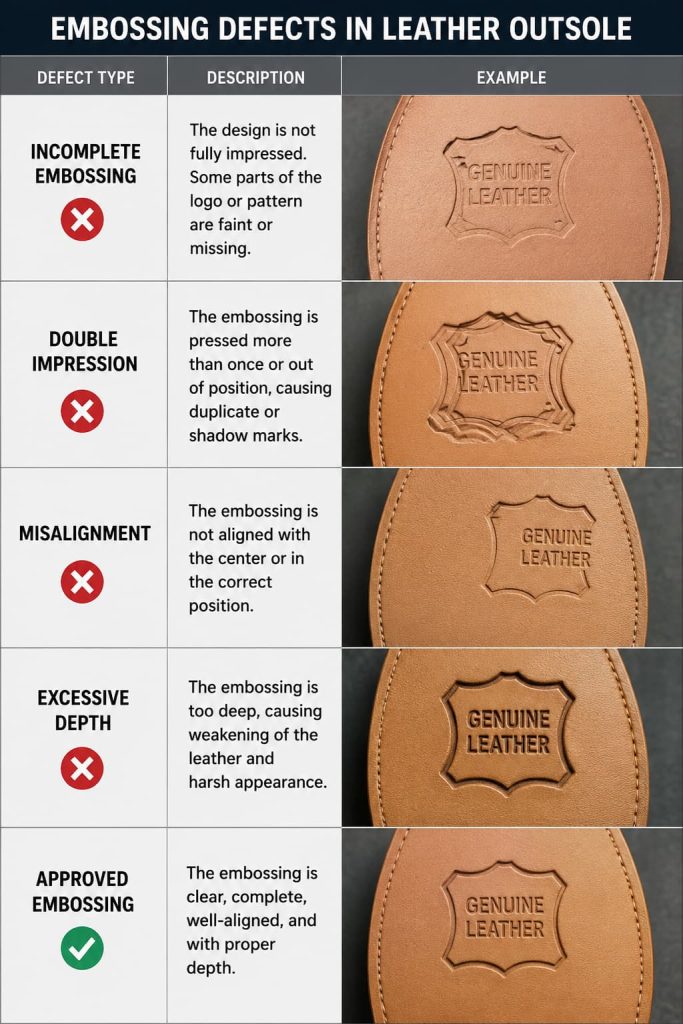
Incomplete Embossing
Incomplete embossing occurs when part of the design fails to transfer completely to the outsole. Logos may appear faint, letters may be missing, or decorative textures may lack definition.
Typical causes include low temperature, insufficient pressure, inadequate dwell time, contaminated dies, or uneven outsole surfaces.
Preventive Measures
- Verify process settings before production.
- Clean embossing dies frequently.
- Inspect outsole surface condition.
- Replace worn dies when necessary.
Double Impression
Double impressions appear when the die contacts the outsole more than once or when the outsole shifts during embossing. This defect creates blurred logos and poor product appearance. The most common causes include unstable fixtures, premature operator movement, or incorrect machine synchronization.
Preventive Measures
- Secure outsole fixtures.
- Prevent movement during pressing.
- Maintain machine timing accuracy.
- Train operators on proper loading techniques.

Misalignment
Misalignment occurs when the embossed design is positioned incorrectly relative to the outsole. Even if the impression quality is excellent, incorrect positioning usually results in rejection.
Misalignment may result from worn locating fixtures, incorrect operator loading, inaccurate die installation, or dimensional variations in moulded outsoles.
Excessive Embossing Depth
Overly deep embossing can weaken the outsole surface, distort surrounding material, or create visible sink marks on the opposite side.
Excessive depth usually results from high pressure, excessive temperature, or prolonged dwell time. Maintaining balanced process parameters prevents structural damage while preserving logo clarity.

Inspection and Quality Control
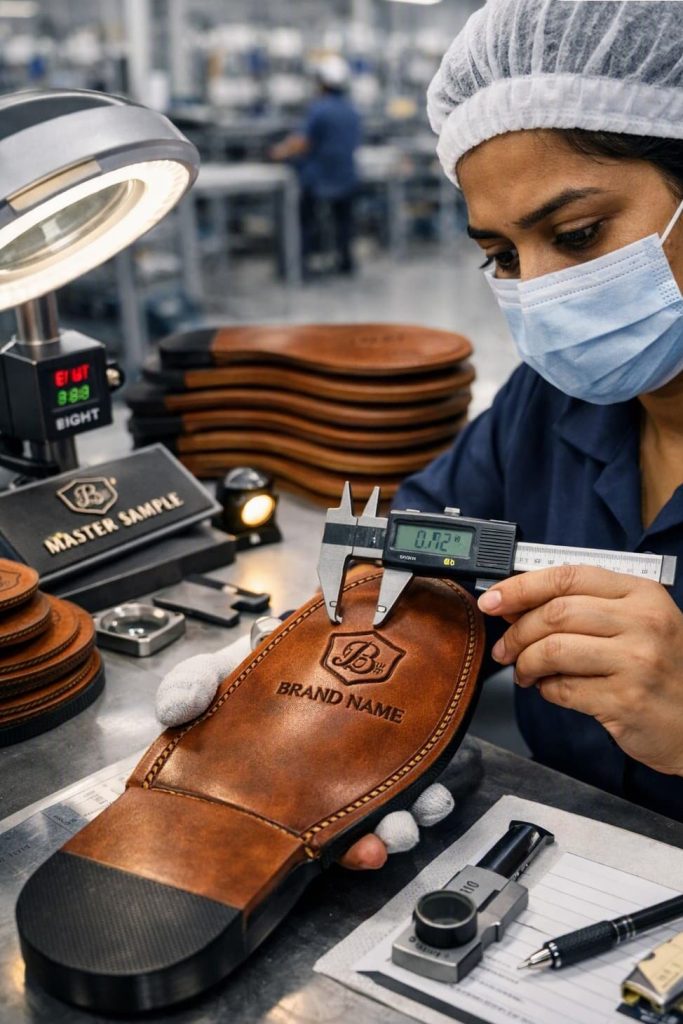
Embossing quality should never rely solely on operator judgment. Most footwear factories include embossing inspection as part of their in-process quality control system.
Inspectors evaluate logo clarity, position accuracy, impression depth, surface finish, and overall appearance against approved master samples. Random sampling during production helps identify process drift before large quantities are affected. For premium footwear, magnification or optical comparators may be used to verify intricate logo details and fine decorative textures.
Inspection Checklist
- Logo clarity
- Correct position
- Uniform depth
- No double impressions
- No surface burns
- No material distortion
- Clean edges
- Approved appearance
Key Control Points
- Approve first-off samples.
- Conduct periodic in-process inspections.
- Maintain traceable quality records.
- Separate non-conforming products immediately.
Conclusion
Embossing is much more than a decorative finishing process. It provides permanent product identification, strengthens brand recognition, improves traceability, and enhances the overall appearance of footwear outsoles. When carried out with the correct combination of temperature, pressure, dwell time, and precision tooling, embossing produces sharp, durable impressions that remain visible throughout the product’s life.
Although the operation is relatively simple, maintaining consistent quality requires disciplined process control, regular equipment maintenance, well-designed fixtures, and continuous inspection. By standardizing machine settings and monitoring critical parameters, manufacturers can minimize defects such as incomplete impressions, misalignment, double embossing, and excessive depth while improving production efficiency and reducing rework.
In the next article, we will explore “Outsole Stitching Operations in Outsole Process: Outsole (Stock Fitting) Assembly Series.” The next blog explains how decorative and functional stitching is performed on outsoles, the machinery involved, stitch patterns, quality requirements, common defects, and factory best practices for achieving durable, accurate, and visually appealing stitched outsoles.
Frequently Asked Questions (FAQs)
Embossing can be performed on rubber, TPR, TPU, EVA, PVC, PU, leather, and several thermoplastic compounds. The machine settings vary depending on the material characteristics.
It depends on the manufacturing process. Many factories emboss before outsole attachment, while others perform embossing after stock fitting or finishing operations to protect the design.
Embossing creates a permanent impression by applying heat and pressure. Hot stamping combines embossing with the transfer of metallic or colored foil for decorative branding.
Temperature directly affects material deformation. Incorrect temperature may result in incomplete impressions, surface burns, distortion, or blurred logos.
Proper locating fixtures, stable machine cycles, correct operator handling, and accurate machine synchronization help eliminate double embossing.
No. When performed using approved process parameters, embossing reshapes only the surface without significantly affecting outsole strength or durability.
No single parameter works independently. Temperature, pressure, dwell time, die condition, and positioning accuracy must all be controlled together to achieve consistent results.