Carbon Plates in Footwear: Construction, Function, Materials and Manufacturing
Carbon plates have become an important structural component in modern performance footwear, particularly in racing and high-performance running shoes. A carbon-fiber-reinforced plate can increase the shoe’s longitudinal bending stiffness while adding relatively little weight compared with many conventional structural materials.
However, a carbon plate does not work independently. Its behavior depends on the interaction between the plate, midsole foam, shoe geometry, rocker profile, outsole, last and runner. Understanding this complete system is important for footwear designers, developers and manufacturers.
What Is a Carbon Plate?
A carbon plate is generally a carbon-fiber-reinforced polymer composite rather than a solid piece of carbon.
Carbon fibers provide much of the structural reinforcement, while the resin matrix holds the fibers together and transfers loads between them. The plate can be flat, curved, split, full-length or locally reinforced. Its performance depends on:
- Carbon-fiber type and grade
- Fiber orientation
- Laminate construction
- Resin system
- Thickness
- Length and width
- Curvature
- Edge profile
- Position inside the midsole
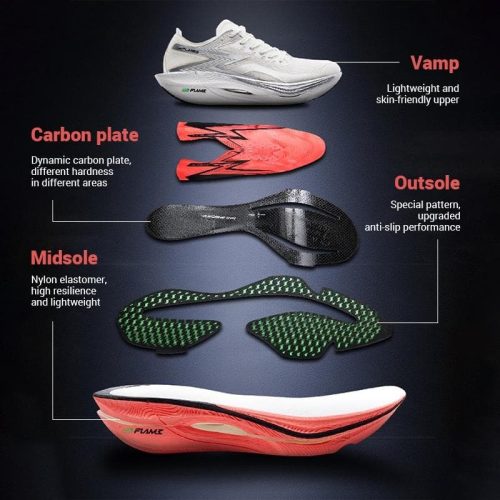
Pro Tips: Design the plate with the complete footwear system, not as an isolated component.
What Carbon Plates Do?
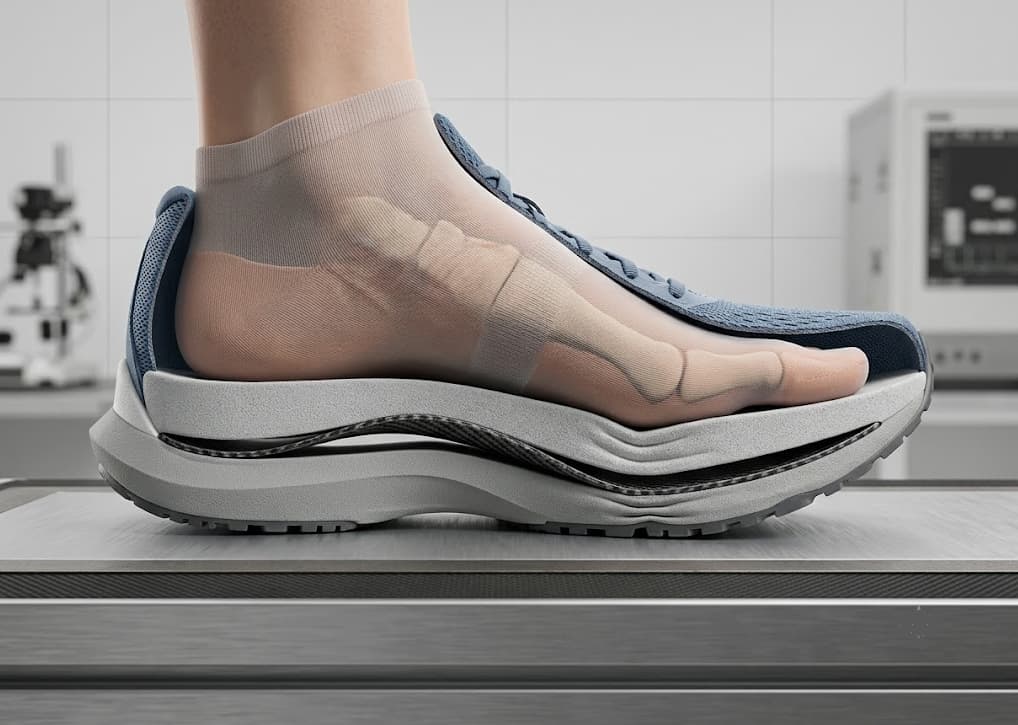
The primary function is to increase longitudinal bending stiffness, particularly through the forefoot.
This can reduce uncontrolled bending at the metatarsophalangeal region and influence the way the shoe transitions toward toe-off.
Research has found improvements in running economy with footwear having increased longitudinal bending stiffness, although results vary with plate design, shoe construction, running speed and the individual runner. A 2026 systematic review found that carbon-plated footwear reduced metabolic demand by approximately 2–3% on average, while emphasizing that the effect cannot be attributed to the plate alone.
Pro Tips: Control fiber orientation carefully because laminate direction strongly affects stiffness.
Spring-Like Effect
When the plate bends under load, the composite structure can store elastic energy. During unloading, this energy can contribute to the shoe’s mechanical response. More importantly, the plate interacts with highly resilient midsole foams, such as PEBA-based systems, to create the overall energy-storage and return behavior. Therefore, it is more accurate to consider the plate + foam + geometry as the performance system rather than treating the carbon plate as an independent spring.
Pro Tips: Do not rely only on thickness; geometry and lay-up can also tune stiffness.
Curved Geometry
Many performance plates use a curved or three-dimensionally shaped profile. Combined with a rocker-shaped midsole, this geometry can influence the foot-to-ground transition and alter joint mechanics. Research also indicates that curved plates can produce different running-economy effects from flat plates. A curved plate should therefore be designed together with the last, midsole profile and rocker geometry.
Pro Tips: Define positioning tolerances early to maintain pair-to-pair consistency.
A Short History: When Did Carbon Plates Enter Performance Running Shoes?
The modern carbon-plated running-shoe era is generally associated with Nike’s Vaporfly development in the mid-2010s. Nike’s own documentation states that early Vaporfly prototypes were being tested in the mid-2010s, with the early prototype becoming the basis for the Vaporfly 4% used in the 2017 Breaking2 project. NIKE
Nike identifies the Vaporfly 4% as the pioneer of the modern “super shoe” category. The shoe combined a carbon-fiber plate with highly resilient ZoomX foam, rather than relying on the plate alone. The first Breaking2 attempt took place on 6 May 2017 at Monza, Italy, where Eliud Kipchoge ran 2:00:25 wearing the Vaporfly. NIKE
Important technical note: It is more accurate to describe Vaporfly as the pioneer of the modern high-performance carbon-plated racing-shoe category, rather than claiming Nike invented the first carbon plate ever used in footwear.
Reference:
Nike — Breaking2 and the Vaporfly 4%
Nike — Vaporfly development and prototype testing
Testing and Parameters for Carbon Plates
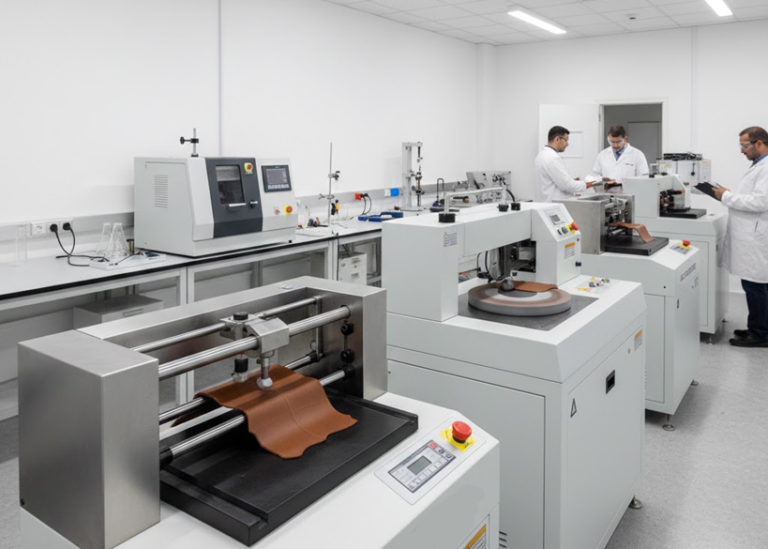
There is no single universal ISO standard that specifies a required carbon-plate thickness, stiffness or carbon-fiber layup for performance running shoes. In practice, manufacturers establish product specifications and test the plate as a component and, more importantly, as part of the completed footwear.
Key Parameters to Test
| Parameter | What should be evaluated | Typical purpose |
|---|---|---|
| Thickness | Plate thickness and thickness uniformity | Controls mass and stiffness |
| Length & width | Dimensional accuracy | Controls fit and mechanical behavior |
| Curvature / rocker profile | 3D geometry and consistency | Controls bending and transition |
| Longitudinal stiffness | Force/deflection or bending stiffness | Determines resistance to forefoot bending |
| Flexural behavior | Load versus displacement | Evaluates mechanical response |
| Fiber orientation | 0°, 90°, ±45° or specified layup | Controls directional stiffness |
| Laminate integrity | Voids, wrinkles, delamination, fiber displacement | Ensures composite quality |
| Fatigue resistance | Repeated bending/loading | Evaluates durability |
| Bonding / adhesion | Plate-to-foam interface | Prevents separation during use |
| Finished-shoe flex | Whole shoe rather than plate alone | Confirms the intended final behavior |
Relevant Footwear Test Methods
SATRA TM10 — Longitudinal Stiffness, Three-Point Bending
This method measures the stiffness and modulus of elasticity of semi-rigid sheet materials. It is applicable to soling and insole materials and can therefore be useful when characterizing plate-like footwear components. – SATRA
SATRA TM194 — Longitudinal Stiffness of Footwear
This is particularly relevant for a carbon-plated running shoe because it measures the longitudinal stiffness of the complete footwear, rather than evaluating the plate in isolation. The method determines the force required to flex footwear to a defined angle or maximum permissible bending moment. SATRA
ISO 24266:2020 — Whole-Shoe Flexing Durability
For finished footwear, flexing durability can be evaluated using ISO 24266:2020. It specifies two methods for determining the flexing durability of whole shoes. ISO
Competition Compliance Is a Separate Requirement
For racing footwear, World Athletics regulations are also important. Under the current 2026 athletic-shoe regulations, a non-spike athletic shoe must not contain more than one rigid structure, which may extend through all or part of the sole. Separate parts must not overlap.
World Athletics also specifies maximum sole thicknesses depending on the event; for example, road running and race walking have a 40 mm maximum sole thickness, while different limits apply to track and field events. WORLD ATHLETICS
Laboratory testing determines whether the carbon plate and finished shoe meet the intended engineering specification; World Athletics regulations determine whether competition footwear is permitted under the applicable event rules.
World Athletics also maintains an approved-shoe system and provides a shoe-check application for verifying competition models. WORLD ATHLETICS

Carbon-Plated Footwear Construction
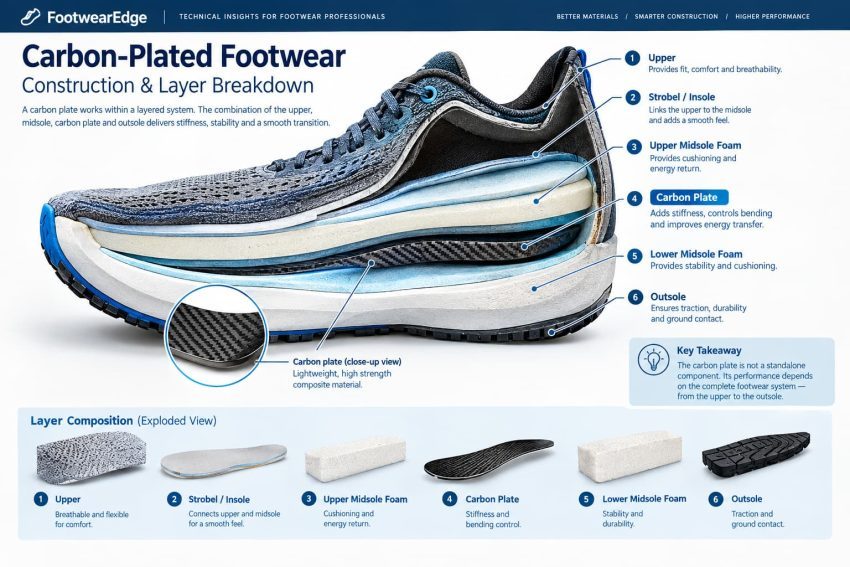
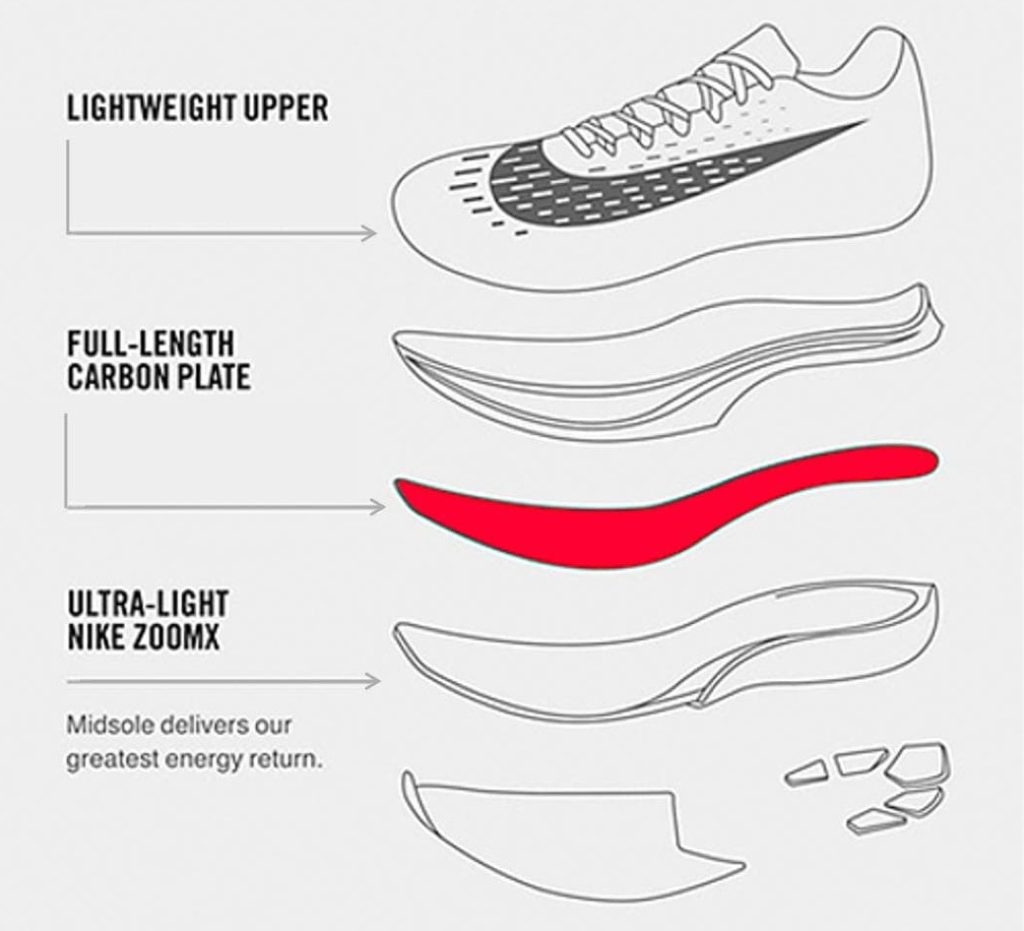
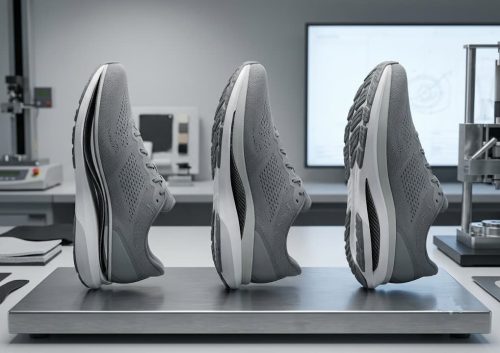
A simplified cross-section can contain:
Upper → Strobel/Insole → Upper Midsole Foam → Carbon Plate → Lower Midsole Foam → Outsole
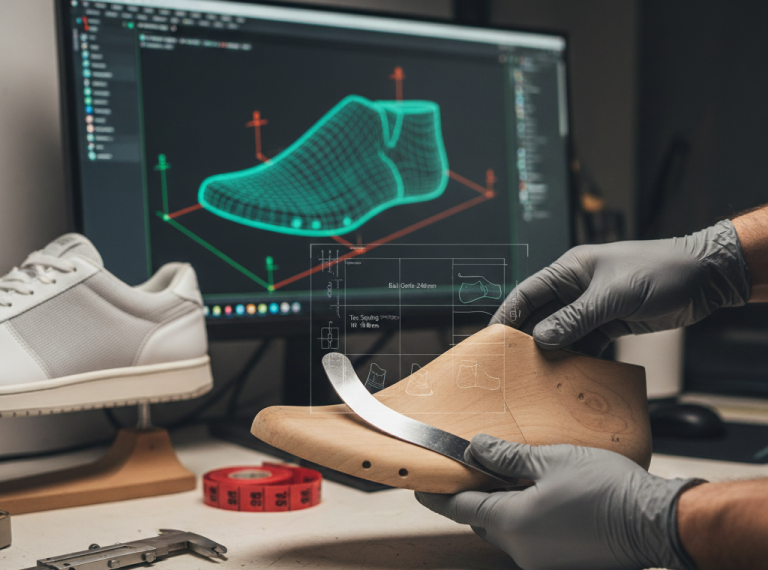
The plate may be positioned closer to the foot, around the middle of the midsole, or closer to the outsole. Changing its position changes how the plate interacts with the surrounding foam. The same carbon plate can therefore behave differently when used in different midsole constructions.
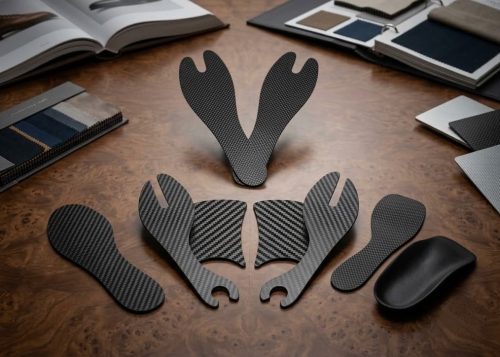
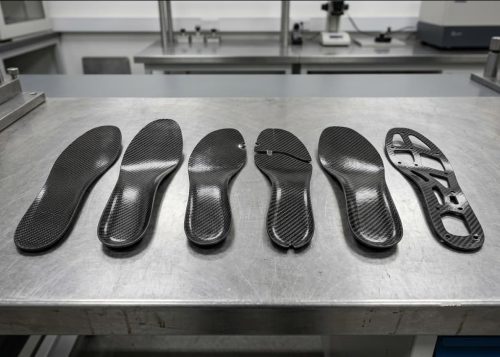
Types of Carbon Plates
| Plate Type | Construction | Typical Design Purpose |
|---|---|---|
| Full-Length | Extends through most of the shoe | Broad bending control |
| Forefoot | Concentrated toward the front | Forefoot stiffness |
| Split | Separate plate sections | Localized stiffness tuning |
| Flat | Relatively planar | Controlled structural reinforcement |
| Curved | Designed three-dimensional profile | Works with rocker geometry |
| Engineered | Variable geometry or stiffness | Localized mechanical tuning |
Pro Tips: Validate adhesive compatibility with both the carbon composite and foam.
Carbon-Fiber Materials Used in Plates
The mechanical behavior of a carbon plate begins with the composite material itself.
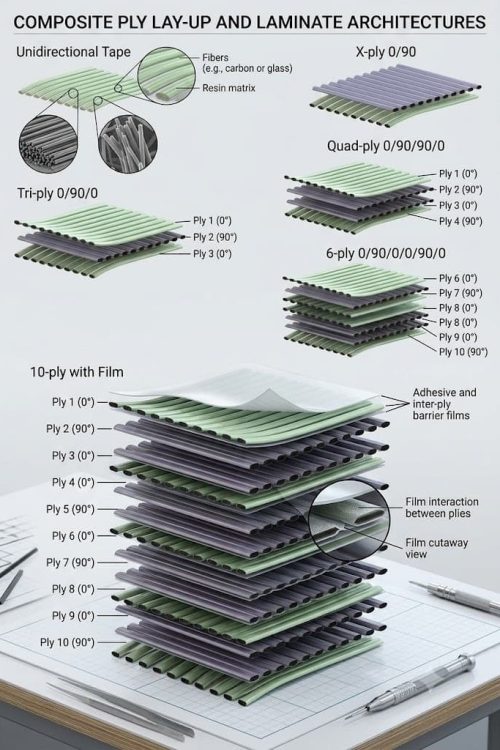
Carbon fibers are available in different grades and forms, with variations in tensile properties, fiber diameter, modulus and processing characteristics. For footwear applications, the selected material must also be compatible with the required manufacturing process. Common composite forms include:
- Unidirectional carbon-fiber reinforcement
- Woven carbon-fiber fabric
- Multidirectional laminate
- Carbon-fiber prepreg
- Thermoset carbon composites
- Thermoplastic carbon composites
- A unidirectional laminate places most fibers in a controlled direction. This can provide strong directional stiffness.
- A woven construction provides fibers in multiple directions and can offer different handling and mechanical characteristics.
- The resin system is equally important because it binds the fibers and transfers load between reinforcement layers.
Pro Tips: Protect plate edges during trimming, handling and assembly.
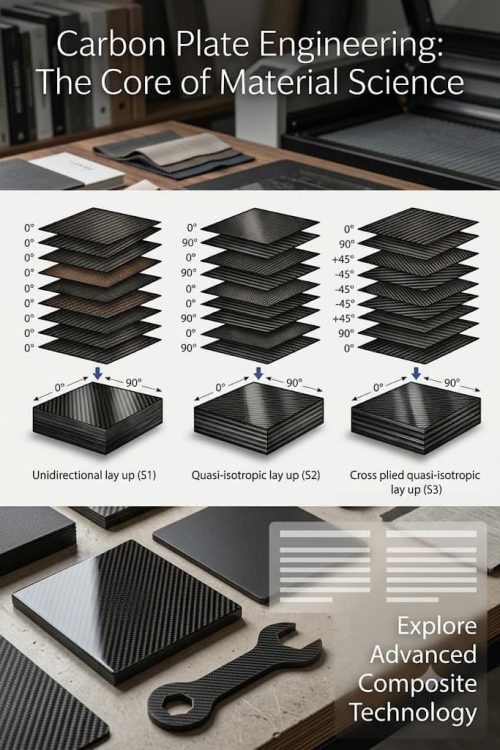
Fiber Orientation: The Hidden Engineering Factor
One of the most important factors in composite plate design is fiber orientation. Carbon-fiber composites are highly directional materials.
Their mechanical behavior depends strongly on the direction in which the reinforcing fibers are arranged. A simplified laminate may use:
- 0° orientation — primarily contributes to longitudinal stiffness
- 90° orientation — contributes to transverse reinforcement
- +45° / −45° orientation — contributes to shear and torsional behavior
- Multidirectional lay-up — balances different mechanical requirements
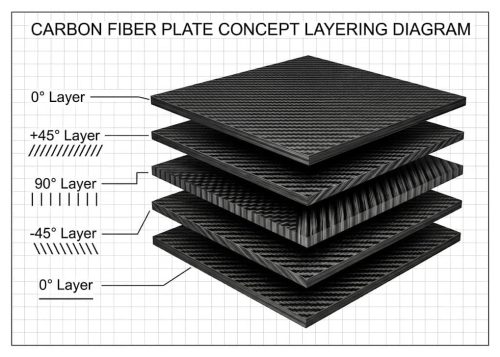
This means two plates with the same overall thickness can behave differently if their internal fiber architecture is different. For footwear development, fiber orientation therefore becomes a design parameter rather than simply a manufacturing detail.
Pro Tips: Test the finished shoe, not only the individual carbon plate.
Carbon Plate and Midsole Interaction
The plate works together with the foam rather than replacing it. The foam provides cushioning and deformation, while the plate influences bending behavior. The rocker and outsole then determine how the complete assembly interacts with the ground.
This interaction is why high-performance footwear often combines a stiff carbon plate with a lightweight, resilient foam system. Studies of advanced footwear technology suggest that foam properties and plate geometry contribute jointly to metabolic benefits.
Pro Tips: Avoid assuming maximum stiffness is optimal; the desired stiffness depends on the complete shoe design.
Performance Benefits
Research on carbon-plated footwear has reported measurable improvements in running economy, although the magnitude varies between studies and footwear systems. Earlier studies of high-performance racing shoes reported approximately 2.6–4.2% improvements in running economy under particular test conditions, while newer meta-analytic evidence places the average metabolic benefit of plated footwear around 2–3%.
| Performance Factor | General Finding | Important Note |
|---|---|---|
| Running economy | Often improved | Magnitude varies by shoe and runner |
| Metabolic demand | About 2–3% lower on average in recent meta-analysis | Plate alone is not responsible for the entire effect |
| Running speed | Benefits can vary with speed | Some studies report greater effects at higher speeds |
| Foam system | Highly important | Resilient foams contribute substantially |
| Plate geometry | Important | Curvature and stiffness influence the response |
Research also shows that the relationship between plate stiffness and performance is not simply “stiffer is better.” One study found that a moderately stiff advanced-footwear configuration produced better running economy than both a control and a very stiff configuration.
Limitations and Trade-Offs
Carbon-plated footwear also introduces engineering and practical trade-offs. High-performance racing constructions can be expensive, and their lightweight materials and aggressive geometries may prioritize race performance over long-term durability. Individual responses also vary. Running speed, gait, body characteristics, shoe geometry and adaptation can influence the outcome. Research does not support treating carbon plates as a universal performance solution for every runner.
Key considerations include:
- Performance benefits that may differ between racing and training
- Higher manufacturing and retail cost
- Potentially different durability characteristics
- Greater structural complexity
- Need for adaptation to unusual stiffness and rocker geometry
- Individual variation in biomechanical response
Who May Consider Carbon-Plated Footwear?
Carbon-plated footwear is primarily associated with distance racing and performance-oriented running, including 10K, half-marathon and marathon applications. Competitive runners may use the technology where running economy is important. Recreational runners may also benefit, but the value depends on their running goals, budget, durability requirements and personal response.
For runners with previous injuries or specific biomechanical concerns, shoe selection should not be based solely on the presence of a carbon plate. A rocker or stiff plate may change loading patterns, but it should not automatically be assumed to reduce injury risk.
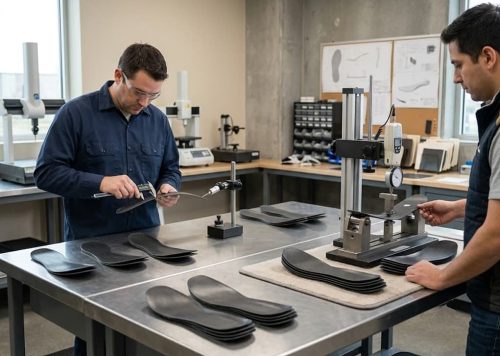
Quality Control and Testing
For footwear manufacturers, consistency is as important as the original plate design. Important checks include:
- Finished-shoe flex behavior
- Plate length, width and thickness
- Curvature and profile
- Surface and edge condition
- Fiber/laminate consistency
- Bending stiffness
- Fatigue performance
- Bonding strength
- Plate positioning
- Left/right pair consistency
Conclusion
Carbon plates have brought advanced composite engineering into modern footwear. Their role extends beyond simply making a shoe stiff. Fiber orientation, laminate construction, curvature, thickness, plate position, midsole foam and rocker geometry all contribute to the final footwear response.
The most important principle is simple: the carbon plate is one component of a complete footwear system. Its value comes from how effectively the plate, foam, geometry and outsole are engineered to work together.
Carbon Plate / Composite Technology Manufacturers
Carbitex — Carbitex specializes in flexible carbon-fiber composite technologies for footwear, including MonoFlex and GearFlex plates used by brands such as adidas, Altra, Saucony and Scott. CARBITEX
Toray Advanced Composites — Toray supplies CFRT continuous-fiber thermoplastic composites for footwear, including spring, propulsion, heel-stability and shank plates with tunable fiber orientations and stiffness.
ARRIS Composites — ARRIS develops continuous-fiber-reinforced thermoplastic footwear plates using additive molding, advanced materials and simulation, including its technology partnership with Brooks for performance running shoe1s.


FAQs – Frequently Asked Questions
A carbon plate is a thin, lightweight composite component made from carbon fibers embedded in a polymer resin. In performance footwear, it is usually positioned within the midsole to increase longitudinal bending stiffness and influence the shoe’s bending and rocker behavior.
A carbon plate increases the shoe’s resistance to longitudinal bending, particularly through the forefoot. Working together with the midsole foam and rocker geometry, it can influence the transition from midstance to toe-off and may improve running economy under suitable conditions.
No. Most footwear carbon plates are carbon-fiber-reinforced polymer composites, rather than solid carbon. Carbon fibers provide reinforcement while the polymer resin binds the fibers together and transfers loads throughout the laminate.
The plate and foam perform different functions. The foam provides cushioning and energy return, while the plate controls bending and contributes to the shoe’s mechanical response. High-resilience foams such as PEBA-based compounds can complement the plate’s function in high-performance footwear.
Manufacturers can evaluate dimensions, thickness, curvature, fiber orientation, longitudinal bending stiffness, flexural behavior, fatigue resistance, laminate integrity and bonding. Finished footwear can also be tested for longitudinal stiffness and flexing durability using applicable footwear test methods such as SATRA TM194 and ISO 24266.
Not necessarily. The performance response depends on the complete footwear system, including plate geometry, stiffness, curvature, foam properties, shoe mass, rocker geometry and the runner’s biomechanics. Research indicates that increasing stiffness beyond an appropriate range does not necessarily produce additional running-economy benefits.
Carbon-plated footwear is particularly common in high-performance road-racing shoes for events such as 10K races, half marathons and marathons. Recreational runners may also use plated footwear, but the benefits, cost, durability and adaptation requirements can vary between individuals.
- PMMA stands for Polymethyl Methacrylate, a transparent thermoplastic commonly known by brand names such as Acrylic, Plexiglas, Perspex, and Lucite. ↩︎
- POM (Polyoxymethylene) Also known as: Acetal, Delrin® (a trademarked form of POM by DuPont) ↩︎
- UHMW-PE (Ultra-High-Molecular-Weight Polyethylene) A specialized polyethylene with extremely long polymer chains. ↩︎