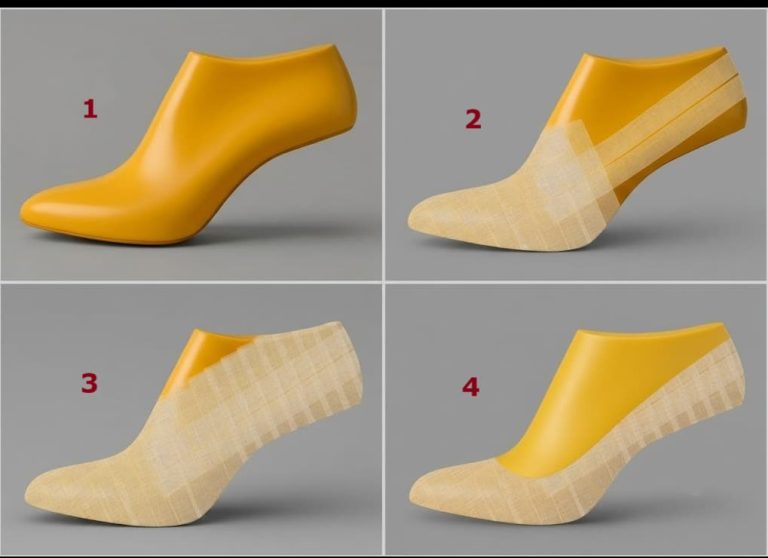
Vacuum Forming in Footwear: Last Masking, Style Development, Last Marking & Packing Support
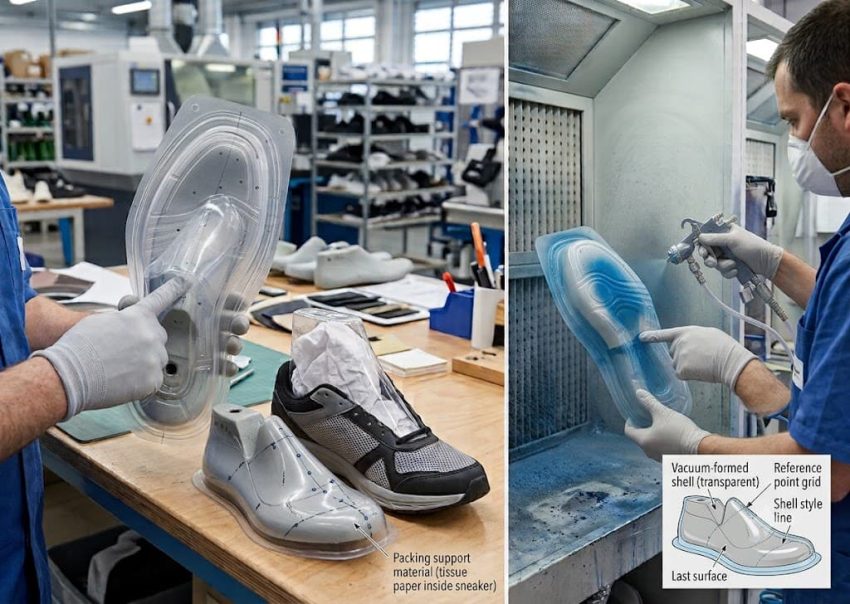
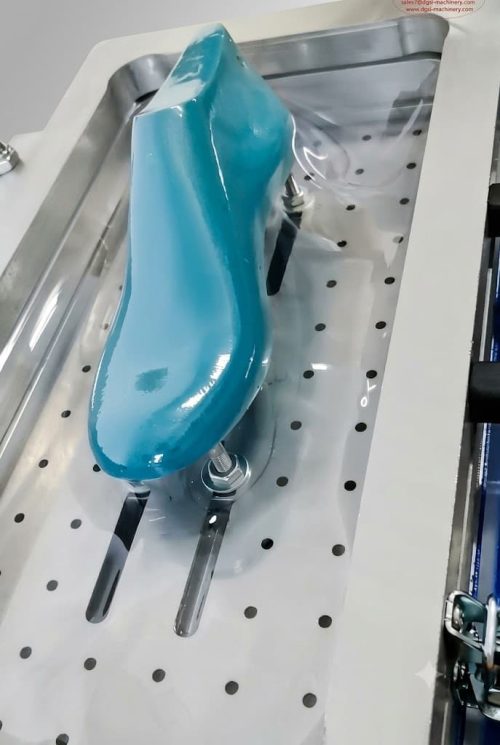
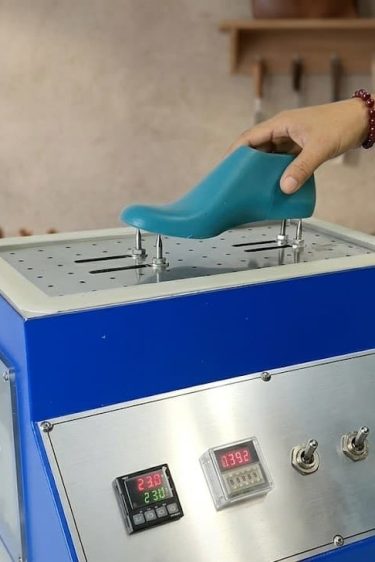
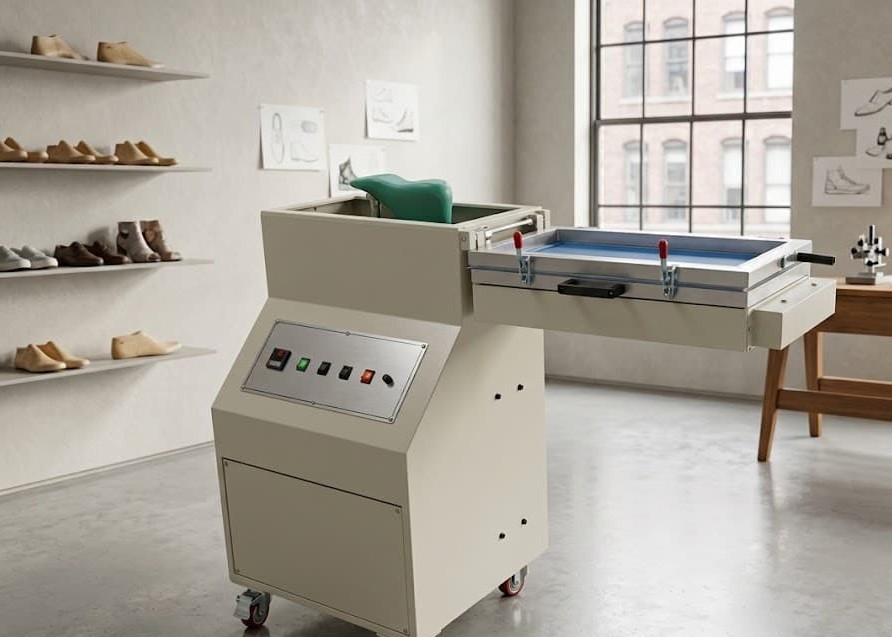
Vacuum forming is a thermoforming process in which a heated thermoplastic sheet is drawn tightly over a three-dimensional form using vacuum pressure. In footwear manufacturing, the shoe last itself can be used as the forming reference, allowing the plastic shell to reproduce the important contours and geometry of the last.
This makes vacuum forming particularly useful where footwear production requires repeatable 3D positioning, masking, marking, design communication or shape support.
Although the equipment and forming principle are relatively simple, the resulting shell can become a valuable footwear engineering tool. Depending on how it is designed, trimmed and marked, the same basic technique can support four different applications: last masking, style-line development, last marking/reference transfer, and shoe packing support.
Vacuum-Formed Last Masking
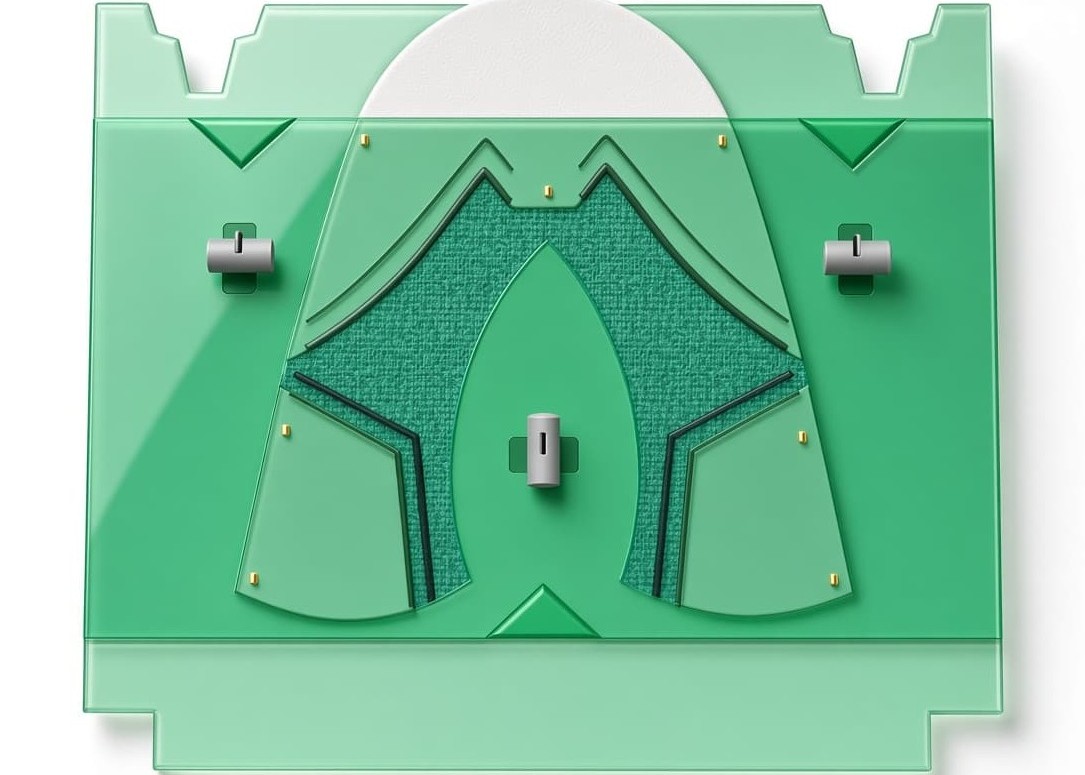
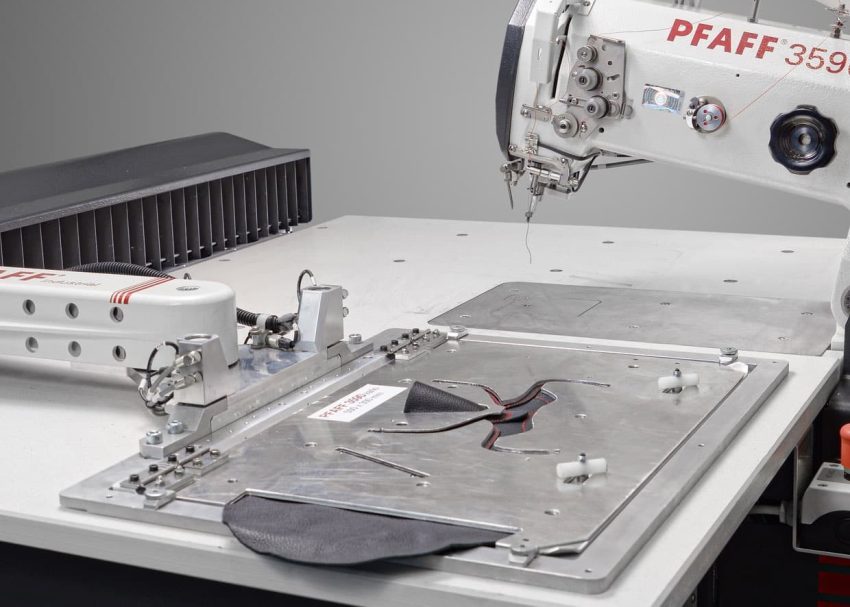
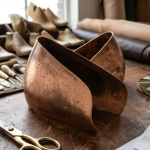
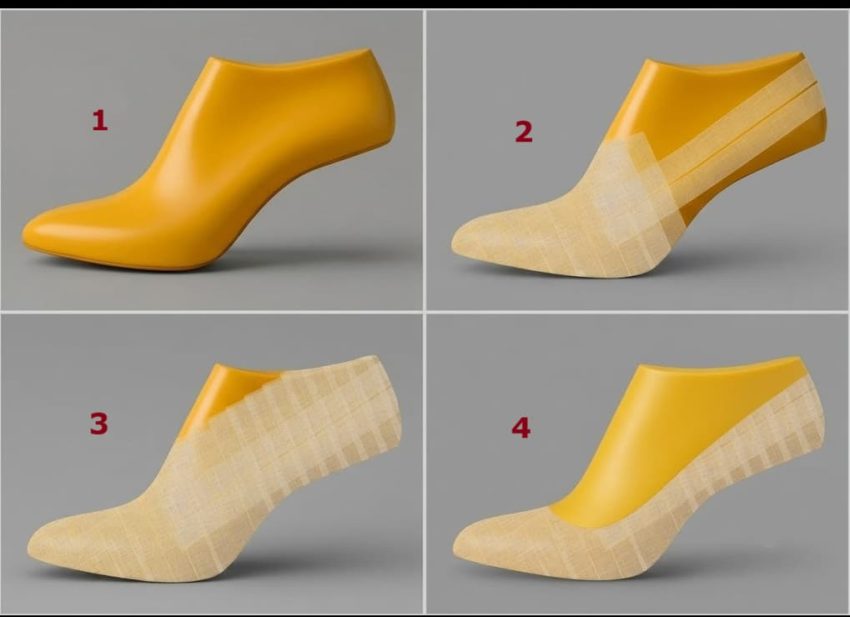
One of the important applications is creating a mask directly from the shoe last. A thermoplastic sheet is formed over the last and then trimmed according to the required masking boundary. The resulting shell can cover selected areas while leaving other areas exposed.
The mask can be used during painting, spraying, priming, coating and other surface-treatment operations where certain areas must be protected. For example, if only a particular zone of the last or footwear component needs to receive a spray treatment, the formed mask can cover the remaining area. Once positioned, it provides a consistent three-dimensional boundary.
This is particularly useful in production because manually applying masking tape can introduce variation between operators and between production pairs.
A dedicated formed mask provides a more repeatable reference.
Typical benefits
- Consistent masking boundary
- Faster preparation
- Reduced dependence on manual masking
- Repeatable positioning
- Protection of restricted areas
- Potential for repeated use
- Easier production standardization
The design of the mask is important. It must fit the last correctly without excessive looseness, while still allowing easy removal. The trimming line should accurately correspond to the intended production boundary. For repeated production, the material should also withstand the relevant paints, primers, adhesives, solvents or other chemicals used in the process.
Pro Tips:
Use the Correct Master Last: Always form the shell from the approved master last to maintain accurate geometry and references.
Vacuum-Formed Shell for Style-Line Development
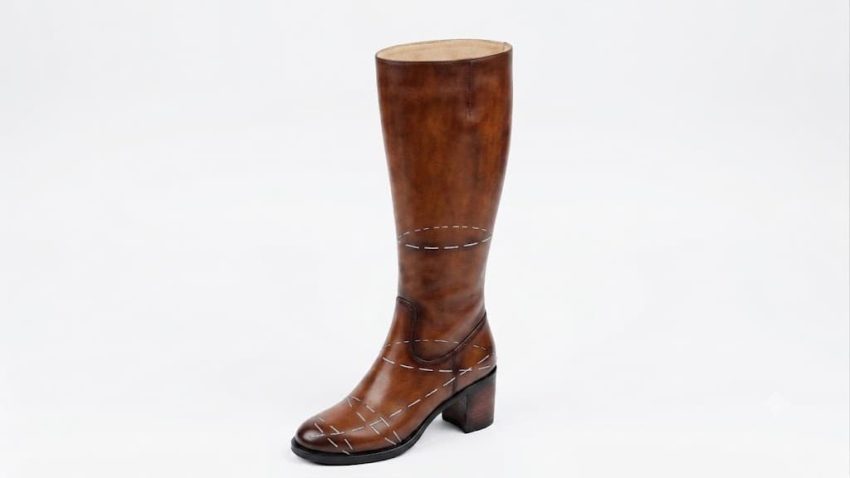
A particularly useful application is using the formed shell as a three-dimensional style-development reference. After the thermoplastic sheet has been formed over the last, the shell reproduces the three-dimensional surface. A designer or pattern engineer can draw the proposed style lines directly onto this formed surface. Lines can represent:
- Vamp boundaries
- Toe-cap lines
- Quarter lines
- Overlays
- Strap positions
- Decorative panels
- Openings
- Other design details
This gives the development team a physical 3D representation rather than relying entirely on a flat drawing. The marked shell can also be sent to the customer for review or model copying.
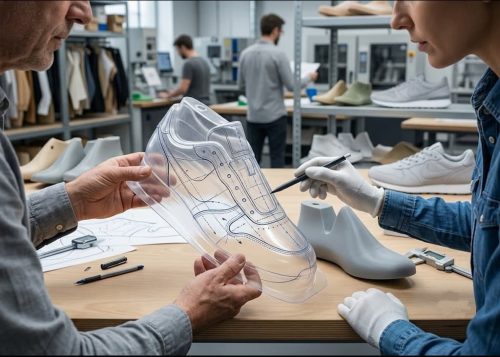
The customer can physically examine the position and flow of the style lines around the three-dimensional form. This can reduce interpretation differences between the footwear manufacturer and customer because the intended design is communicated on a surface that follows the actual last geometry.
Why it can improve customer communication
- Shows the design in three dimensions
- Allows viewing from different angles
- Makes style-line curvature easier to understand
- Helps communicate proportions
- Provides a physical copying reference
- Reduces ambiguity in 2D drawings
For development work, the vacuum-formed shell therefore acts as a 3D style communication template.
Pro Tips:
Prefer Transparent Material: Use clear or translucent material for marking and style-line templates to make alignment and visibility easier.

Vacuum-Formed Shell for Last Marking & Reference Points
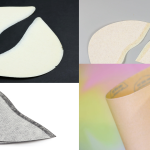
Another important application, particularly in sandal manufacturing, is using a vacuum-formed shell to establish and transfer reference markings to production lasts. A master last can be used to produce the formed shell. Required reference points are then marked on the shell. These may include last-pin locations, sandal strap positions, centre lines, attachment points, alignment references and other critical construction points.
The shell can subsequently be positioned over production lasts of the same model. The marked locations provide a physical reference for transferring the required markings consistently. This is especially useful when a model requires the same reference geometry to be reproduced across a large number of production lasts.
Instead of individually estimating or manually locating each point, the formed shell provides a repeatable 3D reference.
Typical reference applications
- Last pin locations
- Sandal strap reference points
- Centre lines
- Component positioning
- Attachment references
- Alignment points
- Other model-specific markings
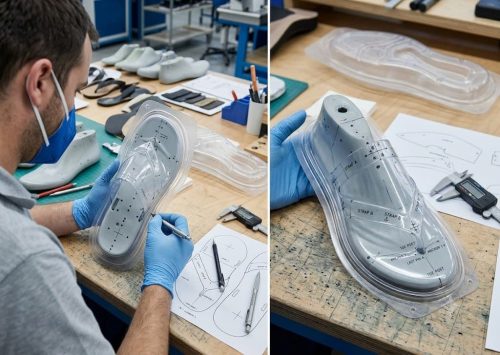
Why transparent material is valuable
A transparent or translucent thermoplastic sheet is particularly useful for marking templates. When the shell is placed over the last, the operator can see the last underneath it. This makes alignment and positioning easier and allows the operator to visually check the relationship between the marked shell and the last surface. Transparency can therefore improve:
- Positioning accuracy
- Visual alignment
- Reference-point transfer
- Inspection
- Operator convenience
- Identification of existing last markings
For this reason, transparent material is often preferred when visibility and accurate reference transfer are more important than simply producing an opaque fixture.
Pro Tips:
Select the Right Thickness: Match sheet thickness to the application—flexibility for masking, rigidity for templates, and balanced support for packing.
Vacuum-Formed Support for Shoe Packing
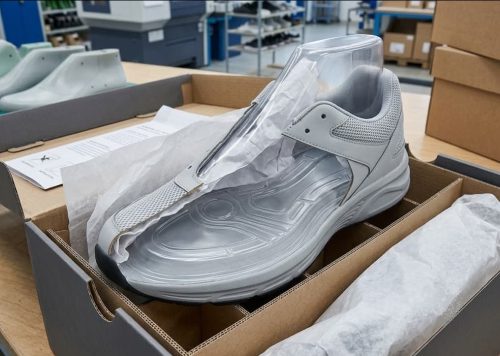
The next application occurs after footwear production: shoe packing and shape retention. Finished footwear can become distorted when compressed during packing, storage, handling and transportation. The effect can be particularly noticeable around the toe box, vamp, quarters and opening.
A vacuum-formed support can be designed according to the internal shape of the shoe. Tissue paper is stuffed into or around the formed support, and the support is then inserted into the finished shoe. The formed plastic provides a consistent three-dimensional structure, while the tissue fills the remaining space and provides cushioning. The objective is not to make the shoe rigid. Instead, the support helps maintain the intended shape and reduces the possibility of collapse or excessive deformation.
Typical benefits
- Maintains toe shape
- Supports vamp geometry
- Helps maintain quarter shape
- Reduces unwanted creasing
- Provides consistent packing
- Reduces dependence on irregular hand-stuffed tissue
- Helps preserve appearance during transportation
This method can be particularly useful for footwear where presentation, shape and appearance at the point of sale are important.
Pro Tips:
Ensure Easy Release: Avoid excessive undercuts and ensure the formed shell can be removed from the last without distortion.
Materials Used for Vacuum-Formed Footwear Shells
Material selection depends strongly on the purpose of the formed shell. The material used for a temporary style-development template may not be the best choice for a repeatedly used production mask or packing support.
Common thermoformable materials include PETG, PVC, ABS, PP, PS/HIPS and PE.
| Material | General Characteristics | Potential Footwear Application |
|---|---|---|
| PETG (Polyethylene Terephthalate Glycol) | Clear, good forming, good surface appearance | Transparent marking and style-reference shells |
| PVC (Polyvinyl Chloride) | Flexible, economical, available in clear/translucent grades | Masking and general templates |
| ABS (Acrylonitrile Butadiene Styrene) | Rigid, durable and impact resistant | Reusable masks and robust fixtures |
| PP (Polyethylene/High Impact Polystyrene) | Lightweight, flexible and chemically resistant | Process masks and reusable supports |
| PS/HIPS (Polystyrene) | Easy to form and economical | Simple templates and limited-use applications |
| PE (Polyethylene) | Flexible and chemically resistant | Selected masking/support applications |
Material purpose by application
- For style-line and last-marking shells: Clear or translucent PETG or PVC can be advantageous because the operator or designer can see the last through the shell.
- For production masking: The material should have sufficient flexibility for fitting and removal while also resisting the chemicals and process conditions to which it will be exposed.
- For packing supports: The material should provide sufficient dimensional stability while remaining lightweight and practical for insertion into the shoe.
- For repeated-use fixtures: Durability, dimensional stability, wear resistance and resistance to the production environment become more important.
Material thickness should also be selected according to the application. A shell that is too thin may lack stability, while excessive thickness can increase material cost and make forming and trimming more difficult.
Pro Tips:
Trim Accurately: Precise trimming is essential for consistent masking boundaries, style lines and reference-point transfer.
Basic Vacuum-Forming Process
The basic process can be summarized as:
Master last preparation → Thermoplastic sheet heating → Sheet positioning → Vacuum forming → Cooling → Removal → Trimming → Marking/finishing → Inspection
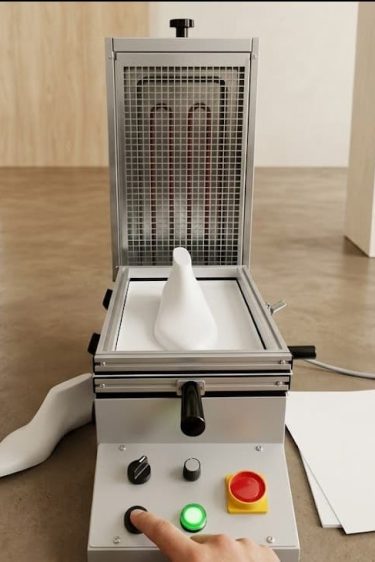
The thermoplastic sheet is heated until it reaches a suitable forming condition. It is then positioned over the last, and vacuum pressure draws the softened material tightly against the three-dimensional surface After cooling, the formed shell retains the last’s general geometry and can be removed. The shell is then trimmed according to its intended application.
- For a mask, trimming establishes the process boundary.
- For a style-development shell, the surface becomes a reference on which style lines can be drawn.
- For a last-marking shell, reference points can be established and transferred.
- For a packing support, the formed geometry is used to support the finished shoe.
Pro Tips:
Control Master Markings: Establish all critical pin, strap and alignment points from one approved master template.
Important Design Considerations
Successful vacuum forming is not only dependent on the machine. The design of the shell and the characteristics of the master last are equally important. Key considerations include:
- Last geometry
- Forming depth
- Draft and release
- Thermoplastic thickness
- Material shrinkage
- Vacuum distribution
- Edge trimming
- Shell rigidity
- Ease of removal
- Repeated-use requirements
- Storage and identification
- For masking, accurate trimming and repeatable positioning are critical.
- For style development, dimensional conformity and surface quality are important.
- For last marking, the shell must maintain its geometry and allow accurate alignment with the production last.
- For packing support, the balance between rigidity, weight, flexibility and shoe fit becomes the priority.
Pro Tips:
Inspect Before Production: Check fit, alignment, distortion, trimming and critical reference points before releasing the shell for production.
Four Applications at a Glance
| Application | Main Purpose | Most Important Requirement |
|---|---|---|
| Last Masking | Protect selected areas during production | Accurate boundary and easy removal |
| Style-Line Shell | Communicate and copy 3D design | Accurate last conformity and visibility |
| Last Marking Template | Transfer reference points to production lasts | Repeatable positioning and alignment |
| Packing Support | Maintain finished shoe shape | Correct internal geometry and support |
Pro Tips:
Design for Actual Use: Select the material and construction based on exposure to chemicals, heat, repeated handling, or packing pressure.
Conclusion
Vacuum forming has a wider role in footwear than simply producing a plastic cover. By forming a thermoplastic sheet directly over a shoe last, manufacturers can create a repeatable three-dimensional engineering tool for different stages of footwear development and production.
The value of vacuum forming in footwear therefore comes from its ability to convert complex last geometry into a lightweight, repeatable and practical 3D reference—supporting design communication, production accuracy, process protection and final product presentation.


FAQs – Frequently Asked Questions
Vacuum forming is a thermoforming process in which a heated thermoplastic sheet is drawn over a shoe last or other three-dimensional form to create a shaped plastic shell.
It is a plastic shell formed over a shoe last and trimmed to protect selected areas during painting, spraying, priming, coating or other production operations.
Yes. A formed shell can reproduce the last’s 3D geometry, allowing designers to draw style lines directly on its surface and provide a physical reference to a customer.
Transparency allows the operator to see the last through the shell, making alignment, positioning and transfer of reference points easier.
Depending on the footwear model, reference points can include last-pin locations, sandal strap positions, centre lines, attachment points and other construction references.
A formed internal support can be combined with tissue paper and inserted into the finished shoe to help maintain its shape during packing, storage and transportation..
PETG, PVC, ABS, PP, PS/HIPS and PE can be considered depending on the required transparency, flexibility, rigidity, chemical resistance, durability and cost.
Clear PETG can be a useful option where transparency, good forming characteristics and visibility of the underlying last are important.