Lacing in Footwear Upper Manufacturing – Stitching Process Series
Lacing in footwear upper manufacturing is a controlled stitching-stage activity that directly influences upper presentation, shape retention, and readiness for lasting. Although it appears simple, improper lacing leads to uneven vamp shaping, distortion during lasting, and rejection at final inspection. Therefore, factories standardize lacing methods, tension control, and sequence to ensure consistency across production lines.
Lacing in Footwear Upper Manufacturing
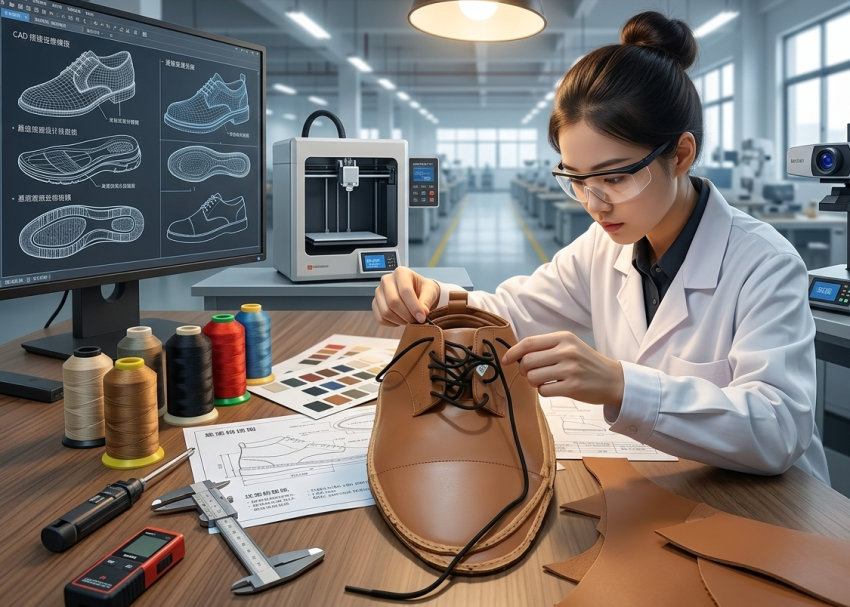
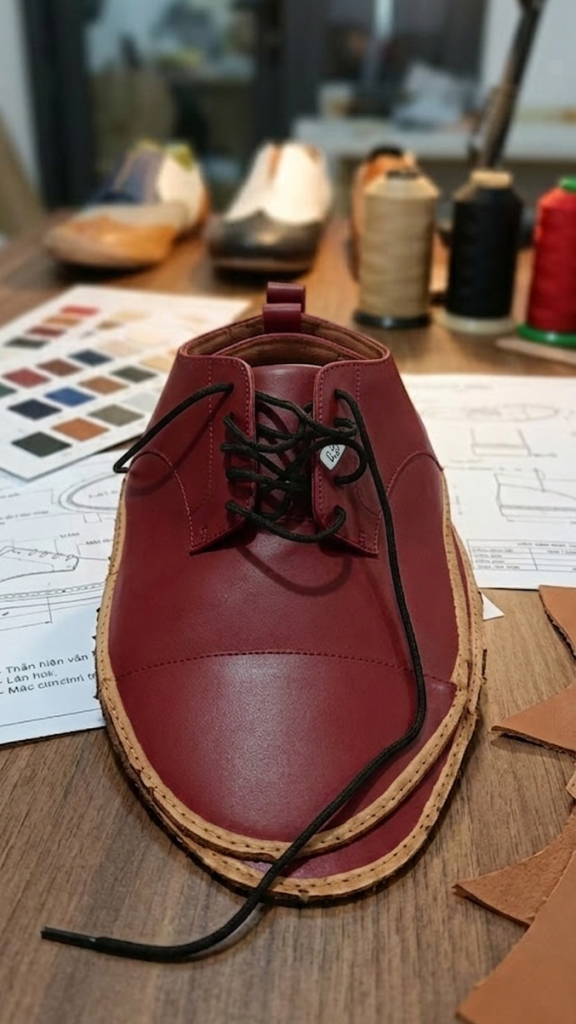
Lacing is the process of inserting shoelaces through eyelets or loops in a defined pattern to prepare the upper for lasting, handling, and final presentation. In production environments, lacing is not only aesthetic but also functional, as it stabilizes the upper structure before downstream operations.
In most factories, operators follow pre-defined lacing patterns based on shoe design, eyelet configuration, and customer requirements. Additionally, lace length, material type, and insertion direction are controlled to maintain uniformity. Furthermore, lacing is performed either before or after lasting depending on the construction method and finishing requirements.
Two types of lacing are commonly used in manufacturing:
- Temporary Lacing – Used only for lasting support and removed later
- Permanent Lacing (Direct Lacing) – Final lace inserted during upper production
Key Control Points:
- Maintain correct lacing pattern as per tech pack
- Ensure even tension across all eyelets
- Use correct lace length and type
- Avoid twisting or overlapping of lace
Pro Tip : Use color-coded temporary laces to differentiate from final laces
Temporary Lacing (For Lasting Support)
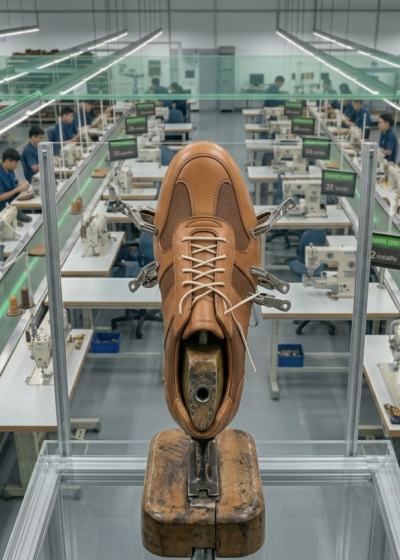
Temporary lacing is used to support the upper during lasting operations. In this method, laces are inserted to hold the upper shape correctly on the last but are removed before finishing.
This approach is widely used in shoes that undergo finishing processes such as polishing, cream application, or dyeing.
Since these processes can stain or damage laces, temporary laces act as a placeholder. As a result, factories avoid rework and maintain clean final appearance.
During execution, operators loosely lace the upper while ensuring sufficient hold for proper toe and vamp shaping. After lasting, the laces are removed before finishing operations begin. Moreover, temporary lacing helps reduce handling issues by stabilizing the upper during movement between stitching and lasting sections.
Key Control Points:
- Use low-cost or reusable temporary lace
- Maintain moderate tension for proper shaping
- Remove laces before finishing operations
- Avoid tight lacing that may cause upper marks
Pro Tip : Train operators with visual SOP charts for faster consistency
Permanent Lacing (Direct Lacing in Upper Stage)
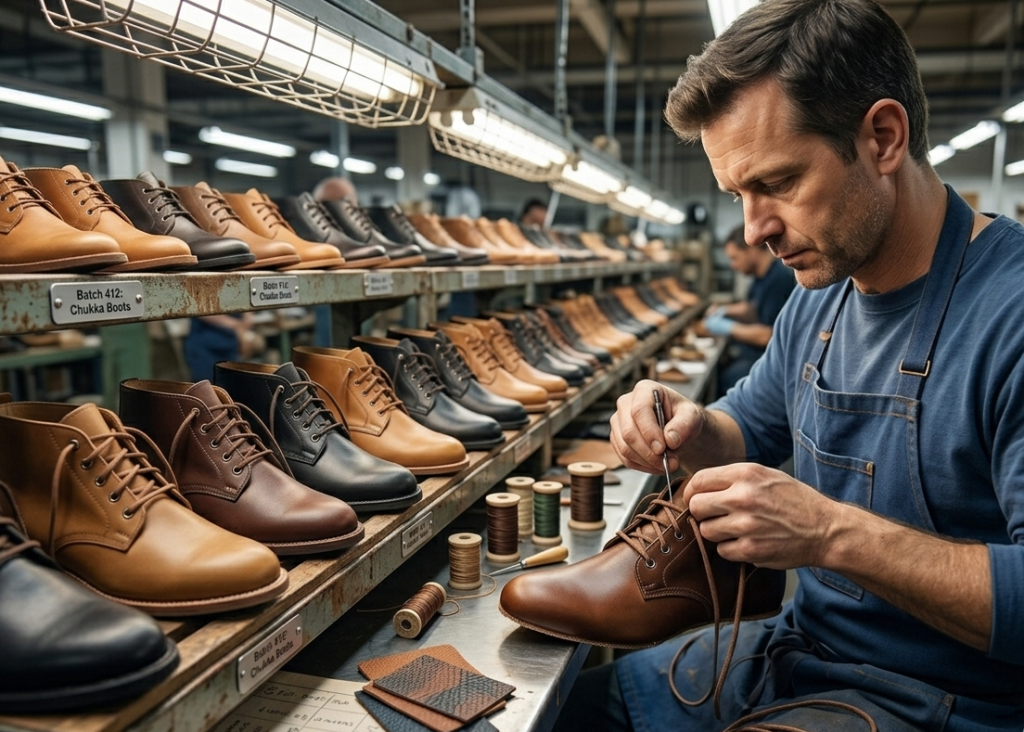
Permanent lacing, also known as direct lacing, is performed during upper manufacturing and remains in the shoe until final packing. This method is used for products that do not require finishing processes. In such cases, inserting the final lace early reduces additional handling, improves line efficiency, and minimizes labor dependency in later stages. Therefore, this method is preferred for sports shoes, casual footwear, and models with no polishing or cream application.
Operators follow exact lacing patterns as per design specifications. Additionally, lace alignment and presentation are strictly monitored since the product moves directly toward packing after assembly.
Consequently, permanent lacing contributes to both productivity improvement and consistent visual appeal.
Key Control Points:
- Follow exact customer-approved lacing pattern
- Maintain uniform lace tension and symmetry
- Ensure lace cleanliness (no stains or oil marks)
- Verify correct lace length before insertion
Pro Tip : Always keep standard reference samples at workstation
Lacing Patterns and Methods
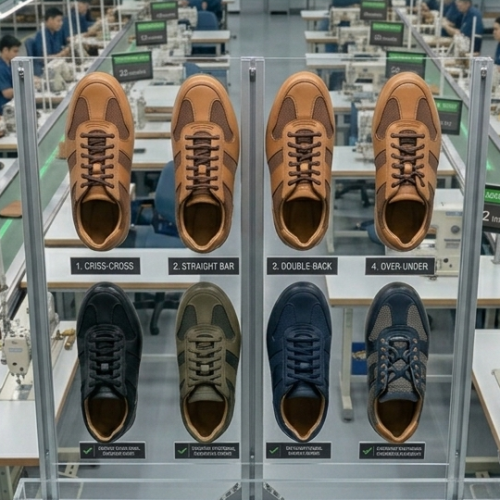
Lacing patterns are defined based on footwear design, number of eyelets, and brand requirements. Common patterns include criss-cross lacing, straight bar lacing, and decorative lacing for fashion footwear. Each pattern impacts both aesthetics and functional performance. For example, criss-cross lacing provides better tightening flexibility, while straight lacing offers a clean and minimal appearance.
In factory practice, operators are trained using visual guides or standard samples. Moreover, guides or fixtures may be used to maintain uniformity in high-volume production. Consistency in pattern execution is critical because even minor variation can lead to visual defects and customer rejection.
Key Control Points:
- Follow standard reference sample strictly
- Maintain symmetry between left and right shoes
- Avoid lace twisting during insertion
- Ensure correct starting and ending points
Pro Tip : Avoid over-tight lacing to prevent vamp distortion
Lace Material and Length Selection
Selecting the correct lace material and length is essential for both functionality and appearance. Laces can be made from polyester, cotton, nylon, or blended materials depending on product requirements. The length of the lace must match the number of eyelets and lacing pattern. If the lace is too short, it affects usability. If it is too long, it creates handling issues and poor presentation.
Additionally, lace tip finishing (aglet quality) must be checked to ensure smooth insertion through eyelets without fraying. Factories usually standardize lace specifications in the bill of materials (BOM) to maintain consistency across production.
Key Control Points:
- Verify lace length as per specification
- Check aglet quality for smooth insertion
- Ensure color matching with upper design
- Avoid defective or frayed laces
Pro Tip : Use pre-cut lace lengths to reduce variation
Lacing Defects and Quality Control
Lacing defects can directly affect both appearance and functionality. Common issues include uneven tension, incorrect pattern, twisted laces, and contamination. These defects usually occur due to lack of operator training, improper handling, or absence of standard references. Therefore, inline inspection and final QC checks are essential.
Inspectors verify lacing symmetry, tension consistency, and cleanliness before approving the upper for next stages. Early detection helps avoid rework and ensures consistent output quality.
Key Control Points:
- Check uniform tension across all eyelets
- Inspect for correct pattern execution
- Ensure lace cleanliness and alignment
- Reject twisted or damaged laces
Pro Tip : Implement inline QC checks instead of end-line corrections


Process Integration with Lasting and Finishing
Lacing plays a crucial role in preparing the upper for lasting and finishing. Temporary lacing supports proper shape formation during lasting, while permanent lacing eliminates extra handling in non-finishing models. Therefore, the selection between temporary and permanent lacing must align with the production flow. Improper selection can lead to rework, inefficiency, or product damage.
Additionally, coordination between stitching, lasting, and finishing teams ensures smooth process flow and avoids delays. Standard operating procedures (SOPs) must clearly define when and how lacing should be performed.
Key Control Points:
- Align lacing type with production flow
- Ensure coordination between departments
- Avoid unnecessary re-lacing operations
- Maintain process standardization
Pro Tip : Store laces in clean, dry conditions to avoid contamination
Frequently Asked Questions – FAQs
1. Why is lacing important in upper manufacturing?
It stabilizes the upper, ensures proper shape during lasting, and improves final presentation.
2. What is the difference between temporary and permanent lacing?
Temporary lacing is removed after lasting, while permanent lacing remains in the final product.
3. When should temporary lacing be used?
It is used when finishing processes like polishing or dyeing can damage the lace.
4. Can incorrect lacing cause rejection?
Yes, wrong pattern, uneven tension, or twisted lace can lead to visual defects.
5. How is lace length determined?
Based on number of eyelets and lacing pattern defined in specifications.
6. What are common lacing defects?
Uneven tension, incorrect pattern, lace twisting, and contamination.
7. Is lacing done manually or by machine?
Mostly manual, but guided methods and fixtures are used in high-volume production.
Pro Tip : Standardize lacing sequence across all production lines
Explore other Stitching Process Series
- Reinforcement (Backers & Tapes) Process in Footwear Manufacturing – Stitching Process Series
- Nosew Application in Footwear Manufacturing – Stitching Process Series
- Component Folding in Footwear Manufacturing – Stitching Process Series
- Stitching Assembly Process in Upper Manufacturing (Part 1)– Stitching Process Series
- Stitching Assembly Defects, Line Balancing & Productivity (Part 2)– Stitching Process Series
- Cementing in Upper Manufacturing (Stitching Support Process)– Stitching Process Series
- Toe Puff (Box Toe) Attaching Process in Footwear Upper Manufacturing – Stitching Process Series
- Counter Stiffener Attaching in Footwear Upper Manufacturing – Stitching Process Series
- Upper & Lining Lamination in Footwear Upper Manufacturing – Stitching Process Series
- Bottom Stitching (Upper Feather Edge) in Footwear Upper Manufacturing