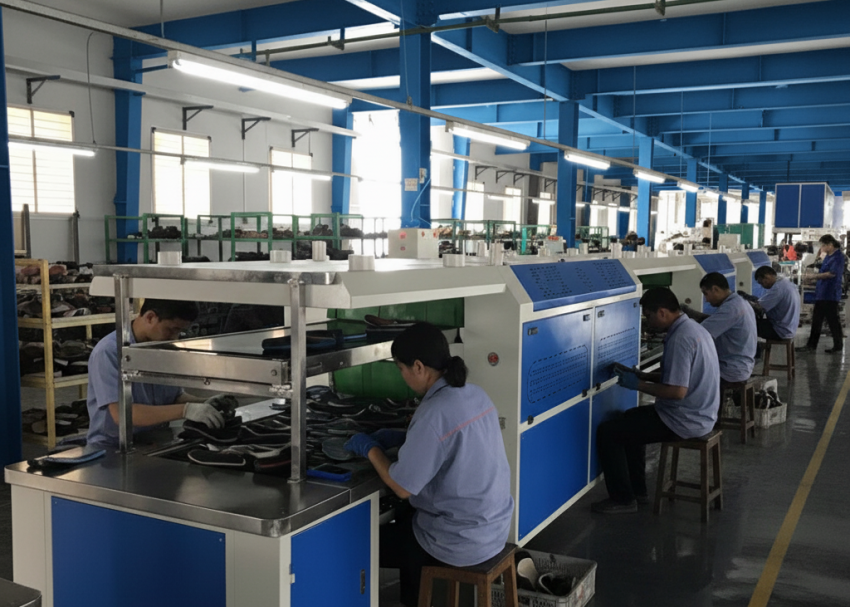
Drying and Activation Operations in Outsole Process: Outsole (Stock Fitting) Assembly Series
In the previous blog, Secondary Cement Coating Operations in Outsole Process, we covered the application of the second adhesive coat on the outsole. Once this coating is completed, the outsole must pass through controlled drying and activation before it can be attached to the lasted upper.
The fundamental principles of adhesive drying and activation have already been explained in our Full Shoe Assembly Series article, Cement / Adhesive Drying & Activation in Footwear Manufacturing. This blog therefore focuses specifically on how the operation is controlled within the Outsole (Stock Fitting) Assembly process.
At this stage, the objective is simple: prepare the cemented outsole for reliable attachment while maintaining the correct adhesive condition, temperature, and timing.
Drying of the Cemented Outsole
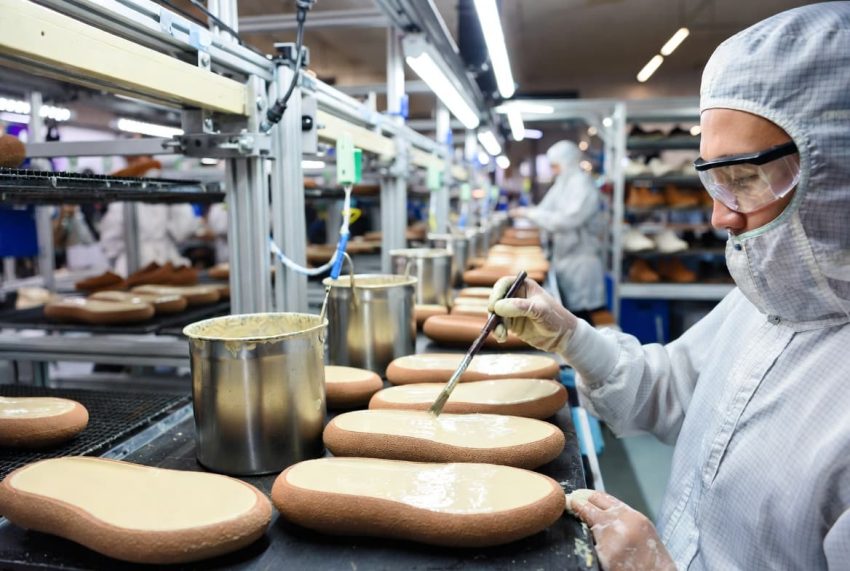
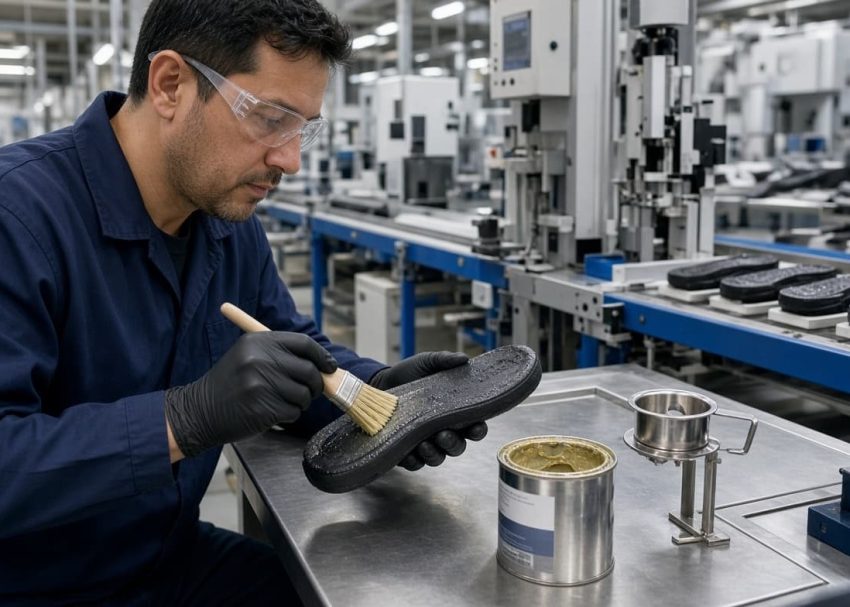
After the secondary cement coating, the outsole carries a wet adhesive film. Drying removes the solvents or moisture from this film and prepares it for subsequent activation. In stock fitting, consistent drying is particularly important because outsole components may differ significantly in thickness, material, colour, and surface construction. Rubber, EVA, PU, and TPU outsoles can therefore respond differently to the same drying conditions.
The outsole should reach the approved dry condition without excessive heating. Incomplete drying can leave residual solvent or moisture in the adhesive film, while excessive drying may affect subsequent activation performance.
For production control, factories should use the adhesive supplier’s validated parameters rather than relying only on visual appearance. Conveyor speed, dryer temperature, airflow, and dwell time should remain consistent throughout the production run.
Key Control Points
- Follow adhesive supplier specifications.
- Confirm complete adhesive drying before activation.
- Maintain approved dryer temperature and conveyor speed.
- Avoid excessive heat exposure to outsole materials.
Expert Tip:
Include drying and activation checks in the stock fitting process audit.
Keep activated outsoles moving directly toward the attaching station.

Activation Before Outsole Attaching
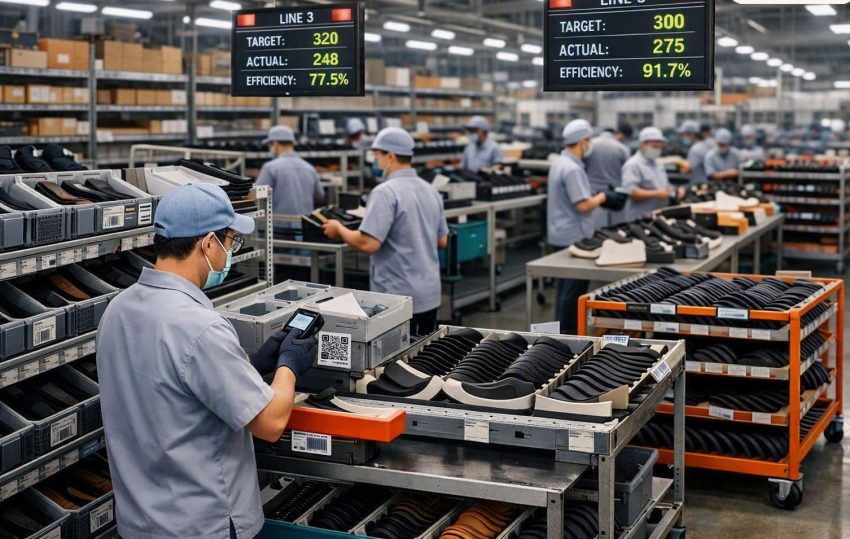
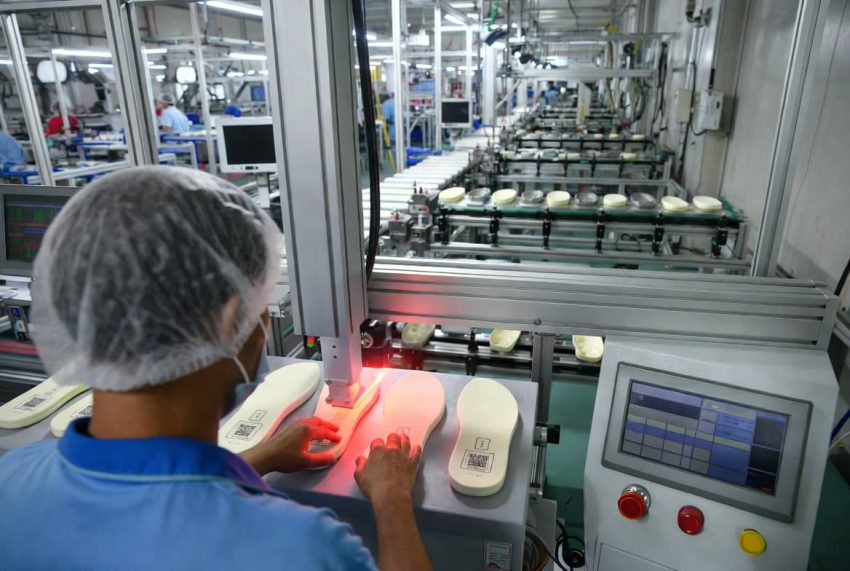
Once the cemented outsole has dried, activation restores the adhesive surface to the required bonding condition. Controlled heat increases adhesive tack so that the outsole can bond effectively with the prepared upper during the attaching operation.
In the stock fitting process, activation must be coordinated closely with the next operation. The activated outsole should reach the outsole attaching station within the approved open-time window. If unnecessary delays occur, adhesive tack can reduce before pressing, increasing the risk of weak bonding.
Activation temperature should also match the outsole material and adhesive system. A rubber outsole may tolerate different heating conditions compared with EVA, PU, or TPU. Therefore, factories should maintain product-specific settings rather than applying one universal activation temperature.
The actual outsole surface temperature should be verified during process validation and routine production audits. Machine setpoint alone does not always represent the temperature reaching the adhesive surface.
Key Control Points
- Prevent overheating of heat-sensitive outsole materials.
- Use validated activation temperatures for each outsole material.
- Control activation-to-attaching time.
- Verify actual surface temperature periodically.
Expert Tip:
Establish separate recipes for different outsole materials.
Verify actual surface temperature during line setup.
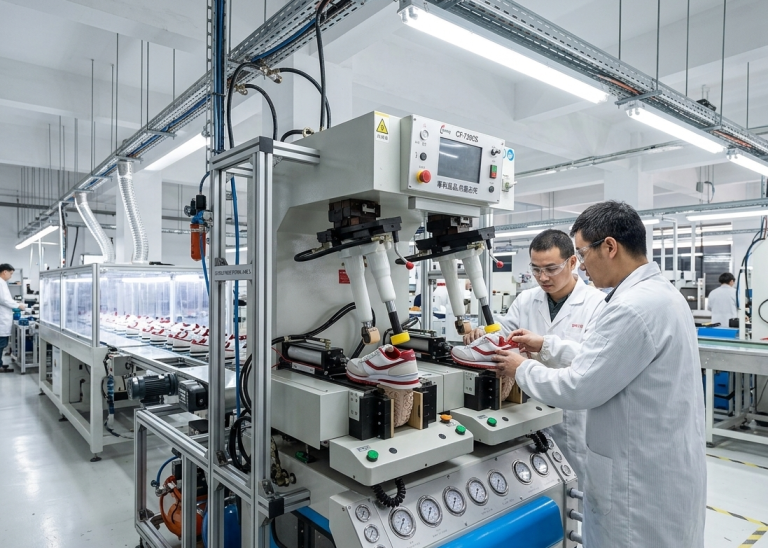
Equipment Used in Stock Fitting
The equipment selected depends on production volume, outsole material, line layout, and required cycle time.
Short Activator
A short activator provides rapid heating immediately before outsole attaching. It suits production lines where the distance between activation and attaching is short. Its compact design also helps maintain adhesive open-time control.
Infrared Activator
Infrared activation provides rapid and concentrated heating of the adhesive surface. It is suitable for high-speed production because it can achieve the required activation condition within a short exposure time. However, lamp condition, distance, and exposure time require regular monitoring.
Tunnel Dryer
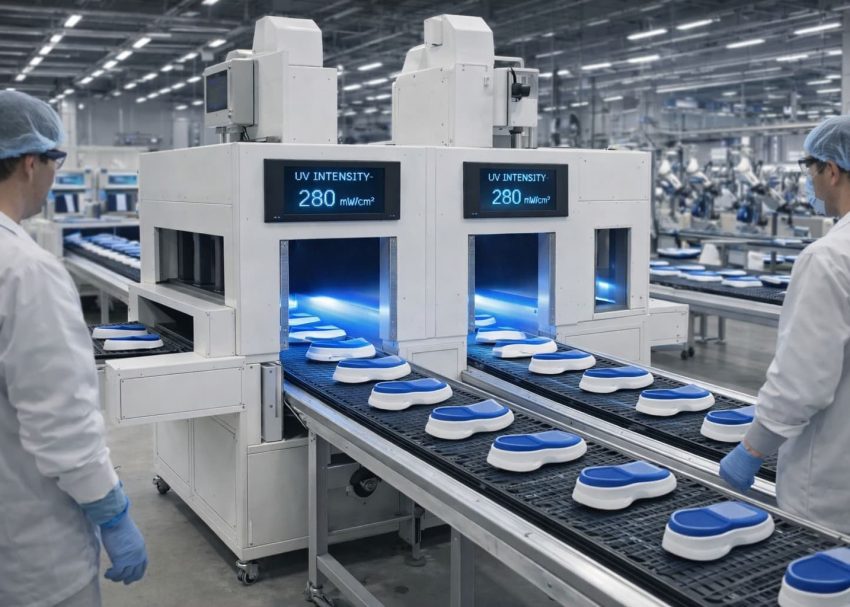
A tunnel dryer primarily removes solvents or moisture after cement application. Conveyor speed and temperature determine the drying dwell time. Therefore, production speed changes should never occur without confirming the effect on drying performance.
Conveyorized Oven
A conveyorized oven provides controlled and repeatable heating through a defined production path. It is particularly useful for higher-volume operations where consistent drying and activation conditions are required across multiple production shifts.
Key Control Points
- Verify temperature uniformity across the outsole.
- Select equipment according to the validated process requirement.
- Synchronize conveyor speed with production output.
- Maintain heating elements and sensors regularly.
Expert Tip:
Recheck parameters after machine stoppages or major breaks.
Common Drying and Activation Defects
Most defects at this stage result from process variation rather than from the adhesive itself. Therefore, troubleshooting should begin with process verification.
Under-activation occurs when the outsole does not receive sufficient heat. The adhesive remains inadequately tacky and may produce weak bonding.
Overheating can damage the adhesive or distort sensitive outsole materials. Excessive exposure may also create cosmetic defects.
Incomplete drying leaves residual solvent or moisture in the adhesive layer. This condition can reduce bond strength and contribute to later outsole separation.
Bonding failure may also occur when the activated outsole remains too long before attaching. Even when temperature is correct, exceeding the approved open time can reduce adhesive tack.
Key Control Points
- Check temperature, conveyor speed, and dwell time when defects occur.
- Verify activation-to-attaching time.
- Conduct routine bond-strength checks.
- Quarantine production when significant process deviation occurs.
Expert Tip:
Never increase activation temperature simply to compensate for poor drying.
Record critical settings for repeat production.
Conclusion
Drying and activation in stock fitting are not separate quality decisions; they are the final preparation stages before outsole attaching. Since the fundamental adhesive principles have already been covered in the Full Shoe Assembly Series, the focus here should remain on outsole-specific temperature control, drying consistency, activation timing, and open-time management.
When these parameters remain stable, the cemented outsole reaches the attaching station in the correct bonding condition, providing a reliable foundation for the next operation.
Next in the Outsole (Stock Fitting) Assembly Series: Outsole Attaching Operations in Outsole Process, where we will cover outsole alignment, positioning, attaching, pressing, and the key controls required to achieve consistent outsole bonding.
Frequently Asked Questions (FAQs)
Drying removes solvents or moisture from the adhesive film, allowing proper activation and strong bonding.
The adhesive remains insufficiently tacky, resulting in weak bond strength and possible outsole separation.
Conveyor speed determines dwell time inside the dryer or activator, directly affecting adhesive performance.
No. Rubber, TPU, EVA, PU, and other materials require different activation temperatures based on their properties.
Open time is the period after activation during which the adhesive remains sufficiently tacky for effective bonding.
Infrared activators are widely used because they provide fast, controlled, and uniform heating.
Through regular calibration, preventive maintenance, standardized machine settings, operator training, and routine process verification.