Understanding the Three Basic Types of Outsole
Outsole (Stock Fitting) Assembly Series
In the previous blog, Introduction to Outsole (Stock Fitting) Assembly, we explored the role of outsole assembly within footwear manufacturing and discussed how stock fitting operations bridge outsole production and final shoe assembly.
Before examining individual stock fitting processes, footwear professionals must first understand the three fundamental outsole categories used throughout the industry. These constructions determine production flow, machine requirements, labor content, inspection standards, component preparation methods, and assembly complexity.
Although outsole preparation methods vary significantly, many downstream assembly operations remain similar. Therefore, understanding outsole categories helps production teams select suitable manufacturing methods, establish quality standards, improve efficiency, and prevent assembly-related defects.
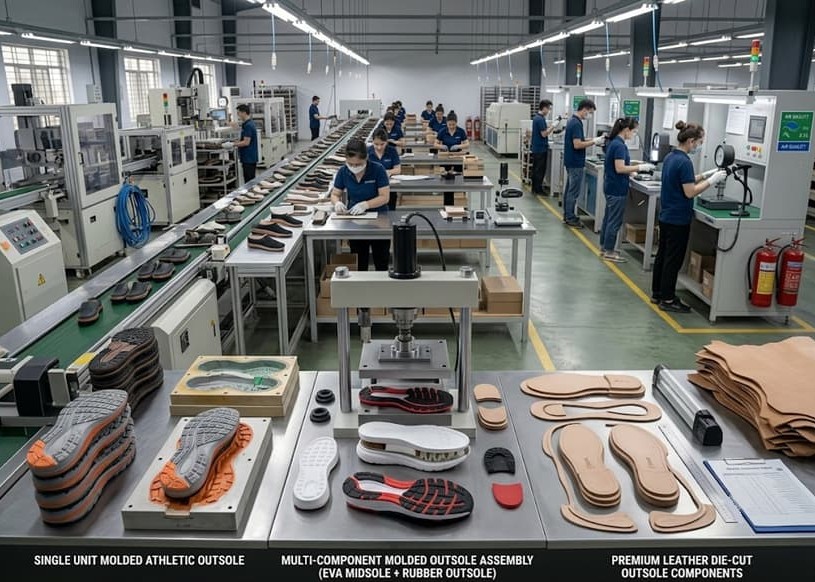
Across global footwear manufacturing, nearly every outsole can be classified into one of three major categories:
- Single Unit Outsole
- Multiple Moulded Assembled Outsole
- Multiple Un-Moulded Die-Cut Assembled Outsole
Each category serves different market segments and product requirements. Consequently, footwear engineers, production managers, quality personnel, and industrial engineers must understand their characteristics before establishing assembly procedures.
Single Unit Outsole
A single unit outsole represents the simplest and most widely used outsole construction in modern footwear manufacturing. The entire outsole is moulded as one complete component and reaches the assembly line as a finished outsole package requiring minimal additional preparation.
Because all functional features are integrated into a single moulded component, manufacturers can eliminate many intermediate assembly operations. As a result, production becomes faster, more consistent, and easier to control.
This construction is especially popular in high-volume manufacturing environments where efficiency, repeatability, and cost control are critical. Athletic footwear, sports shoes, slippers, sandals, and casual footwear frequently utilize this outsole category.
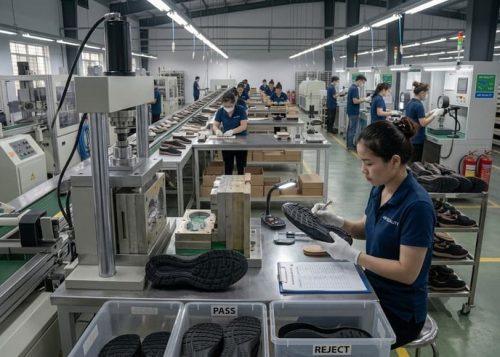
Another significant advantage involves dimensional stability. Since multiple components do not require assembly before shoe lasting, the risk of alignment variation decreases substantially. Consequently, manufacturers achieve improved consistency across large production volumes. Furthermore, inventory management becomes easier because only one outsole component requires tracking, storage, and handling.
Common Materials
- Rubber
- EVA
- TPU
- TPR
- PU
- Phylon
Typical Applications
- Running shoes
- Sports footwear
- Sandals
- Slippers
- Casual footwear
Manufacturing Characteristics
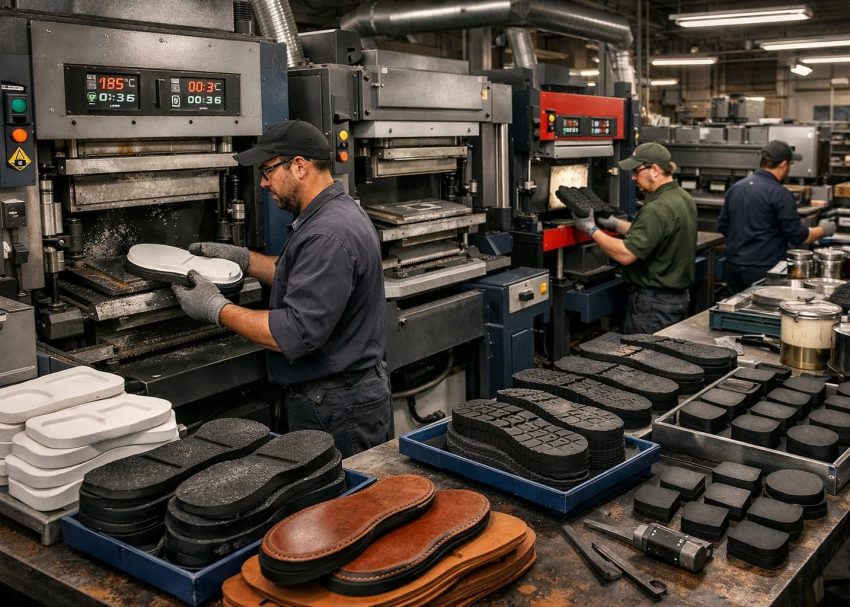
Single unit outsoles typically emerge directly from moulding operations with tread patterns, logos, flex grooves, and functional features already incorporated. Depending on material selection and product design, manufacturers may perform:
- Flash trimming
- Surface cleaning
- Primer application
- Roughing
- Inspection
- Storage before assembly
Compared with other outsole categories, the manufacturing route remains relatively short.
Advantages
- Reduced assembly operations
- Lower labor requirement
- Faster production speed
- Better dimensional consistency
- Simplified inventory management
- Reduced assembly defects
Key Control Points
- Verify mould dimensional accuracy
- Monitor hardness consistency
- Inspect flash and mould defects
- Confirm outsole dimensions against specifications
Expert Tip: Factories producing high-volume athletic footwear often prefer single unit outsole constructions because assembly variation is significantly lower compared to multi-component outsole systems.
Multiple Moulded Assembled Outsole
Modern footwear increasingly demands advanced cushioning, improved traction, enhanced aesthetics, and specialized performance features. To achieve these objectives, manufacturers frequently combine several moulded components into one outsole package before shoe assembly.
This construction category is known as the Multiple Moulded Assembled Outsole. Instead of relying on a single moulded component, manufacturers assemble multiple individually moulded parts. Each component performs a specific function within the footwear system.
For example, an athletic shoe may combine an EVA midsole for cushioning with a rubber outsole for abrasion resistance and traction. Similarly, fashion footwear may integrate decorative heels, moulded wedges, shanks, and outsole plates into a complete outsole assembly.
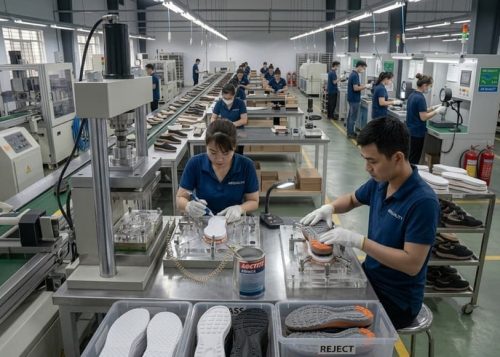
Because multiple components must fit together precisely, dimensional control becomes significantly more critical than in single unit constructions.
Even minor mismatches can create:
- Bonding failures
- Visible gaps
- Poor aesthetics
- Lasting difficulties
- Functional performance issues
Therefore, precision assembly procedures become essential.
Common Component Combinations
- Moulded Midsole + Moulded Outsole
- Moulded Heel + Outsole
- Heel + Shank + Welt + Outsole
- Wedge + Outsole
- Co-moulded Assemblies
Typical Applications
- Fashion footwear
- Outdoor footwear
- Safety footwear
- Premium casual footwear
- Dress footwear
Manufacturing Characteristics
The manufacturing process generally involves:
- Receiving moulded components
- Dimensional inspection
- Surface preparation
- Roughing operations
- Cement application
- Component assembly
- Pressing operations
- Curing
- Final inspection
Because several materials may be involved, process engineers must carefully evaluate adhesive compatibility and bonding performance.
Advantages
- Greater design flexibility
- Multi-material performance optimization
- Enhanced visual appeal
- Improved comfort engineering
- Better functional customization
Key Control Points
- Verify component dimensional matching
- Confirm bonding surface preparation
- Monitor assembly alignment
- Validate material compatibility
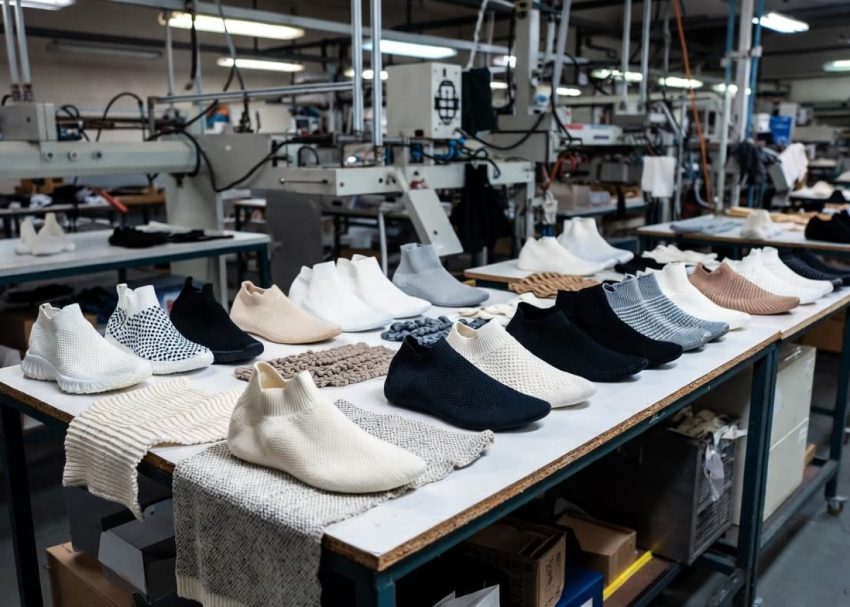
Midsole and Outsole Combinations in Multi-Component Assemblies
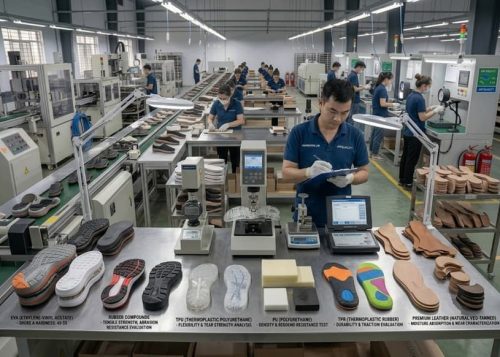
One of the most common examples of multiple moulded assembled outsoles involves combining a lightweight cushioning midsole with a durable traction outsole. Manufacturers use this approach because different materials excel at different functions. For example:
- EVA provides cushioning and lightweight performance.
- Rubber provides durability and grip.
- TPU provides stability and energy return.
- PU provides comfort and resilience.
By combining materials strategically, footwear designers can optimize product performance while maintaining manufacturing efficiency. However, successful integration depends heavily on precise stock fitting operations. Every assembled component must match design specifications before entering final shoe assembly.
Key Control Points
- Confirm component matching before assembly
- Verify adhesive compatibility
- Monitor curing parameters
- Inspect assembled outsole geometry
Expert Tip: Many outsole bonding failures originate from poor surface preparation rather than adhesive quality. Therefore, proper roughing and cleaning procedures often have a greater impact on bond strength than adhesive selection alone.
Multiple Un-Moulded Die-Cut Assembled Outsole
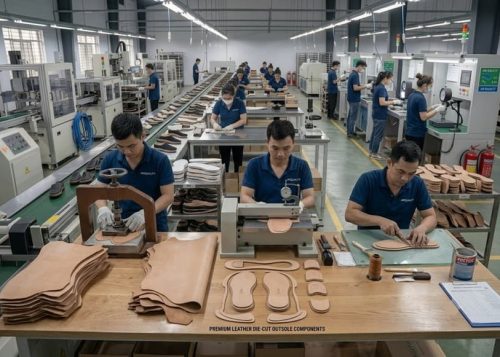
The third major outsole category differs substantially from moulded constructions. Instead of moulding components into finished shapes, manufacturers start with sheet materials and convert them into outsole components through cutting, splitting, skiving, finishing, and assembly operations.
This category is commonly known as the Multiple Un-Moulded Die-Cut Assembled Outsole. Premium leather footwear manufacturers widely use this construction because it offers exceptional flexibility in design, aesthetics, and craftsmanship.
Unlike moulded systems, which depend heavily on tooling investments, die-cut constructions allow manufacturers to create sophisticated outsole designs through skilled assembly operations. Consequently, this category remains popular in high-end footwear manufacturing.
Common Materials
- Leather bends
- Synthetic sheets
- Fibre sheets
- Rubber sheets
- Composite boards
Typical Applications
- Leather footwear
- Formal shoes
- Premium dress shoes
- Welted footwear
- Handcrafted footwear
Manufacturing Characteristics
Production typically includes:
- Material grading
- Thickness inspection
- Splitting operations
- Die cutting
- Skiving
- Edge finishing
- Assembly preparation
- Component bonding
- Final outsole finishing
Since raw materials originate from sheet stock, manufacturers must carefully control thickness variation and material consistency throughout production.
Advantages
- Superior appearance
- Excellent design flexibility
- Traditional craftsmanship compatibility
- Premium product positioning
- Lower mould investment requirements
Key Control Points
- Verify thickness consistency
- Monitor material grading standards
- Control cutting accuracy
- Maintain grain direction consistency
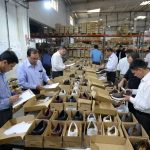

Leather Bend Outsoles in Premium Footwear
Leather bend construction remains one of the most respected outsole systems within premium footwear manufacturing. Manufacturers cut outsole components directly from dense vegetable-tanned leather bends. These materials provide exceptional aesthetics, durability, and finishing quality.
The process often involves multiple operations including: Leather grading, Moisture conditioning, Cutting, Splitting, Channel opening, Stitch preparation, Finishing, Polishing.
Although labor requirements are considerably higher, premium brands continue using leather outsole constructions because customers associate them with craftsmanship and luxury.
Key Control Points
- Inspect leather quality before cutting
- Verify moisture content
- Control thickness variation
- Monitor grain orientation
Pro Tip: When processing leather bends, grain direction control is often overlooked. However, incorrect orientation can affect outsole flexibility, dimensional stability, and long-term wear performance.

Comparison of the Three Basic Outsole Types
| Feature | Single Unit | Multiple Moulded Assembly | Multiple Die-Cut Assembly |
|---|---|---|---|
| Component Count | Low | Medium to High | High |
| Assembly Complexity | Low | Medium | High |
| Labor Requirement | Low | Medium | High |
| Tooling Investment | High | High | Moderate |
| Design Flexibility | Moderate | High | Very High |
| Production Speed | Fast | Medium | Slow |
| Dimensional Consistency | Excellent | Good | Operator Dependent |
| Premium Appearance | Moderate | High | Excellent |
| Typical Footwear | Sports | Fashion & Outdoor | Leather & Dress |
Why Understanding Outsole Categories Matters
Every stock fitting operation that follows depends on the outsole category selected during product development.
The outsole type influences: Machine selection, Process routing, Quality standards, Material handling, Production planning, Labor allocation, Inspection requirements, Cost structure.
Consequently, production teams must identify outsole categories before establishing manufacturing procedures. A clear understanding of outsole construction helps factories reduce defects, improve productivity, and maintain consistent product quality throughout assembly operations.
Posts you make Like

Troubleshooting Adhesive Bond Failures in Footwear Manufacturing…
Conclusion
The three basic outsole categories form the foundation of all stock fitting assembly operations in footwear manufacturing. Single unit outsoles deliver efficiency and consistency, multiple moulded assembled outsoles provide performance and design flexibility, while multiple un-moulded die-cut assembled outsoles support premium craftsmanship and aesthetic excellence.
Understanding these categories allows production teams to establish appropriate manufacturing methods, inspection standards, and assembly controls before products enter final shoe assembly.
In the next blog, we will examine Outsole Component Receipt and Incoming Inspection, where we will explore how factories verify incoming outsole quality before beginning stock fitting operations.
Frequently Asked Questions (FAQs)
Which outsole type is most common in athletic footwear?
Single unit moulded outsoles and moulded EVA midsole plus rubber outsole assemblies are the most common constructions.
Why are multiple moulded assembled outsoles used?
They allow manufacturers to combine different materials for cushioning, traction, durability, and aesthetics.
Why are leather outsoles usually die-cut rather than moulded?
Leather materials are supplied as sheet stock and require cutting and finishing operations before assembly.
Which outsole category requires the most labor?
Multiple un-moulded die-cut assembled outsoles generally require the highest labor content.
What is the biggest risk in multi-component outsole assembly?
Poor dimensional matching and inadequate bonding preparation.
Which outsole category offers the best dimensional consistency?
Single unit moulded outsoles typically provide the highest dimensional consistency.
Are stock fitting operations required for all outsole types?
The level of stock fitting varies significantly, but quality verification and preparation activities are normally required for all categories.