Reinforced Reaction Injection Moulding (R-RIM and S-RIM) in Footwear Manufacturing
Introduction
Reinforced Reaction Injection Moulding (R-RIM) and Structural Reaction Injection Moulding (S-RIM) are advanced variations of the Reaction Injection Moulding (RIM) process used to produce high-strength polyurethane components. These technologies enable footwear manufacturers to create lightweight yet structurally strong parts with improved stiffness, durability, and dimensional stability.
In modern footwear manufacturing, reinforced RIM processes are increasingly used for performance midsoles, structural sole components, protective footwear parts, and technical sports footwear where high mechanical strength is required.

What is Reaction Injection Moulding (RIM)?
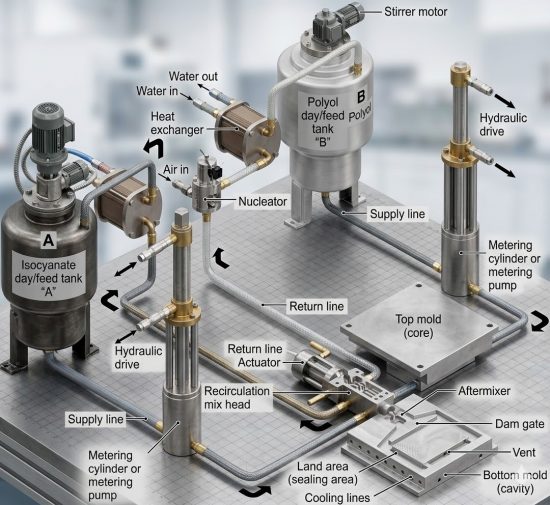
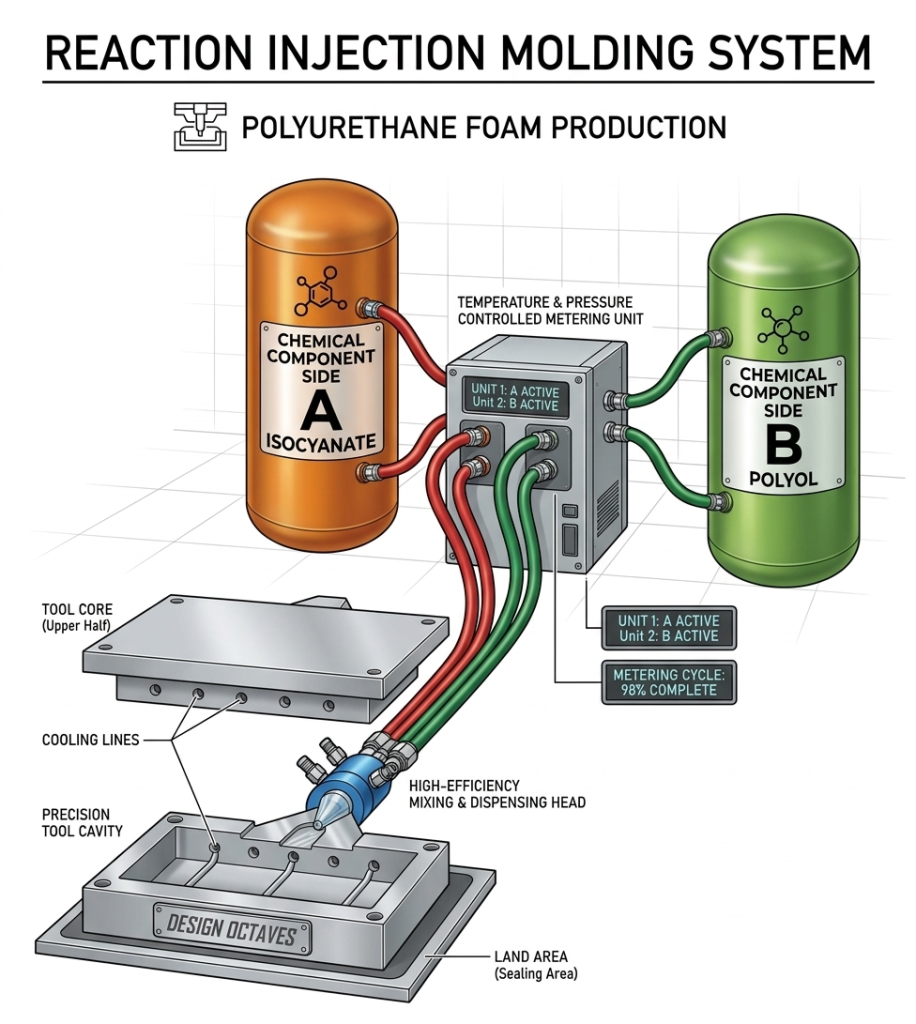
Reaction Injection Moulding is a process in which two liquid reactive components—typically polyol and isocyanate—are mixed and injected into a mould where they chemically react and cure into a solid polyurethane component.
Unlike conventional thermoplastic injection moulding, RIM uses low-viscosity liquids injected at low pressure, allowing the material to flow easily into complex mould geometries.
Key characteristics of RIM
- Low injection pressure
- Excellent surface finish
- Ability to produce large parts
- Lightweight polyurethane components
- Good chemical and heat resistance
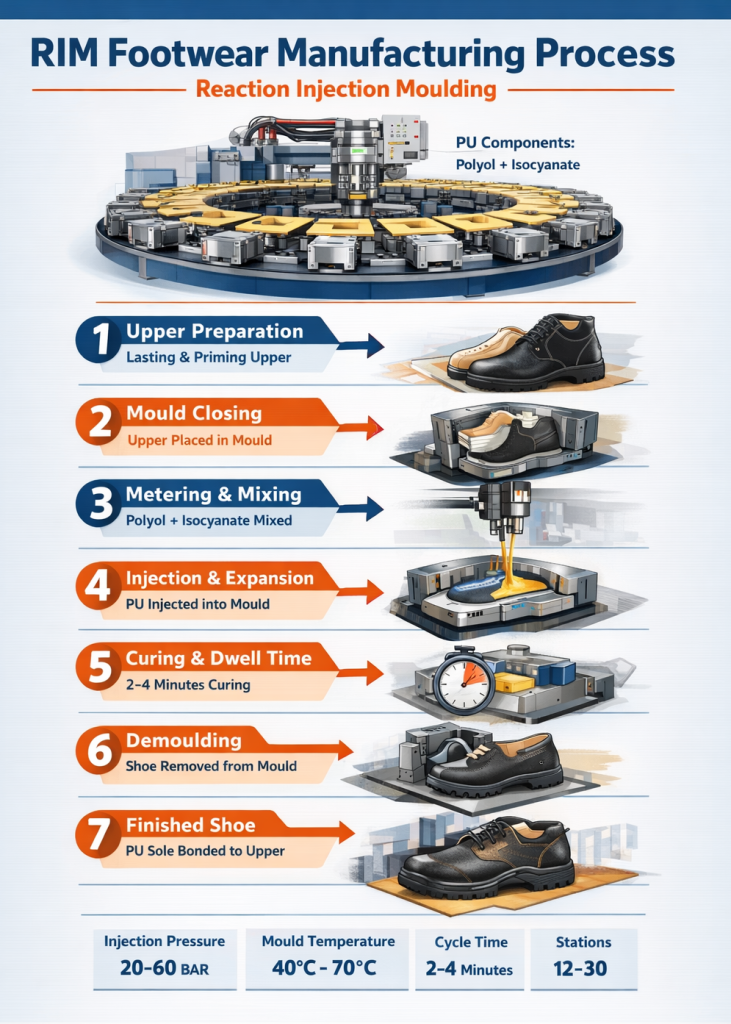
However, conventional RIM materials may lack sufficient stiffness for structural applications. This limitation led to the development of reinforced RIM technologies.
Expert Tip : Moisture Control
Maintain strict moisture control in raw materials and environment to prevent voids, poor surface finish, and reduced mechanical strength.
Reinforced RIM Technologies
Two major reinforced RIM variants are used in industrial moulding:
- R-RIM – Reinforced Reaction Injection Moulding
- S-RIM – Structural Reaction Injection Moulding
Both processes improve mechanical properties by adding reinforcing materials.
R-RIM (Reinforced Reaction Injection Moulding)
R-RIM is a process where reinforcement fillers such as glass fibers or mineral fillers are mixed into the liquid polyurethane resin before injection. These reinforcements increase:
- Tensile strength
- Impact resistance
- Dimensional stability
- Heat resistance
The result is a polyurethane component that is stronger and more durable than standard RIM mouldings.
How R-RIM Works
- Polyol and isocyanate are prepared in tanks.
- Reinforcement fillers (glass fiber, mineral fillers) are mixed into the resin.
- The mixture is injected into a closed mould.
- Chemical reaction forms a reinforced thermoset polyurethane component.
Advantages of R-RIM
- Improved mechanical strength
- Reduced thermal expansion
- Higher dimensional stability
- Suitable for larger moulded components
Footwear Applications
- Structural midsole components
- Protective safety footwear parts
- Reinforced heel counters
- Industrial footwear components
Best Practices : Fiber Length Optimization
Use controlled fiber length distribution to balance flowability and reinforcement, ensuring consistent strength without processing difficulties.
S-RIM (Structural Reaction Injection Moulding)
S-RIM takes reinforcement further by placing reinforcement materials such as fiber mats, fabrics, or continuous strands directly into the mould before injection.
The polyurethane resin then impregnates the fibers during moulding, forming a fiber-reinforced composite structure.
How S-RIM Works
- Fiber reinforcement (glass mat or fabric) is placed in the mould.
- Liquid polyurethane components are injected.
- The resin impregnates the fibers.
- Chemical reaction cures the composite structure.
Advantages of S-RIM
- Extremely high strength-to-weight ratio
- Excellent stiffness and structural integrity
- Controlled fiber orientation
- Reduced deformation under load
Footwear Applications
- Protective toe structures
- Structural sports shoe components
- High-performance midsoles
- Safety footwear reinforcement
Best Practices : High-Quality Mixing
Ensure efficient mixing of polyol and isocyanate to avoid soft spots, incomplete curing, and inconsistent mechanical properties.
Comparison: R-RIM vs S-RIM
| Feature | R-RIM | S-RIM |
|---|---|---|
| Reinforcement | Short fibers or fillers mixed in resin | Fiber mats or fabrics placed in mould |
| Strength | Medium to high | Very high |
| Processing complexity | Moderate | Higher |
| Structural capability | Semi-structural | Fully structural |
| Typical use | Reinforced polyurethane parts | Composite structural components |
Best Practices : Preform Design in S-RIM
Design fiber preforms carefully, aligning reinforcement with load direction to achieve maximum structural strength and durability.


Advantages of Reinforced RIM in Footwear Manufacturing
Reinforced RIM technologies provide several benefits for footwear manufacturers:
Lightweight Structural Parts
Fiber reinforcement allows strong components without increasing weight.
High Design Flexibility
Complex geometries can be produced due to low viscosity liquid materials.
Reduced Tooling Cost
RIM moulds are generally less expensive compared to high-pressure injection moulding.
Improved Durability
Reinforced PU components show better resistance to fatigue and impact.
Integrated Components
Multiple parts can be moulded into a single structure, reducing assembly steps.
Best Practices : Process Timing Control
Optimize cream time, gel time, and demould time to ensure proper flow, curing, and efficient production cycles.

Process Flow in Reinforced RIM Footwear Production
- Post-processing (trimming, painting)
- Raw material preparation (polyol and isocyanate)
- Reinforcement preparation (fibers or fillers)
- Metering and mixing
- Injection into heated mould
- Chemical reaction and curing
- Demoulding
Future of Reinforced RIM in Footwear
As footwear design moves toward high-performance lightweight structures, reinforced RIM technologies are becoming more relevant. Future developments are expected in:
- Fiber-reinforced PU midsoles
- Composite footwear structures
- Automated multi-material moulding systems
- Sustainable bio-polyurethane materials
These innovations could enable stronger, lighter, and more durable footwear products, especially in sports, safety, and industrial footwear segments.
Best Practices : Mould Temperature Management
Maintain consistent mould temperature to improve surface finish, ensure complete curing, and reduce defects in polyurethane components.

Conclusion
Reinforced Reaction Injection Moulding technologies such as R-RIM and S-RIM represent a powerful advancement in polyurethane moulding. By integrating reinforcement materials into the moulding process, manufacturers can produce lightweight yet highly durable components suitable for demanding footwear applications.
As footwear manufacturers increasingly adopt advanced materials and composite structures, reinforced RIM technologies will play a growing role in the development of next-generation performance footwear.
Explore other Outsole Materials Posts
- Overview of Moulded Shoe Construction in Footwear Manufacturing
- Direct Injection Moulding in Footwear: Process, Materials, Machinery and Industrial Applications
- PVC Injection Moulding in Footwear Manufacturing : Process, Machines, Technical Parameters, and Industrial Applications
- Polyurethane (PU) Direct Injection Moulding in Footwear – A Complete Guide for Footwear Manufacturing
- EVA Soles in Footwear: Compression vs Injection Moulding
- Rubber Sole Manufacturing: Pressing and Injection Moulding: Complete Technical Guide
- Multi-Color and Multi-Component Sole Moulding in Footwear
- Vulcanised Shoe Construction and Manufacturing Process
- TPU and TPR Injected Outsoles Manufacturing Process – Detailed Technical Guide
- Dual Density PU Sole Manufacturing Process – A Detailed Technical Guide
- Footwear Outsole Materials: Complete Comparison Guide for PVC, PU, TPU, EVA, Rubber, Vulcanised & Leather