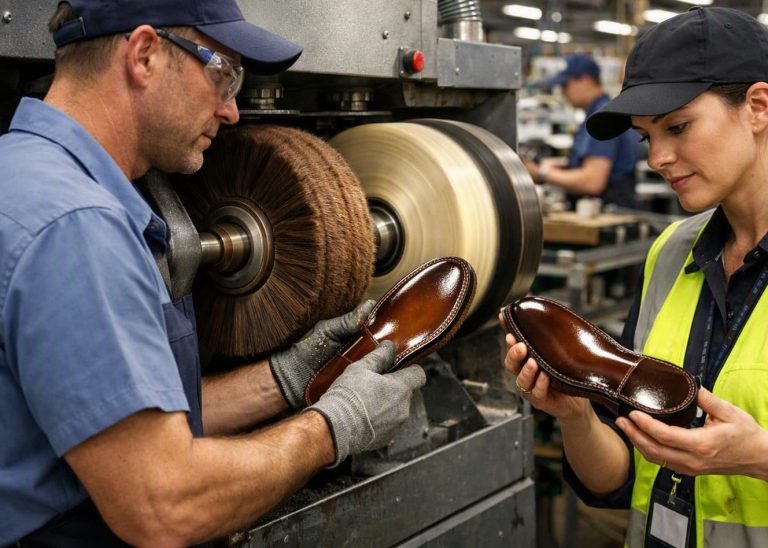
Overview of Moulded Shoe Construction in Footwear Manufacturing
In modern footwear manufacturing, moulded construction has become one of the most efficient and scalable production methods. Unlike traditional methods, where the outsole is manufactured separately and later attached to the upper, moulded construction integrates sole formation directly with the upper using specialised moulding technologies.
As a result, manufacturers achieve stronger bonding, faster production cycles, improved durability, and consistent product quality. Consequently, this method is widely used for safety shoes, sports footwear, casual footwear, sandals, and industrial footwear.
Today, several moulding technologies support this manufacturing method. Each technology is designed to meet specific product requirements, material characteristics, and performance expectations.
Therefore, understanding moulded construction is essential for footwear professionals involved in product development, engineering, and factory production.
What is Moulded Shoe Construction?
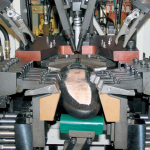
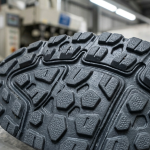
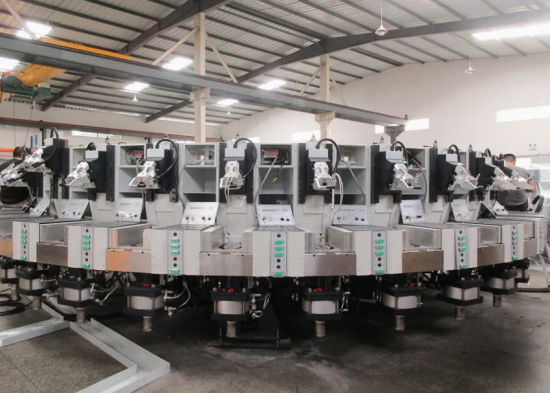
Moulded shoe construction refers to a footwear manufacturing process where the sole forms directly on the upper using a moulding machine. During the process, liquid or molten material enters a mould cavity and shapes around the upper while bonding simultaneously.
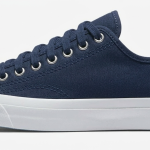
Unlike traditional methods, manufacturers do not attach the sole later. Instead, the moulding process creates both the sole shape and the bond with the upper at the same time. Because of this integrated process, moulded construction eliminates several conventional sole attachment methods, including:
Consequently, the sole and upper develop a mechanical and chemical bond, which significantly improves durability and structural strength.
Why Moulded Construction is Popular in Footwear Manufacturing
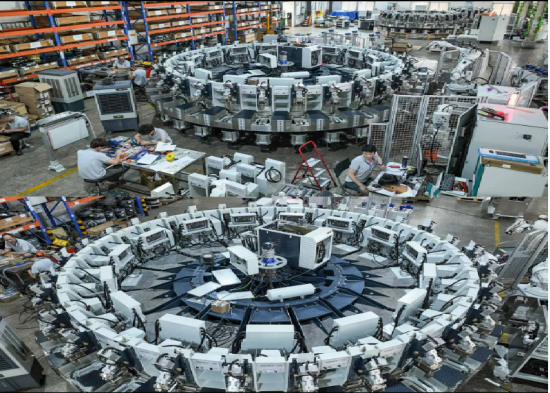
Moulded construction has gained popularity because it improves production efficiency, product durability, and manufacturing automation. In addition, the process reduces several manual operations that are common in traditional footwear assembly.
Several advantages make moulded construction highly attractive for large-scale footwear factories.
Key Advantages
1. Strong Bonding
First, the sole material bonds directly with the upper during moulding. As a result, bond strength becomes significantly higher than that of cemented constructions.
2. High Production Efficiency
Secondly, automated moulding machines allow fast cycle times. Therefore, factories can produce large volumes with reduced labour dependency.
3. Consistent Product Quality
Moreover, machine-controlled moulding ensures consistent sole thickness and shape. Consequently, variation between pairs becomes minimal.
4. Design Flexibility
In addition, moulding technology allows complex sole structures and detailed tread patterns. Manufacturers can also create multi-density or multi-color designs.
5. Reduced Assembly Steps
Furthermore, moulded construction eliminates several operations such as buffing, cementing, and sole pressing.
6. Improved Waterproof Performance
Finally, because the sole forms directly around the upper, water penetration at the sole joint becomes significantly lower.

Main Materials Used in Moulded Shoe Construction
Different materials are used depending on the product category, performance requirements, and cost targets. The most common materials include:
Polyurethane (PU)
- Lightweight
- Excellent cushioning
- Good abrasion resistance
- Common in safety footwear and casual shoes
Polyvinyl Chloride (PVC)
- Economical material
- Good flexibility
- Suitable for sandals and casual footwear
Thermoplastic Rubber (TPR)
- Rubber-like flexibility
- Good grip
- Used in fashion and casual footwear
Rubber Compounds
- High durability
- Excellent grip
- Common in outdoor and industrial footwear
EVA Compounds
- Lightweight and shock absorbing
- Frequently used in sports and comfort footwear
Major Types of Moulded Shoe Construction
Different moulding technologies are used depending on the material and product design. The most widely used types include the following.
1. Direct Injection Moulding
Direct Injection Moulding is one of the most common moulded footwear construction methods. In this process:
- The upper is placed on a last inside the mould.
- Molten sole material is injected directly into the mould cavity.
- The material forms the outsole and bonds with the upper.
Typical Applications
- Safety shoes
- Industrial footwear
- Work boots
- Outdoor footwear
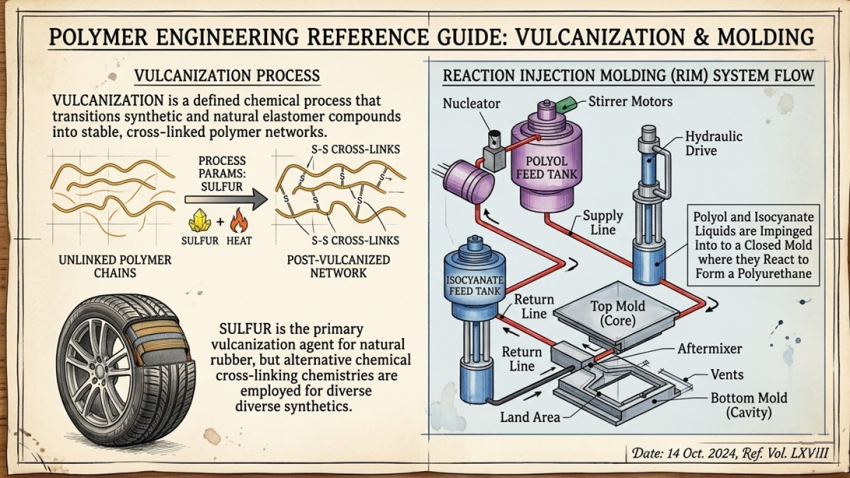
2. Reaction Injection Moulding (RIM)
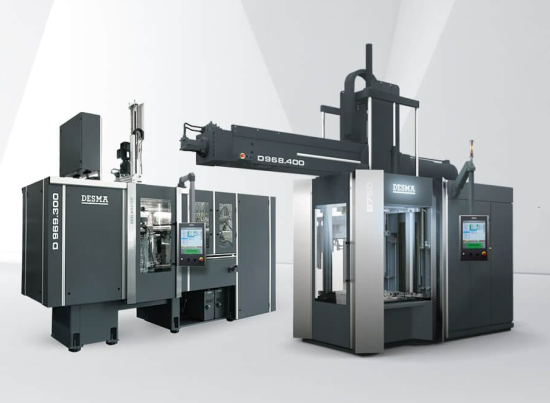
Reaction Injection Moulding is primarily used for polyurethane (PU) sole production. Instead of injecting molten plastic, two liquid chemical components react and expand inside the mould to form the sole structure.
Key Characteristics
- Widely used for comfort and safety footwear.
- Produces lightweight soles
- Excellent cushioning properties
3. Multi-Color / Multi-Component Injection Moulding
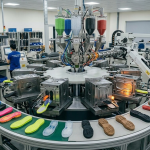
Modern footwear designs often require multiple materials or colors in the same sole. Multi-component moulding machines allow manufacturers to inject different materials sequentially into the same mould.
Benefits
- Dual density soles
- Improved grip zones
- Enhanced design aesthetics
4. PVC Injection Moulding
Firstly, PVC injection moulding is widely used for economical footwear production. Secondly, PVC pellets are melted and injected into the mould where the sole forms around the upper.
Typical Products
- School shoes
- Sandals
- Slippers
- Casual footwear
5. PU Injection Moulding
PU injection moulding is commonly used for safety shoes and premium comfort footwear. The polyurethane material expands inside the mould, forming a lightweight yet durable sole.
Advantages
- Excellent shock absorption
- Lightweight structure
- High durability
6. Rubber Pressing and Rubber Injection
Rubber soles can be produced using compression pressing or injection moulding. This method is widely used for footwear requiring high grip, abrasion resistance, and durability.
Typical Applications
- Military footwear
- Hiking shoes
- Work boots
- Outdoor footwear
Challenges in Moulded Shoe Construction
Although moulded construction offers many advantages, manufacturers must carefully control several technical factors. For example, improper mould temperature or incorrect material flow may cause defects during production. Therefore, process control becomes extremely important in moulded footwear manufacturing.
Common challenges include:
- Upper material compatibility with moulding temperature
- Correct upper positioning inside the mould
- Material flow control during injection
- Prevention of flash formation
- Maintaining stable mould temperature
- Controlling cycle time for productivity
Therefore, factories must maintain precise machine settings, proper mould design, and strict process monitoring.
Future Trends in Moulded Footwear Manufacturing
Footwear manufacturers are continuously improving moulding technologies to achieve higher efficiency, sustainability, and design innovation. Key industry trends include:
- Lightweight material development
- Recyclable moulding compounds
- Energy-efficient moulding machines
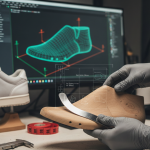
- 3D mould design optimization
- Automation and robotic handling systems
These advancements will further strengthen the role of moulded construction in modern footwear production.


Conclusion
Moulded shoe construction has transformed the way footwear is manufactured in large-scale factories. By integrating sole formation directly with the upper, manufacturers achieve stronger bonding, improved durability, and highly efficient production processes.
Different moulding technologies such as Direct Injection Moulding, Reaction Injection Moulding, PVC Injection, PU Injection, Multi-component Injection, and Rubber Moulding allow footwear manufacturers to produce a wide variety of products across multiple categories.
Understanding these construction methods is essential for footwear professionals involved in product development, production engineering, and factory operations.
In the upcoming articles in this series, we will explore each moulding technology in detail to understand machine operations, materials, process parameters, and production advantages.

Explore other Outsole Materials Posts
- Direct Injection Moulding in Footwear: Process, Materials, Machinery and Industrial Applications
- PVC Injection Moulding in Footwear Manufacturing : Process, Machines, Technical Parameters, and Industrial Applications
- Polyurethane (PU) Direct Injection Moulding in Footwear – A Complete Guide for Footwear Manufacturing
- EVA Soles in Footwear: Compression vs Injection Moulding
- Rubber Sole Manufacturing: Pressing and Injection Moulding: Complete Technical Guide
- Multi-Color and Multi-Component Sole Moulding in Footwear
- Reinforced Reaction Injection Moulding (R-RIM and S-RIM) in Footwear Manufacturing
- Vulcanised Shoe Construction and Manufacturing Process
- TPU and TPR Injected Outsoles Manufacturing Process – Detailed Technical Guide
- Dual Density PU Sole Manufacturing Process – A Detailed Technical Guide
- Footwear Outsole Materials: Complete Comparison Guide for PVC, PU, TPU, EVA, Rubber, Vulcanised & Leather