Supercritical Foam in Footwear: How It Works and Why It Matters
Introduction
Modern footwear needs to combine low weight, effective cushioning, high resilience and long-term durability. To meet these demands, manufacturers increasingly explore advanced foam technologies. One important example is supercritical foam technology.
Supercritical foam is not a separate polymer. Instead, it is a manufacturing technology that uses a physical blowing agent, such as carbon dioxide (CO₂) or nitrogen (N₂), to create a cellular structure inside a polymer.
For example, manufacturers can apply this technology to EVA, TPU, PEBA and other suitable thermoplastic materials. However, the final performance depends on more than the polymer itself. Density, cell structure, processing conditions and component design also play important roles.
What Is Supercritical Foam?
A supercritical fluid forms when a substance exceeds its critical temperature and pressure.
Under these conditions, it combines properties of both liquids and gases.
In footwear manufacturing, supercritical CO₂ or N₂ can enter a polymer under controlled processing conditions.
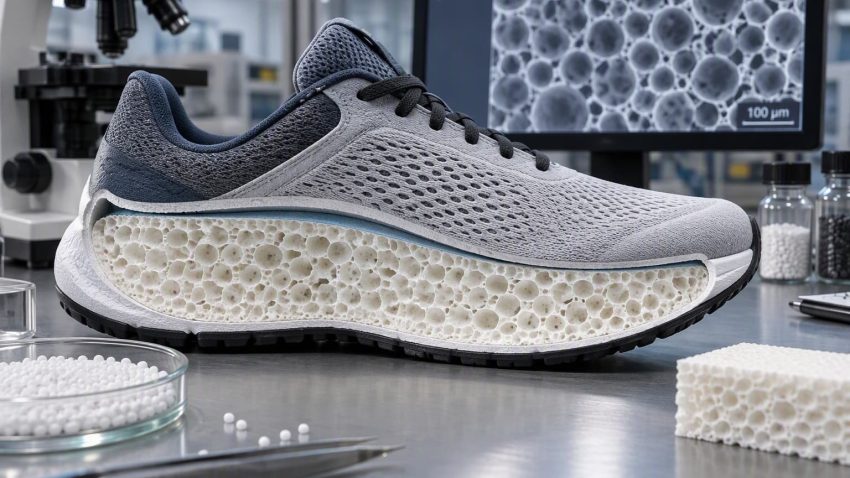
The gas then helps form small cells within the material, creating a lightweight foam structure.
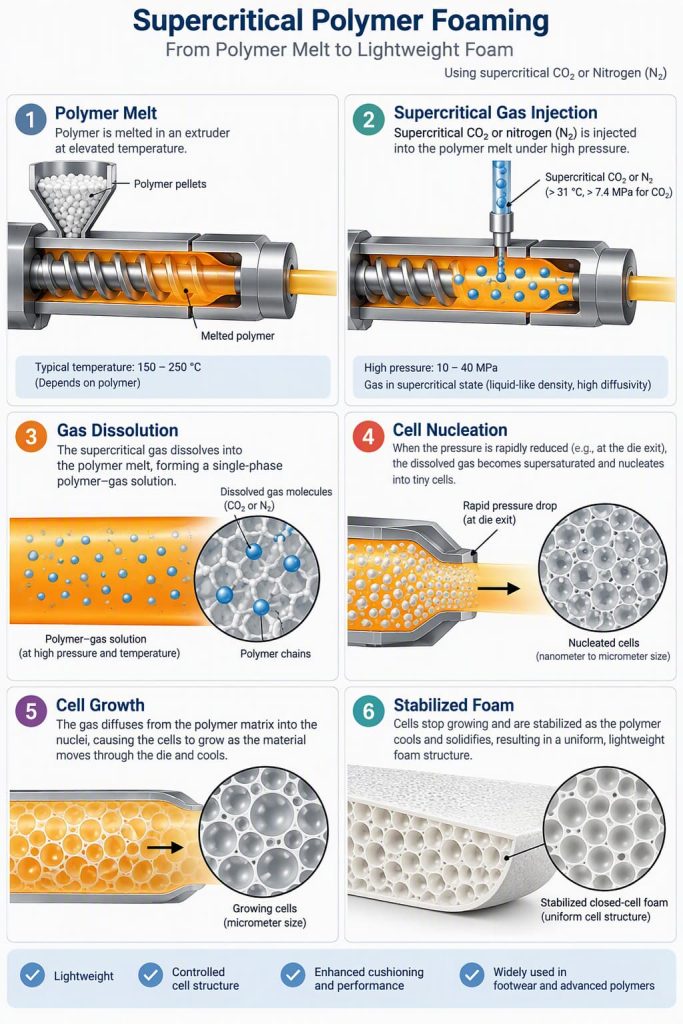
The basic process follows this sequence:
Polymer + Gas + Controlled Processing → Cell Formation → Foam Structure
Unlike conventional chemical foaming, physical foaming uses a gas as the blowing agent.
However, the final cell structure still depends on how the gas interacts with the polymer and how the manufacturer controls expansion.
How Does the Process Work?
Polymer Preparation
The selected polymer and additives are prepared for the intended foam system.
Gas Introduction
CO₂ or N₂ is introduced under controlled pressure.
Gas Dissolution
The gas becomes distributed within the polymer.
Cell Nucleation
Pressure or temperature changes initiate microscopic gas-cell formation.
Cell Growth
The cells expand as the gas comes out of solution.
Consequently, pressure, temperature, gas concentration and polymer viscosity can significantly affect the result. If the manufacturer fails to control these factors, the foam may develop uneven cells, shrinkage or inconsistent density.
CO₂ vs N₂
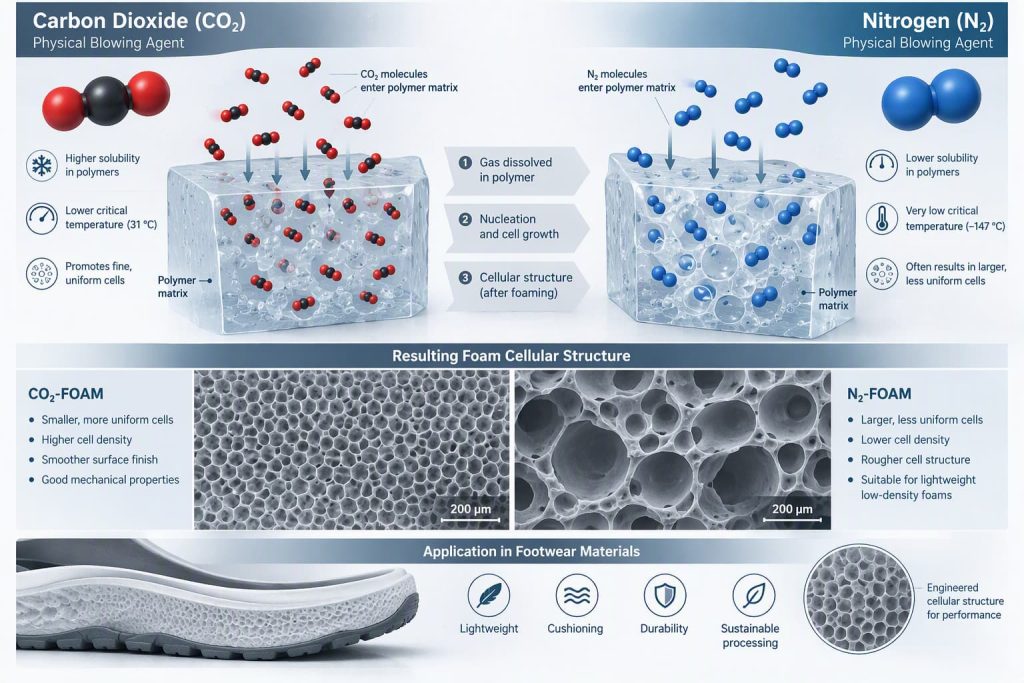
Both carbon dioxide and nitrogen can serve as physical blowing agents. However, they interact differently with polymers, so manufacturers must evaluate them against the target material and process.
Parameter | Carbon di oxide | Nitrogen |
Type | Physical blowing agent | Physical blowing agent |
Polymer interaction | Generally higher solubility | Generally lower solubility |
Main control factors | Pressure, temperature, concentration | Pressure, temperature, concentration |
Key consideration | Diffusion and gas retention | Gas solubility and expansion |
Application | Widely researched for polymer foaming | Used in physical foam processes |
CO₂ has been extensively studied for polymer foaming because its solubility and diffusion can be controlled through pressure and temperature. N₂ is also used where its processing characteristics suit the polymer and equipment.
There is no universally better gas. The correct choice depends on the polymer, target density, cell structure and manufacturing process.
Which Footwear Materials Can Be Supercritically Foamed?
EVA is widely used in footwear cushioning. Supercritical processing can be used to develop lightweight EVA foam structures, with formulation and structural stabilization being important factors.
TPU offers a combination of elasticity, toughness and resilience. Supercritical TPU foams are attractive where designers need lightweight cushioning with strong mechanical performance.
PEBA (Polyether Block Amide) is used in high-performance footwear applications where lightweight and responsive behaviour are important.
TPEE (Thermoplastic Polyester Elastomer) & Other thermoplastic elastomers can also be considered when their polymer characteristics and processing window are suitable.
The key point is:
Supercritical describes the foaming process—not the polymer itself.
Why Does Cell Structure Matter?
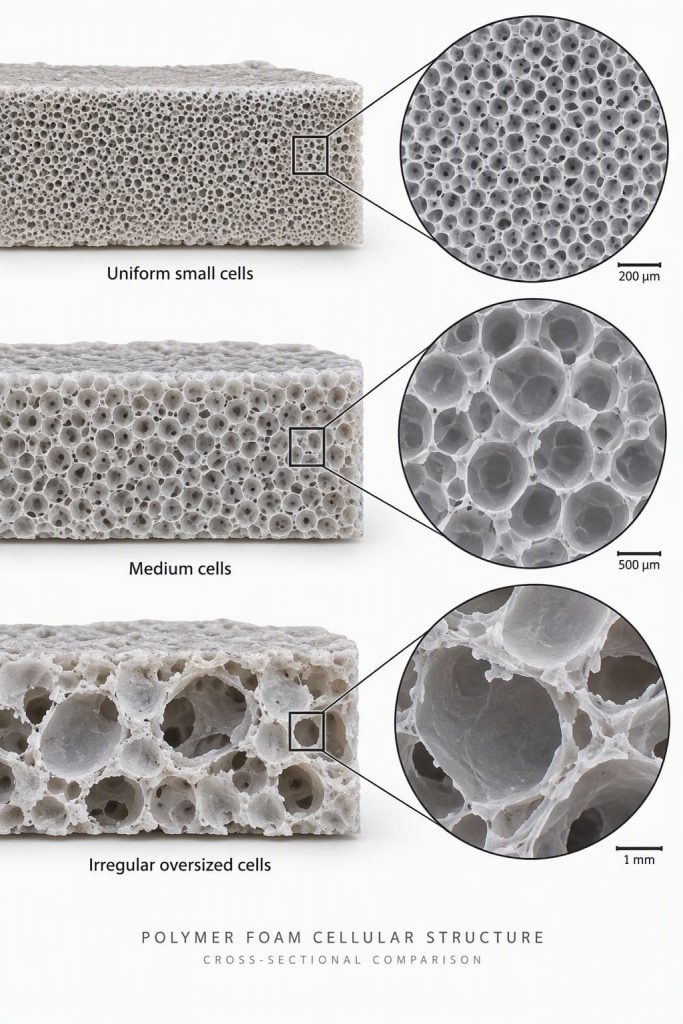
A professional evaluation should combine visual inspection, physical inspection and production trials. The performance of a foam depends heavily on its cellular structure. Important characteristics include:
- Cell size
- Cell-size distribution
- Cell density
- Cell-wall thickness
- Open/closed-cell structure
- Cell orientation
Two foams can have similar density but different mechanical behaviour because their cell structures are different. For footwear developers, the relationship should therefore be considered as:
Processing → Cell Morphology → Material Properties → Shoe Performance
This is why microscopic foam analysis can be valuable when investigating unexpected changes in hardness, compression or durability.
Density, Cushioning and Energy Return
Density is one of the most important foam parameters because it directly influences component weight. However:
Lower density does not automatically mean better cushioning.
If the foam is expanded excessively, cell walls may become too weak, reducing compression resistance, durability or dimensional stability.
Similarly, “energy return” should not be treated as a single universal number. It depends on polymer chemistry, density, cell structure, deformation rate, temperature and component geometry.
A laboratory resilience result also does not automatically represent the energy returned by a complete running shoe.
Manufacturing Methods
Injection Foaming
The blowing agent is introduced into the polymer melt under controlled pressure. Pressure changes during processing can initiate nucleation and cell growth.
Batch Foaming
The polymer is saturated with supercritical fluid and subsequently expanded through controlled temperature or pressure changes. This approach is particularly useful for material research and process development.
Bead Foaming
Expanded polymer beads can be produced and subsequently moulded into components. The final performance depends on bead structure and inter-bead bonding.
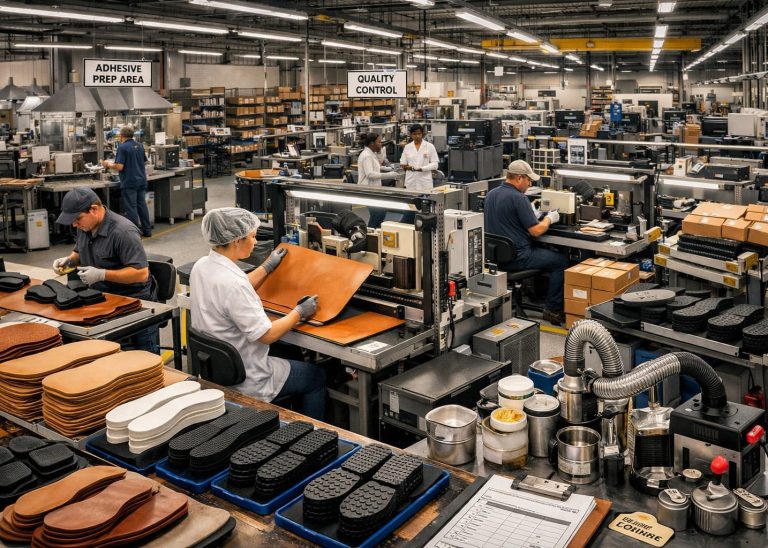
For production footwear, mould design, venting, expansion, cooling and dimensional control are just as important as the foam formulation.
Important Testing
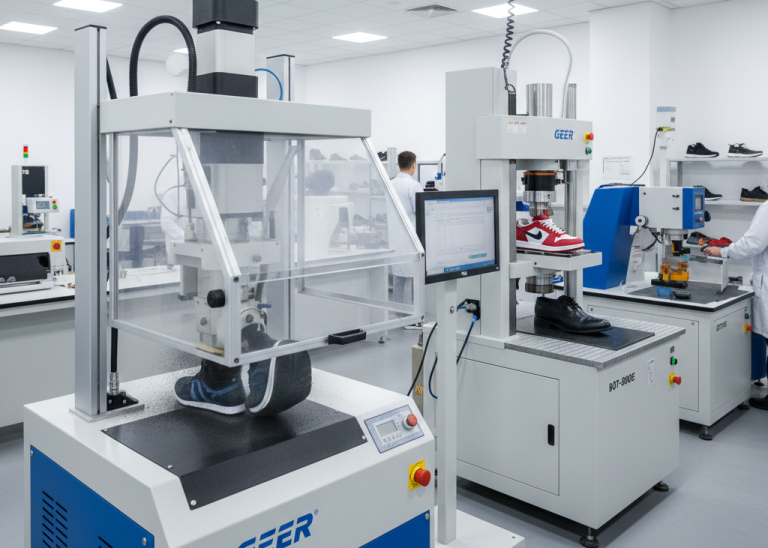
Supercritical foam should be evaluated using a combination of material and footwear tests.
Property | Why It Matters |
Density | Weight and structural efficiency |
Hardness | Firmness/feel |
Compression stress | Load-bearing behaviour |
Compression set | Permanent deformation |
Resilience | Recovery behaviour |
Fatigue | Repeated-loading durability |
Tensile/tear | Material integrity |
Dimensional stability | Component accuracy |
Cell morphology | Understanding foam structure |
Ageing | Long-term performance |
ISO 3386-1:2025 provides methods for determining compression stress-strain characteristics of low-density flexible cellular materials. ASTM D395 provides compression-set test methods for rubber materials. The appropriate method and specification limits should always be selected according to the actual footwear material and application.
Advantages and Limitations
Potential Advantages
- Lightweight foam structures
- Controlled cellular morphology
- Physical rather than chemical gas generation
- Potentially high resilience
- Applicable to several polymer families
- Opportunity to optimize density and cushioning
Challenges
- High-pressure processing equipment
- Sensitive process window
- Gas distribution control
- Cell-growth control
- Scale-up from laboratory to production
- Tooling and dimensional-control requirements
- Higher process complexity
Supercritical foaming should therefore be viewed as a process-engineering opportunity, not as an automatic performance upgrade.
Where Is It Used in Footwear?
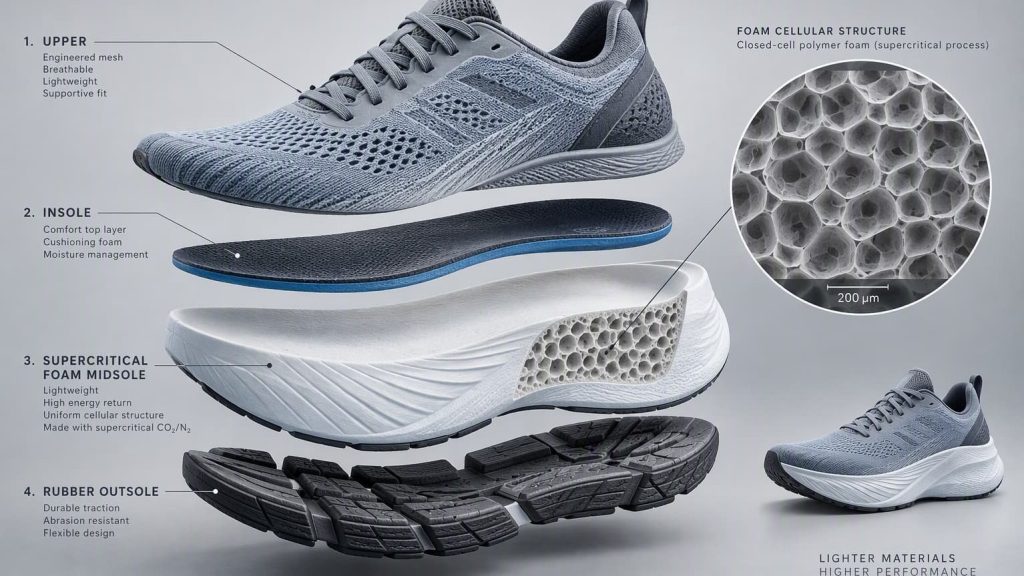
Supercritical foams can be considered for:
- Midsoles — lightweight cushioning and resilience
- Insoles/footbeds — comfort and cushioning
- Sandal components — lightweight construction
- Cushioning inserts — localized heel or forefoot cushioning
The appropriate foam density and mechanical properties will vary according to the footwear application.
Takeaways
Supercritical foam is best understood as a controlled method for creating cellular polymer structures. Its footwear potential comes from the ability to engineer density and cell morphology while working with materials such as EVA, TPU and PEBA. The real development equation is:
Polymer + Gas + Pressure + Temperature + Cell Structure + Geometry = Foam Performance
For footwear engineers, the goal should not simply be the lowest density or highest rebound. The objective is to achieve the right combination of weight, cushioning, resilience, durability, dimensional stability and production consistency. That is what turns supercritical foam technology into a successful footwear component.