
Global Footwear & Leather Stock Pulse: October 2026
MONTHLY INDUSTRY INTELLIGENCE · 1–31 OCTOBER 2026
Executive Summary
Market Benchmark
-0.93%
S&P 500
Top documented earnings-driven performer
+32.30%
Capri Holdings – October
October 2026 was a month of selective recovery and significant stock-market divergence for the global footwear, apparel and luxury leather industries. Although the broader global equity market declined, individual footwear companies attracted investor interest following improved earnings, stronger direct-to-consumer (DTC) sales and upgraded financial forecasts.
The standout performer was Crocs, which rallied following strong third-quarter results and an improved full-year outlook. Capri Holdings and On Holding also recorded positive monthly share-price movements. Conversely, Allbirds and Kering remained under considerable pressure, highlighting the challenges facing brands dealing with weak demand, brand repositioning and profitability concerns. TREND ARC FINANCE CHARTS INVESTING, CROCS
Three macroeconomic factors shaped the operating environment:
For footwear manufacturers and leather tanneries, the message is clear: demand recovery remains selective, and operational efficiency, material cost control and inventory management continue to determine supplier competitiveness.
Global Market Benchmarks
The broader market provides important context for understanding footwear-stock movements.
Market benchmark | October return |
S&P 500 | -0.93% |
Dow Jones Industrial Average | +1.70% |
Nasdaq Composite | -5.30% |
Russell 2000 | +0.54% |
STOXX Europe 600 | +1.87% |
Nikkei 225 | –5.19% |
Hang Seng | -5.36% |
KOSPI | -16.19% |
Source: October 2026 market closing comparisons, 30 September versus 30 October. Returns are price-index changes. GLOBAL TERMINAL, NASDARQ
The US market experienced a notable rotation away from large technology companies. The equal-weighted S&P 500 gained 5.0%, while the conventional S&P 500 declined 0.9%. This suggests that market weakness was concentrated rather than universal. NASDAQ
For consumer discretionary businesses, this environment placed greater emphasis on individual company earnings, cash generation and forward guidance.
Footwear & Leather Industry Gainers
The following table presents a selected global industry basket of listed footwear, sportswear and accessories companies.
Company | Ticker | Oct. return | YTD return |
Capri Holdings | CPRI | +32.30% | -23.40% |
Crocs | CROX | +28.31% | +76.01% |
On Holding | ONON | +14.08% | -23.58% |
Caleres | CAL | +10.88% | +12.79% |
Nike | NKE | +9.24% | -36.97% |
Amer Sports | AS | +7.84% | -21.20% |
Wolverine Worldwide | WWW | +7.48% | +7.05% |
Deckers Outdoor | DECK | +4.93% | -20.84% |
Birkenstock | BIRK | +3.15% | -18.26% |
Tapestry | TPR | +1.10% | -8.10% |
Returns are rounded and based on available October-end market-data snapshots; YTD figures are total or price returns as reported by the respective data providers. These are indicative rankings within the selected basket, not a complete exchange-wide ranking. (Sources: Capri Holdings, Crocs, On Holding, Amer Sports, Caleres, frenzy, tapestry
Footwear & Leather Industry Decliners
Company | Ticker | October return | YTD return |
Allbirds | BIRD | -25.29% | -45.61% |
Kering | KER.PA | -17.32%* | -40.30% |
Lululemon | LULU | -2.26% | -52.36% |
Steven Madden | SHOO | -2.84% | +6.39% |
LVMH | MC.PA | -2.12%** | -41.95% |
*Kering’s figure reflects the approximate scale of its October sell-off; its 23 October single-session decline was 16.57%, not its full-month return. **LVMH uses its USD-traded ADR total-return series, not the Paris-listed euro share series. These are selected downside cases, not a fully verified ranking of every global listed company. (Sources: Finance Charts, Investing, finplify, luxury thread)
Gainers – Company Analysis
Crocs (NASDAQ: CROX)
+28.31% October
Crocs delivered the strongest clearly documented earnings-driven performance among the selected footwear companies.
Its Q3 2026 revenue increased 4.6% to $1.043 billion. DTC revenue grew 6.9%, while wholesale revenue increased 1.8%. The Crocs brand recorded 4.4% growth, and HEYDUDE returned to growth with a 6.1% revenue increase.
Management raised its full-year revenue growth forecast to approximately 3% and adjusted EPS guidance to $14.45–$14.65.
The improvement in international sales, DTC performance and HEYDUDE’s recovery strengthened investor confidence. Crocs, Reuters
Manufacturing implication: Better demand visibility can support more consistent production planning, although wholesale growth remains modest.
Capri Holdings (NYSE: CPRI)
+32.30% October
Capri recorded the largest monthly gain in this selected basket. Its share price closed at $18.68 on 30 October, following strong late-month trading.
However, the share-price rally should not automatically be interpreted as an equivalent improvement in factory orders or underlying demand. Capri’s year-to-date performance remained negative.
Investors should monitor the group’s brand-level sales, inventory reduction, wholesale replenishment and operating-margin recovery before treating the rally as evidence of a sustained turnaround. Capri Holdings, Stock Analysis
Manufacturing implication: Suppliers serving luxury handbag and leather-accessory brands should remain cautious about capacity expansion until confirmed purchase orders and replenishment programmes improve.
On Holding (NYSE: ONON)
+14.08% October
On Holding maintained positive market momentum, outperforming the S&P 500 during October.
Its performance reflects continued investor interest in specialist performance footwear and premium athletic positioning. However, the company’s negative year-to-date return indicates that the monthly recovery has not eliminated earlier market concerns.
DTC expansion, international distribution, product launches and the ability to maintain premium selling prices remain important indicators for investors. Finance Charts
Manufacturing implication: Performance footwear suppliers need to maintain flexibility in technical materials, engineered mesh, cushioning components and specialised outsole production.
Caleres (NYSE: CAL)
+10.88% October
Caleres recorded a positive monthly performance, supported by improving investor sentiment toward footwear retail and its portfolio of footwear brands.
Its year-to-date return remained positive at approximately 12.79%, making it one of the stronger performers on a cumulative basis in the selected US footwear group.
For suppliers, the key indicators to watch are retail inventory levels, store replenishment and the balance between full-price sales and promotional activity. Caleres, Yahoo Finance
Nike (NYSE: NKE)
+9.24% October
Nike recorded a positive monthly return, although its year-to-date performance remained substantially negative.
The monthly improvement should be viewed as a recovery in investor sentiment rather than confirmation of a complete operational turnaround. Product innovation, wholesale partner relationships, DTC execution and inventory discipline remain critical.
Manufacturing implication: Suppliers should monitor order visibility and production allocation carefully. A stock-market recovery does not necessarily mean immediate increases in footwear factory utilisation.
Decliners – Company Analysis
The Manufacturing Impact: What These Results Mean for Factories
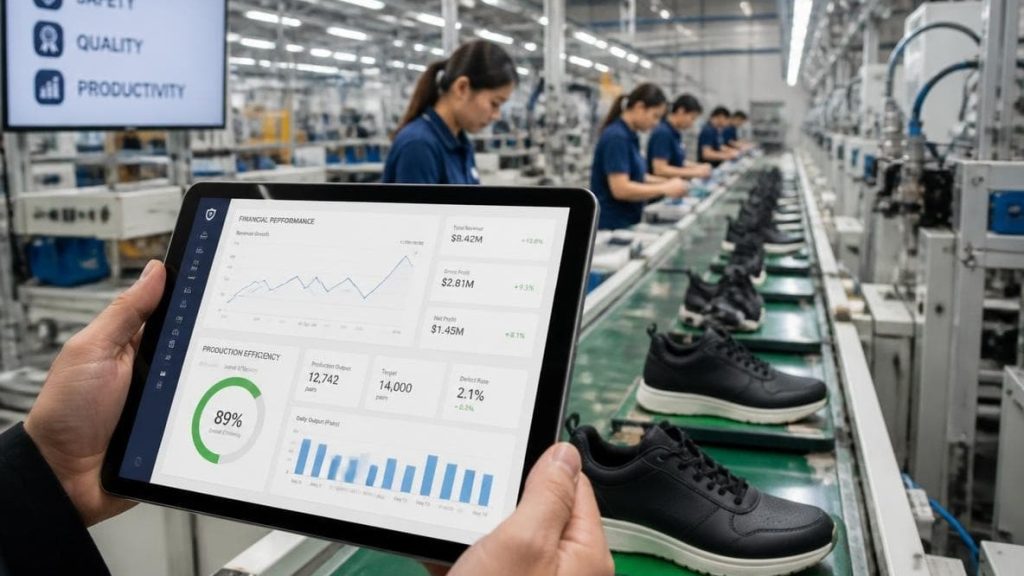
Footwear production planning
The contrasting performances of Crocs, On Holding and Allbirds demonstrate that demand is not recovering uniformly across footwear categories.
Factories should consider:
Crocs’ improved financial outlook is encouraging, but its wholesale channel grew only 1.8% in Q3. This is a reminder that brand-level revenue growth does not necessarily translate into equivalent wholesale factory demand. investors. crocs.com
Leather tanneries and material suppliers
The performance of luxury groups such as Kering and LVMH highlights the vulnerability of premium leather supply chains to changes in consumer demand.
Tanneries supplying luxury footwear, handbags and accessories should focus on:
When luxury brands reduce inventory exposure, the impact can move upstream to leather suppliers through lower material releases and delayed replenishment.
Shipping and supply-chain management

The Drewry index moved from $4,434 per 40-foot container on 1 October to $4,429 on 29 October, after reaching $4,585 on 22 October.
The late-month reduction offers some relief, but transpacific shipping remained particularly expensive, with Shanghai–Los Angeles rates at $7,514 per 40-foot container on 29 October. (WCI, Drewry]
For footwear exporters, freight costs influence:
Manufacturers should review freight quotations regularly and consider shipment consolidation wherever delivery schedules permit.
Cost and margin control
Inflation remains a concern for manufacturers because it affects energy, transportation, chemicals, wages and other operating expenses.
With US PCE inflation at 3.6% year-on-year in September, factories should not assume that material and operating costs will automatically decline simply because certain commodity or freight indicators improve.
Operational priorities should include:
- Reducing material wastage in cutting and stitching.
- Improving machine utilisation and labour productivity.
- Monitoring chemical consumption in leather processing.
- Improving first-pass quality and reducing rework.
- Reviewing energy consumption per pair produced.
The objective is to protect manufacturing margins without compromising product quality or delivery performance.
October 2026: Key Industry Takeaways
What the October market tells footwear professionals
Strongest documented earnings-driven performer | Crocs |
Major luxury-sector concern | Kering / Gucci |
Global equity market | Selective rotation |
Shipping environment | Elevated freight costs |
Factory priority | Cost and inventory control |
The October results reinforce that the footwear and leather industries are entering a period in which brand strength, channel performance and operational efficiency matter more than general market sentiment.
Companies demonstrating genuine demand growth and better cost management are attracting investor interest. Businesses struggling with weak consumer demand and excess inventory continue to face valuation pressure.
For footwear manufacturers, component suppliers and tanneries, the immediate priority should be disciplined production planning, efficient material utilisation and stronger coordination with customers.
The next monthly report should monitor whether the October earnings improvements translate into stronger wholesale orders, sustained production requirements and improved supplier visibility.
📚 Previous Weekly Stock Market Reports
Stay updated on historical performance trends and market shifts across the consumer footwear and leather sector:
Global Footwear & Leather Stocks Pulse Week 40, 2026 Macro drivers including regional back-to-school sell-through dynamics
39th Week Market Pulse: Sep 21 – Sep 25, 2026: Direct-to-Consumer Margin Expansions & Regional Wholesale Inventory Rebalancing.
38th Week Market Pulse: Sep 14 – Sep 18, 2026: Supply Chain Lead Times, Material Input Costs, and Q3 Back-to-School Sell-Through Metrics.
37th Week Market Pulse: Sep 07 – Sep 11, 2026: Luxury Leather Resilience vs. Mass Market Lifestyle Discounting.