
Automating the Artisanal: How the FAIST Project is Bringing Robotics to Shoe Manufacturing
For centuries, shoemaking has been defined by human hands. Crafting a quality shoe—stretching leather, aligning uppers, applying adhesives, and stitching soles—requires a subtle touch and acute spatial judgment that traditional industrial automation has long struggled to replicate.
That narrative is changing. Through major initiatives like the FAIST project (Factory of the Future for the Footwear Sector), the industry is turning a corner. Backed by tens of millions in investments and uniting dozens of tech centers, universities, and historic manufacturers, FAIST is proving that even the most traditional, labor-intensive manufacturing sectors can successfully transition into Industry 4.0.
Why Footwear Automation is Uniquely Hard
If you look at automotive or electronics manufacturing, high-speed robotics are everywhere. Parts are rigid, tolerances are microscopic, and paths are completely predictable.
Footwear, on the other hand, is an automation engineer’s ultimate stress test:
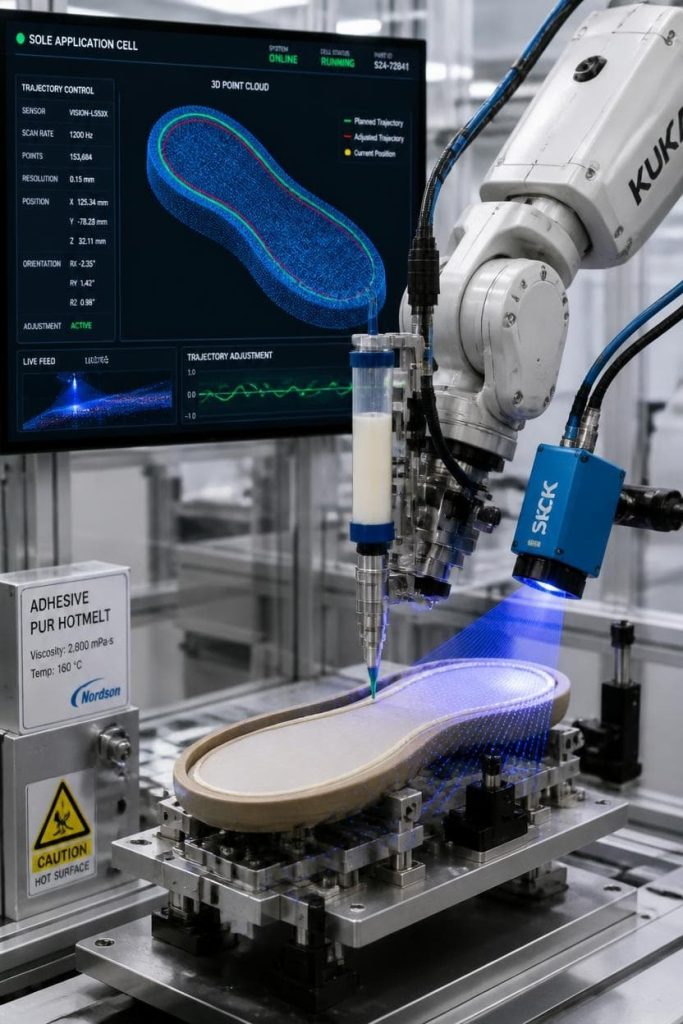
Precision Adhesive Deposition
Environmental regulations and sustainability goals demand a reduction in volatile organic compounds (VOCs) and solvent-heavy glues, pushing factories toward water-based alternatives.
Smart Last Handling & Soft Grippers
Moving a fragile, unstructured shoe upper through different automated cells requires a delicate touch.
Beyond the Factory Floor: Data and Sustainability
Automation in FAIST isn’t just about replacing manual labor with robotic arms—it’s a total digital overhaul:
Final Thoughts
Initiatives like FAIST highlight a vital shift in global manufacturing: the winners won’t necessarily be the cheapest factories, but the smartest ones.
By blending centuries of artisanal shoemaking heritage with cutting-edge 3D vision, adaptive robotics, and sustainable engineering, the footwear sector is setting a blueprint for how traditional industries can future-proof themselves.