Footwear Manufacturing Cutting-3 : Leather Grading Systems & Vendor vs Factory Sorting
Leather grading is one of the most influential yet frequently misunderstood activities in footwear manufacturing. However, grading is commonly performed by tanneries and the grading logic used by vendors does not always align with the cutting, costing, and performance requirements of shoe factories.
In Footwear Manufacturing Cutting 1, we explained how leather area discrepancy and cuttability are measured to establish the net coefficient. Similarly, in Footwear Manufacturing Cutting 2, we demonstrated how this net coefficient converts purchase price into the true cost per cuttable area. [[Building on these principles,]] this blog focuses on leather grading systems and explains the difference between vendor grading and factory vendee sorting, [[and also clarifies]] why factories must take ownership of grading decisions.
As a result, this topic is essential for people who want to understand how grading directly affects cutting efficiency, material cost, and production consistency.


1.Purpose of Leather Grading in Footwear Manufacturing
The primary objectives of leather grading are:
- To classify leather based on usable quality
- To control cutting yield
- To allocate leather correctly to shoe styles
- To support accurate costing and performance evaluation
Therefore, grading is not only a quality activity. Instead, it also serves as a material control and cost management tool.
2.Vendor Leather Grading Systems
2.1 Typical Vendor Grading Practice
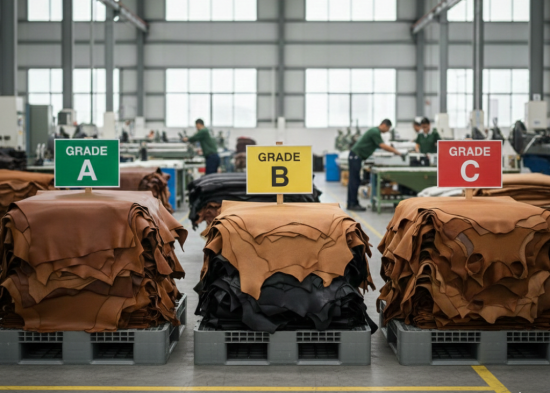
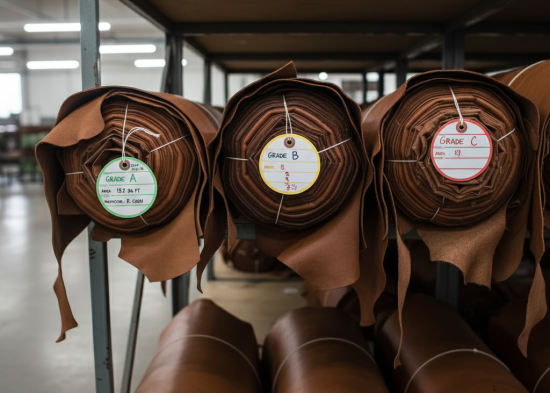
Most tanneries sort leather into grades such as A, B, C, and D, where:
- Grade A has the least defects
- Grade D has the highest defect concentration
The grading is generally based on:
- Visual defect assessment
- Overall appearance
- General cuttability perception
However, grading criteria and tolerance limits vary widely between vendors, which often creates inconsistency for factories


2.2 Cuttability-Based Grading Example
A commonly used cuttability classification is shown below.
Grade Cuttability Co-efficeint
A > 0.92
B 0.91 – 0.86
C 0.85 – 0.81
D < 0.80
Although this system provides a quantitative basis, vendors do not always apply grading consistently
2.3 Limitations of Vendor Grading
Vendor grading may be insufficient for factory use because:
- Grading standards are not uniform
- Factory cutting requirements differ by style
- Area are not always considered
- Cost impact is not evaluated
As discussed earlier in Footwear Manufacturing Cutting 2, even small grading differences can significantly affect the cost per cuttable square foot


3. Table-Run Leather
3.1 Definition of Table-Run Leather
Leather sold without grade separation is called table-run leather. In this case:
- No grading distinction exists at tannery level
- All skins are treated as one quality level
3.2 Implications for Factories
When table-run leather is received:
- Average cuttability must be assumed
- Net coefficient must be determined through sampling
- Cost variation risk increases
Therefore, factories using table-run leather must rely heavily on internal inspection and data-driven control
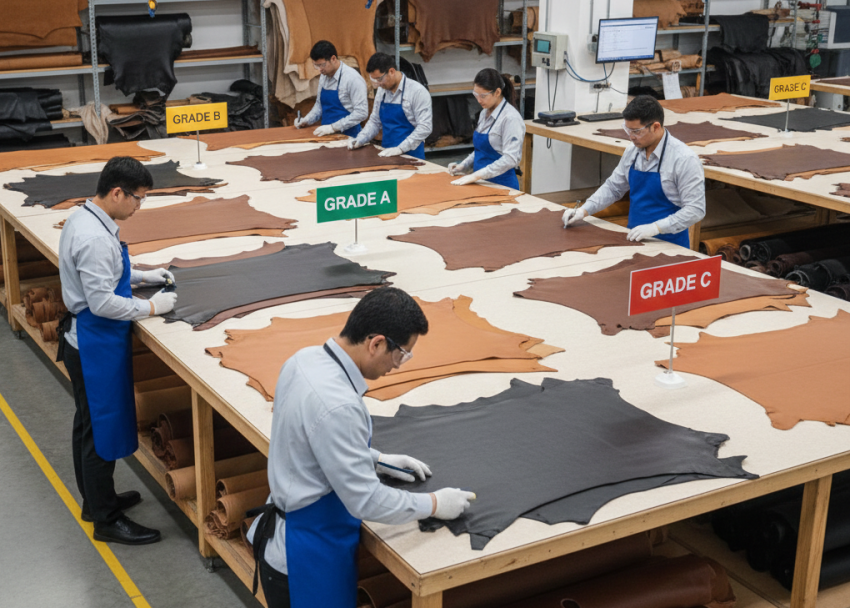
4. Factory (Vendee) Leather Grading and Re-Sorting
4.1 Why Factories Must Re-Sort Leather
Footwear factories typically re-sort leather after receipt to ensure:
- Better style allocation
- Improved cutting yield
- Consistent clicker performance
As a result, this practice shifts grading control from vendor to factory, ensuring better alignment with production needs
4.2 Factory Sorting Criteria
Leather may be re-sorted based on a combination of:
- Color consistency
- Thickness range
- Softness and temper
- Skin size and spread
- Defect distribution
At the same time, leather is grouped into internal grades (A, B, C, etc.), which are aligned with factory cutting standards.
4.3 Role of Net Coefficient in Factory Grading
In factory grading systems:
- Each internal grade is linked to a standard net coefficient
- These coefficients are derived from historical inspection data
This approach connects grading directly to:
- Cost calculations (Footwear Manufacturing Cutting 2)
- Cutting allowance systems
- Performance evaluation


5. Vendor Grading vs Factory Grading – Key Differences
| Aspect | Vendor Grading | Factory Grading |
| Basis | Visual quality | Cutting performance |
| Objective | Selling classification | Cost and yield control |
| Consistency | Vendor-dependent | Factory-defined |
| Link to Cost | Indirect | Direct |
| Use in Cutting | Limited | Essential |
Factories that rely solely on vendor grading often experience higher waste and inconsistent results
6. Using Grading Data for Management Control
When grading is aligned with net coefficient data:
- Vendor performance can be monitored objectively
- Purchase standards can be updated periodically
- Leather allocation to styles becomes systematic
Consequently, this creates a closed-loop control system, which connects inspection, costing, and production.
7. Connection to Previous and Next Topics
- Related Reading – Footwear Manufacturing Cutting 1: Leather Area Measurement, Discrepancy & Net Coefficient
Explains how quantitative leather quality data is generated. - Related Reading – Footwear Manufacturing Cutting 2: Calculating True Leather Cost Using Cuttable Area
Demonstrates how grading impacts actual leather cost. - Next Blog – Footwear Manufacturing Cutting 4: Clicker Allowance & Pattern Scale Area Calculation
Will explain how graded leather data is used to set cutting standards and evaluate clicker performance.
These links help readers progress logically from measurement, to cost, to grading, and finally to cutting performance.


Conclusion
Leather grading in footwear manufacturing must extend beyond vendor classifications. By adopting factory-controlled grading systems linked to net coefficients, footwear manufacturers gain accuracy in costing, stability in cutting performance, and transparency in vendor evaluation.
For this reason, understanding this distinction is critical before moving into advanced topics such as clicker allowance, cutting efficiency analysis, and incentive systems.