Lasting in Footwear Manufacturing: Principles, Methods, Shape Retention, and Modern Technological Practices
Introduction to Lasting in Footwear Manufacturing
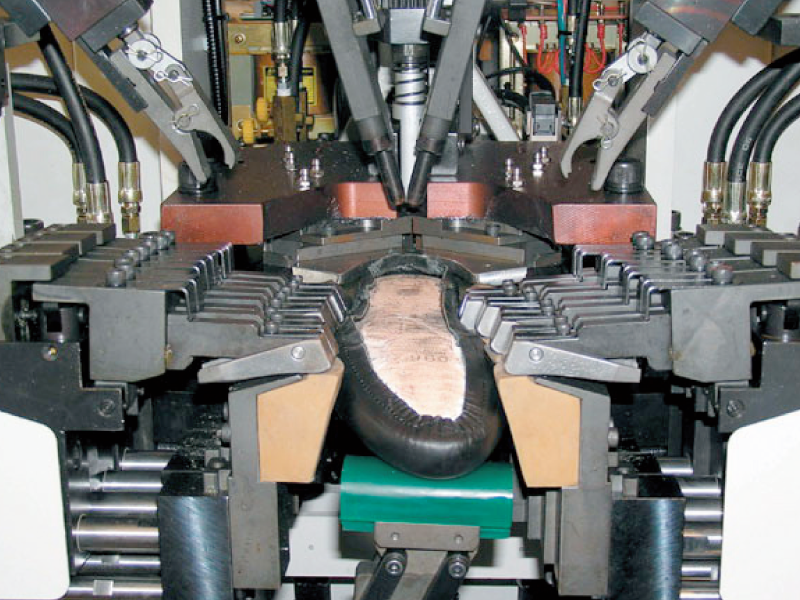
Lasting is defined as the process in which the upper is stretched, shaped, and secured over the last so that it accurately adopts the form intended by the designer. During this operation, the upper is attached to the insole using tacks, thread, or adhesive, depending on the construction method being applied. As a result, the three-dimensional form of the shoe is created. Once the last is removed, the upper must retain this imposed shape, as this directly influences fit, comfort, appearance, and durability.
In modern footwear manufacturing, lasting is no longer viewed as a simple mechanical stage. Instead, it is recognized as a critical shaping and control operation. If lasting is poorly executed, subsequent processes such as bottoming and finishing cannot fully correct the defects. Therefore, lasting is regarded as one of the most technically demanding stages in shoe production.
Functional Role and Technical Importance of Lasting
The primary function of lasting is to ensure that the upper conforms precisely to the contours of the last while maintaining material integrity. However, not all areas of the upper respond equally to strain. The regions that undergo the greatest shape change during lasting are also the areas where the highest risk of distortion exists. Consequently, strain must be applied selectively and with precision.
Furthermore, the success of lasting is closely linked to how well the upper material, last design, and shoe construction method interact. If these elements are not properly aligned, problems such as wrinkling, loose quarters, excessive tightness, or heel discomfort may occur. Therefore, strain application is carefully controlled to balance shape accuracy with wearer comfort.


Strain Application and Shape Retention Control
The amount of strain applied during lasting must always be limited to the minimum necessary to achieve conformance to the last. Excessive strain weakens the fiber structure of the upper, while insufficient strain leads to poor shape definition. For this reason, the selection of lasting strain depends on the material characteristics, shoe design, and intended end use.
Once the upper has been lasted, shape retention becomes the dominant concern. It is essential that the upper maintains its shape after the last has been removed. This ensures not only a good visual appearance but also long-term comfort during wear. To achieve this, upper materials must exhibit a controlled balance between elasticity and plasticity.
Elasticity allows the upper to stretch during lasting and recover partially, while plasticity enables the material to accept and hold the newly formed shape. If elasticity dominates without sufficient plasticity, the upper will relax and lose its form. Conversely, if plasticity dominates excessively, the shoe may become uncomfortably tight and resistant to foot movement.
Pro Tip: From a professional perspective, lasting quality is determined long before the shoe reaches finishing. Applying only the minimum effective strain preserves material strength and improves comfort. Topline balance should always be corrected during lasting rather than during finishing, as finishing adjustments rarely address structural imbalance.
Topline Balance and Quarter Alignment
One of the most visible indicators of correct lasting is topline balance. The topline must be tight, smooth, and symmetrically aligned. If the initial stretch applied during lasting is not properly removed, the topline may loosen during wear, resulting in a poor fit and unattractive appearance.
In addition, correct quarter alignment is essential for heel comfort. The outside quarter is generally positioned slightly lower than the inside quarter, typically by approximately three millimeters. This adjustment compensates for natural differences in ankle bone height and improves overall balance. When this relationship is ignored, heel rubbing and instability are likely to occur.
Evolution of Lasting Philosophy
Historically, lasting was performed by stretching the upper excessively so that all strain was permanently removed. This method was believed to improve shape retention. However, experience and research later demonstrated that this approach was inefficient, damaging to materials, and detrimental to comfort.
Modern footwear technology has therefore shifted toward a principle of controlled minimal strain. The objective is no longer to force the upper into shape but to guide it into conformance using material science, moisture control, and heat-assisted processes. As a result, both quality and efficiency have improved significantly.

Methods of Lasting in Footwear Construction
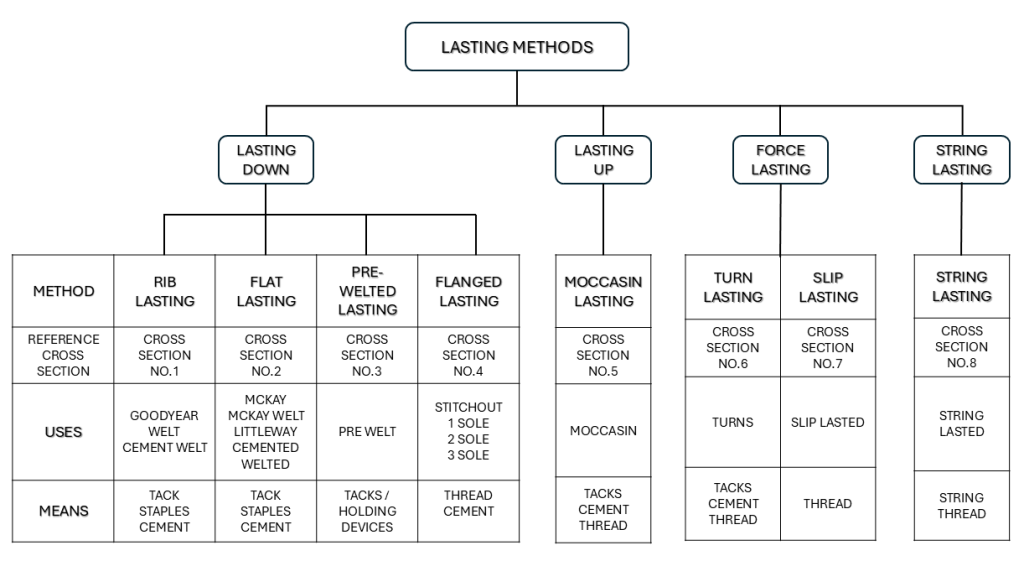
Traditional footwear manufacturing recognizes several basic methods of lasting. These methods are selected based on shoe type, construction, and performance requirements. Although the sequence of strain application may vary, the central objective remains the same: the upper must be positioned centrally on the last and shaped uniformly.
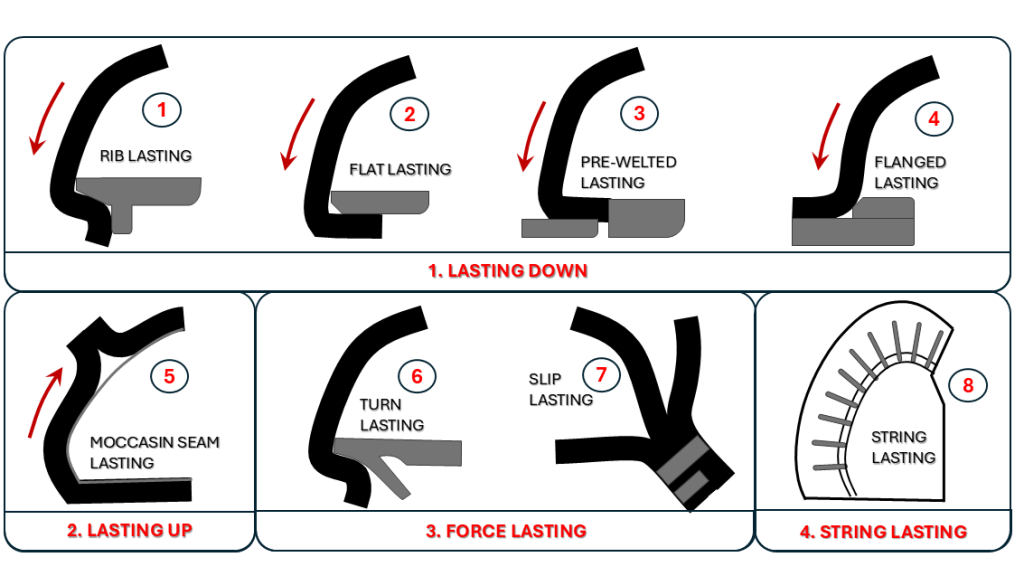
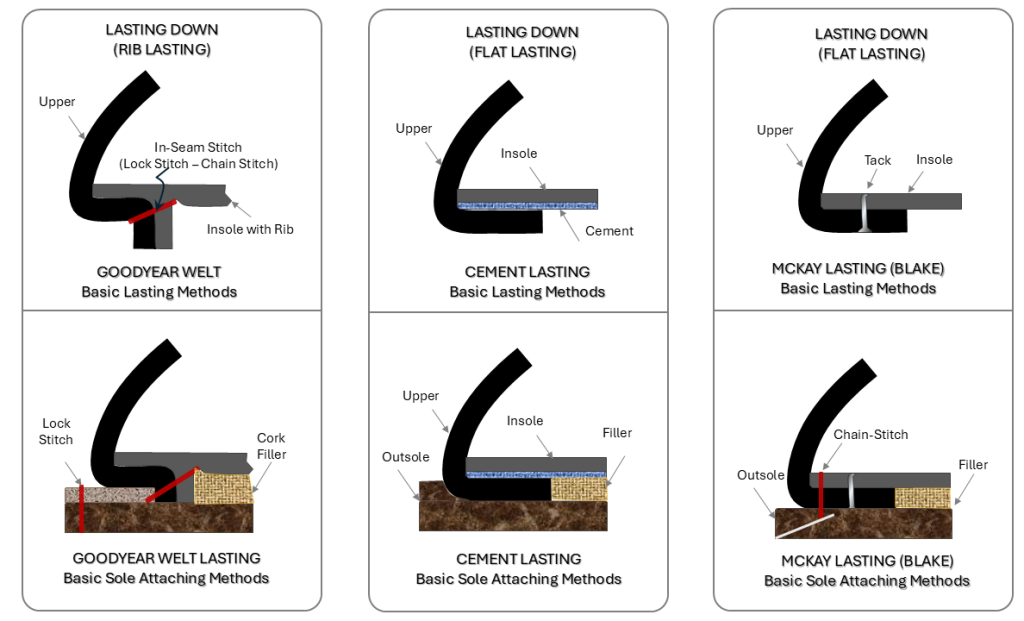
Lasting down is commonly used in structured footwear such as Goodyear welted, cemented, and McKay constructions. In this method, the upper is pulled down over the last and secured to the insole using mechanical or adhesive means. Variations such as rib lasting, flat lasting, pre-welted lasting, and flanged lasting are applied depending on the construction system.
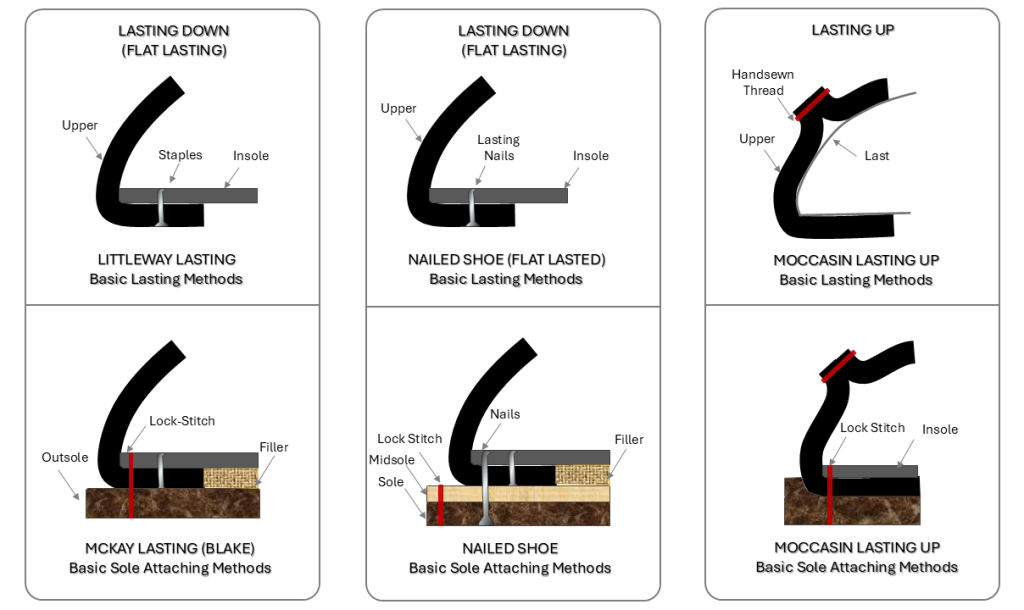
Lasting up is primarily associated with moccasin constructions. In this method, the upper is drawn upward around the last and secured using a combination of tacks, cement, or stitching. This approach allows for a distinctive wrap-around construction and enhanced flexibility.
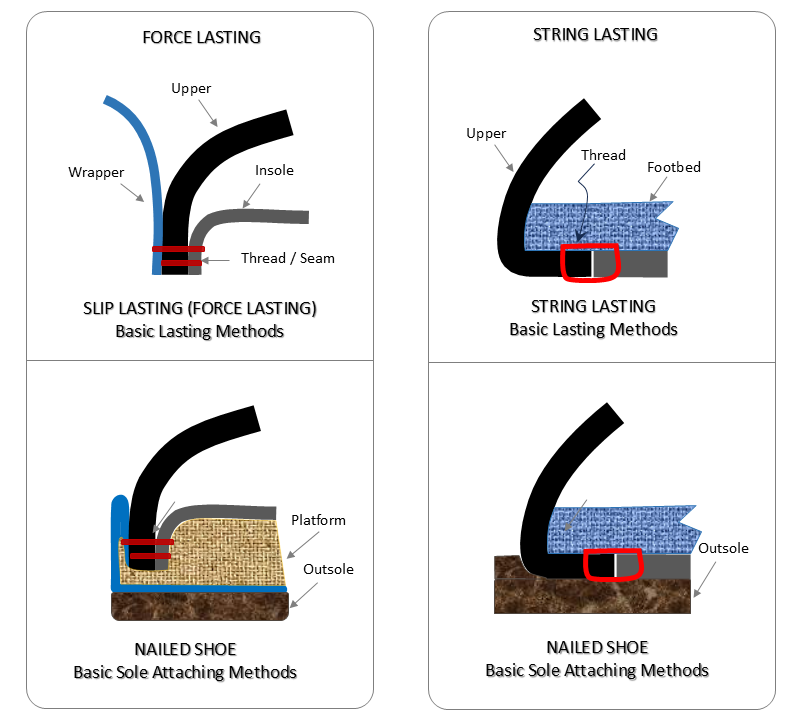
Force lasting is used in constructions where flexibility and lightweight performance are essential. Turned and slip-lasted footwear fall into this category. Here, mechanical force is applied to shape the upper while minimizing structural rigidity.
String lasting is typically used in lightweight and casual footwear. In this method, tension is applied using string or thread to draw the upper into shape. While simpler in concept, accurate control is still required to prevent distortion.
Pro Tip: Moisture should be introduced carefully during mulling, particularly when working with fine leathers. Excess moisture without adequate heat setting can lead to long-term instability. Finally, lasting methods should be aligned with construction type during the design phase to prevent costly corrections later in production.

Organization of the Making Department
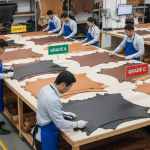
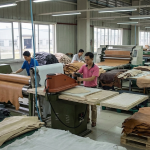
The making department is generally divided into three functional areas: assembly, lasting, and attaching. In the assembly section, uppers from the closing room are combined with soles, insoles, heels, and shanks. All components are gathered according to work tickets before production proceeds.
Planning plays a crucial role at this stage. A last plant register is maintained to monitor last usage and availability. This planning system, often referred to as Ford Print Planning, ensures that lasts are used efficiently and that all required components are available before lasting operations commence. As a result, workflow interruptions are minimized.
Modern Techniques for Enhanced Shape Retention
To improve shape retention and reduce production time, modern footwear manufacturing incorporates mulling and heat setting. These techniques support the lasting process by conditioning the upper material.
Mulling involves introducing controlled moisture into the upper prior to lasting. Moisture softens the leather fibers, allowing the upper to stretch more easily and evenly. Commonly, steam vapour is applied immediately before forepart lasting. This process typically lasts less than one minute but significantly improves workability. An additional benefit is the softening of thermoplastic toe puffs during the same operation.
Heat setting is usually performed after lasting and before bottoming operations. Modern high-velocity air systems force heated air through the upper, rapidly removing moisture and locking the shape into place. Compared to older cabinet systems, modern heat setters complete the process in approximately one hundred seconds. This results in consistent shape retention across production batches.
Types of Shoe Lasting and Construction Methods
Lasting Down Construction
Lasting down is one of the most traditional footwear construction methods, where the upper and its lining are pulled over the last and secured directly to the insole. In this process, the lasting margin is fixed using tacks, stitching, or adhesive cement. As a result, the upper becomes an integral structural element of the shoe. Consequently, lasting down construction is commonly used in classic leather footwear where durability, shape retention, and long-term wear performance are essential.
Flat Lasting Construction
In flat lasting, the upper is pulled over the last and attached directly to a flat insole without any raised rib structure. This construction method simplifies the lasting operation while still providing adequate support and stability. As a result, flat lasting is commonly applied in casual and semi-formal footwear where production efficiency is important. Additionally, this method allows easier sole bonding, making it suitable for cemented sole constructions.
Pre-Welted Lasting Construction
Pre-welted lasting is a specialized technique where the welt is attached to the insole before the upper is lasted. Once the upper is pulled over the last, it is stitched to the pre-attached welt, ensuring precise alignment and consistency. Consequently, this method reduces manual variation during lasting. Furthermore, pre-welted lasting is often used in high-quality footwear manufacturing to achieve uniformity while preserving the traditional benefits of welted construction.
Flanged Lasting Construction
Flanged lasting utilizes a specially designed insole with an outward flange that extends around the perimeter. During lasting, the upper is pulled over the last and secured onto this flange. Therefore, the process improves bonding strength between the upper and the sole unit. In addition, flanged lasting offers better control over lasting margins, making it suitable for both cemented and combination constructions in modern footwear production.
Moccasin Lasting-Up Construction
Moccasin lasting-up is a unique construction method where the upper wraps around the foot and is stitched underneath, forming a sock-like structure. In this technique, the upper is lasted upward rather than downward, which is why it is referred to as “tube last” construction. As a result, the footwear offers exceptional flexibility and comfort. Consequently, moccasin construction is widely used in casual, comfort, and traditional footwear styles.
String Lasting Construction
String lasting has gained popularity due to its simplicity and efficiency. In this method, a strong string is stitched along the edge of the upper’s lasting allowance using a special string-stitching machine. The string is then pulled tight to draw the upper evenly over the last. Therefore, multiple lasting operations are replaced by a single controlled action. Additionally, string lasting improves consistency and reduces labor dependency in mass footwear production.
Force Lasting (Slip Lasted / California Construction)
Force lasting involves forcing the upper over the front of the last while the backstrap is pushed into position to achieve the final shape. This method is commonly associated with slip-lasted or California construction footwear. As a result, the shoe remains lightweight and highly flexible. Moreover, force lasting is frequently used in athletic, casual, and comfort shoes where softness, adaptability, and reduced structural stiffness are desired.
Attaching Principles in Footwear Manufacturing
The attachment of the sole to the upper is achieved either directly or indirectly. Direct attachment involves bonding or stitching the sole directly to the upper. Alternatively, indirect attachment uses an intermediate component such as a welt or runner. While both methods are widely used, indirect attachment systems are generally easier to repair and maintain over the life of the shoe.
Conclusion
Lasting remains one of the most influential operations in footwear manufacturing. When executed with precision, it ensures accurate shape, reliable fit, and long-term durability. By combining traditional craftsmanship with modern mulling and heat-setting technologies, manufacturers can achieve superior results while maintaining efficiency and consistency. Ultimately, effective lasting is the foundation upon which high-quality footwear is built.