
Girths, Sizes, and Measurement Standards for the USA Market: Footwear Manufacturing Insights
For footwear factories exporting to the United States, understanding shoe sizing alone is not sufficient. Equal importance must be given to girth classification, as the US market demands multiple width options across the same size range. When girth control is poorly understood or incorrectly applied, fit complaints increase, grading errors multiply, and return rates rise.
Therefore, this Footwear Manufacturing Insights article explains how girths and sizes are distributed in the USA, and clarifies how girth must be accurately measured on the foot and on lasts to ensure fit consistency and market compliance.


Understanding Girths and Sizes in the USA Footwear System
The US footwear sizing system combines length sizes with multiple girth categories, allowing the same shoe length to be produced in different width fittings. This system is especially relevant for court shoes, dress footwear, and structured styles, where precision fit is critical.
Common girth designations include:
- AAA (extra narrow)
- AA (very narrow)
- A (narrow)
- B (standard narrow)
- C (medium)
- D (standard)
- EW (extra wide)
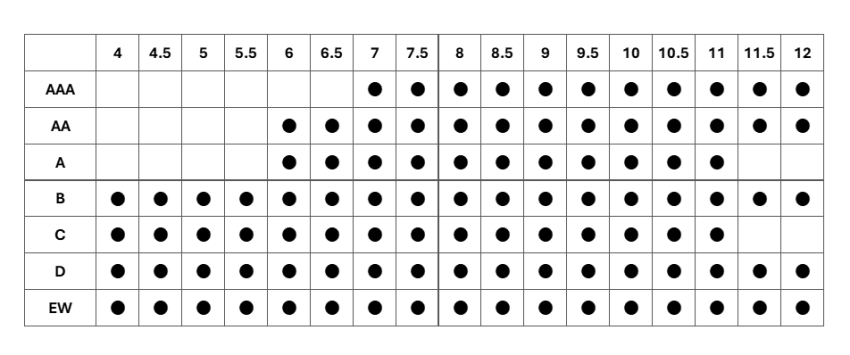
In practice, not all girths are produced across all sizes. Instead, girth availability is spread strategically over the size range. For example, very narrow girths such as AAA are typically limited to mid and larger sizes, while extra wide girths are more commonly offered from medium sizes upward.
As a result, factories must avoid assuming that every girth applies uniformly to all sizes. The image table illustrates this controlled distribution clearly, showing how each girth is selectively applied across sizes ranging from approximately 4 to 12.
This structured spread allows brands to serve diverse foot shapes without excessive tooling or inventory complexity.


Why Girth Distribution Matters in Footwear Manufacturing
From a manufacturing perspective, incorrect girth planning leads to significant downstream issues. If girth allocation is not aligned with market expectations, lasts may be developed incorrectly, uppers may be strained during lasting, and finished shoes may fail fit trials despite correct length sizing.
Moreover, US buyers expect consistent girth behavior across size runs, meaning that grading rules must be carefully engineered rather than uniformly scaled.
Therefore, girth distribution should always be finalized during last development and size range planning, not after sampling begins.
How to Measure Girth Correctly in Footwear Engineering
While length measurement is universally understood, girth measurement is often misunderstood or oversimplified. In professional footwear engineering, girth is not an arbitrary circumference but a precisely defined measurement point determined by foot anatomy.
Last manufacturers usually mark measurement points directly on the last, ensuring consistency across production and development stages. However, understanding where these points originate on the human foot is essential for accurate interpretation.
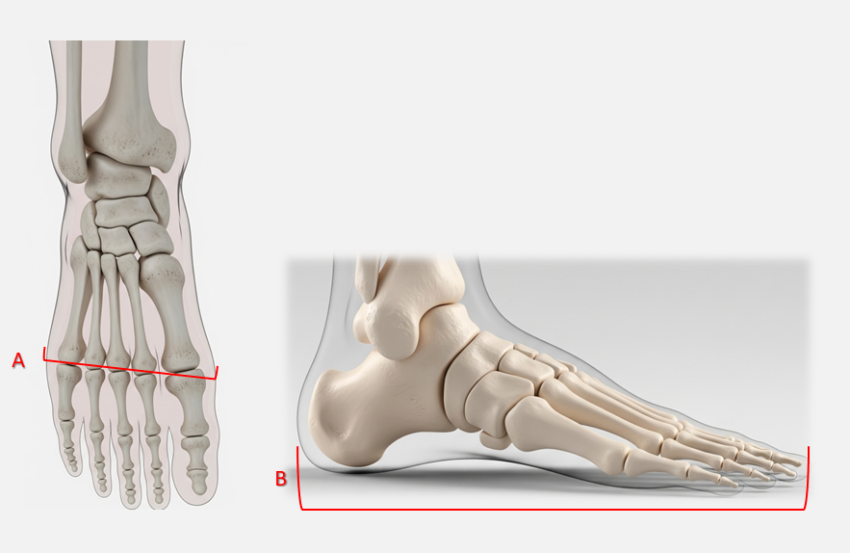
The correct girth position is defined by two anatomical joints in the forefoot. This location represents the functional flex and width zone of the foot, making it the most reliable reference for fit.
In the illustration:
- A represents the foot length, measured from heel to toe.
- B represents the girth, measured around the ball of the foot at the joint line.
This girth position must always be used consistently. Measuring too far forward or too far back results in misleading data and incorrect last selection.
Relationship Between Foot Girth and Last Girth
Foot girth and last girth are closely related but not identical. Last girth must account for:
- Upper material thickness
- Lining and reinforcement layers
- Intended toe shape and volume
- End-use comfort allowances
Consequently, last girth values are engineered slightly differently from raw foot measurements. Nevertheless, the measurement location must remain constant, otherwise grading logic breaks down.
Factories working with multiple last suppliers should verify that girth markings follow the same anatomical reference, particularly when developing US-width programs.


Manufacturing and Fit Control Implications
Accurate girth measurement directly influences:
- Upper pattern width
- Last grading accuracy
- Forefoot comfort
- Return and rejection rates
When girth logic is misunderstood, fit problems are often incorrectly blamed on materials or workmanship. In reality, the root cause frequently lies in measurement inconsistency or incorrect girth selection during development.
By contrast, factories that standardize girth measurement and align girth availability with US market norms achieve better fit reliability and stronger buyer confidence.
Conclusion
Girth control is a critical yet frequently underestimated aspect of footwear manufacturing for the US market. Understanding how girths are distributed across sizes, and knowing precisely where and how girth must be measured, allows manufacturers to deliver consistent fit across complex size programs.
When combined with disciplined last engineering and grading control, proper girth measurement becomes a powerful tool for reducing fit complaints, improving product acceptance, and strengthening brand performance in the US footwear market.