Global Footwear Supply Chain & Trade Intelligence Briefing (October 2026)
Executive Summary:
Navigating global trade shifts requires clear visibility into changing tariffs, regional manufacturing shifts, and margin strategy. Welcome to the October 2026 Industry Round-Up, your monthly strategic briefing for footwear brand executives, sourcing directors, and trade compliance teams.
This month’s report highlights key global supply chain developments—including the USTR’s Section 301 tariff extensions, strict new CBP parcel filing rules, and regional supply chain realignments across Southeast Asia. We also feature an exclusive brand strategy deep-dive analyzing how Nike, Inc. is shifting toward a variable-cost supply chain model to protect margins in 2026.
Quick Navigation
Global Footwear & Supply Chain News Highlights (October 2026)
USTR Confirms China Section 301 List 4A Tariffs Continuation for Footwear
On October 7, 2026, the USTR confirmed Section 301 tariffs on Chinese imports. As a result, the +7.5% List 4A duty on 242 HTS Chapter 64 footwear lines will remain active. Therefore, brands sourcing from China must maintain current tariff mitigation models.
CBP Proposes Strict Low-Value Parcel Filing Rules for Imported Shoes
On October 8, 2026, U.S. Customs and Border Protection proposed new rules for low-value parcels. Consequently, informal entry rules for goods valued under $2,500 will face tighter restrictions. In addition, direct-to-consumer footwear brands must provide enhanced electronic documentation.
Nike Announces Global Operating Model Restructuring
On October 1, 2026, Nike announced systemic changes to its global operating model. Specifically, the company is shifting toward a flexible and responsive supply chain. As a result, this strategy will lower logistics overhead while aligning production with consumer demand.
Rocky Brands Reports Q3 Footwear Sales Growth Driven by Domestic Demand
In October 2026 fiscal filings, Rocky Brands announced a 13.3% net sales increase to $138.8 million. Furthermore, wholesale growth in work and outdoor boot lines led this expansion. This performance highlights continuous demand for functional footwear.
Vietnam Deploys Electric Barges to Reduce Footwear Supply Chain Emissions
On October 28, 2026, major footwear logistics operations launched zero-emission electric cargo barges in Vietnam. In addition, these vessel fleets operate across regional inland waterways. Consequently, the initiative targets Scope 3 transport emission reductions between Tier-1 factories and export ports.
UK Footwear Retail Sector Adapts to Inventory Normalization Pressures
Late-October 2026 trade metrics showed European and UK shoe retailers trimming forward orders. Meanwhile, discretionary high-street shoe purchasing dropped by 4.5%. Therefore, supply chain planners are carefully managing overall inventory balances.
CAFTA-DR Footwear Lines Maintain Competitive Advantage Under Standard Duties
Throughout October 2026 tariff reviews, footwear entered under CAFTA-DR rules retained zero base duty. As a result, Central American production pipelines offer strong duty relief. Thus, regional nearshoring investments remain highly attractive compared to transpacific routes.
Industrial Rubber and Synthetic Upper Sourcing Prioritized Over Leather
Sourcing metrics logged in October 2026 confirm a strategic material shift. Specifically, athletic and utility brands are favoring bio-based TPU and recycled synthetic meshes over traditional leather. Consequently, brands avoid leather price spikes while satisfying carbon mandates.
Automated Lasting Investment Increases Across Southeast Asian Clusters
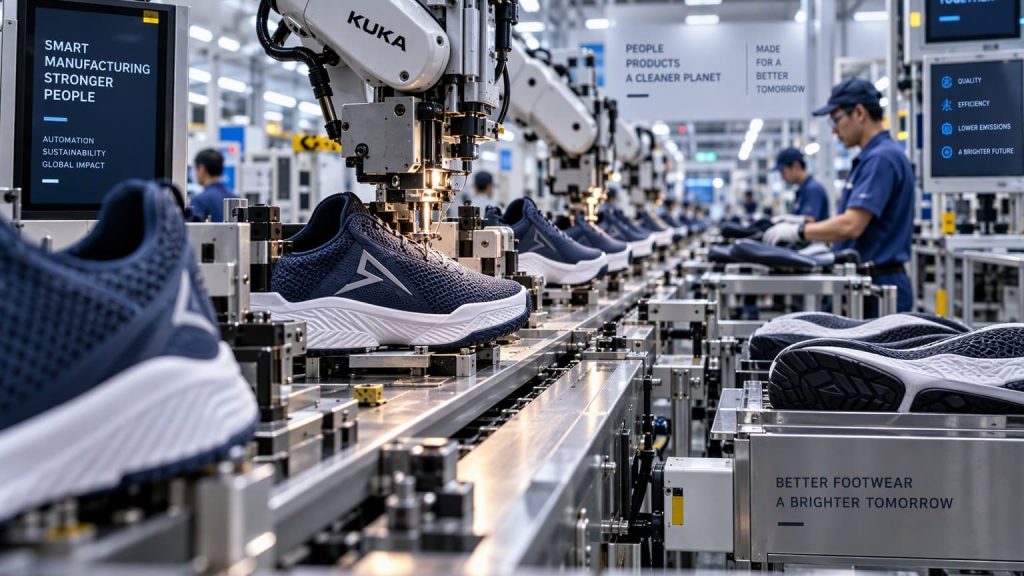
During October 2026 factory updates, Tier-1 manufacturing groups in Southeast Asia expanded capital expenditure on automated upper-lasting and robotic sole-attaching units to stabilize per-unit labor expenditures.
Container Shipping Buffer Schedules Stabilize for Ocean Footwear Cargo
Logistics reports in late October 2026 indicated that main East-West shipping channels held steady transit lead times, permitting footwear supply chain managers to finalize holiday buffer schedules without incurring premium air-freight surcharges.
Brand Strategy Deep-Dive: Nike, Inc.
Global Sourcing Architecture & Factory Footprint
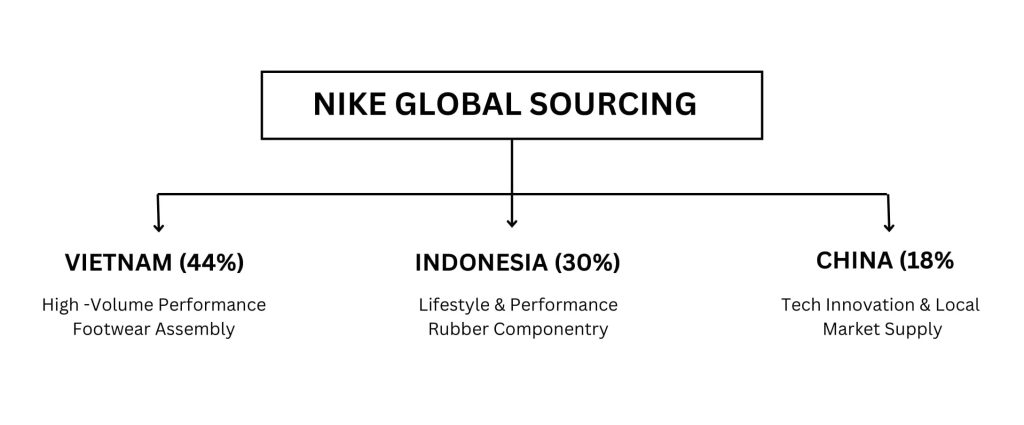
Nike, Inc. operates entirely through an independent contract manufacturing network rather than owning physical footwear assembly plants. Production is concentrated in three main Asian manufacturing hubs: COSMOS EPICSOURCING
Regional Footprint Diversification & Global Operations Model
To reduce tariff vulnerabilities and geopolitical risk, Nike maintains a “China-Plus-One” strategy by routing global production lines through Southeast Asia. EPICSOURCING
In corporate operational announcements, Nike updated its global operations structure by shifting materials integration closer to footwear supply chain teams and modernizing specialized Air Manufacturing Innovation (Air MI) facilities across Oregon, Missouri, and Vietnam. NIKE
Strategic Cost-Structure Transformation: Project Pace
Nike formally launched Pace, an enterprise initiative targeted at moving its supply chain from a high fixed-cost model into a flexible, highly variable cost structure.
Strategic Summary & Moving Forward
As we close out October 2026, two supply chain priorities stand out for footwear executives: regulatory agility and cost structure flexibility. With trade authorities tightening compliance frameworks and nearshoring corridors maturing, sourcing teams must balance duty minimization with rapid lead times.
Brands that replicate high-flexibility strategies—such as material standardization, predictive demand sensing, and variable logistics—will be best positioned to protect operating margins regardless of global trade shifts.
📚 Previous Weekly Stock Market Reports & Global Footwear & Leather News
Stay updated on historical performance trends and market shifts across the consumer footwear and leather sector & Global Footwear and Leather News Update:
Global Footwear & Leather Stock Pulse: October 2026 – MONTHLY INDUSTRY INTELLIGENCE · 1–31 OCTOBER 2026 Executive Summary Market Benchmark -0.93% S&P 500 Top
Global Footwear & Leather Stocks Pulse Week 40, 2026 Macro drivers including regional back-to-school sell-through dynamics
39th Week Market Pulse: Sep 21 – Sep 25, 2026: Direct-to-Consumer Margin Expansions & Regional Wholesale Inventory Rebalancing.
38th Week Market Pulse: Sep 14 – Sep 18, 2026: Supply Chain Lead Times, Material Input Costs, and Q3 Back-to-School Sell-Through Metrics.