Building Circularity Step by Step: How BASF Advanced Materials Outperform Legacy Footwear Concepts
The footwear industry faces a dual challenge: consumers demand higher athletic performance and durability, while global environmental targets demand radical waste reduction. Traditionally, performance footwear relies on complex multi-material assemblies—such as EVA midsoles, vulcanized rubber outsoles, and solvent-based adhesives—that make shoes nearly impossible to recycle at the end of their lifecycle.
Chemical leader BASF is driving a paradigm shift by developing advanced material platforms that deliver superior physical properties while enabling closed-loop circularity. Below is a detailed look at BASF’s core footwear technologies, their specific physical performance metrics compared to conventional materials, and their circularity benefits.
Elastopan® SpringPURe: Rethinking Midsoles
Traditional Ethylene-Vinyl Acetate (EVA) and cast Polyurethane (PU) midsoles often force shoemakers to compromise: EVA is lightweight but suffers from poor compression set (it loses shock absorption quickly), while standard PU is durable but heavy and generates up to 25% trim scrap during production.
Physical & Mechanical Benchmarks vs. Conventional Materials:
Circular & Environmental Impact
Thermoformed Waste Reduction: Uses heat-press deposition to form midsoles, eliminating edge scrap generated in conventional die-cutting and casting.
CO₂-Based blowing agents: Reduces fossil footprint right at the formulation stage.
Elastollan® GripTec: Next-Level Outsole Traction & Durability
Vulcanized rubber has long been the gold standard for outsole grip and abrasion resistance. However, rubber is a thermoset material—once cross-linked (vulcanized), it cannot be remelted or recycled into high-value applications. Standard TPUs offer recyclability, but historically fell short in wet-grip traction.
Physical & Mechanical Benchmarks vs. Conventional Materials:
Circular & Environmental Impact
100% Thermoplastic Recyclability: Unlike vulcanized rubber, Elastollan® GripTec can be reground and remelted directly into new outsoles or structural components without losing key polymer characteristics.
Infinergy® Revolution: High-Resilience E-TPU Particle Foam
Standard EVA particle foams exhibit energy resilience (rebound) around 30% to 37%. Over time and under changing weather conditions.
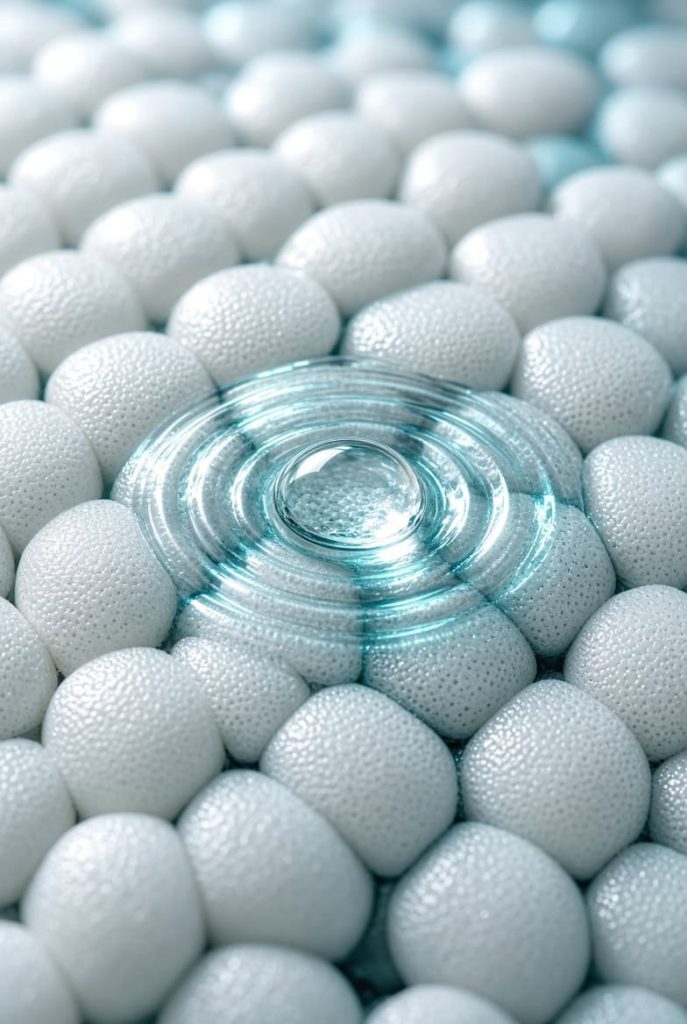
EVA hardens in the cold and degrades under continuous impact. Infinergy® (Expanded TPU) fundamentally changed athletic cushioning through its closed-cell particle structure.
Physical & Mechanical Benchmarks vs. Conventional Materials:
Circular & Environmental Impact
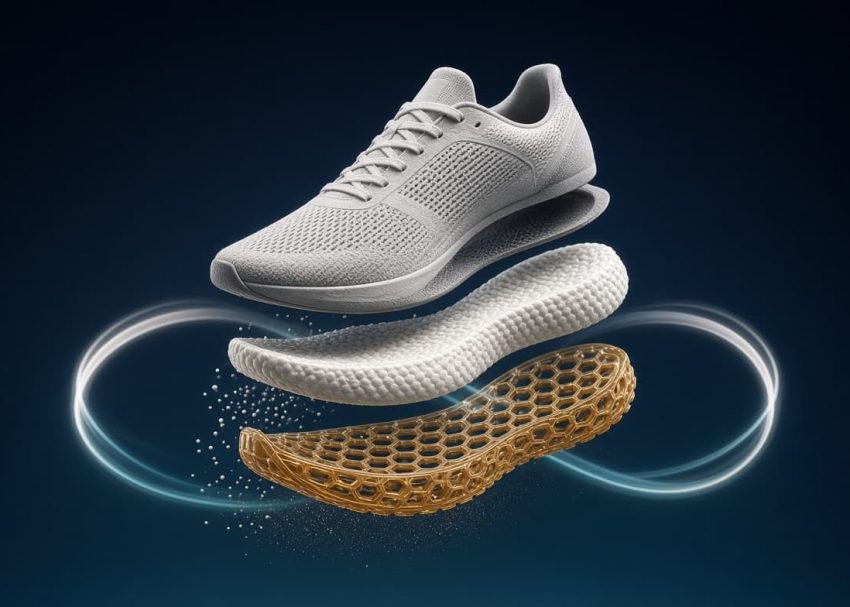
Adhesiveless Thermal Bonding: The “Revolution” processing method thermally fuses E-TPU beads together using heat instead of heavy polyurethane binders. This allows post-consumer midsoles to be easily re-processed into pure recycled E-TPU.
Debonding-on-Demand: Solving the Separation Bottleneck
Even if shoe components are made from pure recyclable plastics, gluing them together with permanent cross-linked polyurethane or neoprene adhesives renders the entire shoe non-recyclable.
Physical & Mechanical Benchmarks vs. Conventional Materials:
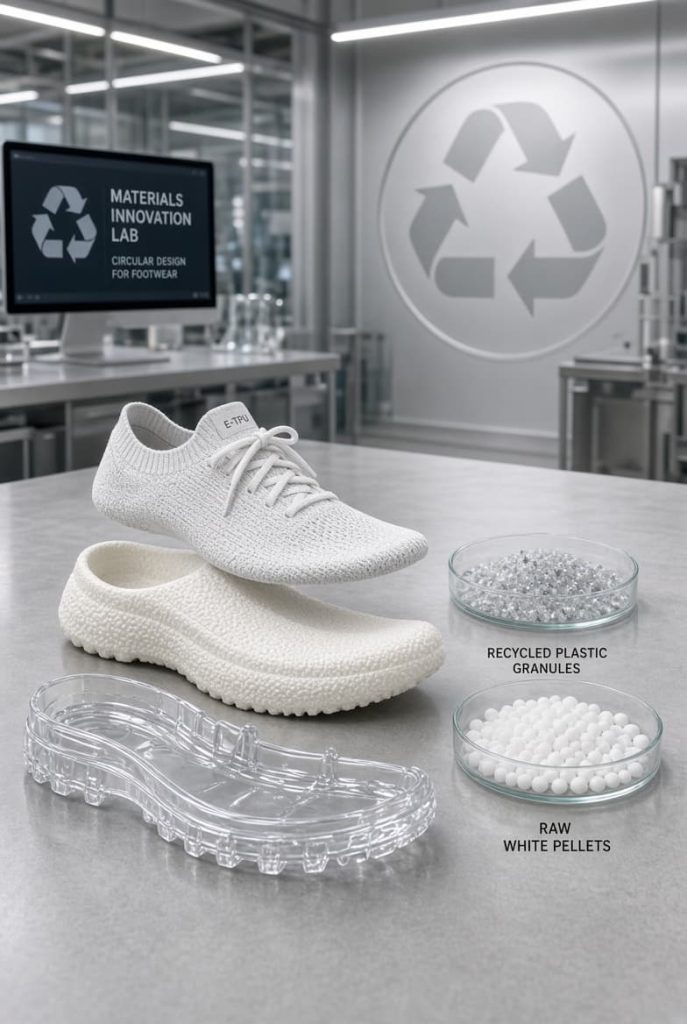
BASF’s Raw Material Strategies: ChemCycling® and Biomass Balance
To ensure that high physical performance starts with a low carbon footprint, BASF integrates two main feedstock replacement models:
Performance Matrix: BASF vs. Traditional Materials
| Component / Technology | Primary BASF Material | Legacy Material Alternative | Density Comparison | Key Mechanical Advantage | Recycling Mechanism |
| Midsoles | Elastopan® SpringPURe (Thermoformed PU) | Conventional Cast PU / Standard EVA | Low Density (~0.25 – 0.35 g/cm³) vs Standard PU (0.40–0.50 g/cm³) | Higher tear strength & lower compression set | Meltable TPU/PU system for mechanical recycling |
| Outsoles | Elastollan® GripTec (Specialized TPU) | Vulcanized Rubber / Standard TPU | ~1.12 – 1.18 g/cm³ (Similar to standard TPU) | ~50% lower abrasion loss (mm³) vs Rubber; superior wet grip | 100% Thermoplastic remelting (Zero thermoset waste) |
| Cushioning Foams | Infinergy® Revolution (E-TPU) | Standard EVA Foam | ~0.15 – 0.25 g/cm³ (Density-optimized bead foam) | >55%–70% Energy Return vs EVA (~30%–37%) | Adhesiveless heat-fusion bead recycling |
| Assembly System | Debonding-on-Demand | Permanent Solvent Adhesives | N/A (Assembly Layer) | Thermal/triggered bond breakdown under targeted heat | Pure material stream separation at end-of-life |
Summary
The transition to sustainable footwear requires materials that do not ask consumers or manufacturers to trade durability for circularity. By combining low density, high rebound, superior abrasion resistance, and meltable thermoplastic chemistry, BASF provides a realistic, scalable path toward zero-waste footwear design.
References
Elastopan® SpringPURe (Midsoles)
“Developed alongside partners like Gusbi and Stemma, BASF’s Elastopan® SpringPUReuses thermoformed heat-press technology to enable waste-free, high-rebound midsole production.”
Elastollan® GripTec (Outsoles)
“As detailed in BASF’s Elastollan® GripTec series release, this specialized TPU provides a durable, slip-resistant rubber alternative with lower lifecycle carbon emissions.”
Infinergy® (E-TPU Cushioning)
“According to BASF’s Infinergy® product portal, heat-pressed E-TPU achieves over 75% pendulum energy rebound while extending cushioning lifespan well beyond conventional EVA.”
Closed-Loop & Debonding-on-Demand
“In partnership with DESMA, BASF demonstrated debonding-on-demand footwear conceptsthat allow full shoes to separate cleanly at end-of-life into recyclable PU and TPU streams.”

![Weekly Footwear & Leather News Roundup: Sep 27 – Oct 3, 2025]](https://thefootwearedge.com/wp-content/uploads/2025/10/News-Featured-Image-768x491.png)