Footwear Pattern Grading: Principles, Radial Projection Method, and Geometric Scaling Techniques
Introduction
Pattern grading is one of the most fundamental yet frequently misunderstood processes in footwear pattern engineering. While pattern creation defines shape and fit for one size, grading ensures that the same design integrity is maintained across a complete size range. Therefore, grading is not simply enlargement or reduction — it is a controlled engineering process.
In footwear manufacturing, grading accuracy directly influences fitting consistency, material behavior, visual proportion, and production repeatability. If grading principles are not correctly applied, distortion occurs, resulting in poor fitting and structural imbalance.
This article explains the principles of pattern grading, the role of similar triangles, and the practical application of radial projection, supported by geometric concepts traditionally used in footwear pattern development.
What is Pattern Grading?
Pattern grading is the systematic process through which an approved sample pattern is converted into multiple sizes according to customer or market requirements.
Instead of redesigning every size individually, the master pattern is scaled using defined increments.
Key Characteristics of Grading
- Approved sample patterns act as the base reference.
- Size increments are applied proportionally.
- Shape integrity must remain unchanged.
- Grading may be performed:
- Manually (traditional method)
- Mechanically or digitally (modern CAD systems)
Although tools may differ, the grading principle remains identical.


Fundamental Principle Behind Grading
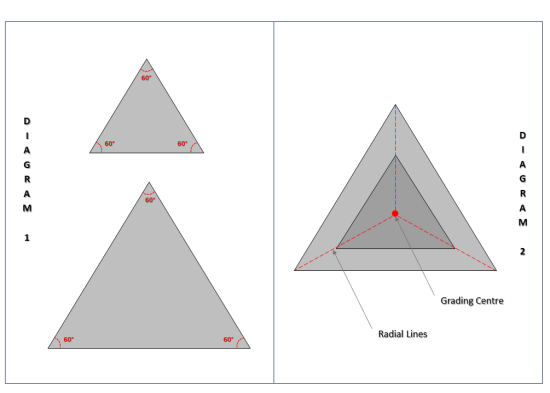
The entire grading system is based on geometric relationships — particularly the concept of similar triangles.
Properties of Similar Triangles
Even when triangles vary in size:
- Angles remain identical.
- Shape proportions are preserved.
- Relative dimensions scale consistently.
Because of these properties, pattern points can be extended outward using controlled directional lines. As a result, scaling occurs without altering the original shape geometry.
Radial Projection — The Core Grading Method
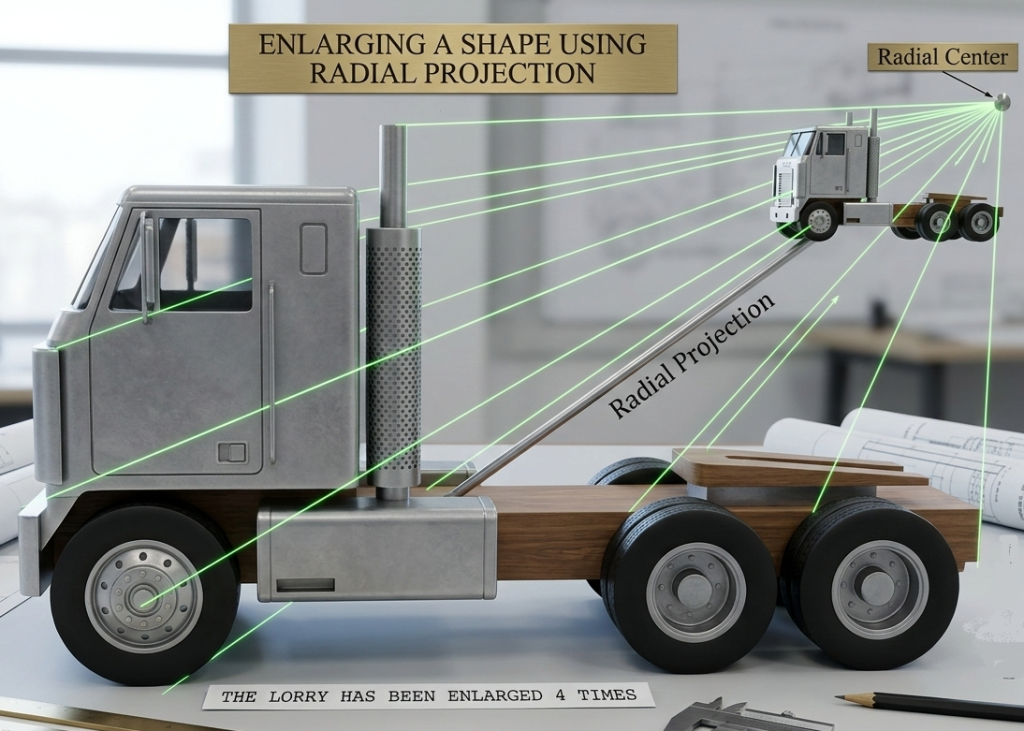
Radial projection is a geometric enlargement technique widely used in traditional footwear pattern rooms.
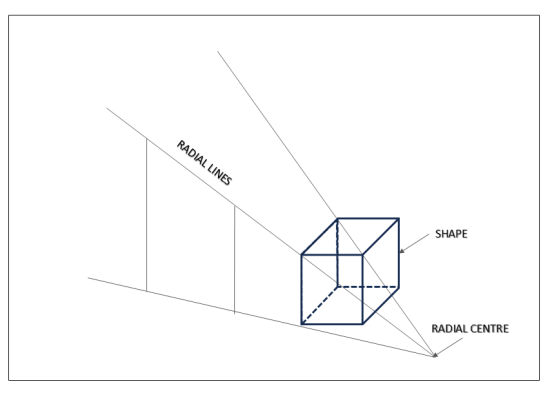
A fixed point called the radial centre acts as the origin from which grading lines extend.
How Radial Projection Works
- A radial centre is marked near the pattern.
- Straight lines are drawn from this centre through every corner and angle of the shape.
- Measurements are extended proportionally along these lines.
- New points are connected to form the graded pattern.
Because all movement occurs along controlled directions, proportional accuracy is maintained.
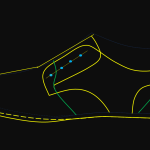
Practical Exercise: Radial Projection Method
The traditional training exercise demonstrates grading fundamentals clearly.
Step-by-Step Process
- Draw a three-dimensional shape approximately 76.2 mm × 76.2 mm in size.
- Leave a surrounding margin of about 50.8 mm from the edges.
- Mark a nearby dot — this becomes the radial centre.
- Draw light radial lines from the centre through every corner.
- Using dividers, measure the distance from the radial centre to each corner.
- Extend the distance outward along the same line.
- Mark new points and connect them.
The resulting shape becomes exactly twice the original size, proving geometric enlargement accuracy.
Enlarging and Reducing Shapes Using Squares
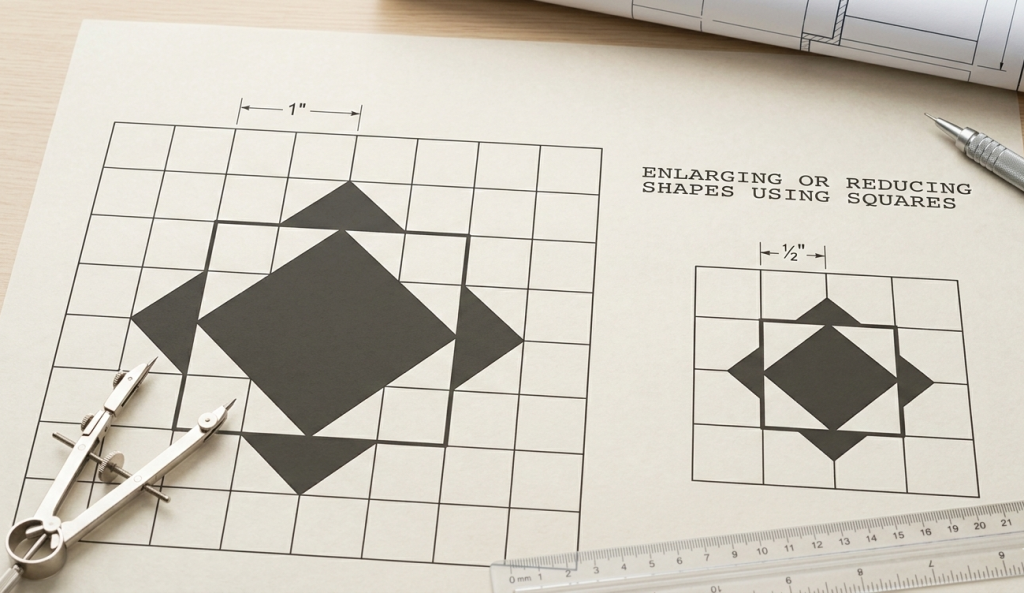
Another educational method uses grid or square enlargement.
Principle
- Shapes are transferred square-by-square.
- Each square represents proportional scaling.
- Accuracy depends on maintaining equal ratios.
Although useful for learning, this method is slower and less precise compared with radial projection for footwear patterns.
Geometric vs Arithmetic Grading
Understanding the difference between these two grading approaches is critical.
Geometric Grading (Proportional Scaling)
- Maintains proportion between length and width.
- Similar to photographic enlargement.
- Visual features remain recognizable at any size.

Arithmetic Grading (Non-Proportional Scaling)
- Dimensions change independently.
- Used in footwear because foot growth is not perfectly proportional.
- May introduce distortion if poorly controlled.

| Feature | Geometric Grading | Arithmetic Grading |
|---|---|---|
| Shape proportion | Maintained | Adjusted |
| Visual consistency | High | Moderate |
| Footwear application | Limited | Widely used |
| Distortion risk | Low | Higher if uncontrolled |
Why Footwear Requires Special Grading Logic
Unlike clothing, footwear sizing does not grow uniformly.
Reasons Include:
- Foot length increases differently from girth.
- Toe shape variation across sizes.
- Functional performance requirements.
- Last geometry constraints.
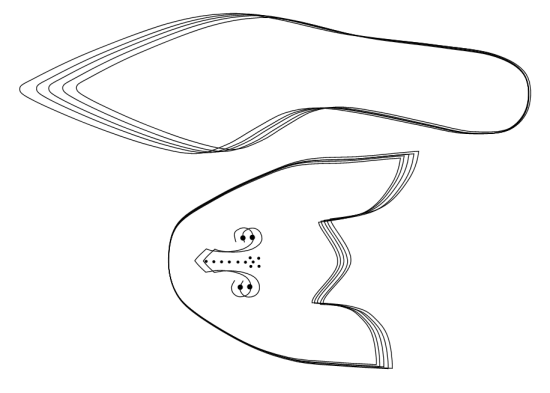
Therefore, footwear grading combines geometric theory with arithmetic adjustment.
Expert Insight: Common Grading Mistakes
Many production issues originate from grading errors rather than stitching or lasting problems.
Frequently Observed Problems
- Over-extension of toe areas.
- Incorrect radial centre placement.
- Non-uniform scaling direction.
- Ignoring last curvature influence.
Even small grading deviations can later cause:
- Upper tension imbalance
- Wrinkling
- Fit complaints
- Assembly misalignment


Pro Tips from Pattern Engineers
- Always verify grading using overlay comparison between sizes.
- Maintain consistent radial reference points across pattern pieces.
- Grade structural areas (heel seat, ball region) with extra control.
- Avoid visual grading — rely on measured projection lines.
- Validate graded patterns on physical lasts before bulk production.
Industrial Relevance Today
Although modern CAD systems automate grading, digital software still applies the same geometric rules developed through manual radial projection techniques.
Understanding these principles helps engineers.
- Diagnose grading defects quickly
- Improve fitting accuracy
- Communicate effectively with CAD technicians
- Maintain brand consistency across size ranges


Conclusion – The Future Starts on Screen
Pattern grading is not merely scaling; it is controlled geometric engineering. Through the principles of similar triangles and radial projection, footwear designers ensure that every size preserves the original design intent.
While technology has evolved, the mathematical foundation remains unchanged. Mastering these traditional grading concepts strengthens modern footwear development and prevents costly production errors.