Footwear Manufacturing Insights: Maintaining Insole Thickness and Skiving the Upper Lip
In footwear manufacturing, dimensional control is not limited to cutting accuracy or sole attachment alone. Instead, consistent product performance is strongly influenced by insole thickness control and upper edge preparation during lasting. Although these aspects are often treated as secondary operations, improper execution can result in fit imbalance, excessive strain, and visible construction defects. Therefore, maintaining correct insole thickness and skiving the lip of the upper must be treated as essential engineering controls rather than corrective actions.

Maintaining the Thickness of Insoles in Footwear Construction
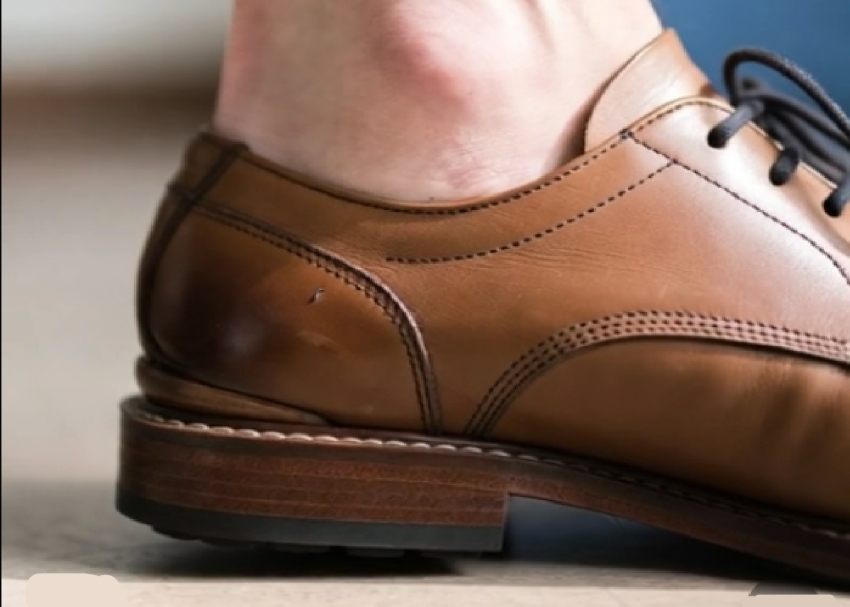
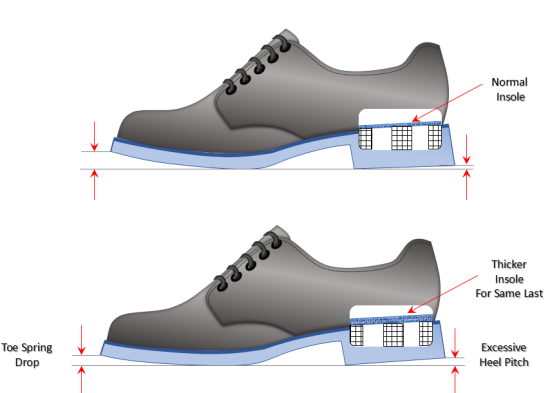
In a correctly balanced shoe, the insole and heel assembly must allow the shoe to rest evenly on a flat surface. When a shoe is placed on a level plane, it may occasionally be observed that the back end of the heel sits slightly above the surface. Under controlled limits, this condition is not necessarily detrimental, as the upper edges may grip the foot more securely during wear. However, when the pitch becomes excessive, the weight-bearing surface of the shoe is no longer flat. As a result, excessive longitudinal strain is introduced into the upper and bottom components.
Furthermore, similar performance issues may arise when the insole thickness is altered without adjusting the original design intent. If a shoe is engineered for a specific insole thickness, that thickness must be respected throughout production. A thicker insole cannot simply be substituted without consequence. When additional thickness is introduced—particularly in the heel region—the shoe’s seating position is altered, leading to changes in pitch and load distribution.
This effect becomes especially pronounced when transitioning from steel-shank insoles to insoles with moulded heel sections. In such cases, even minor thickness deviations can influence heel height perception, strain distribution, and long-term comfort. Therefore, insole thickness control should always be aligned with last design, shank configuration, and heel construction.
Skiving the Lip of the Upper for Improved Seat Appearance
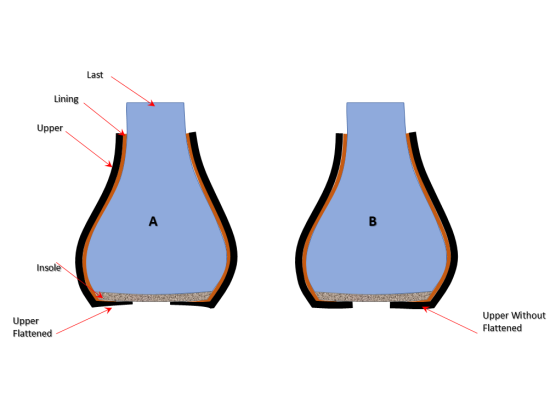
In certain footwear constructions, such as moccasins, a lasting lip naturally forms in the seat region. If this lip is left unskived, it may become visible through thin top pieces, resulting in a poor aesthetic finish. Consequently, skiving the lip of the upper is essential to ensure smooth visual transitions and uniform material thickness.
When the lip is skived correctly, the upper material blends seamlessly into the seat area. This correct method prevents the edge from telegraphing through the top piece and maintains a clean internal profile. Conversely, when skiving is omitted or performed incorrectly, the lip remains pronounced. As a result, the seat area appears bulky, and construction lines become visible on the finished shoe.
From a manufacturing perspective, correct skiving not only improves appearance but also enhances lasting control. Reduced material buildup allows the upper to settle more naturally around the last, which improves bonding consistency and reduces stress concentration at the seat.

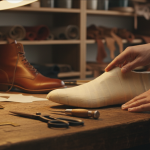
Manufacturing Insight and Best Practice
From a process-control standpoint, both insole thickness management and upper lip skiving directly influence shoe balance, fit integrity, and visual quality. Therefore, these operations should be standardized within pattern engineering guidelines and controlled at the work-in-progress stage rather than addressed during final inspection. When these details are managed proactively, production consistency improves, rejection rates decrease, and long-term wearer comfort is enhanced.