Footwear Manufacturing Insights: Stitch Length and Seam Distance Control in Upper Closing
Stitch length and seam distance control in footwear manufacturing play a critical role in achieving strong, consistent, and visually balanced upper stitching. In footwear upper closing, stitching accuracy is not decorative — it directly affects structural performance. When operators maintain correct stitch length and seam spacing, they improve seam strength, material behavior, and long-term durability.
Therefore, manufacturers use simple yet precise measurement tools to standardize stitching quality. This Footwear Manufacturing Insights article explains practical methods used to measure stitch length, verify seam distance, and maintain production consistency across operators and lines.

Measuring Stitch Length in Footwear Manufacturing
During upper closing, technicians must clearly define stitch length specifications and monitor them continuously. Correct stitch length ensures balanced seam elasticity, controlled tension, and uniform appearance across components.
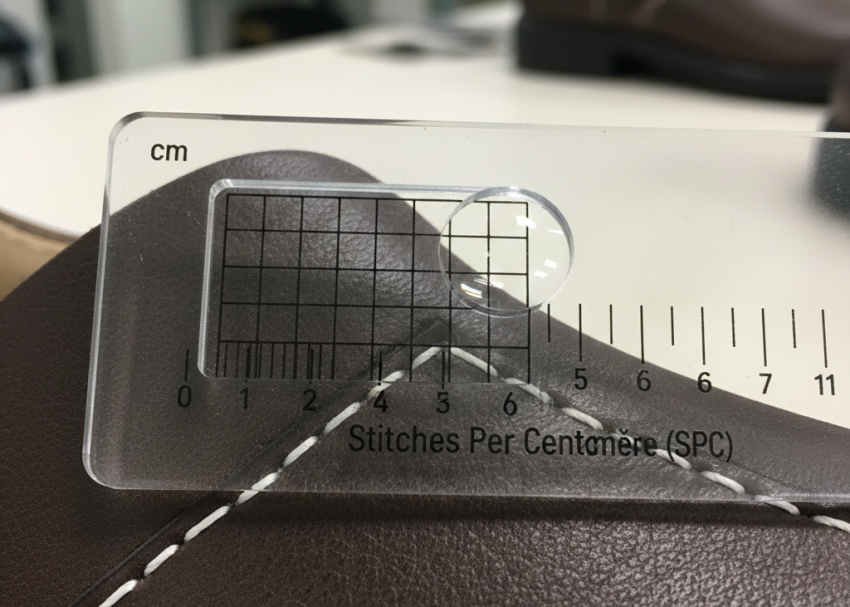
Even small variations can create problems such as seam puckering, uneven feeding, or localized stress concentration. As a result, factories rely on a stitch length rule to verify stitch density quickly during production.
This measuring rule contains marked segments representing different stitch counts per centimeter / inch allowing immediate comparison with the required specification.
Method for Checking Stitch Length
To achieve accurate measurement, operators should follow a consistent checking method:
- The seam line must remain straight and free from distortion
- The measuring rule should stay parallel to the seam
- The full one-centimeter or inch measuring width must be used
- Operators should align stitches directly with the rule markings
Because each marking indicates stitches per centimetre/inch, inspectors can instantly confirm compliance without stopping the machine. Consequently, this method supports fast in-line quality control and reduces production interruption.


Why Stitch Length Consistency Matters
Consistent stitch length improves both performance and appearance. When stitch density varies, several defects may occur:
- Uneven seam tension
- Material tearing under stress
- Reduced seam strength
- Poor visual symmetry between pairs
Moreover, inconsistent stitching complicates defect analysis because failures appear random. By contrast, controlled stitch measurement prevents problems before they reach final inspection.
Checking Seam Distance in Upper Closing
Besides stitch length, manufacturers must control the distance between parallel seams. Decorative stitching, reinforcement seams, and structural rows require uniform spacing to maintain both aesthetics and durability.
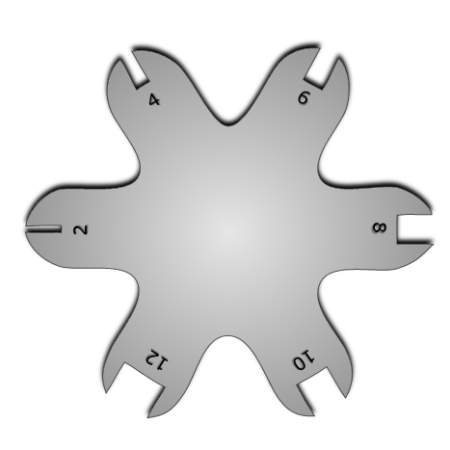
To achieve this consistency, operators commonly use a rosette-type seam distance gauge made from metal or engineered plastic. Each notch on the tool represents a fixed spacing measurement.

How the Seam Distance Tool Is Used
The seam distance gauge simplifies verification during stitching:
- Each numbered notch corresponds to a defined seam spacing
- Operators place the tool directly over stitched areas
- Incorrect spacing becomes immediately visible
- Measurement errors caused by visual estimation are eliminated
As a result, closers and supervisors can maintain repeatable accuracy even during high-speed production.
Manufacturing Benefits of Seam Distance Control
When factories maintain consistent seam spacing, they achieve several advantages:
- Balanced stress distribution along stitched zones
- Improved alignment between left and right shoes
- Reduced rejection rates at inspection
- Higher perceived product quality
Furthermore, standardized spacing minimizes variation between operators, shifts, and production lines.
Posts you may like


Integrating Stitch Measurement into Quality Systems
Although stitch rules and seam gauges are simple tools, they deliver significant quality benefits. When factories integrate them into standard operating procedures:
- Operators follow objective measurement standards
- Subjective judgement decreases
- Process stability improves
- ISO-based quality systems become easier to maintain
Export-oriented manufacturers especially benefit because buyers closely evaluate stitching consistency during audits.
Conclusion
Accurate stitch length and seam distance control form the foundation of reliable footwear upper closing. By applying practical measurement tools and disciplined checking methods, manufacturers improve seam durability, visual consistency, and overall product performance.
Ultimately, precision during stitching translates directly into comfort, longevity, and stronger brand confidence in the finished shoe.