Footwear Manufacturing Insights: Sewing Machine Catching Devices and Accurate Cementing of Vamp and Tongue
In footwear manufacturing, efficiency depends not only on machines and materials but also on small workplace innovations that improve handling accuracy and operator productivity. Simple engineering solutions often prevent material damage, reduce unnecessary movement, and improve assembly precision. Two practical examples include the use of sewing machine catching devices and controlled cementing of the vamp and tongue during upper preparation. When applied correctly, these methods improve quality consistency while supporting faster production flow.
Posts you may like


Sewing Machine Table with Catching Device
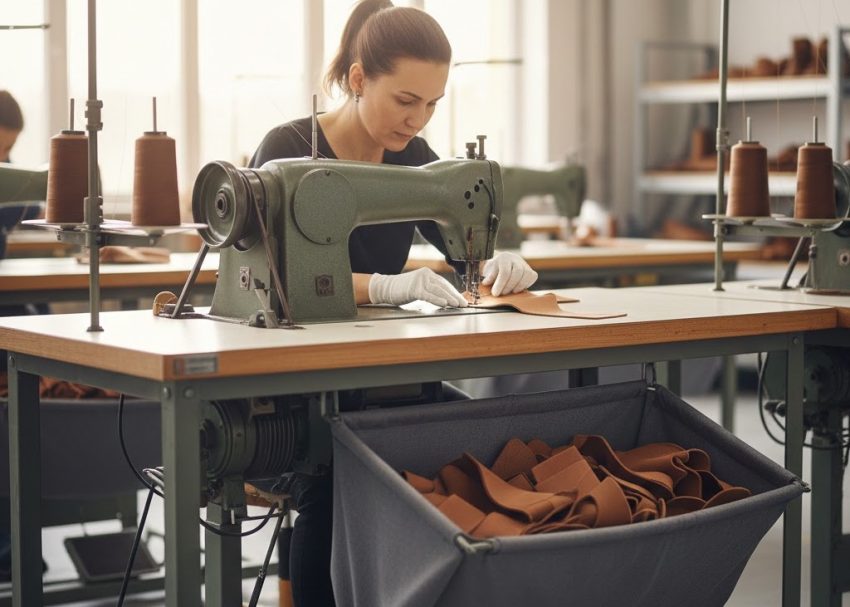
In high-quality shoe production, upper components frequently pass through stitching operations where handling control becomes critical. During sewing, completed or partially stitched uppers may slip from the machine table and fall to the floor. This creates contamination risk, increases handling time, and interrupts operator rhythm.
Factories solve this issue by installing a simple catching device at the rear edge of sewing machine tables. Metal rods are fixed underneath the back edge, and a flexible material strip is stretched between them. The stretched material forms a soft receiving surface that safely catches falling upper parts.
This arrangement prevents components from touching the floor and keeps materials clean. At the same time, operators no longer need to leave their position to retrieve dropped parts. As a result, workflow remains continuous and operator fatigue decreases.
Manufacturing Advantage
- Supports ergonomic workstation design
- Prevents soiling of uppers and linings
- Reduces unnecessary operator movement
- Improves stitching productivity
- Maintains cleaner production environment

Cementing of Vamp and Tongue for Accurate Positioning
Certain shoe constructions require the tongue to be cemented before stitching to ensure correct alignment and shape with the vamp. Without controlled positioning, the tongue may shift during sewing, causing asymmetry and fit problems.
Manufacturers use a wedge-shaped wooden support with a rounded top surface to assist this operation. The stitching allowance of the tongue is first coated with adhesive. The tongue is then placed over the rounded wooden form, after which the vamp is positioned accurately over it.
Because the support shape follows the curvature of the last, the assembled parts naturally adopt a three-dimensional form. This preparation allows the operator to sew the components together while maintaining proper alignment and curvature.
Production Benefit
- Supports better final fitting performance
- Ensures accurate tongue placement
- Reduces alignment defects during stitching
- Improves upper shape consistency
- Minimizes rework and correction time