
Advanced Principles of Shoe Fitting: Essential Techniques for Optimal Footwear Alignment and Foot Health
Estimated Reading Time: ~10 minutes
Shoe fitting constitutes a precise biomechanical process that extends beyond basic measurements of length and width. It requires systematic evaluation of multiple foot dimensions, material interactions, and dynamic foot behaviors to prevent deformities and ensure longevity of both footwear and foot integrity. This guide delineates core principles, including dimensional variances, proportional accommodations, and checkpoint assessments, to facilitate accurate fitting in professional contexts.
Core Challenges in Shoe Fitting: Dimensional and Proportional Variances
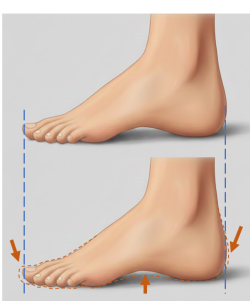
Shoe fitting encounters inherent obstacles due to foot asymmetry and variability. No two feet match exactly in length, width, volume, or proportions, as evidenced by comprehensive surveys indicating universal mismating. The foot transforms under load, expanding in volume by 5–8% over a day, which equates to potential size shifts of up to 1¼ units.
Proportional fit demands alignment of foot sections—heels, balls, arches, and toes—with corresponding shoe components. Discrepancies arise from manufacturing factors, such as last tolerances and pattern designs, leading to shoes of identical marked sizes differing by up to 7/16 inch in girth. These variances necessitate experimentation with styles, lasts, and materials to achieve balanced accommodation.
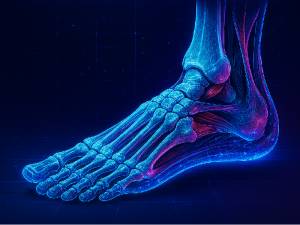
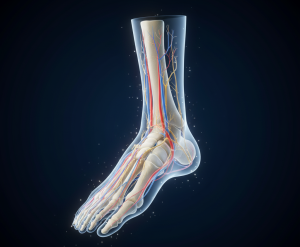
The Four Phases of Shoe Fit: Static, Weight-Bearing, Functional, and Thermal Considerations
Effective fitting addresses the foot across four operational phases:
- Static Phase: Evaluated with the foot at rest and seated. Dimensions remain baseline, focusing on bone and gristle structure. The shoe must provide initial containment without pressure.
- Weight-Bearing Phase: Assessed standing, where the foot expands under gravitational force. Proportions shift, requiring allowances for increased length and width. Measurements taken seated yield inaccuracies, as the foot’s seated state does not reflect load-bearing realities.
- Functional Phase: Observed during locomotion, such as walking. The foot flexes, demanding alignment of ball joints with shoe flexion points. Low-heel designs need greater vamp room for heel lift, while high heels concentrate load on the ball, minimizing toe extension.
- Thermal Phase: Accounts for expansion from heat, humidity, or prolonged activity. Volume increases necessitate materials with recovery properties, like leather, to prevent constriction. Daily swelling, averaging 5%, underscores the need for adaptive fits.
These phases highlight the foot as a dynamic entity housed in a static shoe, compelling compromises in selection.
Heel-to-Ball Measurement: Foundation of Proportional Alignment
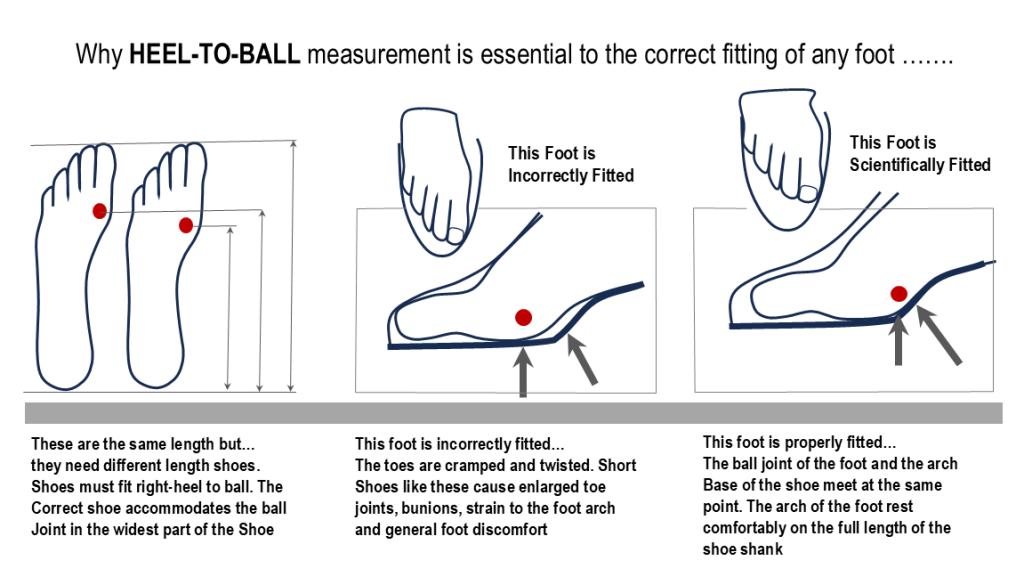
Heel-to-ball measurement prioritizes joint positioning over overall length. Two feet of equal total length may differ by ¼-¾ inch in this dimension, affecting toe room and arch support. Correct alignment places ball joints in the shoe’s widest section, ensuring stable tread and preventing cramping.
Illustrations demonstrate that mismatched fits cramp toes, enlarge joints, and strain arches, while proper fits rest the arch on the shank comfortably. Outer and inner ball measurements must both be considered, as overlooking the outer joint leads to imbalance. Experimentation with lasts balances this with overall length, particularly in varying heel heights.
Ball Width and Flex Angle: Ensuring Tread Stability and Material Accommodation
Ball width encompasses both upper girth and insole tread. Fitters often err by assuming yield in materials, but synthetics lack leather’s elasticity, causing discomfort if fitted too snugly. Width varies under rest, weight-bearing, and thermal conditions, requiring judgment to compromise across states.
The ball flex angle must coincide with the foot’s natural bend; misalignment results in faulty tread or creasing. Positioning too forward crowds toes; too rearward causes vamp issues. Tread width prevents overriding, ensuring the foot’s base aligns with the insole for balanced weight distribution.
Toe Shape and Length Fit: Accommodating Forward Extension and Patterns
Toe configurations dictate length requirements. Pointed toes demand more room than rounded, with no fixed allowance due to variables like heel height and style. Low heels permit ½-¾ inch for forward stretch during gait, averaging half a size extension per step.
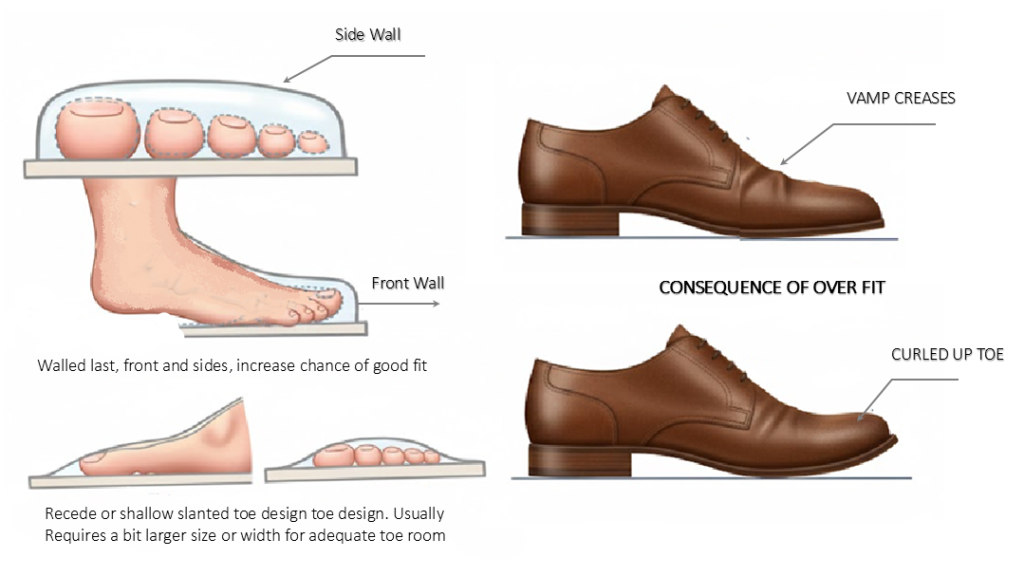
Length fit indications derive from standing measurements, adjusting for style trueness. Recede toes require extra length for adequate space, while stretch toes in high heels minimize this need. Toe patterns affect size and fit, with shape influencing overall accommodation.
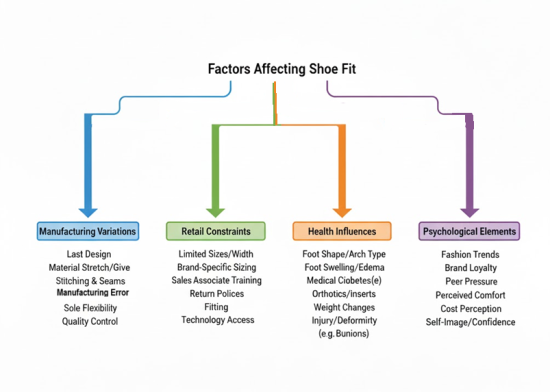
Comprehensive Factors Affecting Fit: Manufacturing, Retail, and Foot-Specific Influences
A hierarchical analysis reveals interconnected factors:
- Manufacturing Elements: Last production variations, tariffs, inventory inconsistencies.
- Retail Factors: Stockouts, fitter capability, price, style availability.
- Foot-Related Variables: Normal shape/size deviations, health conditions, psychological perceptions.
- Production Aspects: Material yielding, upper concessions.
This framework, illustrates why ideal alignment occurs rarely, demanding cautious application of terms like “correct” fit.


Volume Fit: Addressing Girth and Inner Space
Volume fit measures girth at ball, waist, instep, and heel-to-instep, accounting for the foot’s three-dimensional nature. Lastmakers incorporate these for inner space, yet variances persist across identical sizes due to style and heel factors.
The foot’s expandable quality requires shoes to accommodate swelling without constriction. Leather’s memory aids this; synthetics demand precise initial sizing. Volume discrepancies explain why mated shoes fit mismated feet inadequately without adjustments.
Throat, Vamp, and Topline Configurations: Upper Dynamics and Hold
The throat serves as entry, with short vamps offering more room than long. Tight throats restrict circulation, causing numbness; allowances prevent this, greater in low heels.
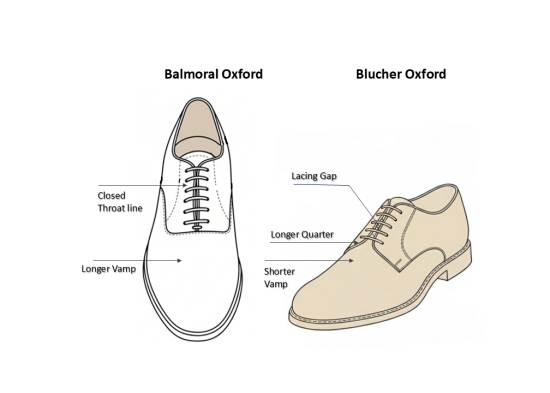
Vamps require flexion space to avoid creasing bites, varying by heel height. Toplines must hug without gaping, with blucher styles providing adjustment over bals. Fleshy tops benefit from space, preventing irritation.
Heel Influence in Fit: Variations by Height and Design
Heel height alters stance and function. Low heels necessitate toe room for 2-inch lifts per step; high heels fix the heel, focusing load on the ball and reducing extension needs.
Open-back designs risk slippage without counters; fleshy heels avoid these, favoring enclosed styles. Counters must curve to the heel’s back without biting tendons.
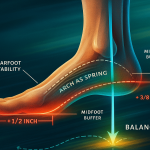

Shoe Fitting Procedure and Devices
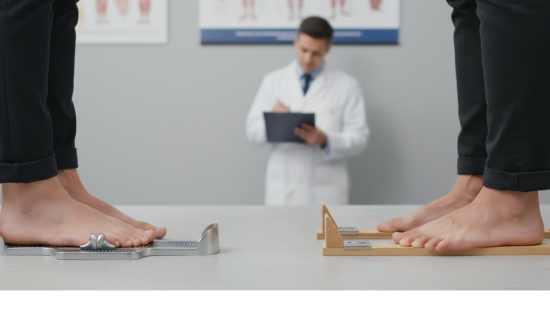
Shoe fitting procedures emphasize standing measurements for accuracy, as seated evaluations fail to capture weight-bearing expansions. Both feet must be assessed, prioritizing the longer or wider for size selection. Devices like Brannock and Ritz provide indications, not absolutes, due to style and manufacturing variances.
The Brannock device measures overall length, heel-to-ball, and ball width, with scales for adults, children, and juveniles. Proper use involves placing the heel firmly and ensuring toes are forward, lifting the big toe to verify ball position. It offers three scales to avoid errors in borderline sizes.
The Ritz stick provides linear measurements, requiring chart reference for width. It features dual scales for children and adults. Procedures mandate pulling socks forward to ensure full toe extension and measuring under weight-bearing conditions to reflect true dimensions.
These tools serve as guides; final fit relies on fitter judgment, testing multiple styles for proportional match. Ignoring devices or standing protocol results in frequent misfits.
The Fifteen Essential Fitting Checkpoints: Systematic Evaluation
Length & Proportional Checkpoints
Overall Length – Measured to the longest toe (not necessarily the big toe), allowing ½–¾ inch beyond the longest toe for extension. Low-heel shoes require greater allowance (up to a full size) for forward stretch during push-off; high heels need minimal extra room. Style (pointed vs round) and pattern (recede vs square) dramatically affect required length.
Heel-to-Inner-Ball – The inner ball joint must sit precisely in the shoe’s widest “pocket.” Even a ⅛-inch mismatch forward cramps toes; rearward strains the arch. Taken standing on both feet; always fit to the longer measurement. Essential for correct flexion angle and tread.
Heel-to-Outer-Ball – The outer ball joint requires its own designated pocket. Often overlooked, misalignment here creates torsion and uneven pressure. Bilateral pocket alignment is mandatory for balanced weight transfer and stable gait.
Ball-to-Toe Proportion – Calculated as overall length minus heel-to-ball. Long toes may force a size increase, sacrificing heel fit; short toes allow tighter heel seating. Must be tested independently—never assumed from heel-to-ball alone.
Ball & Heel Stability Checkpoints
Ball Tread Width – The insole (tread surface) must match the foot’s weight-bearing width. Narrow tread causes overriding; excessive width creates instability. Upper girth alone is insufficient—tread width governs actual stability under load.
Heel Seat Security – Heel must sit flush on the heel seat without overlap or slippage. Fleshy or pronated heels require enclosed counters; open-back styles are contraindicated. Cushions or combination lasts resolve minor looseness.
Back-of-Heel Clearance – Counter top edge must clear the Achilles tendon without biting. Low heels allow more vertical play; high heels demand snugger hold. Irritation here indicates counter height or curve fault.
Quarter Topline Contact – Quarter edges must not impinge on ankle bones. Right/left quarter construction prevents low-ankle-bone rubbing. Fleshier ankles need clearance; contact produces chronic irritation.
Upper & Flexion Checkpoints
Topline Gaping – Excessive “grinning” in pumps or grinning toplines indicates poor pattern hold. Blucher styles forgive more than bal; lacings can adjust. Walking test reveals functional gaping.
Vamp Flexion Room – Low-heel shoes require mild looseness across the vamp for natural creasing during flexion. High heels permit tighter vamp due to reduced motion. Torsion wrinkles signal insufficient allowance.
Throat Pressure – One finger should insert easily under the throat-line. Tight throats cut circulation, producing reddish marks and numbness. Low heels need more room than high heels.
Instep/Waist Girth – No torsion wrinkles or artery constriction across the instep. High or fleshy insteps require wider or combination lasts; lacings provide adjustment in oxfords.
Arch & Final Dynamic Checkpoints
Dynamic Tread Balance – Shoe must remain stable and level during walking—no wobble or lateral tilt. Faulty tread width, flex point, or last shape produces imbalance.
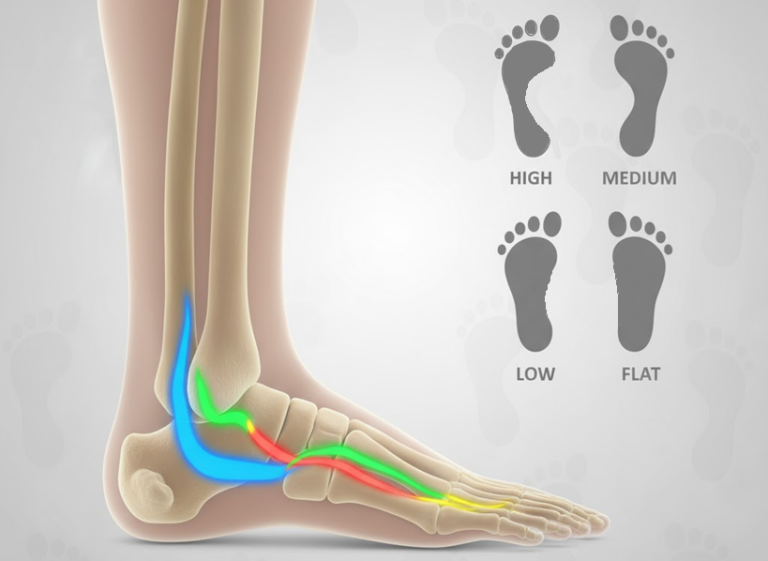
Arch Contact – Full longitudinal contact along the shank; voids cause collapse or wrinkles. Low arches may need cookies; high arches require deeper counters.
Little-Toe Freedom – Fourth and fifth toes must not be squeezed—primary corn and hammertoe sites. Inflare lasts and pointed styles are high-risk; wider or square lasts resolve.
Time Allocation in Fitting: Efficiency of Skilled Practice
Skilled fitters expend 8-12 minutes per session, leveraging expertise to minimize trials. This contrasts with unskilled approaches, yielding faster resolutions and superior outcomes.
Conclusion: Step Into Smarter Shoe Choices
Foot problems from ill-fitting shoes—from corns to claws—stem from squeezes, sweats, and strains. But armed with this manual’s wisdom, prevention prevails: Measure annually, width-first; ally with fitters/podiatrists.