Selecting the Right Cutting Personnel – Skills, Aptitude & Best Practices: Footwear Manufacturing Cutting
Estimated Reading Time: ~ 5 – 6 minutes
Introduction
In footwear manufacturing, cutting is not just a mechanical task — it is a skill that directly influences material utilization, product quality, and production efficiency. While factories invest heavily in machines and tools, the real success of cutting operations depends on selecting the right people for the job.
Not everyone naturally possesses the aptitude required for professional cutting. That is why leading industry practices strongly recommend a structured approach to selecting cutting personnel, combining aptitude testing, interviews, and practical evaluations before formal training begins.
This blog explains how factories can scientifically identify the right cutting operators and build a strong foundation for long-term quality performance.

Why Proper Selection of Cutting Personnel Matters
The factory has a clear responsibility to ensure that cutters are provided with:
- Safe and well-organized working conditions
- Proper cutting equipment and tools
- Structured training and skill development
- A role that matches their natural abilities
However, even the best training program cannot fully compensate for a lack of natural aptitude. Industry studies confirm that only about one in three people has the right combination of:
- Hand–eye coordination
- Sensitivity to colour and texture
- Spatial awareness
- Precision under production pressure
This makes pre-selection as important as training itself.
The Role of Aptitude Testing in Cutter Selection
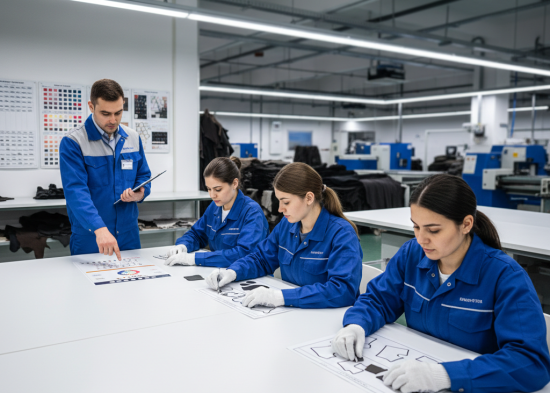
Aptitude tests help evaluate a candidate’s potential ability to meet the physical and mental demands of cutting work. These tests should never be used alone, but as part of a wider assessment that includes:
- Personal interviews
- Practical trials
- Group discussions
- Observation of work behaviour
The goal is not to eliminate candidates unfairly, but to place the right people in the right roles — ensuring long-term productivity and job satisfaction.
Key Aptitudes Required for Cutting Personnel
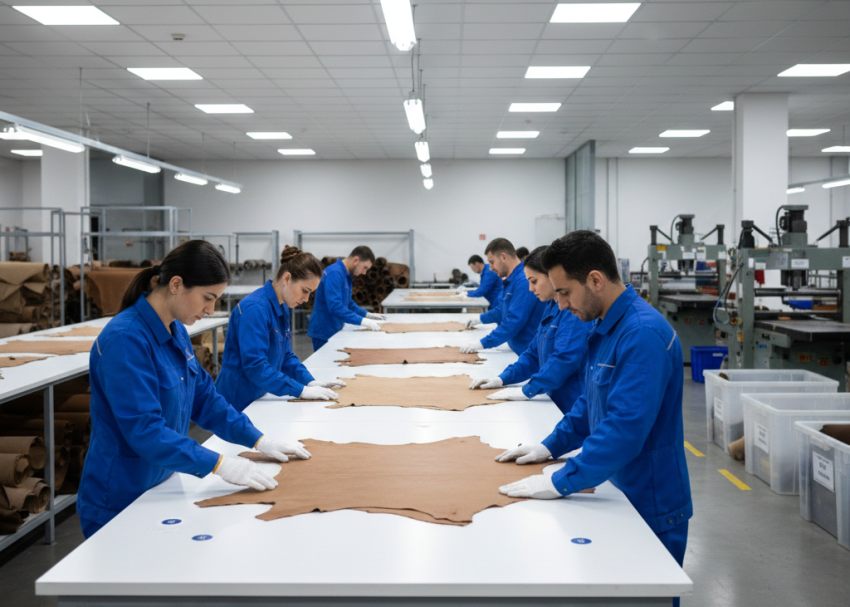
For personnel working in leather inspection and cutting, factories should evaluate the following abilities:
- Colour Vision (Colour Blindness)
- Ability to detect shade differences, defects, and grain variations.
- Perception
- Understanding shapes, patterns, and cutting boundaries accurately.
- General Aptitude
- Overall capability to learn and adapt to cutting processes.
- Numeracy
- Ensuring correct piece counts, sizes, and batch quantities.
- Memory
- Remembering cutting rules, pattern layouts, and quality standards.
- Spatial Awareness
- Visualizing pattern placement to minimize waste and maximize yield.
- Dexterity
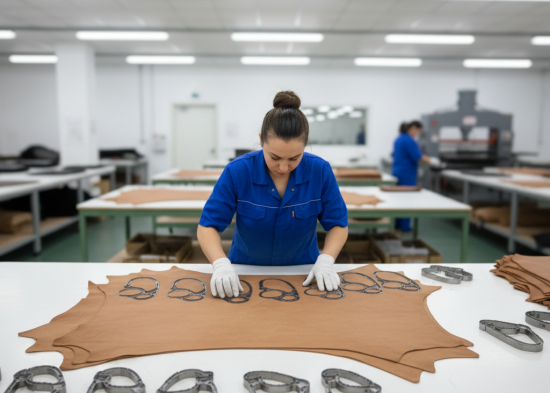
- Hand control and coordination when handling knives, dies, or materials.
Company-Specific Testing Standards
There is no universal testing benchmark for all factories. Each company should define standards based on:
- Types of leather used
- Level of colour variation
- Complexity of cutting patterns
- Production volume and speed requirements
Examples
- If your factory works with high shade variation leather, colour vision testing becomes critical.
- If production involves large order volumes, numeracy becomes essential to avoid shortages or excess.
The testing system must reflect real shop-floor conditions, not theoretical expectations.
What to Observe Beyond Test Scores
Test results alone do not tell the full story. The manner in which candidates complete tests often reveals just as much as the final score.
Look for trainees who demonstrate:
- Organized working habits
- Methodical problem-solving
- Attention to detail
- Calmness under pressure
Experience shows that individuals who behave systematically during testing usually carry the same discipline into daily production work.
From Selection to Skill Development
Once the right candidates are selected, the factory must implement a structured continuation program that:
- Builds on initial aptitude results
- Develops cutting techniques step by step
- Teaches material behavior and defect recognition
- Reinforces safety and quality principles
- Encourages continuous improvement
This approach ensures that cutters grow not only as machine operators, but as skilled professionals who understand the full impact of their work on product quality and factory profitability.


Conclusion
Selecting cutting personnel is not a routine HR activity — it is a strategic quality decision. By combining aptitude testing, practical evaluation, and structured training, footwear factories can dramatically improve:
- Cutting accuracy
- Material yield
- Consistency of quality
- Operator confidence
- Long-term workforce stability
When the right people are placed in the right roles, cutting transforms from a production step into a competitive advantage.